
Key Takeaways
- Activepieces provides agile operational teams with visual workflow builders, AI agents, embedded tables, and dual cloud or self-hosted installation options.
- Activepieces features a no-cost tier granting 1,000 monthly credits, followed by Plus at 20 dollars and Team at 200 dollars per month.
- Activepieces includes an open Model Context Protocol server alongside full application programming interfaces to coordinate autonomous agents across external client tools.
- Activepieces will frustrate organizations wanting strict budget predictability without credit governance, or those needing enterprise security policies on lower-cost tiers.
Activepieces is the automation platform to choose when you want to start a small team on a free plan, then keep cloud and self-hosted deployment open as the work grows. Skip it if you need a fixed usage bill without watching credits, or dedicated support and advanced governance on Free or Plus.
Agent access
- API
- Yes, The API overview limits Platform Dashboard API-key generation for managing multiple projects to Platform and Enterprise editions; pricing lists API access on Free. The pages do not explain how these entitlements map.
- MCP server
- Official, hosted or local, OAuth
- Works with
 Claude
 Cursor
What are the core advantages and drawbacks of Activepieces?
What works
- Free plan with 1,000 credits, unlimited flows, and up to 5 users
- Cloud or on-premise hosting on every listed plan
- Flows, agents, tables, MCPs, and API access are listed on Free
What to watch
- Usage above the included allowance costs $0.007 per credit on Plus and Team
- Free and Plus rely on community support
- SSO, roles, and email support begin on Team
What does Activepieces do for workflow automation?
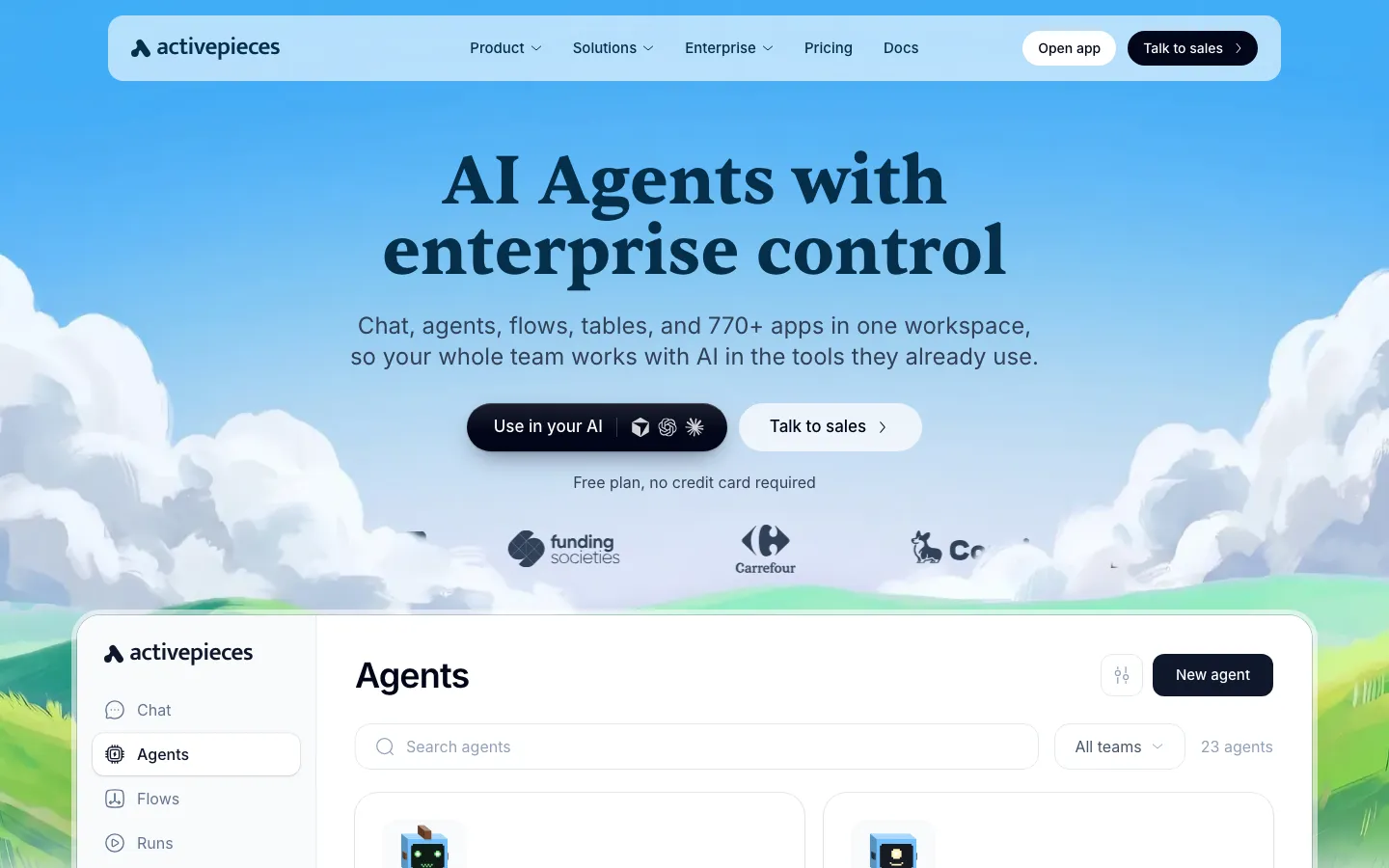
Activepieces puts flows, agents, chat, tables, connected apps, and an MCP server in the same workspace. A flow is the deliberate route through triggers and steps; an agent can take a task across the apps you connect; tables give both somewhere to read and write data. That combination is useful when the handoff is not just “send this field there,” but still needs a person to approve steps that touch customers, money, or production.
The accessible part is the entry plan. Free has no card or time limit, allows up to five users and unlimited flows, and includes 1,000 credits each month. It also lists MCPs and API access. For a team browsing the marketing tools directory because repetitive routing or enrichment work is piling up, that is enough room to establish whether one real process belongs in automation.
The constraint is not the number of flows. It is the credit model. The pricing grid says Free credits reset daily, while its FAQ says the 1,000-credit allowance refreshes monthly. Confirm the reset timing before relying on Free for a recurring process. Plus and Team include more credits and charge $0.007 for each additional credit. I would choose Activepieces for its broad, open starting point, but make one person accountable for credit volume before it becomes a company-wide layer.
Who should use Activepieces for internal operations?
Small operations teams
Start with five people, unlimited flows, and monthly credits for a focused recurring handoff.
Marketing operations
Connect lead routing and campaign work, then use approvals where a record needs human judgment.
Technical teams
Choose cloud or on-premise deployment while exploring API access and MCP-connected AI workflows.
Product teams embedding automation
Use Embed when customers need a white-label builder, SDK, and selected apps inside your product.
It is a weaker fit for a team that needs a completely hands-off buying decision. Credit-based capacity rewards a clear workload model, and Free and Plus have community support rather than human email support. If your rollout needs identity controls, roles, and someone to answer support tickets, Team is the practical starting point.
Which integration features does Activepieces offer?
Flows for repeatable work
Flows are the foundation: choose a trigger, define steps, and connect the tools that take the work forward. Activepieces lists unlimited flows across Free, Plus, Team, and Ultimate, so the decision is not whether Activepieces will let you create another workflow. The better question is whether the workflow earns the credits and ownership it needs to run reliably.
Agents, chat, and approvals
The product lets a team describe an outcome in chat, then build an agent or automation from it. Agents can call flows, flows can run agents, and both can use the same tables. Activepieces also presents approvals as a way to gate sensitive actions. That makes it suitable for a workflow where the system prepares the work but a person still releases the consequential step.
Tables and connected apps
Tables are Activepieces' shared rows-and-columns data layer for flows and agents. Its integrations directory lists 775 apps, including common sources and destinations for marketing, sales, support, and finance work. Validate the specific trigger and action your process needs before promising a team that the whole handoff can run unattended.
MCP server and API access
Activepieces documents an MCP server that you connect from an AI client, and names Claude, Copilot, Cursor, Gemini CLI, Devin, and Zed among the supported client examples. Its Free plan also lists MCPs and API access. This is meaningful for a technical team that wants an assistant to work through approved tools, but the permissions and credentials deserve the same design attention as any other production automation.
Hosting and governance
Every public plan lists cloud or on-premise hosting. Team adds SSO, standard roles, global connections, unlimited projects, and email support. Ultimate is custom and adds dedicated workers, priority execution, SCIM, custom roles, releases and Git Sync, audit logs, secrets, and dedicated support. That is a sensible ladder: start with a process, then pay for governance when more builders and systems make it necessary.
How are Activepieces plans and credit limits priced?
Price checked 27 Nov 2026
| Plan detail | Free$0/mo | Plus$20/mo | Team$200/mo | UltimateCustom |
|---|---|---|---|---|
| Credits included | 1,000 a month | 10,000 a month | 50,000 a month | Sized with you |
| Credit reset | Grid: daily; FAQ: monthly | Monthly | Monthly | Yearly |
| Users | Up to 5 | Up to 5 | 25 | Unlimited |
| Projects | ✕ | ✕ | Unlimited | Unlimited |
| Hosting | Cloud or on-prem | Cloud or on-prem | Cloud or on-prem | Cloud or on-prem |
| Support by humans | Community | Community | Dedicated |
Activepieces prices in US dollars, 27 Nov 2026.Activepieces pricing
Plus and Team are flat monthly plans, but the headline price is not the whole operating cost. Both list $0.007 per extra credit once the included allowance is used. A three-person team can fit inside either plan's user limit, so the relevant comparison is $20 for 10,000 credits versus $200 for 50,000 credits, before any overage. That is not a price difference to bridge with seats: it is a workload decision.
- Free is free forever, needs no card, and includes 1,000 credits a month. Confirm its reset timing before you depend on it.
- Plus adds 10 times the Free capacity and lets you bring your own AI keys
- Team adds 25 users, unlimited projects, SSO, standard roles, global connections, and email support
- Annual billing advertises a saving of two months, while the public grid shows the monthly figures above
There is also a separate Embed offer from $36,000 a year. It places a white-label builder, one SDK, and your own pieces and templates inside a software product. Treat that as an embedded-product purchase, not an add-on for an internal automation team.
What does Activepieces Ultimate deliver for enterprise governance?
Activepieces Ultimate serves as the customized package designed for extensive organizational deployment. It adds capacity sized yearly, dedicated workers, execution priority, SCIM, custom roles, releases and Git Sync, audit logs, secrets, and dedicated support. The separate Enterprise control offer can run Activepieces on your own servers or fully air-gapped, with custom RBAC, secret-manager support, and audit logs.
These are controls to buy because your environment requires them, not because an early proof of concept feels important. Get a quote that names the credit arrangement, deployment model, support level, and the governance controls your security team actually needs.
Where does Activepieces fall short for growing teams?
Activepieces limits users primarily through credit forecasting constraints across variable automated workloads. Unlimited flows can make the product look unlimited, but executions still use a credit allowance. Plus and Team each charge $0.007 per additional credit, while Ultimate is negotiated at volume rates. A workflow that appears inexpensive in a quiet month may not remain so once more apps, agents, or teams depend on it.
Support is the second boundary. Free and Plus list community support. Email support begins on Team, and dedicated support appears on Ultimate. That makes the free tier a good place to establish a straightforward process, but it does not guarantee the operating help a business may need during a broad rollout.
Finally, governance features are not evenly distributed. SSO and standard roles are Team features; SCIM, custom roles, audit logs, and secrets sit on Ultimate. If identity, auditability, or a controlled builder environment is non-negotiable, compare the Team and Ultimate scope before a team invests in a growing set of flows.
What alternatives compare closely with Activepieces?
 Adalo review is relevant when the job is to build a customer-facing app, rather than coordinate work across connected apps. One project can publish to web, native iOS, and Android, which suits a team that needs app delivery more than an automation workspace.
Airtable review is the closer comparison when a shared database and internal workflow are the center of the operation. Its Free plan includes Interface Designer, five editors, and 1,000 records per base. Activepieces is the stronger fit when that data must trigger work across a large set of connected apps and AI clients.
What is the final verdict on Activepieces?
Activepieces provides five user seats, unlimited flows, 1,000 monthly execution credits, and full tool access for teams testing automation. Its cloud or on-premise option keeps the technical path open, but you should confirm the disputed Free credit-reset timing before making that plan part of a recurring process.
The obligation is to manage the usage, not admire the feature list. Buy Plus for a daily builder that has already proven its credit needs, move to Team when projects, SSO, roles, and email support are justified, and treat Ultimate as a governance and scale conversation.
Build one recurring flow on Free, record its credit use over a representative period, and decide whether its next constraint is capacity, support, or governance. That gives you the evidence to choose Plus, Team, or a custom conversation without guessing.
How was the data for this Activepieces review compiled?
Activepieces documentation, piece catalogs, pricing guides, and product specifications provided the baseline facts verified on 27 Nov 2026. Prices are in US dollars, as Activepieces presents them, and every figure follows how we check figures.
- Activepieces pricing page for plans, credits, support, and enterprise offers
- Activepieces documentation for agents, flows, tables, hosting, and MCP
- Activepieces pieces directory for connected-app coverage
What are frequently asked questions about Activepieces?
Is Activepieces free?
Yes. Free is $0 forever with no card, 1,000 credits a month, unlimited flows, and up to 5 users. Its pricing grid says credits reset daily, while its FAQ says the allowance refreshes monthly, so confirm the timing before relying on it.
How much does Activepieces cost for a team?
Plus is $20 a month for up to 5 users and 10,000 credits. Team is $200 a month for 25 users and 50,000 credits. Both charge $0.007 for each additional credit.
Can Activepieces be self-hosted?
Yes. Every listed plan supports cloud or on-premise hosting. Activepieces also offers Enterprise control for own-server or fully air-gapped deployments.
Does Activepieces work with AI agents?
Yes. Activepieces lists agents, flows, tables, MCPs, and API access on Free, and documents an MCP server for connecting an AI client to Activepieces.
 Reviewed byDanny Kirk
Founder of ReddiReach.
 Checked byAndrés Felipe
Digital designer and marketer.
Every figure is checked against the vendor's own page. Read our editorial standards.