
Key Takeaways
- Adbeat assists media buyers and advertising agencies in auditing competitor banner creatives, native placements, landing page structures, and publisher networks.
- Adbeat lists monthly pricing at 249 dollars for Standard and 399 dollars for Advanced, which drop to 200 and 315 dollars annually.
- Adbeat provides standalone REST and JSON programmatic feeds as an isolated, usage-based product rather than bundling data access with core subscriptions.
- Adbeat is not cost-effective for marketing teams without heavy display advertising programs or those needing integrated API access within base software licenses.
Adbeat is the right pick when your team already buys display or native media and needs to see competitor creatives, landing pages and publisher placements in one place. Skip it if that channel is not central to your work, or if you need programmatic access included in the subscription, because Adbeat sells its API separately.
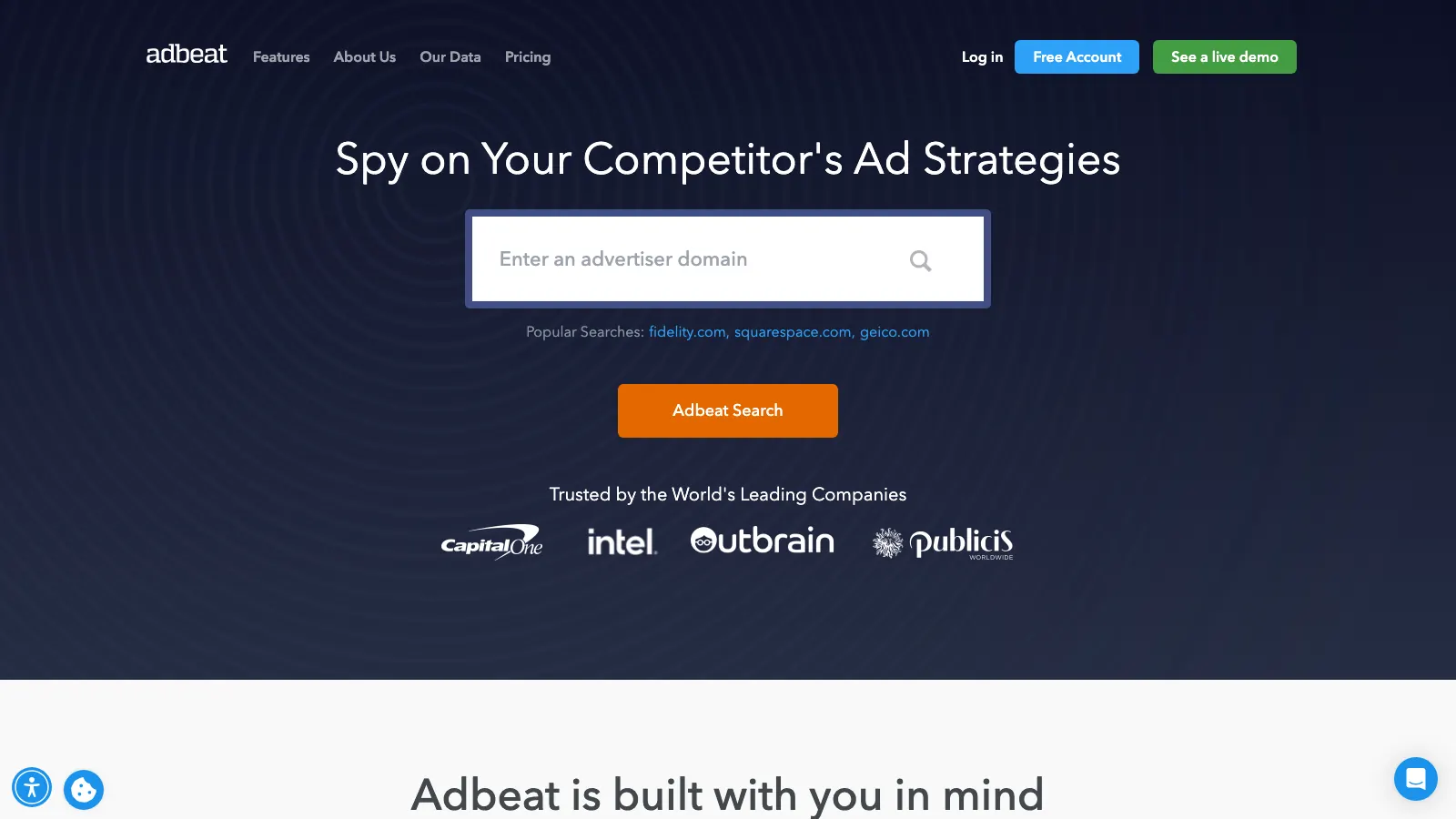
What are the notable pros and cons of Adbeat?
What works
- 151 display networks plus 31 native networks
- Creative, landing-page and publisher placement research
- One year of history and country filters on Advanced
What to watch
- Standard starts at $249 a month
- Private-label reports and spend estimates need Enterprise
- The API has separate subscription and usage charges
What does Adbeat do for competitive media buyers?
Adbeat lets your media team inspect display, programmatic and native advertising activity: ads, landing pages and publisher placements. It covers 151 display networks, DSPs and exchanges, plus 31 native networks, across 35 named countries. In the marketing tools directory, its clearest job is competitive research for an advertising channel, rather than broad marketing reporting.
Standard lets you search advertisers, ads and publishers by keyword, separate desktop from mobile activity, view placement URLs and export reports. Advanced adds country filters, competitor alerts, comparisons, direct-buy placements, unlimited search results and a year of history. That makes Advanced the plan for a team whose question is not merely who is advertising, but how activity changes by market.
Enterprise adds estimated ad spend, category and industry browsing, campaign views, smart alerts, advanced reporting, private-label reports, pre-roll video and three years of history. I would reserve it for an agency packaging this intelligence for clients, or an advertiser with enough media spend that the extra context affects a real buying decision.
Who gets the highest value from Adbeat?
Performance media buyers
Compare competitor creative, placements and landing pages before committing display budget.
Multi-market advertisers
Use Advanced country filters to separate competitive activity by your target market.
Agency strategy teams
Turn Enterprise reports and spend estimates into client-facing competitive intelligence work.
Advertising data builders
Use the separate API when your product needs advertising data in JSON.
Small advertisers doing preliminary research can start with the free tools, which show advertiser activity, channels, publisher-site counts and dozens of creatives. The paid plans make sense when you need a meaningful look-back window, reports or a repeatable view across competitors. A generalist marketer without an active display or native program will find the subscription difficult to justify.
Which competitive intelligence features does Adbeat offer?
Creative and landing-page research
Adbeat lets you examine competitor ads alongside the landing pages they point to. Its free tools offer an advertiser profile, dozens of creatives and an ad locker; Standard expands that into keyword search for advertisers, ads and publishers, full-size creative and 90 days of history. That is enough to turn a vague competitor watchlist into a library your media and creative teams can discuss.
Publisher placements and direct buys
Publisher placement URLs are included from Standard, so you can see the sites where an advertiser has appeared. Advanced adds direct buys, which Adbeat defines as placements bought directly from publisher sites, and Enterprise adds estimated ad spend. Keep those last two facts separate: the ability to see a placement starts on the lower paid tier, while the spend estimate belongs to Enterprise.
Country filters, alerts and comparisons
Standard shows its 35 covered countries combined. Advanced lets you filter ads, advertisers and publishers by country, create alerts for a competitor's new ads, networks and publishers, and compare advertisers in a dedicated report. Those controls are why a multi-market buyer should begin with Advanced instead of treating the lower price as the whole decision.
Enterprise research and agency reporting
Enterprise adds category and industry browsing, campaign performance, ad paths and tags, brands, ad density and authorized seller tracking. It also includes private-label reports, advanced reporting tools, smart alerts, phone support, a dedicated support representative and onboarding training. That bundle suits an agency that needs deliverables under its own presentation, not a one-off competitive search.
API for custom workflows
The Adbeat API returns raw advertising data through REST and JSON for apps, integrations and custom reports. It is not an app-plan perk: an Adbeat account still needs its own API plan. The API charge combines a monthly subscription with request and result costs, so a team building an automated workflow should price the expected volume before treating it as a fixed add-on.
How is Adbeat pricing structured across plans?
Price checked 27 Nov 2026
| Plan detail | Standard$249/mo | Advanced$399/mo | EnterpriseCall |
|---|---|---|---|
| Annual billing | $200/mo, $2,400 billed annually | $315/mo, $3,780 billed annually | Call |
| Data history | 90 days | 12 months | 36 months |
| Search results | 1,000 per search | Unlimited | Unlimited |
| Country filters | Countries combined | ✓ | ✓ |
| Alerts | 5 | 10 | Unlimited |
| Private-label reports | ✕ | ✕ | ✓ |
| API in app plan | ✕ | ✕ | ✕ |
Adbeat prices in US dollars, 27 Nov 2026.Adbeat pricing
The first paid plan is Standard at $249 a month. With annual billing, one Standard subscription costs $2,400 a year. Adbeat does not publish seat allowances or the cost for three individual users on this pricing page, so confirm those details before treating it as a team bill. That subscription does not include an API budget.
- Adbeat Basic, also called Free Tools, is free for preliminary research and does not have a time limit.
- There is no free trial for Adbeat Pro plans, although the pricing page offers a 30-day satisfaction guarantee.
- The separate API has both a monthly subscription cost and request and result costs.
Monthly subscribers can switch plans or cancel at any time. For a team that needs individual-country filtering and a year of history, Advanced at $315 a month on annual billing is the practical comparison point, not Standard.
What does Adbeat Enterprise add for research agencies?
Enterprise is where Adbeat moves from research interface to reporting resource. It is priced by calling the company, and it is the only plan that lists estimated ad spend, category and industry browsing, campaign views, smart alerts, advanced reporting, private-label reports, pre-roll video, three years of data and dedicated support.
That makes Enterprise an agency or high-spend advertiser choice. Do not upgrade merely for a longer history if you only need placement research, since Advanced already provides direct buys, country filters and a year of data. Upgrade when you can name the client deliverable or media decision that needs the Enterprise-only material.
Where does Adbeat fall short for smaller advertisers?
Adbeat restricts smaller marketing budgets primarily through its high entry-level software cost. Standard costs $249 a month, while Advanced costs $399 monthly, so a paid plan needs to support a real display or native advertising decision. The free tools are useful for an early look, but they do not replace the 90-day history, reports and search depth of Standard.
The other limit is packaging. Individual-country filters, advertiser comparisons, direct buys and one year of history all begin on Advanced. If those are the questions your team needs answered, the annual Advanced price of $315 a month is the relevant baseline. Buying Standard because it is cheaper and then working around its combined-country view is false economy.
Finally, automation has its own bill. The application plans do not include API access, including Enterprise, and the API meter has subscription, request and result components. Teams that need a fixed, bundled machine-data cost should choose a product that publishes that arrangement rather than assuming a top-tier Adbeat subscription covers it.
What are the best competitive alternatives to Adbeat?
 Adbeat alternatives like AI Peekaboo offer better alignment when monitoring brand visibility across artificial intelligence search results. Its published plans start at $30 a month and include API and MCP access, which is a simpler fit when your work begins with how AI systems describe a brand. The AI Peekaboo review explains its reporting and agency options.
 AdClarity is the closer comparison when you need display, social and video intelligence under one service. Its Basic plan starts at $129 a month for one geo and one channel. Read the AdClarity review before treating the two tools as interchangeable.
 Contify is a different kind of competitive-intelligence option, with team workspaces and a Business News API. The Contify review is the better next read if your brief is competitive change, not media-buying activity.
What is the definitive verdict on Adbeat?
Adbeat Advanced represents the most practical package for multi-national display and native advertising competitive research. Standard gives you a serious research baseline, while Advanced adds the country filters, direct-buy placements and year of history that make cross-market competitive work useful. Enterprise is defensible for agencies and larger advertisers that can use its spend estimates, private-label reporting and deeper history in their own deliverables.
Start with the free tools for advertiser activity, ad-channel and creative research. Publisher placement URLs begin with Standard. Move to annual Advanced only when country filters, direct buys and one year of history will change how you allocate media budget, and price the API as a separate project.
How was this Adbeat review researched and validated?
Adbeat documentation, support articles, API guides, and pricing pages provided the factual information audited on 27 Nov 2026. Prices are shown in US dollars as Adbeat lists them, and every figure follows the rules in how we check figures.
- Adbeat pricing and annual-pricing pages
- Adbeat plan-selection and trial help pages
- Adbeat API page and API billing documentation
What are frequently asked questions about Adbeat?
How much does Adbeat cost?
Standard costs $249 a month and Advanced costs $399 a month. Annual billing lists Standard at $200 a month, billed as $2,400 annually, and Advanced at $315 a month, billed as $3,780 annually. Enterprise is available by calling Adbeat.
Does Adbeat have a free trial?
No. Adbeat does not offer a free trial for Pro plans, but its Basic or Free Tools are available for preliminary research without a time limit. Its pricing page also lists a 30-day satisfaction guarantee for paid subscriptions.
What does Adbeat cover?
Adbeat covers 151 display networks, DSPs and exchanges, plus 31 native networks, in 35 named countries and territories. Paid plans include display, programmatic and native ads, desktop and mobile activity, landing pages and publisher placements.
Does Adbeat have an API?
Yes. Adbeat offers a REST and JSON API for raw advertising data, apps, integrations and custom reports. It is a separate product, even for an existing Adbeat account, and pricing combines a subscription with request and result costs.
 Reviewed byDanny Kirk
Founder of ReddiReach.
 Checked byAndrés Felipe
Digital designer and marketer.
Every figure is checked against the vendor's own page. Read our editorial standards.