
Key Takeaways
- Ads Lighthouse enables search marketers and affiliate managers to monitor Google and Bing ad auctions, preserving time-stamped proof of partner and competitor activities.
- Ads Lighthouse sets Starter at 49 dollars monthly for one tracked campaign with no per-user fees, moving up to Scale at 299 dollars.
- Ads Lighthouse incorporates an authenticated MCP server across every tier, reserving programmatic REST API connectivity for Scale subscribers and higher.
- Ads Lighthouse is unsuited for advertisers requiring intelligence across social networks, retail marketplaces, or generative search engine answer results.
You need a record of who appears when customers search your brand. Ads Lighthouse suits brand-protection, affiliate-compliance and paid-search teams monitoring Google and Bing, while teams centered on social ads, Amazon, broad competitor discovery or AI-answer visibility should choose a different tool.
Agent access
- API
- Yes, Scale, Business and Enterprise, including trials of those plans
- MCP server
- Official, hosted, OAuth 2.1 with PKCE, or a Bearer API key on Scale and above
- Works with
 Claude
 ChatGPTClaude Code
 VS Code
 Gemini
 Cursor
What are the core pros and cons of Ads Lighthouse?
What works
- Saved observations retain ad copy, place, device, time and destination
- Published monthly prices, without per-seat or overage charges
- MCP access, exports and team roles on every plan
What to watch
- Monitoring stops at Google, Bing and Google Shopping
- Starter has one project, 20 keywords and two locations
- REST API and white-label PDFs start at $299 a month
What does Ads Lighthouse do for search monitoring?
Ads Lighthouse watches the defined searches your team cares about, then keeps the ad and its context together. A project covers one brand's domains, keywords, markets, devices and schedule. Each saved result records an advertiser domain, headline, description, destination URL, search term, engine, location, device and time. That is a narrower job than the wider marketing tools directory suggests, but it is exactly the right scope when an affiliate, coupon site or lookalike domain needs a clear record.
Ads Lighthouse measures observed visibility, its share of the searches you configured where a domain appeared, not Google impression share. It can establish that an ad was observed in a particular context. It cannot establish spend, a purchased keyword or infringement. Teams that need a source of evidence for a conversation or case will value that restraint more than a speculative competitor metric.
Who benefits most from Ads Lighthouse search monitoring?
Brand protection teams
Preserve contextual ad records before discussing trademark, lookalike or coupon-site concerns.
Affiliate managers
Match known affiliate IDs in saved Google ad links and review unfamiliar ones.
In-house PPC teams
Track competitor appearances on chosen brand searches across locations and devices.
Reporting agencies
Use Scale when client-branded PDFs and REST data access become necessary.
It is not for a team whose first task is hunting for social creative or researching ads beyond its own monitored terms. The vendor lists social platforms, Amazon, Yahoo, regional engines and AI answer surfaces as unavailable. If that coverage is non-negotiable, pick a tool built around that channel rather than stretching a brand-search monitor past its remit.
Which monitoring features does Ads Lighthouse provide?
Monitored paid-search coverage
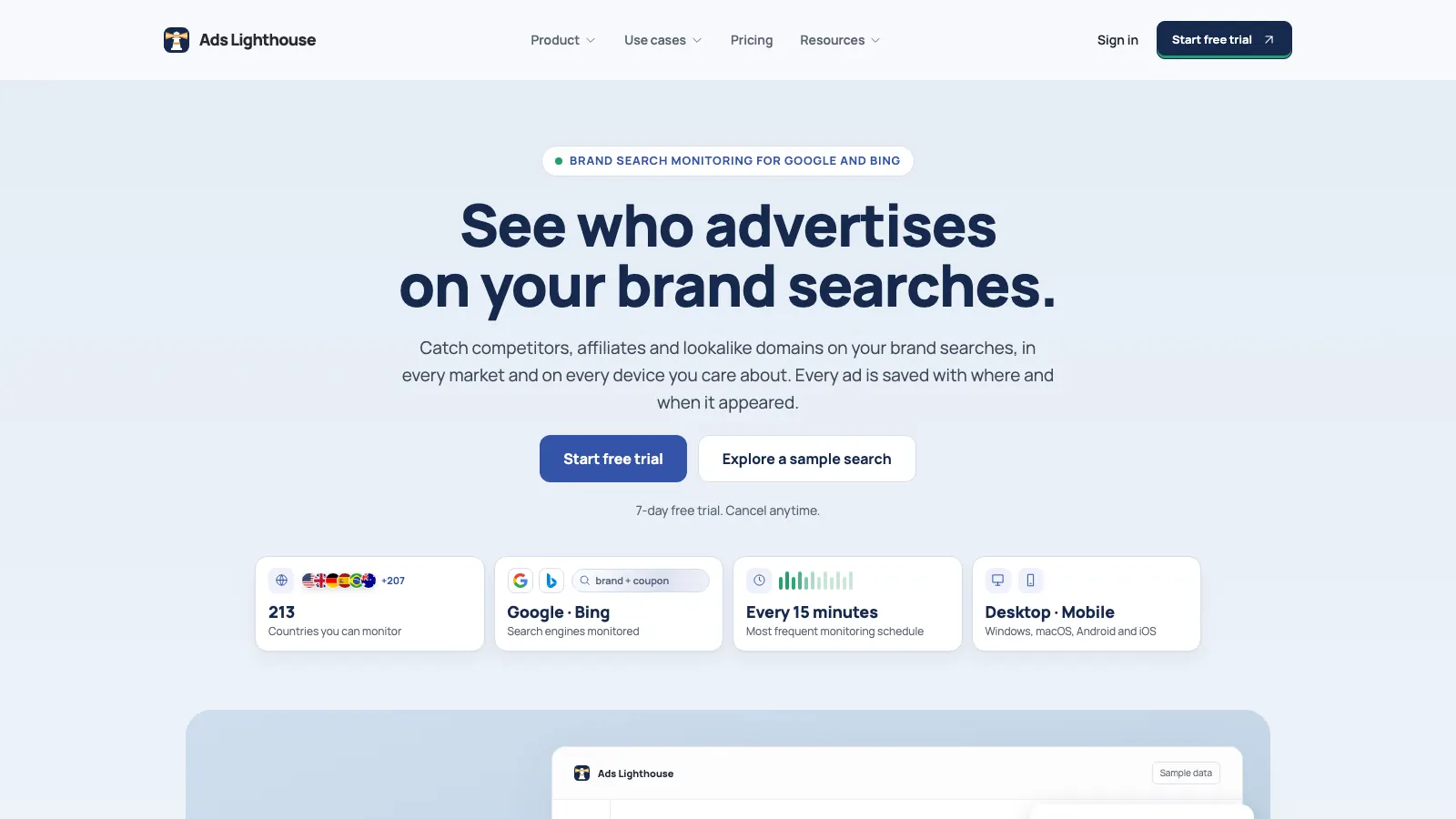
Google and Bing paid text ads are available across the plans. Your team can monitor whole countries or selected cities, on desktop and mobile, with operating-system context saved for each observation. The maximum schedule moves from daily on Starter to every six hours on Growth, every two hours on Scale, hourly on Business and every 15 minutes on Enterprise. Faster checks use the same monthly allowance across fewer keyword and location combinations, so coverage design matters more than the fastest interval on the price grid.
Google Shopping from Growth
Growth and higher plans add sponsored Google Shopping listings with the product, merchant, price, destination and position. That is a sensible reason to leave Starter if product ads form part of the brand-risk picture.
Compliance cases and redirect traces
Affiliate managers can declare an affiliate URL parameter and known IDs. Ads Lighthouse matches saved Google ad links exactly and leaves unknown IDs visible. The product also supports policy cases with an owner, status, notes, history and evidence. For eligible destinations, its server-side trace records status codes, the final page and affiliate IDs in the redirect chain. This is where Ads Lighthouse becomes more practical than a screenshot folder: a finding can be assigned, explained and kept with its supporting details.
Alerts, exports and connected reports
Alerts can reach email, Slack or a webhook when a new advertiser appears, returns after 30 days away, mentions the brand or uses an affiliate ID. Daily and weekly summaries are available too. Every table exports the filtered rows to CSV or Excel, and teammates share the account's projects, history and plan. Optional read-only Google Ads and Search Console connections can run separate reports from your own accounts, but their data does not flow into the monitoring reports.
MCP and REST API
The hosted MCP server is included in every plan, including trials, through account sign-in. Starter includes signed-in MCP access at $49 a month. It can read projects, keywords, saved checks and reports, and it can make changes only when the connection has write access. The REST API and API keys start on Scale and above, including trials of those plans. Reading through the API returns saved checks without starting searches; creating a project or running an on-demand check consumes the plan allowance.
How is Ads Lighthouse priced across monitoring tiers?
Price checked 27 Nov 2026
| Plan detail | Starter$49/mo | Growth$99/mo | Scale$299/mo | Business$599/mo |
|---|---|---|---|---|
| Projects | 1 | 2 | 5 | 10 |
| Keywords | 20 | 50 | 150 | 500 |
| Locations per project | 2 | 5 | 12 | 25 |
| Scheduled checks per month | 7,500 | 18,000 | 60,000 | 144,000 |
| Most frequent schedule | Daily | Every 6 hours | Every 2 hours | Hourly |
| Google Shopping | ✕ | ✓ | ✓ | ✓ |
| REST API and white-label PDFs | ✕ | ✕ | ✓ | ✓ |
Ads Lighthouse prices in US dollars, tax included, 27 Nov 2026.Ads Lighthouse pricing
The price model is refreshingly simple: the vendor lists no per-seat pricing and no automatic overage charges. A three-person team on Growth still pays $99 a month, because invited teammates share the account's projects, plan and allowances. Growth is the practical plan for a brand that needs Google Shopping, while Scale is the first sensible plan for an agency that needs API keys or client-branded PDF reports.
What does Ads Lighthouse Enterprise deliver for large teams?
Ads Lighthouse Enterprise provides custom negotiated pricing supporting up to 100 locations per project and flexible checking thresholds. It reaches a 15-minute maximum schedule. Consider it only after mapping the keyword, location, device and source combinations that your monitoring needs, because each combination affects the shared allowance.
Where does Ads Lighthouse fall short in coverage?
Ads Lighthouse purposefully limits its platform scope by functioning as a targeted search compliance monitor rather than an ad library. It does not cover social platforms, Amazon, Yahoo, regional engines or AI answer surfaces. A team evaluating broad creative trends, paid social or marketplace competitors will quickly run out of road. The narrower coverage is valuable only when brand-search observations are the thing you need to preserve.
Starter is a controlled entry point, not a flexible small-team plan. One project, 20 keywords, two locations and 7,500 scheduled checks can suit a single brand, but it leaves little room for a portfolio or wide local coverage. Google Shopping starts at Growth, while API access and white-label reports start at Scale. Those gates make the free trial of the $49-a-month Starter plan useful for proving the workflow, not for assuming the entry price will fit every use case.
History has a hard boundary as well. Observations and related history rows are held for three UTC calendar months. An empty older window does not prove an advertiser was absent, because the records may have expired. Export evidence your team may need later, particularly when a case will outlast that retention window.
What are the top alternatives to Ads Lighthouse?
 AI Peekaboo review is useful for a different visibility question: its plans start at $30 a month, price checked 27 Nov 2026, and include API and MCP access for teams tracking AI answers. It does not replace Ads Lighthouse's saved paid-search observations, but it is the first comparison to make when your concern is what AI systems say about a brand rather than who bids around its name.
 Adspread review belongs in the conversation when the job is buying Telegram placements. It is a managed workflow for turning a brief into approved Telegram Sponsored Messages or Mini App inventory, not a self-serve brand-search record. That makes it a different answer to a different paid-media problem.
 AdSpy review suits a paid-social researcher who needs Meta creative filters across copy, pages, URLs and landing-page technologies. Its published price is $149 a month, price checked 27 Nov 2026, while Ads Lighthouse starts at $49 for monitored Google and Bing brand searches. Choose based on channel before comparing either price.
What is the final assessment of Ads Lighthouse?
Ads Lighthouse serves as a reliable solution when brand bidding evidence must hold up under legal scrutiny and affiliate compliance audits. The $49-a-month Starter plan includes signed-in MCP access, while Google and Bing coverage, a lean Starter allowance and REST access from Scale define its boundaries.
Start a 7-day Starter trial for one brand and design the keyword, location, device and schedule combinations first. Move to Growth for Shopping, or to Scale only when API keys or client-branded PDFs are part of the operating workflow.
How was the data for this Ads Lighthouse review gathered?
Ads Lighthouse integration documentation, API guides, and published pricing pages supplied the technical parameters validated on 27 Nov 2026. Prices are in US dollars, as the vendor shows them, and every figure follows how we check figures.
- Ads Lighthouse pricing and plan limits
- Ads Lighthouse features and integrations
- Ads Lighthouse API and MCP documentation
What are the most common questions about Ads Lighthouse?
How much does Ads Lighthouse cost?
Starter costs $49 a month, Growth $99, Scale $299 and Business $599. Enterprise is custom priced. The vendor lists monthly US-dollar prices with tax included and a 7-day trial.
Does Ads Lighthouse monitor Google Shopping?
Yes, from Growth upward. Google and Bing paid text-ad monitoring is available on every plan, while Google Shopping records product listings from Growth.
Is observed visibility the same as impression share?
No. Observed visibility is the share of your monitored searches where a domain appeared. It is not Google impression share, and an observation does not prove spend, a purchased keyword or infringement.
Does Ads Lighthouse work with AI agents?
Yes. Its MCP server is included on every plan through account sign-in. REST API access and API keys begin with Scale, including Scale trials.
 Reviewed byDanny Kirk
Founder of ReddiReach.
 Checked byAndrés Felipe
Digital designer and marketer.
Every figure is checked against the vendor's own page. Read our editorial standards.