
Key Takeaways
- Aircall delivers a collaborative voice platform featuring shared inboxes, smart routing, and CRM integrations to eliminate communication silos across customer-facing teams.
- Aircall requires a three-user minimum commitment, pricing its Essentials tier at €30 and its Professional tier at €50 per license monthly.
- Aircall supports AI agent workflows through webhooks, a native Embed SDK, a dedicated AI API, and full Model Context Protocol integration.
- Aircall is inefficient for solo operators needing one or two lines or businesses wanting lightweight pipeline tracking rather than dedicated telephony.
When sales or support calls need to survive a handoff, Aircall gives the team one workspace instead of leaving the history in one rep’s inbox. It is strongest for teams that will use its shared inbox, routing and CRM connections: Essentials suits eligible domestic outbound calling within its 1,000-minute monthly allowance, while Professional earns its premium for unlimited eligible domestic calls, a power dialer or live monitoring.
Agent access
- API
- Yes, Essentials, Professional, and Enterprise
- MCP server
- Official, hosted, OAuth
- Works with
 ClaudeClaude Code
 ChatGPT
- Automation
- Zapier
What are the key Aircall pros and cons for growing sales teams?
What works
- Shared inbox, contacts, assignments and comments keep handoffs visible
- Essentials includes 250+ integrations and 50 AI Voice Agent minutes
- Professional lists outbound campaigns, coaching and full API access
What to watch
- Essentials and Professional both require at least three users
- Essentials includes 1,000 eligible domestic outbound minutes per user each month
- Enterprise pricing is custom and starts at 25 users
How does Aircall turn phone conversations into shared operational records?
Aircall transforms every customer phone call into a unified, accessible team record integrated directly with connected customer databases. Calls, SMS and messaging sit in one workspace, with a shared inbox, assignment and comments for the next person who needs to act. It belongs in the marketing tools directory because the important question is not whether you can place a call, but whether the conversation reaches the CRM, help desk and colleague who need it next.
That is a sensible setup for an inbound support desk or an outbound sales team where one person answers and another closes. Business hours, IVR, routing, queues, shared contacts and warm transfers shape the path. Call recordings, transcripts, summaries and tags make the outcome easier to find later. The product earns its cost when those handoffs are real, not when every person simply uses it as a standalone dialer.
The plan divide is practical. Essentials covers the shared calling foundation, including 1,000 eligible domestic outbound minutes per user every month. Professional lists unlimited eligible domestic outbound calls and adds smart routing, queue callback, a power dialer, outbound campaigns, live monitoring and user-level analytics. That makes Professional the more credible option for an active calling program, even though it costs €20 more per license each month.
Who gets the most value from using Aircall as a primary phone system?
Inbound service teams
Route and queue calls with shared inboxes, contacts and assignments, keeping every handoff visible.
Outbound sales teams
Professional adds a power dialer, campaigns, coaching and live monitoring for structured call routines.
CRM-connected operations
Use integrations, webhooks and API tools to send call activity into existing systems.
Teams automating routine calls
AI Voice Agents resolve routine requests and escalate difficult calls with handoff context.
It is less convincing for a founder who needs only one line and a light CRM. The three-seat floor turns Essentials into a €90 monthly commitment on annual billing before any add-ons. That is a fair price for a working call desk, but it is not a casual phone subscription.
Which telephony, routing, and dialing features come with Aircall?
Call routing that reflects the team
Aircall lists business hours, call routing, IVR, call queuing, ring groups and time- and date-based routing. Those controls matter because a business phone system fails at the exception: the caller who reaches the wrong queue, calls after hours, or needs a specific specialist. Map those paths before you choose a tier, then make the routing match who can actually solve the call.
A shared workspace for calls
The shared call inbox collects calls needing follow-up, while shared contacts, call commenting and assignment give the next owner context. Conversation Center adds recordings and transcripts in a filterable call and voicemail log. This is where Aircall is stronger than a plain business number: it makes call ownership visible rather than relying on a colleague’s memory.
AI assistance and voice agents
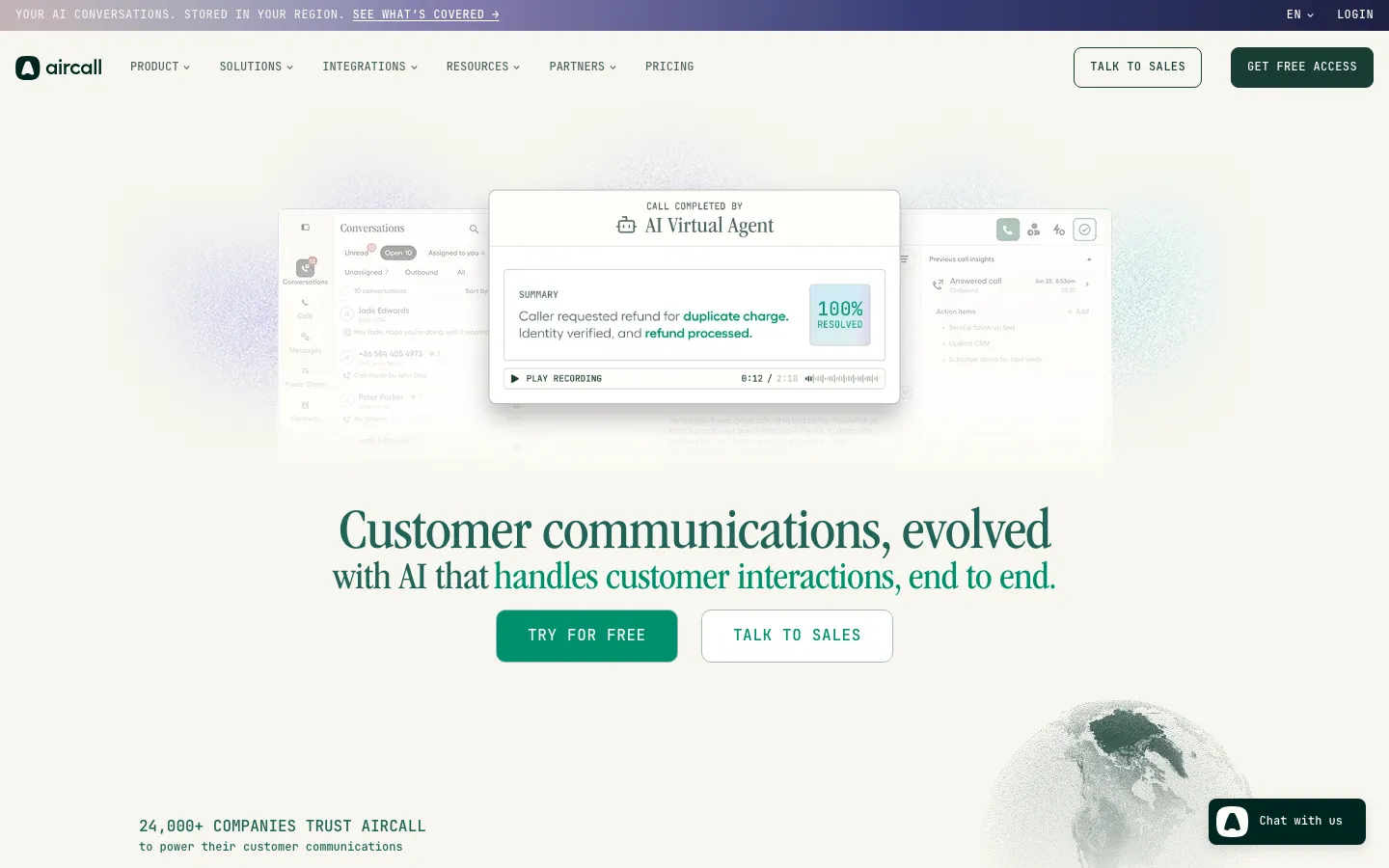
Aircall says its AI Assistants provide live guidance, transcription, sentiment and topic insights, then can capture notes, update CRM records and create follow-up tasks. AI Agents can answer routine calls and escalate complex issues with context. Essentials includes 50 minutes of AI Voice Agents a month, so treat that allowance as a useful starting point, not proof that it will cover a busy support queue.
Outbound calling and coaching
Professional adds the power dialer, outbound call campaigns, call whispering and barge call, alongside user-level analytics and live monitoring. Those features are for a manager who has an active coaching rhythm and a defined list to call. If no one will review the calls or use the data to change the work, the extra plan cost will not produce much value.
Developer platform and integrations
Essentials lists more than 250 business-tool integrations, including CRM and help-desk connections. Aircall’s developer platform offers an AI API, MCP, REST API, webhooks and an Embed SDK. It says MCP can connect your tools and data to AI Virtual Agents so they can take actions during inbound or outbound calls. Aircall says all plans include API access and 250+ integrations, while its pricing table lists full API access on Professional. Confirm the precise scope your workflow needs before choosing a tier.
How does Aircall pricing compare across its annual seat tiers?
Price checked 27 Nov 2026
| Plan detail | Essentials€30/mo | Professional€50/mo | EnterpriseCustom |
|---|---|---|---|
| Billing shown | Per license/month, annual | Per license/month, annual | Talk to sales |
| Minimum users | 3 | 3 | 25 |
| Eligible domestic outbound calls | 1,000 min/user/month | Unlimited | Unlimited |
| AI Voice Agents | 50 min/month | Included | Included |
| Full API access | Confirm scope | Listed | Listed |
| Max teams | 3 | Unlimited | Unlimited |
Aircall prices in euros, 27 Nov 2026.Aircall pricing
Eligible domestic minutes cover calls within France, the UK, Germany, Spain, Italy, Belgium, the Netherlands, Mexico, Ireland, Portugal, Singapore, Australia and New Zealand.
The minimum makes the team bill easy to calculate. Three Essentials licenses cost €90 a month, while three Professional licenses cost €150 a month, both with annual billing selected. That €60 gap is the decision: pay it when your team needs unlimited eligible domestic outbound calls, smart routing, the power dialer, campaigns or live monitoring. Professional also lists full API access, while Aircall says all plans include API access, so confirm the scope before you make API access the deciding factor.
Aircall also publishes add-ons, so the plan price is not always the final bill:
- AI Assist Pro at €49 per seat/month for live AI coaching
- WhatsApp in Aircall at €10 per seat/month
- Analytics+ at €15 per seat/month for custom dashboards, scheduled API exports and unlimited history
- AI Messaging Agents at €0.13 to €0.30 per conversation
What does the Aircall Enterprise plan provide high-volume call centers?
Aircall Enterprise delivers custom contract pricing, dedicated onboarding, advanced security, and high-volume routing infrastructure for scaling companies. It has a 25-user minimum and custom pricing. The published plan includes everything in Professional, plus unlimited global calls subject to its Terms of Use, custom onboarding, prioritized support, API developer support, an enterprise SLA and compliance coverage, SSO and SCIM. SAML SSO availability is subject to certain conditions, so confirm it with sales. Take it seriously only when those controls, global calling or onboarding needs are already concrete, because the public page does not give a price for comparison.
Where does Aircall fall short for micro-businesses and solo operators?
Aircall enforces a mandatory three-user minimum requirement that makes the platform unviable for solo entrepreneurs or micro-teams. You cannot buy one Essentials or Professional license, and Enterprise begins at 25 users. A small team should compare the three-license commitment with its actual call volume before assuming a per-license price is its monthly bill.
Aircall’s plan boundaries also put several high-value capabilities above Essentials. Professional lists unlimited eligible domestic outbound calls, smart routing, queue callback, power dialing, outbound campaigns and live monitoring. It also lists full API access, but Aircall says all plans include API access and 250+ integrations, so ask which scope your workflow requires. If the calling features are central to how your team sells or supports customers, Essentials is not the cheaper equivalent, it is a different operating model.
Finally, the AI allowance in Essentials is finite. Fifty AI Voice Agent minutes can be enough to establish a narrow automated path, but it is a poor basis for forecasting a high-volume voice program. Model real routine-call volume, the escalation rate and any add-ons before you sign an annual commitment.
Which Aircall alternatives should buyers evaluate for general CRM needs?
Attio review is the better place to start if your central problem is a customizable CRM. Its Free plan supports up to three users with 50,000 records and three objects, while its developer platform lists REST API, webhooks, an App SDK and MCP. Choose Attio when those CRM-building options matter more to your team than a dedicated calling workspace.
 Bitrix24 review suits a team that wants a CRM, tasks, chat, video calls and automation under one organization-level price. Its paid plans start at €89 a month billed monthly, while the free plan allows unlimited users, checked against Bitrix24’s own pages on 27 Nov 2026. Choose it when breadth matters more than a specialist calling workspace.
What is the final verdict on deploying Aircall?
Aircall is a good buying decision when calls are a shared operating system for sales or service, not a last-mile communication channel. The collaboration features, routing controls, integrations and developer platform give a growing team a credible foundation. Essentials can cover outbound work within its 1,000 eligible domestic minutes per user each month; Professional is the practical choice when unlimited eligible domestic calls, a power dialer or live monitoring are needed. Its published full API access also needs to match the scope you have confirmed.
Choose Essentials when the shared inbox, core calling setup and its 1,000 eligible domestic outbound minutes per user each month fit your operation. Budget for Professional from the first month when you need unlimited eligible domestic calls, a power dialer or live oversight, then calculate the three-seat bill before committing annually. For API-connected workflows, confirm the access scope before you choose a tier.
How were Aircall features and technical limits verified?
Aircall prices, limits and features in this review come from Aircall’s own pricing, product, integration and developer pages, checked on 27 Nov 2026. Prices are shown in euros from Aircall’s Portugal pricing page. Alternative facts were checked against Attio’s and Bitrix24’s own vendor pages on 27 Nov 2026, and every figure follows how we check figures.
- Aircall pricing page and its plan comparison
- Aircall phone-system feature pages
- Aircall integrations and developer platform pages
What are the most common questions prospective buyers ask about Aircall?
What does Aircall do?
Aircall is a customer communications platform for business calling, AI Voice Agents, shared workflows and connected CRM and help-desk conversations. Its phone features include routing, IVR, queues, a shared inbox and call assignment.
How much does Aircall cost?
Aircall’s Portugal pricing page lists Essentials at €30 per license per month and Professional at €50 per license per month with annual billing selected. Both require at least three users. Enterprise has custom pricing and a 25-user minimum.
Does Aircall have an API and MCP?
Yes. Aircall’s developer platform lists an AI API, MCP, REST API, webhooks and an Embed SDK. The pricing page lists full API access on Professional and Enterprise.
What does Professional add to Aircall?
Professional lists unlimited eligible domestic outbound calls, smart routing, queue callback, a power dialer, outbound campaigns, call whispering and barge call, user-level analytics, live monitoring and full API access. Eligible domestic minutes cover calls within France, the UK, Germany, Spain, Italy, Belgium, the Netherlands, Mexico, Ireland, Portugal, Singapore, Australia and New Zealand.
 Reviewed byDanny Kirk
Founder of ReddiReach.
 Checked byAndrés Felipe
Digital designer and marketer.
Every figure is checked against the vendor's own page. Read our editorial standards.