
Key Takeaways
- AirOps unifies AI-search research, workflow automation, human review, and performance tracking into an end-to-end execution system for content teams.
- AirOps prices all Solo, Pro, and Enterprise plans via custom sales quotes based on task consumption, with Solo including 35,000 baseline tasks.
- AirOps features developer API access and Model Context Protocol connectors, though specific plan entitlements and tier permissions remain unpublished.
- AirOps will frustrate buyers looking for a low-cost entry plan, predictable self-serve billing, or simple lightweight visibility tracking without content execution.
When you need to turn AI-search opportunities into reviewed, published work, AirOps is the fit for a content team that wants measurement and execution in one program. Skip it if you need a published monthly price before a sales call, because Solo, Pro and Enterprise are all priced around task volume and requirements. Its value is the loop between intelligence, action and measurement, not a cheap entry plan.
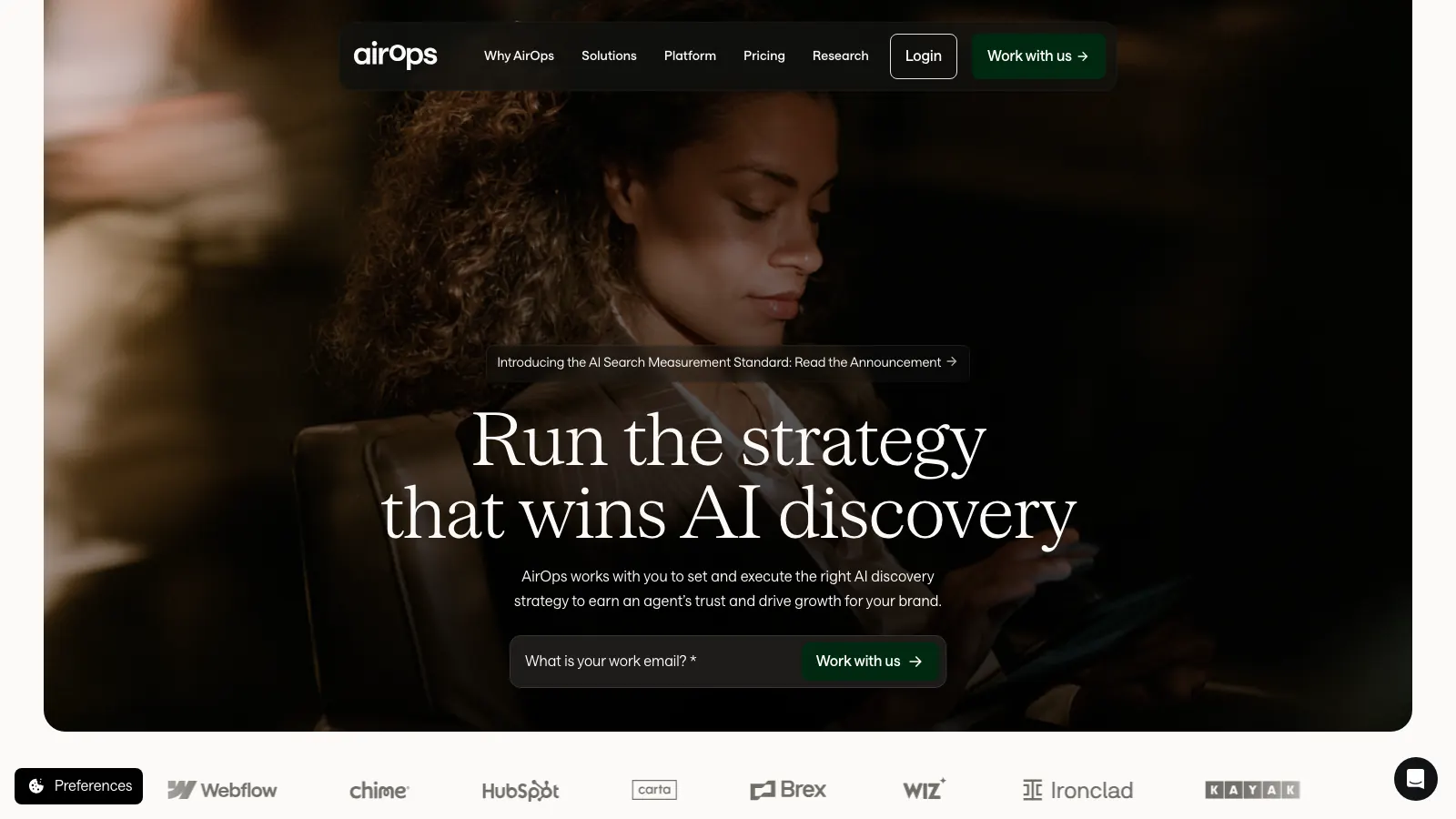
Agent access
- API
- Yes
- MCP server
- Official, hosted, OAuth 2.0 through an AirOps browser sign-in
- Works with
 ClaudeClaude Code
 ChatGPT
 Cursor
 VS Code
What are the main AirOps pros and cons?
What works
- Agents can research, create, publish, monitor and refresh work
- Pro includes 100,000 content-production tasks and unlimited team seats
- Onsite and offsite campaigns connect work across channels
What to watch
- No public subscription price for any paid plan
- Solo has one user, one Brand Kit and ChatGPT Insights only
- Plan-level MCP and API access is not published
How does AirOps connect AI discovery data to editorial execution?
AirOps joins intelligence, action and measurement around AI discovery. Its Insights area shows where a brand stands with the buyers that matter, which competitors lead and which gaps deserve investment. Actions then turns those priorities into Playbooks, Workflows and Grids, while Campaigns ties an objective, accepted actions and results together. That is a broader job than the marketing tools directory entry for a simple tracker suggests.
The important distinction is operational. Agents can carry out research, creation, publishing, monitoring and refreshes, while Brand Kits and Knowledge Bases give the work brand context. A human-review Inbox pauses outputs for review, comments and approval. For a team that already has a content process, that makes AirOps a place to coordinate work rather than another tab where a score goes up or down.
The commercial trade-off arrives early. Solo is for an individual building content for one brand or project. It has one user, one Brand Kit, three Knowledge Bases, 35,000 content-production tasks and ChatGPT Insights only. Pro is for a small team on one brand or project, with 100,000 tasks, one Brand Kit, five Knowledge Bases, unlimited seats and insights across 10+ answer engines. Neither plan carries a public price.
Who benefits most from adopting AirOps for content operations?
Content teams with volume
Use repeatable agents, review checkpoints and shared context across a sustained publishing program.
Teams entering AI search
Connect buyer opportunities, content actions and results instead of tracking disconnected prompt lists.
Small teams on one brand
Pro provides unlimited seats while keeping the work focused on one Brand Kit.
Enterprise growth programs
Enterprise adds custom agent builds, limits, onboarding and dedicated account management for scale.
Solo is the more cautious route for one person who wants ChatGPT Insights alongside content production, but it is not a known low-cost route because the quote is still based on task volume and needs. Teams that need multi-engine insights or shared seats should evaluate Pro as the practical starting point.
Which workflow automation and monitoring features does AirOps offer?
Intelligence tied to buyer priorities
Insights covers analytics, onsite performance, offsite sources, ads, prompts and opportunities. It frames that information around audiences, products and buyer journeys, so the useful question is where competitors have an advantage and where more effort could matter.
Playbooks, Workflows and Grids
Playbooks describe agent work through instructions, tools, context, artifacts, triggers and Human Review. Workflows are the lower-level option, with explicit steps, branching, data processing and integrations. Grids run either format across many rows, making a repeated content task manageable at larger volume.
Review and governed context
AirOps can pause a run when human judgment is needed, route it to the Inbox and resume after approval or editing. Teams can compare versions, accept or reject changes and restore earlier content. Persistent memory turns comments, suggestions and review into governed context for the next run. Brand Kits set a brand's voice, rules, audiences, products, regions and visual guidelines, while Knowledge Bases give Playbooks and Workflows access to proprietary files, websites and connected data.
Onsite and offsite campaigns
Onsite Campaigns support owned content through CMS integrations, while Offsite Campaigns bring external and third-party work into the same program. AirOps lists Offsite Insights under Intelligence. Separately, its Opportunities area covers onsite, offsite, social and community actions, giving a team one place to coordinate work across channels.
Measurement after work ships
Campaign measurement follows changes in visibility, recommendations, citations, sentiment and position, with breakdowns by model, audience, region, topic, buying stage, competitor and source. Content Updates records pages created, refreshed or published with their source, date, URL and campaign context. The result is an evidence trail from an opportunity through an action to the signals that followed it.
MCP and API access
AirOps lists MCP connectors and AirOps MCP + API among its integrations, and its platform page provides connection options for several AI development environments and applications. The pricing material does not say which plan includes that access. Ask for the plan entitlement in writing before making it a dependency for an agent workflow.
How does AirOps pricing work across quote-based task tiers?
Price checked 27 Nov 2026
AirOps does not publish subscription figures. The quote follows task volume and specific requirements, so the table shows the public allowances, not a made-up team bill.
| Plan detail | SoloQuote required | ProQuote required | EnterpriseQuote required |
|---|---|---|---|
| Answer-engine insights | ChatGPT only | 10+ answer engines | Not published |
| Content-production tasks | 35,000 | 100,000 | Custom limits |
| Team seats | 1 | Unlimited | Unlimited |
| Brand Kits | 1 | 1 | Unlimited |
| Knowledge Bases | 3 | 5 | Unlimited |
AirOps prices and allowances checked 27 Nov 2026.AirOps pricing
Tasks are the currency for certain actions such as content generation or data extraction. A successful workflow action can consume tasks, and usage rises as you add data sources, AI model queries and other steps. Each workspace gets 50,000 free credits to test workflows in the builder before going live for Scale, Enterprise and 14-day trial accounts.
- Solo overage costs $0.025 per task after the initial allotment
- Tasks reset to the plan's monthly allotted amount at the start of each calendar month
- The 14-day free trial ends when its tasks run out, 14 days pass or you upgrade early
- Bring-your-own model API keys are an add-on for Solo; other plan availability is not presented as Solo pricing
The last item is why the real cost needs a clear task model before you sign. A team that uses an agent for many sources and model queries can use a very different allowance from a team running a narrow workflow, even if both have the same number of people.
What tailored capabilities does AirOps Enterprise provide large organizations?
AirOps Enterprise supports high-volume content operations requiring bespoke workflow integrations, enterprise security compliance, and custom task volume allocations. It has custom prompt, page and task limits, plus custom agent builds, unlimited Brand Kits and Knowledge Bases, a dedicated account manager, one-to-one expert onboarding, and unlimited seats with collaboration functionality.
Ask for the task allowance, answer-engine scope, MCP/API access and support commitments in the same written proposal, so the team can compare the quote with what it will actually run.
Where does AirOps fall short in pricing transparency?
AirOps introduces friction for procurement teams by requiring custom sales conversations for all plans rather than publishing transparent self-serve pricing. AirOps states that pricing follows task volume and specific needs, but it does not show a monthly or annual price for Solo, Pro or Enterprise. A content lead can see the allowance and seat difference, yet cannot calculate the cost of a three-person team or compare it directly with a fixed-price tool before talking to sales.
Solo is also deliberately narrow. It has single-user access, one Brand Kit and ChatGPT Insights only. Pro widens insight coverage to 10+ answer engines and unlimited seats, but AirOps does not publish the full engine list in its pricing material. If a particular model matters to your reporting, make it a question in the sales conversation.
Agent access deserves the same care. MCP connectors and AirOps MCP + API appear in the plan comparison, while plan-level availability is not explained in the public material. That is enough to show the capability exists, not enough to promise it on the plan you are considering.
Which AirOps alternatives should teams choose for reporting-only needs?
 AI Peekaboo review is the first alternative to weigh when measurement and client delivery matter more than content execution. Its plans start at $30 a month, checked 27 Nov 2026, include API and MCP access at every level, and add white-label reports and share links from $100 a month, checked 27 Nov 2026. It is the more transparent choice when you need tracked-answer data to leave the dashboard.
 Alli AI review matters when AI crawlers need a pre-rendered version of your existing pages because they would otherwise receive blank content. Choose it when that crawler-access problem matters more than AirOps' governed content workflow.
 Content Harmony review is the closer comparison for teams that need one-page content workflows with a Keyword Report, Content Brief and Content Grader. Read it when the editorial process itself matters more than coordinating a wider program of actions, campaigns and measurement.
What is the final verdict on adopting AirOps?
AirOps is most convincing where a content team needs reviewed execution and measurement to inform each other in one system. Its strength is the route from an identified gap to a governed action, not merely reporting that the gap exists.
Do not choose it for price certainty. The quote-based model, task billing and unpublished per-plan MCP/API access mean you should get the operating terms before treating it as your team's platform.
Take a real monthly content workflow to AirOps, estimate its tasks with the team, and ask for a written quote that names the allowance, engine coverage, agent access and overage terms.
How were the features and details in this AirOps review verified?
AirOps platform claims, task structures, and documentation resources were cross-checked directly on the official vendor site on 27 Nov 2026. Solo overage costs $0.025 per task. Every figure follows how we check figures.
- AirOps pricing page for plan allowances, tasks and trial terms
- AirOps platform page for agents, review controls and measurement
- AirOps documentation for product areas, Playbooks and Workflows
What are the most frequent questions teams have about AirOps?
How much does AirOps cost?
AirOps does not publish a subscription price for Solo, Pro or Enterprise. Pricing follows task volume and specific needs. Solo's public overage rate is $0.025 per additional task.
Is there a free AirOps trial?
Yes. AirOps advertises a 14-day trial with all Scale-plan features and no payment details needed until it ends. It can end early when the trial task allotment runs out or you upgrade.
What does the Solo plan include?
Solo includes ChatGPT Insights only, 35,000 content-production tasks, one Brand Kit, three Knowledge Bases, basic CMS and SEO integrations, community and live-chat support, and one user.
Does AirOps work with AI agents?
AirOps lists MCP connectors and AirOps MCP + API, and publishes connection options for several AI development environments. Ask which plan includes the access you need, because the public plan details do not specify it.
 Reviewed byDanny Kirk
Founder of ReddiReach.
 Checked byAndrés Felipe
Digital designer and marketer.
Every figure is checked against the vendor's own page. Read our editorial standards.