
Key Takeaways
- Amplitude unifies user event analytics, conversion funnels, session replays, and experimentation tools into a single product intelligence environment for growth teams.
- Amplitude provides a free plan covering two million monthly events, while Growth and Enterprise tiers require sales-assisted custom contract quotes.
- Amplitude equips teams with AI Agents, SDKs, APIs, and Model Context Protocol support, while gating advanced behavioral cohort APIs behind upper tiers.
- Amplitude is ill-suited for businesses requiring predictable fixed monthly costs or teams searching for a lightweight, entry-level website reporting dashboard.
When an activation flow starts losing people, Amplitude is the right pick for a product team that needs analytics, experimentation and replay to investigate the same decision. You can begin on Free with 2 million events a month, but choose a narrower reporting tool if a fixed paid price matters because Growth and Enterprise use custom quotes.
Agent access
- API
- Yes, free plan for the HTTP V2 API
- MCP server
- Official, hosted, OAuth 2.0 with Amplitude
- Works with
 ClaudeClaude Code
 ChatGPT
 Gemini
 Cursor
What are the core pros and cons of using Amplitude?
What works
- AI Agents and MCP are included from the Free plan
- Analytics, replay and experimentation share one platform
- Growth adds protected schemas and workflows
What to watch
- Growth and Enterprise need a custom quote
- Advanced governance starts at Growth
- User Profile API is Enterprise-only; Behavioral Cohorts API is a Growth and Enterprise add-on
What behavioral insights does Amplitude uncover for product teams?
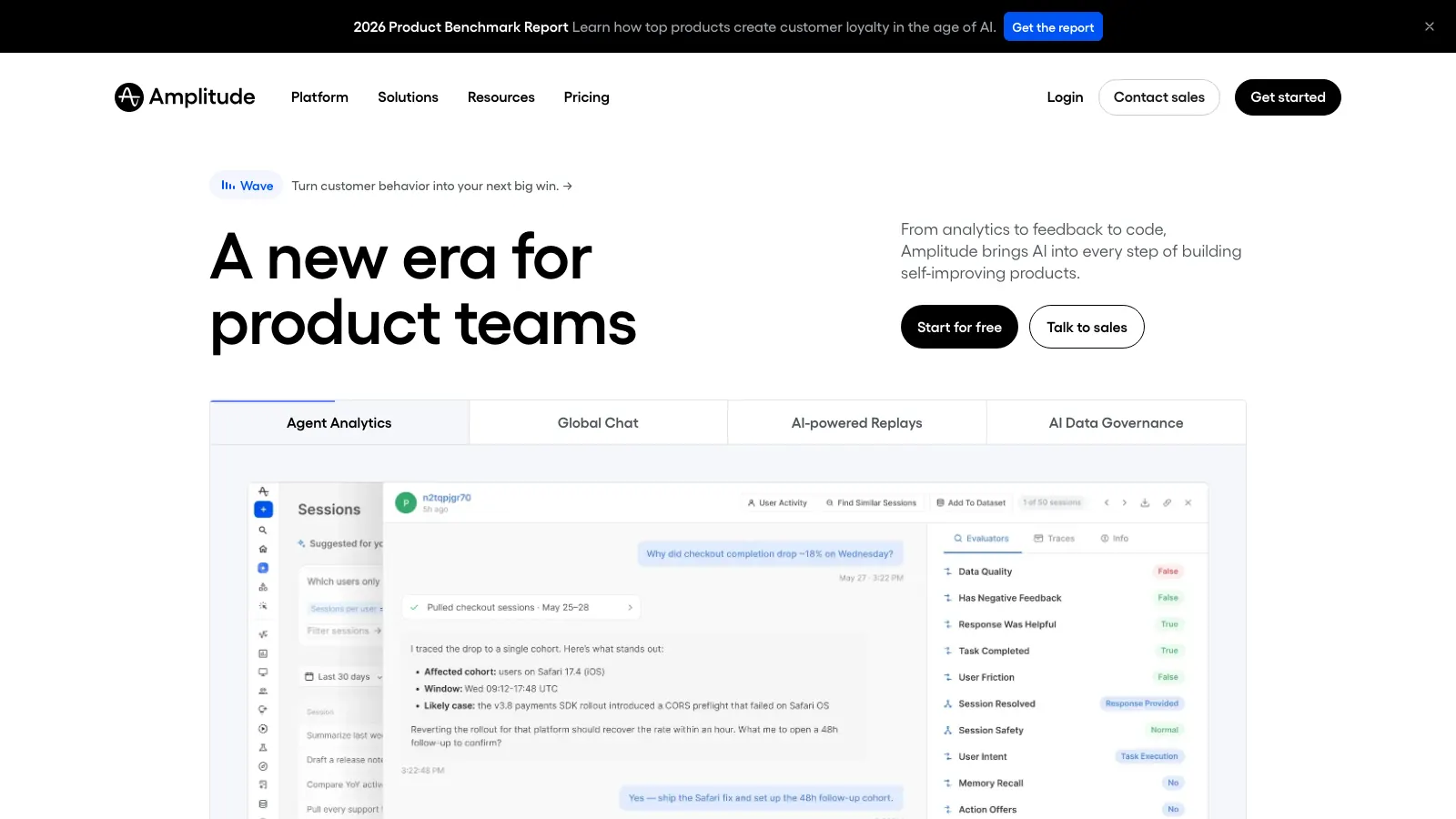
Amplitude turns product behavior into funnels, cohorts, dashboards and follow-up work. It is built for the team deciding what to change in a digital product, rather than a team that only needs a traffic dashboard. That distinction matters when you are choosing from a marketing tools directory: Amplitude brings product and web analytics together with session replay, feature experimentation, guides, surveys, activation and AI features.
The useful promise is not that every team should turn on every module. It is that a product manager can investigate a drop-off, an analyst can segment users, and an engineer can keep the tracking plan in shape without splitting the work across separate interfaces. Amplitude’s own documentation points teams to funnels, segmentation, cohorts and dashboards for behavior questions.
I would pick it when the question is about what people do after they arrive: where they abandon a flow, which cohort returns, or whether a release changed a meaningful action. For a simple reporting requirement, that breadth is more than you need. For a product organization, it gives the evidence and action layer a coherent home.
Who gets the most value from Amplitude product analytics?
Product teams
Find behavior patterns, build funnels, and turn the result into a product decision.
Experiment owners
Run feature flags and web tests beside the analytics used to judge them.
Data teams
Define events, validate data, and keep a trusted taxonomy as products grow.
Agent-enabled teams
Use AI Agents and MCP to bring product data into established work routines.
The Free plan is the sensible starting point for a team that wants to prove the workflow before paying. It has no time limit, needs no card, and includes 2 million events per month. The decision becomes harder when your volume or governance needs take you beyond that tier, because Plus scales by usage and Growth and Enterprise move to a sales conversation.
Which analytics, experimentation, and replay features does Amplitude include?
Behavioral analytics and dashboards
Amplitude’s analytics tools center on product behavior. You can build funnels, segment users, create cohorts and save dashboards. For a product lead, that is the core loop: turn an observed behavior into a repeatable view the team can revisit, rather than reporting a headline metric once and losing the context.
AI Agents and MCP
AI Agents analyze product data, create dashboards and segments, and can help maintain a taxonomy. Amplitude says custom agents can run a defined job on a schedule or on demand. The platform also offers MCP, and its documentation includes an agent-ready index plus a setup prompt for coding agents that install analytics and session replay. That makes Amplitude unusually practical for a team that wants its assistant to ask questions of product data instead of merely summarizing exported reports.
Experimentation where you analyze
Feature flags and web experimentation are available on every plan. Amplitude Experiment lets you launch experiments from analytics charts and session replay, while the documentation describes feature testing as variant targeting and causal-lift measurement. Free and Plus have limited active experiments; full experiment results are listed from Growth. That split is important: a low-cost plan can support testing, but an experimentation program needs the Growth details confirmed in its quote.
Replay, heatmaps and friction clues
Session Replay is included across the four plans, with monthly replay limits that rise from 10,000 on Free and Plus to 20,000 on Growth and 50,000 on Enterprise. The documentation also covers click, selector and scroll maps, plus rage clicks by page region. Use these features to investigate why a funnel moves, not as a substitute for deciding which behavior is worth improving.
Governance and integrations
The governance layer provides tracking plans, event validation, filters, data merging and schema controls. Protected schemas and workflows begin at Growth, as do more advanced controls. The integration catalog lists 160 results and includes data-warehouse, CDP, CRM, attribution and ad-network categories. Featured integrations include  Amazon Web Services S3 and
 HubSpot.
How does Amplitude structure free limits and enterprise pricing?
Price checked 27 Nov 2026
| Plan detail | FreeFree | PlusFrom $0 | GrowthCustom | EnterpriseCustom |
|---|---|---|---|---|
| Events a month | Up to 2M | Up to 70M | Custom | Custom |
| Session replays a month | 10,000 | 10,000 | 20,000 | 50,000 |
| AI Agents and MCP | ✓ | ✓ | ✓ | ✓ |
| Feature flags | Unlimited | Unlimited | Unlimited | Unlimited |
| Protected schemas | ✕ | ✕ | ✓ | ✓ |
| Developer SDKs and APIs | ✓ | ✓ | ✓ | ✓ |
Amplitude plans, 27 Nov 2026.Amplitude pricing
Every plan includes Amplitude and unlimited seats. For an illustrative five-person team that stays within the Free plan's 2 million monthly events, the monthly software bill is 5 × $0 = $0, subject to the published feature limits. A paid team bill cannot be calculated from the published starting price alone: Plus scales with event volume, while Growth and Enterprise are tailored to volume and feature needs.
Budget separately for expanded packages. Amplitude lists Feature Experiment, Web Experiment, Guides and Surveys, Activation, Session Replay and Accounts packages for Growth and Enterprise, and says expanded packages are priced as a percentage of Amplitude plan. The User Profile API is Enterprise-only. The Behavioral Cohorts API is an add-on on Growth and Enterprise, not included in Free or Plus. Ask Amplitude to name the event allowance, replay allowance, API access, package scope and governance controls in writing.
What advanced capabilities do Amplitude Growth and Enterprise tiers add?
Amplitude Growth introduces advanced operational governance and expanded data controls for scaling teams. It adds advanced behavioral exploration, currency conversion, monitoring and alerts, 20,000 monthly replays, SSO and project permissions. Enterprise adds unlimited projects per portfolio, data access controls, unlimited monitoring and alerts, 50,000 monthly replays and advanced user management including RBAC.
Security may be the reason to go higher rather than analysis itself. Amplitude supports SAML 2.0 single sign-on on Growth and Enterprise, and says a Business Associate Agreement is available to customers on those plans that process protected health information. It also offers US and EU hosting, audit logs, data-subject request APIs and privacy controls. Those are tangible buying criteria for a regulated team, not decoration around the analytics package.
Where does Amplitude fall short for smaller organizations?
Amplitude presents limited commercial pricing transparency once organizations outgrow the free tier. You can see what Plus begins with, but its price scales with event volume. Growth and Enterprise require a custom quote. That is reasonable for a high-volume product organization, but it makes it difficult to compare the eventual bill before you talk to sales.
The feature matrix also needs careful reading. AI Agents, MCP, replay, feature flags and web experimentation are all available from Free, but that does not make every related capability unrestricted. Active experiments are limited on Free and Plus, full experiment results are listed from Growth, and protected schemas and workflows start at Growth. User Profile API access is Enterprise-only, while Behavioral Cohorts API is an add-on on Growth and Enterprise.
Finally, the broad platform is a commitment. It works best when product, data and engineering agree on the events and decisions that matter. If your team only wants a simple audience report, a specialist reporting product can be a clearer operating model.
What analytics alternatives compete directly with Amplitude?
 AI Peekaboo review is the first alternative to read when you need to compare the same buyer questions across ChatGPT, Gemini, Perplexity, Google AI Mode and Google AI Overviews.
 Chartbeat review is useful for its Real-Time Dashboard, which tracks every page across your sites to show traffic, reader engagement and referral traffic.
 Cometly review is the relevant alternative when you need marketing attribution that connects ad spend to pipeline and revenue.
What is the final verdict on adopting Amplitude?
Amplitude is a strong choice for a product team that needs more than a dashboard. The Free plan is unusually capable because it includes analytics, 2 million events, replay, experimentation, AI Agents and MCP without a time limit. The practical next step is to see whether your real event volume and governance needs fit Plus before you accept a custom Growth or Enterprise proposal.
Start on Free if your team can name the product decisions it wants to improve. Before paying, map your event volume and the controls you need, then get the Growth or Enterprise scope in writing.
How was product and plan information for Amplitude verified?
Amplitude documentation, pricing pages, and product guides provided the factual foundation verified on 27 Nov 2026. Prices and limits are shown in the vendor’s terms, and the approach follows how we check figures.
- Amplitude pricing and plan details
- Amplitude documentation for analytics, agents, MCP and SDK setup
- Amplitude pages for experimentation, session replay, governance, integrations and security
What are frequently asked questions about adopting Amplitude?
Is Amplitude free?
Yes. The Free plan has no time limit or card requirement and includes up to 2 million events a month, plus AI Agents, MCP, analytics, replay and experimentation features.
Does Amplitude include A/B testing?
Yes. Feature flags and web experimentation are available on every plan. Free and Plus have limited active experiments, while full experiment results are listed from Growth.
Does Amplitude work with AI agents?
Yes. AI Agents and MCP are included on all plans. Its documentation also provides an agent-ready index and setup material for coding agents.
How much does Amplitude cost for a team?
Free costs nothing and includes unlimited seats. Plus starts at $0 and scales with event volume. Growth and Enterprise have custom prices based on volume and feature needs.
 Reviewed byDanny Kirk
Founder of ReddiReach.
 Checked byAndrés Felipe
Digital designer and marketer.
Every figure is checked against the vendor's own page. Read our editorial standards.