Key Takeaways
- Brandwatch consolidates global consumer intelligence, multi-platform social media management, influencer discovery, and search trends into an enterprise suite.
- Brandwatch gates its subscriptions entirely behind private sales demonstrations, withholding public plan fees and baseline seat pricing.
- Brandwatch provisions developer APIs to funnel deep consumer conversation archives and social analytics into proprietary business intelligence infrastructure.
- Brandwatch is mismatched with agile organizations that demand transparent entry-level pricing or quick, self-serve onboarding without enterprise sales friction.
Brandwatch is the enterprise choice when you need consumer intelligence, wide monitoring coverage and social operations in one suite. Skip it if a published price and a quick self-serve start matter more: its plans lead to a demo, while smaller monitoring tools make their entry costs visible.
Agent access
- API
- Yes
- MCP server
- Not found on official pages
What are the main pros and cons of Brandwatch?
What works
- Monitoring across more than 100 million sources
- Consumer intelligence and social management in one suite
- APIs for bringing analysis into your own systems
What to watch
- No public price or visible plan limits
- Demo-led buying process before a quote
- More platform breadth than a small team may need
How does Brandwatch unify social media management and research?
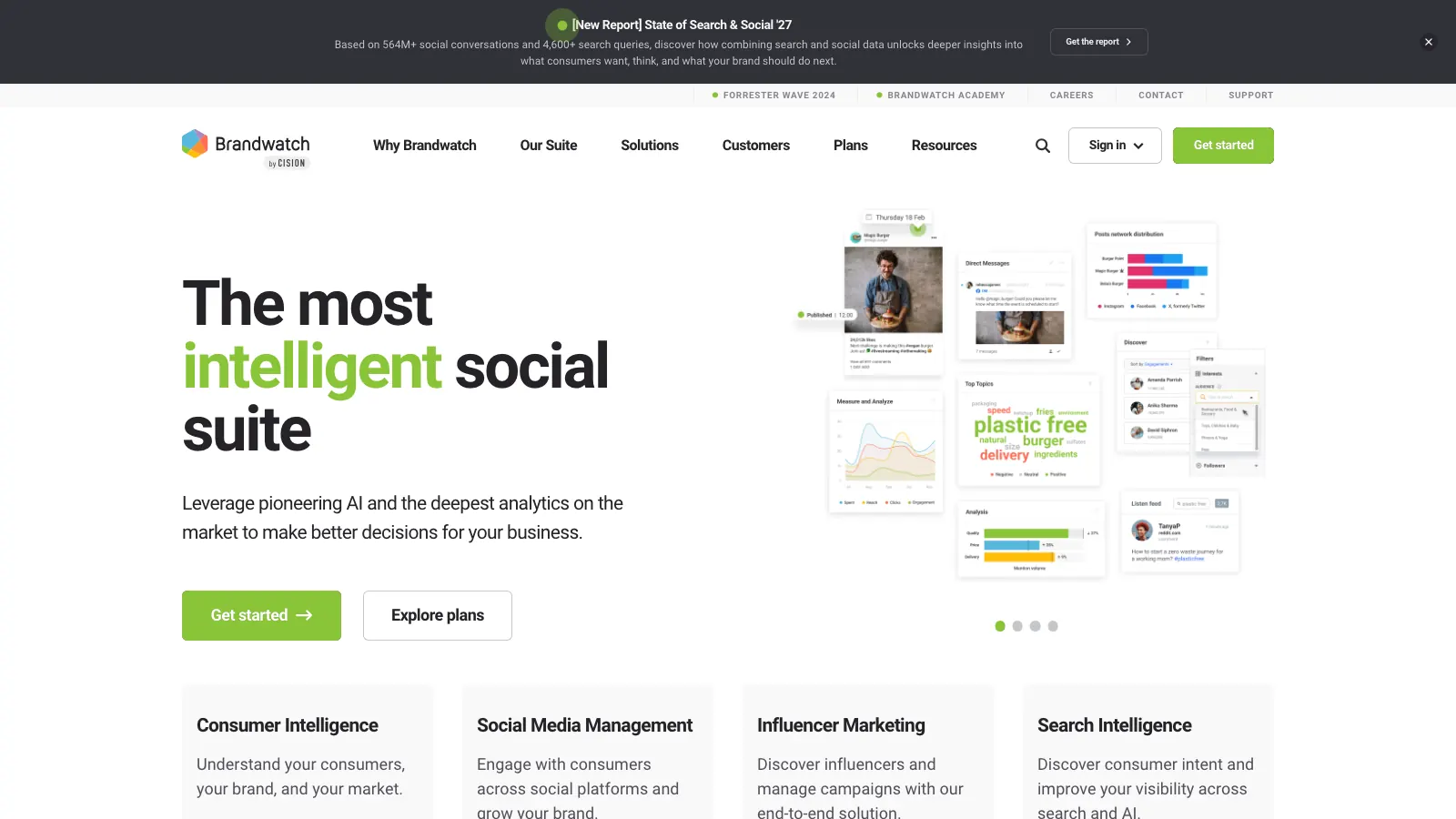
Brandwatch combines consumer intelligence, social media management, search intelligence and influencer marketing under one roof. That makes it one of the broadest entries in the marketing tools directory: a research team can examine consumer conversations while the social team plans content, engages customers and monitors its brand.
The distinction matters. A mention tracker tells you that a discussion happened. Brandwatch is built to make that discussion useful across research, reporting and response. Its consumer intelligence product draws on conversations from 100 million unique sites and billions of sources, while its social suite adds a shared calendar, approval flows, a central social inbox and competitor benchmarking.
I would choose it when several teams need to work from the same signal, not when one person only needs alerts. The breadth creates a credible case for an enterprise program, but it also makes the missing price harder to ignore while you are still deciding whether the scope fits.
Which organizations benefit most from using Brandwatch?
Enterprise brand teams
Monitor threats across markets, with alerts and multi-source conversations ready for investigation.
Consumer insights teams
Turn consumer conversations into searchable research, reporting and stakeholder alerts at organization scale.
Social media teams
Plan content, handle community conversations and benchmark competitors from one shared social workspace.
PR and communications teams
Bring search, social and media signals together before emerging issues acquire momentum.
The wrong buyer is a founder, freelancer or small marketing team that needs a simple monitoring feed with a price beside it. Brandwatch describes itself as an enterprise solution and offers standard through enterprise plans, but it does not show the bill, seat count or source allowance that would let a smaller team compare it cleanly.
What analytics and intelligence capabilities does Brandwatch offer?
Consumer intelligence at conversation scale
Consumer Intelligence is the research layer. Brandwatch says it brings historical and real-time consumer data together, with proprietary and generative AI to make large bodies of conversation easier to explore. Iris, its AI assistant, can search and analyze data, then create charts, summaries and insights from a question. That is useful when the job is to understand a market or a changing perception, rather than merely count mentions.
Monitoring and real-time alerts
Brandwatch says it monitors emerging threats across over 100 million sources and can set smart, real-time alerts. Its documented coverage includes major social networks, news, blogs, forums, review sites, television and radio. News, blog and forum history reaches back to 2010, so an insights team can combine an immediate alert with a longer view of the conversation.
Social management in a shared workspace
The social product is not only for listening. It puts organic and paid content into one interface, gives teams an integrated content calendar and approval flows, and uses a customizable cross-channel inbox for community work. Brandwatch also states that it offers 12 months of consumer data and seven years of competitive channel analytics in this part of the suite. For a social leader, that makes the product more operational than a reporting-only tool.
Search intelligence and GenAI monitoring
Search Intelligence, powered by Trajaan, looks beyond social conversation. Brandwatch says it covers traditional search, social, shopping and generative AI across more than 150 countries, including search data from Google, Amazon, TikTok and Baidu. It also says the product can monitor how leading LLMs cite a brand and competitors across thousands of prompts. That is the layer to consider if demand, reputation and search behavior should be interpreted together.
Developer APIs and reporting
Brandwatch publishes APIs for analysis, data upload, consumer research, measurement, publishing and engagement. Its Consumer Research API exports analysis for databases and visualization systems, while the Measure API moves owned social metrics into external analytics tools. The Engage API can consolidate social inbox conversations with customer inquiries from different platforms. That makes the APIs useful for a data team, though public pages do not state commercial access, rate limits or included usage.
How does Brandwatch structure customer pricing?
Price checked 27 Nov 2026
Brandwatch lists standard through enterprise plans for its solutions, but does not publish prices or a public plan matrix. Treat the following as buying routes, not like-for-like packages.
| Route | Published price | What Brandwatch shows |
|---|---|---|
| Consumer Intelligence | Contact for pricing | Consumer research, AI and reporting |
| Social Media Management | Contact for pricing | Publishing, engagement, listening and benchmarking |
| Full suite demo | Contact for pricing | Discuss the combined suite with Brandwatch |
Brandwatch plans, no prices shown, 27 Nov 2026.Brandwatch plans
Brandwatch does not publish the prices and seat allowances needed to calculate a team bill. Ask for a quote that separates users, solutions and API terms, then compare that total against the scope your team will actually use.
What does Brandwatch offer global enterprise marketing departments?
Brandwatch offers standard to enterprise plans for each solution. Its positioning is centered on global enterprises, which matches the product: research, social operations, reporting, APIs and search intelligence can all sit in one procurement conversation.
The practical question is not whether Brandwatch has enough capability. It is whether your team has enough work that sharing one source of consumer, social and search signals is more valuable than buying narrower tools. If the answer is yes, request a proposal tied to your markets, channels and departments. If it is no, the demo process is probably more effort than you need.
What are the main disadvantages of Brandwatch?
Brandwatch poses substantial procurement friction through its strict lack of public pricing transparency. Without a public starting price, you cannot use the website to set a budget, calculate a multi-user bill or decide whether a particular module is affordable. The site also does not publish a public feature matrix that allocates alerts, APIs, publishing or historical access by plan, so a quoted proposal needs more scrutiny than a self-serve checkout page.
The suite also asks you to be disciplined about scope. Consumer intelligence, social management and search intelligence solve related but different problems. A team that only wants a simple inbox or a daily alert can end up evaluating far more platform than it will use. Start with the outcome that needs to improve, then make every requested module earn its place in the quote.
Which platforms are the top Brandwatch alternatives?
Brandwatch competitor pricing and self-service alternatives were reviewed on 27 Nov 2026.
 AI Peekaboo review is the first place to look if the missing piece is AI answer visibility with a published starting price. Its plans begin at $30 a month and include an API, MCP access and Looker Studio, rather than a consumer intelligence suite.
 The Determ review is useful for PR and communications teams that want public pricing: its Expand plan is listed at $279 a month billed annually, with $335 also displayed, and it monitors 100 million or more sources.
 The ForumScout review suits a sales or growth team that wants monitored conversations turned into AI reply drafts. Its Starter plan is $19 a month and includes unlimited seats with 10 keywords.
Is Brandwatch the right enterprise intelligence platform?
Brandwatch represents a compelling enterprise platform when consumer research, social operations, and PR require an unified operational stack. Its documented scale, real-time alerts, search layer and API catalog make that case well. I would not start a smaller team there, because the price and plan detail remain behind a demo.
Take a demo only after you have named the teams, signals and systems that must share data. Ask Brandwatch to price those requirements separately, then rule out any module your team will not use regularly.
How was this Brandwatch review verified?
Brandwatch product collateral, suite documentation, developer API manuals, and demo policies provided the factual base on 27 Nov 2026. The site did not show public prices, limits by plan, a self-serve trial or API commercial terms. Every figure follows how we check figures.
- Brandwatch plans and suite pages
- Consumer Intelligence, Iris AI and data-network pages
- Social Media Management, Search Intelligence and API pages
What are the most common user questions about Brandwatch?
How much does Brandwatch cost?
Brandwatch does not publish prices on its plans page. You need to schedule a demo and go through sales to get a quote, and the public pages do not state typical contract amounts.
Does Brandwatch offer a free trial?
Brandwatch directs you to request a demo and does not publish a self-serve trial or standard trial duration.
Does Brandwatch have an API?
Yes. Brandwatch publishes APIs for analysis, consumer research, measurement, publishing and engagement. Its public pages do not state rate limits, commercial access or contract scope.
What does Brandwatch monitor?
Brandwatch describes monitoring across more than 100 million sources, including major social networks, news, blogs, forums, review sites, television and radio. It also says real-time alerts are available, with news, blog and forum history reaching back to 2010.
 Reviewed byDanny Kirk
Founder of ReddiReach.
 Checked byAndrés Felipe
Digital designer and marketer.
Every figure is checked against the vendor's own page. Read our editorial standards.