
Key Takeaways
- Buska monitors social web channels to convert public brand buying signals into ranked sales prospect feeds for outreach teams.
- Buska costs $49 monthly for Starter, while the $99 Growth tier unlocks CRM exports, Reply Studio, and 500 monthly API requests.
- Buska documents native Model Context Protocol integration and credit-based API access for autonomous agents to search mentions and score prospects.
- Buska delivers weak return on investment for companies operating in niche business categories where buyers rarely discuss solutions on public social forums.
Buska is the social listening tool to choose when your sales team needs public buying signals turned into a ranked lead feed, and Growth at $99 a month is where its reply, CRM and API features become practical. It belongs in a marketing tools directory for prospecting, not for teams that only need a broad publishing workspace or have too little public conversation to justify a dedicated lead engine.
Agent access
- API
- Yes, Starter ($49/month), Growth ($99/month), or Scale ($249/month)
- MCP server
- Official, hosted or local, OAuth 2.1 with PKCE for the remote server; API key for local stdio
- Works with
 ChatGPT
 ClaudeClaude Code
 Cursor
- Automation
- Make, n8n
What are the core benefits and limitations of using Buska?
What works
- Lead scoring considers intent, freshness, ICP match and engagement
- Growth adds Reply Studio, webhooks, CSV export and API access
- Connections include
 HubSpot, Salesforce,
 Slack and
 Notion
What to watch
- Starter only checks five signals and refreshes leads daily
- Reply Studio and API access begin on Growth at $99 a month
- Private Slack and Discord communities are not covered
How does Buska uncover sales opportunities from online discussions?
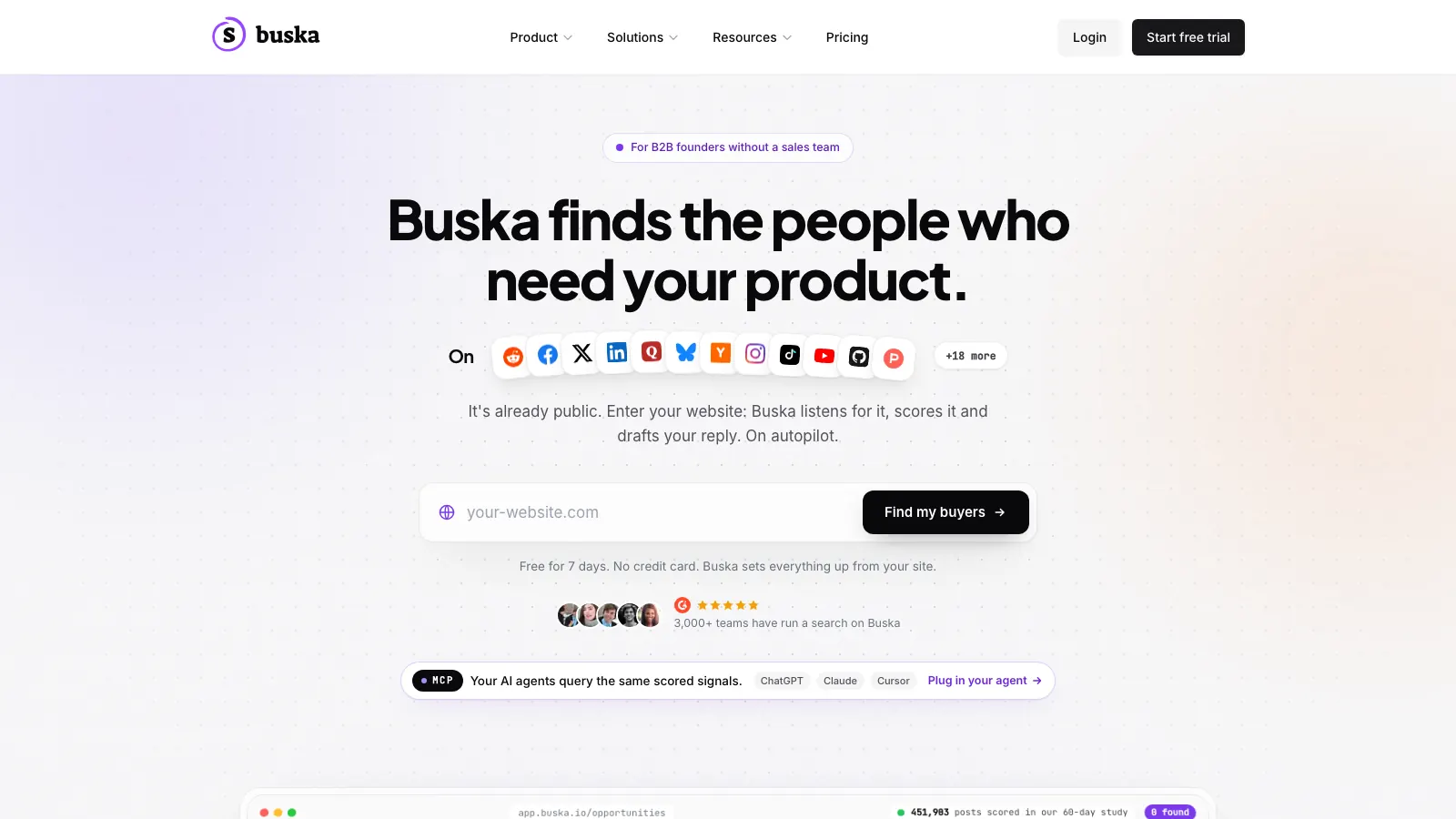
Buska is built for the moment before outreach, when someone has already described a problem or asked for a recommendation in public. It monitors more than 30 platforms for B2B buying signals, scores leads with AI and organizes the resulting opportunities around your team’s signals and ideal customer profile. That makes it a lead-generation product using social listening, rather than a general social inbox.
That distinction matters if your job is to find conversations worth answering. A publishing calendar, a follower report and a pile of brand mentions do not tell a sales person whom to contact first. Buska’s score combines buying intent, freshness, ICP match and engagement, so the queue has an order before a rep begins reading. It is closer to prospecting workflow than social publishing.
The product has a clear dividing line. Starter gives one person five monitored signals, two ICP profiles, 16 or more sources and daily lead updates. Growth costs $99 a month and moves to 15 signals, five profiles, 28 or more sources and updates every three hours, with scans scheduled between 6am and 8pm Paris time. It is also where Reply Studio, webhooks, CSV export and API access arrive. For an active program, I would treat Growth as the real entry point.
Which growth and business development teams benefit most from Buska?
B2B sales teams
Teams that prioritize public buying intent before beginning personalized outreach each day.
Growth teams
Teams building a repeatable signal-to-CRM process across public social channels with shared follow-up.
Founders and small teams
Small teams that can act quickly when a relevant conversation appears publicly.
Agent builders
Developers who need scored signals through an API or MCP-compatible client.
Buska is a weaker fit for a team whose work is publishing, community management or broad reputation reporting. It also needs a category with enough public discussion. No scoring model can make a useful prospect queue when the people you sell to do not discuss their needs in the sources a tool can monitor.
What social listening and lead scoring capabilities are built into Buska?
Signals across public platforms
Buska lists 16 or more sources on Starter, 28 or more on Growth and 33 or more on Scale. The set includes professional networks, discussion sites, video comments, forums and the open web. Scans run daily on Starter, every three hours on Growth and hourly on Scale, between 6am and 8pm Paris time. Private Slack and Discord communities are not covered, a useful boundary to settle before you promise coverage to a sales team.
AI scoring and ICP matching
Each lead is scored from 0 to 100 using buying intent, freshness, ICP match and engagement. You can define an ideal customer profile and filter for the leads that fit it, rather than passing every mention to a rep. Starter includes two profiles, Growth five and Scale 10. That makes the higher plans more useful when separate products, regions or customer types need different rules.
Reply Studio and enrichment
Reply Studio starts with Growth and drafts a contextual response in a peer, expert or founder tone. Growth also includes 20 Prospect Finder searches and 100 lead-enrichment profiles each month; Scale increases those allowances to 250 and 1,000. The point is getting the signal, contact context and a draft into one decision point where a person can decide how to respond.
CRM and workflow connections
Buska documents connections for Slack, Discord, HubSpot, Salesforce, Lemlist, Apollo and Notion, plus webhooks for custom workflows. Its HubSpot setup can create contacts and deals from a detected social signal while retaining the score, platform, keyword match, ICP match and source URL as properties. If your pipeline already lives in a CRM, that is the feature set that keeps the listening work from becoming another tab someone must remember to check.
API and MCP for agents
Growth includes 500 API requests a month, while Scale includes 2,500. The API can search mentions, score a post for buying intent and return detected signals. Buska also documents an MCP server for Claude, ChatGPT, Cursor and other compatible clients. For smaller experiments, it sells API credits separately: $50 buys 1,000 credits, one credit per successful call, and the credits do not expire.
How much do Buska Starter and Growth subscription tiers cost?
Price checked 27 Nov 2026
| Plan detail | Starter$49/mo | Growth$99/mo | Scale$249/mo | AgencyCustom |
|---|---|---|---|---|
| Signals monitored | 5 | 15 | 30 | Not published |
| ICP profiles | 2 | 5 | 10 | Not published |
| Sources | 16+ | 28+ | 33+ | Not published |
| Scan schedule (6am to 8pm Paris time) | Daily | Every 3 hours | Hourly | Not published |
| Reply Studio | ✕ | ✓ | ✓ | Not published |
| API access | ✕ | 500 req/mo | 2,500 req/mo | Not published |
| Team members | 1 | 5 | Unlimited | Not published |
Buska prices in US dollars, 27 Nov 2026.Buska pricing
Buska offers a seven-day trial without a credit card. It publishes an Agency plan with multi-brand monitoring, a dedicated account manager, custom integrations and volume discounts, but asks prospective buyers to book a call rather than printing a rate. Annual billing saves two months, about 17%.
For a five-person sales team, Growth is $99 a month because it includes five team members. A sixth person changes the decision: Scale costs $249 a month and has unlimited members, so Growth plus an unknown extra-seat charge cannot be assumed to be cheaper. Price the headcount with Buska before you choose a plan solely on the signal limit.
What agency monitoring features and custom integrations does Buska support?
Buska Agency provides multi-brand monitoring setups, dedicated account management, and tailored integration support for client service teams. Buska does not publish its price or a feature-limit table for that plan. The sensible conversation is about the number of brands, signals, sources and people that will work in the account, because those are the limits that distinguish the published tiers.
Where does Buska limit signal allowances and data refresh speed?
Buska Starter remains affordable only for operations with small monitoring scopes and limited signal volume. Five signals and daily updates can establish whether your market produces relevant conversations, but they are restrictive for a team expected to respond while a thread is active. The feature gap is just as important: Reply Studio, CSV export, webhooks and API access start with Growth, not Starter.
Coverage needs careful reading. Buska names many public sources, but it explicitly excludes private Slack and Discord communities. It also publishes different source counts by tier, so a channel available to a Scale customer may not be part of a Starter plan. Define the specific places where your buyers talk before treating “30+ platforms” as an answer in itself.
Finally, Buska can bring a sales opportunity to the surface, but it cannot decide whether a reply serves the discussion or your brand. Treat its score and reply draft as a prioritization aid. A person should still decide whether to follow up, what to say and whether the conversation belongs in the CRM.
Which social listening and brand tracking tools compete with Buska?
 AI Peekaboo review is the first place to look when the question is how AI assistants describe your brand rather than which public conversation may become a lead. That is a different job from Buska’s scored signal feed, and the distinction matters before you buy either category.
 Hootsuite review is useful reading when content planning and publishing are as important as listening. Use Buska when signal qualification and sales follow-up are the work; choose Hootsuite when the team also needs a publishing workspace.
 OutX review tracks buying conversations on LinkedIn, X, Hacker News and more than 50 forums, then provides a reply to send from your real account. Compare its channel coverage and reply workflow with the places your buyers actually use.
Is Buska worth the monthly cost for B2B social lead generation?
When a sales team needs to find public buying conversations before a thread goes cold, Buska’s Growth plan is where the workflow becomes usable. It adds every-three-hour scans between 6am and 8pm Paris time, Reply Studio, exports, webhooks, API access and five seats that turn a feed into a working process. If your buyers speak publicly and someone on your team can reply thoughtfully, $99 a month is a clear, legible investment.
Use the seven-day trial to test five signals and the sources where your customers actually speak. Move to Growth only when those signals produce conversations your team can qualify and follow up through its existing CRM process.
How were Buska API limits, features, and pricing details validated?
Every price, limit and feature in this review comes from Buska’s own pricing, product, platform and documentation pages, read on 27 Nov 2026. Prices are in US dollars, as Buska shows them, and every figure follows the rules in how we check figures.
- Buska pricing page and API-credit information
- Buska product and platform pages
- Buska documentation for integrations, API and MCP
What are common practical questions about setting up Buska feeds?
Is there a free version of Buska?
No. Buska offers a seven-day free trial without a credit card. Its published paid plans are Starter at $49 a month, Growth at $99 and Scale at $249.
How much does Buska cost for a team?
Growth costs $99 a month and includes five team members. Scale costs $249 a month with unlimited members. Buska publishes an Agency plan but asks buyers to book a call for pricing.
What does Buska monitor?
Buska monitors public buying signals across 16 or more sources on Starter, 28 or more on Growth and 33 or more on Scale. Private Slack and Discord communities are not covered.
Does Buska work with AI agents?
Yes. Its documentation covers an API for searching mentions, scoring leads and querying signals, plus an MCP server for compatible AI clients. API access begins with Growth, while API credits are also sold separately.
 Reviewed byDanny Kirk
Founder of ReddiReach.
 Checked byAndrés Felipe
Digital designer and marketer.
Every figure is checked against the vendor's own page. Read our editorial standards.