
Key Takeaways
- Byword orchestrates SEO keyword research, article drafting, and CMS publishing into a structured, unified production workflow for growth teams.
- Byword includes five free trial articles, while paid monthly subscriptions start at $99 (or $83 annually) for twenty-five articles.
- Byword includes direct REST API access on Standard and Scale tiers, enabling external software agents to trigger automated batch content generation.
- Byword should not be treated as a complete replacement for human editorial review or used purely as a cheap generic text generator.
Byword is the content-writing platform I would choose when your team needs to turn search research into a repeatable article workflow, then move reviewed drafts toward publishing without stitching several tools together. Skip it if your first priority is the lowest possible cost per draft, or if you only need a general-purpose writing assistant rather than a system for an ongoing content program.
Agent access
- API
- Yes, paid plans
- MCP server
- Official, hosted, OAuth 2.0 with PKCE for interactive clients; approved headless and CI workflows can use a Byword API key
- Works with
 ClaudeClaude Code
 ChatGPT
 Cursor
- Automation
- Zapier, Make, n8n
What are the key benefits and limitations of using Byword?
What works
- Research, drafting, optimization and publishing sit in one workflow
- Full voice matching starts on the paid plans
- Standard adds three seats and API access
What to watch
- Starter is solo-only and includes 25 articles
- Team seats start at Standard, not Starter
- High-volume work needs an Unlimited conversation or careful credit planning
How does Byword streamline high-volume programmatic SEO writing?
Byword reduces workflow friction that arises when keyword research, article drafting, and CMS uploads remain scattered across separate software tools. It is cumulative. Byword brings those moments together: it can surface topic opportunities, create an article around a chosen direction, help refine it, and connect the finished work to publishing tools. That makes it a sensible stop in the marketing tools directory for a team that wants a more deliberate production line than a blank chat window provides.
The useful distinction is that Byword is built around the article rather than the prompt. Its own product framing leaves topic selection, expertise and the final edit with you. I think that is the right boundary. A content operation should use Byword to organize repetitive work, then reserve its scarce human time for claims, examples, points of view and approval.
Its strongest case is not a one-off post. It is a team with a publishing rhythm, a body of existing work to teach the product about its voice, and a clear process for reviewing what reaches readers. If those foundations are absent, the research and publishing connections will not solve the editorial problem for you.
Which content operations and marketing agencies should use Byword?
SEO content teams
Research and optimization give a regular publishing program a single place to move from opportunity to reviewed draft.
Agencies with repeatable work
Standard and Scale support multiple domains, seats and API access for a more structured client workflow.
Programmatic publishers
Templates, datasets and campaigns suit related pages that need a repeatable structure with specific data in each one.
Editorial teams with a voice
Voice matching is useful when you can supply real examples and still have an editor responsible for the result.
Byword is a poor fit for a solo writer producing only occasional articles. Its free allocation is a practical way to see the workflow, but the $99 monthly Starter plan is hard to justify if most credits will sit unused.
What article generation and publishing integrations are included in Byword?
Research before the draft
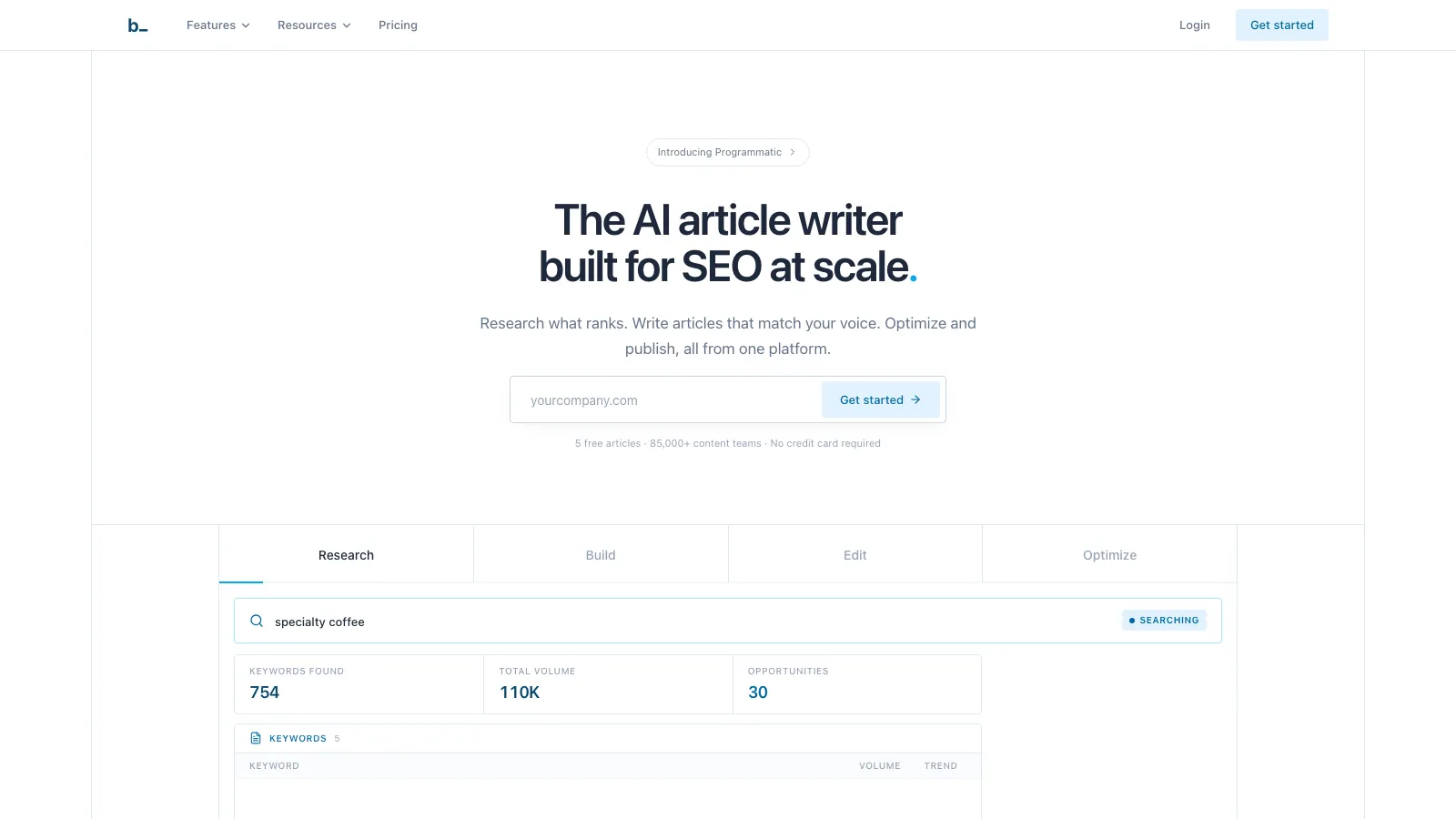
Research Intelligence is the feature that gives the product its shape. Byword says it analyzes keywords, search results, intent, competitor content and coverage gaps, then carries the selected opportunity into content creation. The research view includes volume, difficulty, trends and intent signals. That does not make a topic worthwhile by itself, but it stops the writing stage from pretending the search decision has already been made somewhere else.
Generation with a defined voice
Byword lets you provide existing posts, style guidance or documentation, then uses that material for voice matching. The free plan has basic voice matching, while Starter, Standard and Scale have the full version. The decision is less about a claimed percentage match than about preparation: a thin or inconsistent set of examples will create a thin editorial reference. Give it representative material, and use the draft as a starting point your expert can improve.
Optimization in the editor
The editor presents a live SEO score with suggestions around keyword use, heading structure and readability. It also compares the work with what top-ranking pages do. I would treat that as a revision checklist, not a target to game. A high on-screen score cannot settle whether the page answers the reader’s question, contains credible expertise or says something original.
Templates for related pages
Programmatic SEO is where Byword becomes more operational. You can define a template, connect a dataset and generate related pages at scale, with campaigns to manage the work. The vendor describes support for location, comparison, data and use-case patterns. That is valuable when each page has a real reason to exist and the source data is sound. It is the wrong use when templating becomes a substitute for a distinct reader need.
Publishing connections and API
Byword lists native publishing and export connections, webhooks and automation options, so a reviewed article can move into the rest of a content stack. Its REST API documents endpoints to generate articles, create and generate campaigns, retrieve campaign status and check account information and usage. API access starts on Standard. For a content operation that wants code or an agent to start a campaign and watch its progress, that boundary matters more than a long integrations list.
How much do Byword article credits and monthly subscriptions cost?
Price checked 27 Nov 2026
| Plan detail | Starter$99/mo | Standard$299/mo | Scale$999/mo |
|---|---|---|---|
| Articles each month | 25 | 80 | 300 |
| Extra article | $3.50 | $3.00 | $2.50 |
| Voice matching | Full | Full | Full |
| Included seats | None | 3 | 10 |
| Extra seats | None | $25 each | $20 each |
| API access | ✕ | ✓ | ✓ |
Byword monthly plans, 27 Nov 2026.Byword pricing
Annual billing changes the monthly rate to $83 for Starter, $249 for Standard and $833 for Scale. Those are meaningful savings only when the article allowance matches work you will actually use. Every account begins with five free articles and no card requirement, while the free account carries three domains and basic voice matching.
A three-person content team is a clean example of the real bill. Standard is $299 a month and includes three seats, so the published monthly base stays $299 before any extra articles. Starter is not a cheaper three-person option because it has no team seats. On annual billing, the same Standard plan is $249 a month. That is the comparison I would make before optimizing for the lower per-article figure.
For higher volume, Byword also offers Unlimited at a $1,999 monthly platform fee, with 500 or more articles a month and your own provider API keys. The vendor says its typical direct AI cost is about $0.10 per article. This is an enterprise-style arrangement, not a simple extension of the credit plans, so confirm expected output, provider charges and support terms before treating its stated per-article number as your all-in cost.
When does the Byword Unlimited plan justify its higher price tag?
Byword Unlimited serves content operations that have demonstrated their capacity to edit and manage large-scale article output. It includes unlimited team size, priority support, API access, research and voice matching, while the buyer supplies the model keys. Start with a credit plan if you still need to learn the human review requirement. Move only when volume is stable, template data is governed, and someone owns quality across the program.
Where does Byword face quality and pricing trade-offs?
Byword’s pricing makes the entry point sharper than it first appears. Starter has 25 articles and no seats, so it is designed for a solo user. A team moves immediately to Standard at $299 a month. That can be good value when the group needs the API and a steady 80-article allowance, but it is a large jump for a small collaboration need.
The platform also cannot remove the editorial work that makes SEO content useful. Voice matching needs real material to learn from, research signals still need a business decision behind them, and programmatic templates can multiply weak inputs as efficiently as good ones. If your bottleneck is subject-matter knowledge or review capacity, buying more credits will not solve it.
Finally, the API is not on Free or Starter. That is a sensible plan boundary, but it means a team building an automated workflow must budget for Standard at minimum. If that automation is the reason you are shopping, do not let the lower Starter price anchor the decision.
What software alternatives exist for SEO drafting and AI visibility alongside Byword?
 Byword alternatives like AI Peekaboo measure brand prominence across generative answer engines rather than producing long-form search articles. Its entry plan starts at $30 a month and includes an API and MCP access. The AI Peekaboo review explains that reporting-focused workflow in more detail.
 Copy.ai puts agents inside modular workflow steps, while
 EasyContent centers review and approval workflows with clear owners, automatic reminders and shareable review links. Read the Copy.ai review and the EasyContent review, then compare where research, review and publishing must happen in your own process.
Is Byword the most reliable platform for scaling search content?
For a team that wants to carry a chosen search opportunity through drafting, optimization and publishing, Byword offers a more coherent route than a collection of disconnected writing tools. The connected research, voice, optimization and publishing workflow gives an editor something more useful than another empty prompt box. Standard is the practical starting point for a small team because it includes three seats and the API.
Use the five free articles to test a real topic, your actual voice material and your review process. If the workflow holds up, choose Starter for a single owner or Standard for a team that needs seats, API access and a predictable monthly production run.
How were Byword output capabilities and API limits evaluated?
Byword pricing schedules, feature lists, and API specifications were verified against official platform pages on 27 Nov 2026. The pricing view, research, generation, optimization, programmatic, integrations, API, Unlimited and company pages were used. Every figure follows how we check figures.
- Monthly and annual pricing, including the free account and Unlimited
- Product pages for research, generation, optimization and programmatic work
- Integration and REST API documentation
What are common practical questions about generating content with Byword?
Is there a free version of Byword?
Yes. Every account starts with five free articles and no card requirement. The free plan has three domains and basic voice matching.
How much does Byword cost for a team?
Standard is $299 a month and includes three seats, or $249 a month on annual billing. Extra Standard seats are listed at $25 each; confirm the billing cadence.
Does Byword have an API?
Yes. Standard and Scale include REST API access. The documented endpoints cover article generation, campaigns, account information and usage.
Can Byword create programmatic SEO pages?
Yes. Its programmatic workflow uses templates and datasets to create related pages at scale, with campaigns to manage generation.
 Reviewed byDanny Kirk
Founder of ReddiReach.
 Checked byAndrés Felipe
Digital designer and marketer.
Every figure is checked against the vendor's own page. Read our editorial standards.