Key Takeaways
- Clay fits RevOps and growth engineers orchestrating 150+ data sources, whereas Apollo.io fits SDRs and account executives needing 240M+ contacts with built-in outreach.
- Apollo.io starts paid plans at $49/seat/mo annually ($65/seat/mo monthly) on Basic, while Clay starts at $185/mo on Launch above its 200-row Free tier.
- Clay includes unlimited seats on every plan and unlocks CRM sync at $495/mo on Growth, whereas Apollo.io bills per seat with a 3-seat Organization minimum.
- Clay pairs Claygent AI web research and Sculptor natural-language workflows with ad audience sync, while Apollo.io adds multichannel sequences, US dialing, and call insights.
- Clay and Apollo.io include REST APIs and official hosted MCP servers without extra interface fees, though Apollo.io supports six AI clients versus ChatGPT on Clay.
Clay wins for revenue operations teams, growth engineers, and outbound agencies building waterfall enrichment across 150+ data providers and custom AI web research. Apollo.io wins for SDR teams, founders, and account executives who want a 240M+ contact database, multichannel sequences, and a phone dialer inside one workspace. Pick Clay for unlimited-seat data infrastructure or Apollo.io for turnkey rep execution.
Clay and Apollo.io regularly appear together when B2B revenue leaders evaluate outbound data and prospecting platforms to grow pipeline without signing six-figure legacy data contracts. Although each product enriches leads and sends outbound emails, the two platforms solve different operational problems. Clay acts as programmable go-to-market data infrastructure connecting buying signals to activation channels, whereas Apollo.io unifies contact search, multichannel sequences, calling, and deal execution for front-line sales reps.
Clay prices by workspace capacity rather than headcount, giving unlimited seats on every plan while metering monthly actions and data credits across 150+ providers. Teams can test Clay on its $0/mo Free plan (500 monthly actions, 1,200 annual data credits, 200-row table limit) or 14-day trial before Launch starts at $185/mo. Apollo.io bills per seat around its 240M+ contact database, offering a $0/mo Free tier (900 annual credits, two sequences) before Basic begins at $49/seat/mo annually ($65/seat/mo monthly).
How do Clay and Apollo.io compare at a glance?
Clay and Apollo.io split across workspace seat rules, entry pricing, data coverage, and rep execution tools.
| What you compare |  Clay |  Apollo.io |
|---|---|---|
| Entry monthly price | $185/mo on Launch (from 15,000 actions/mo) | $65/seat/mo on Basic (30,000 credits/seat/yr) |
| Annual billing rate | Separate annual rate not listed; Enterprise via sales | $49/seat/mo Basic, $79 Professional, $119 Organization |
| Free or trial option | $0/mo Free (500 actions/mo, 200 rows) and 14-day trial | $0/mo Free (900 credits/yr, 2 sequences, 5 AI chats) |
| Seats and workspace model | Unlimited seats on all plans; shared action pools | Per-seat billing; 1-seat min (3 seats on Organization) |
| Core job and coverage | 150+ provider waterfall, Claygent AI, Sculptor, sequencer | 240M+ contacts, 30M+ accounts, sequences, US dialer |
| Reporting and collaboration | Shared workspace tables; dedicated support on Enterprise | A/Z testing and call insights (Professional); SSO and custom reports (Organization) |
| Integrations | Zapier; CRM sync, Salesforce, and ad sync on Growth+ | Zapier, Chrome extension, and CRM sync on Basic+ |
| API and MCP access | REST API, CLI, and hosted MCP (ChatGPT) on all plans | REST API and hosted MCP (6 AI clients) across plans |
Which revenue teams fit Clay vs Apollo.io best?
Clay fits growth engineers, revenue operations specialists, and outbound agencies at seed-to-enterprise B2B firms better than Apollo.io when custom data assembly drives pipeline. Each week, an operator pulls accounts from job-change or funding Signals, chains 150+ providers in a sequential waterfall, runs Claygent web research for niche firmographic triggers, and uses Sculptor to translate plain-text rules into table logic. Growth and Enterprise workspaces then sync segmented audiences to LinkedIn, Meta, and Google ads, update CRM records, or launch email sequences with unlimited seats.
Apollo.io fits founder-led sales teams, SDR pods, and account executives at startups through mid-market companies wanting prospecting and outreach under one login. Instead of maintaining enrichment formulas, reps open Apollo.io each morning to work AI-scored lead lists, filter 240M+ contacts across 65+ attributes, capture direct dials with the Chrome extension, and enroll prospects into email, phone, and LinkedIn sequences. Teams calling North American buyers also gain built-in US dialing, email warmup, 26-variant A/Z testing on Professional, and recorded call insights without stitching extra tools together.
Where does Clay outperform Apollo.io for outbound data?
Clay outperforms Apollo.io when revenue teams need sequential waterfall enrichment across 150+ providers, custom AI web research, and unlimited workspace seats.
Clay organizes go-to-market data inside programmable tables sitting between buying signals and outreach activation. Every plan, starting on $0/mo Free and $185/mo Launch, includes unlimited seats, multi-provider waterfalls, Claygent AI web research, Bring Your Own API Key support, Sculptor natural-language workflow building, and a native email sequencer. Launch raises limits from 500 to 15,000+ monthly actions and 50,000 rows per table for initial plays. Still, operational teams usually treat Growth ($495/mo) as the production baseline because Growth unlocks unlimited rows, 40,000+ monthly actions, CRM sync, Salesforce integration, and Audiences ad syncing.
Clay requires disciplined table design in exchange for that power. Because waterfall providers and AI prompts consume credits at varying rates, with a fully enriched record typically using 6 to 20 Data Credits, unmonitored workflows can deplete balances quickly unless operators connect their own API keys or rank provider priority carefully. Learning waterfall rules, formula syntax, and CRM connectors takes ramp time even with Sculptor, while Free caps tables at 200 rows. Clay also excludes voice dialing and call recordings, and Enterprise pricing requires a custom sales quote.
| Plan | Price | Included limits & seats |
|---|---|---|
| Free | $0/mo | 500 actions/mo, 1,200 credits/yr, 200 rows, unlimited seats |
| Launch | $185/mo | From 15,000 actions/mo, credits included, 50,000 rows, unlimited seats |
| Growth | $495/mo | From 40,000 actions/mo, unlimited rows, CRM, Salesforce, Audiences sync |
| Enterprise | Custom via sales | Custom actions and credits, unlimited rows and seats, dedicated support |
Clay plans and limits, 27 Nov 2026.Clay pricing
RevOps teams, growth engineers, and agencies running multi-provider waterfalls, custom AI web research, and CRM or ad audience syncs.
Where does Apollo.io outperform Clay for sales execution?
Apollo.io outperforms Clay when sales reps want a 240M+ contact database, multichannel sequences, phone dialing, and call intelligence inside one seat.
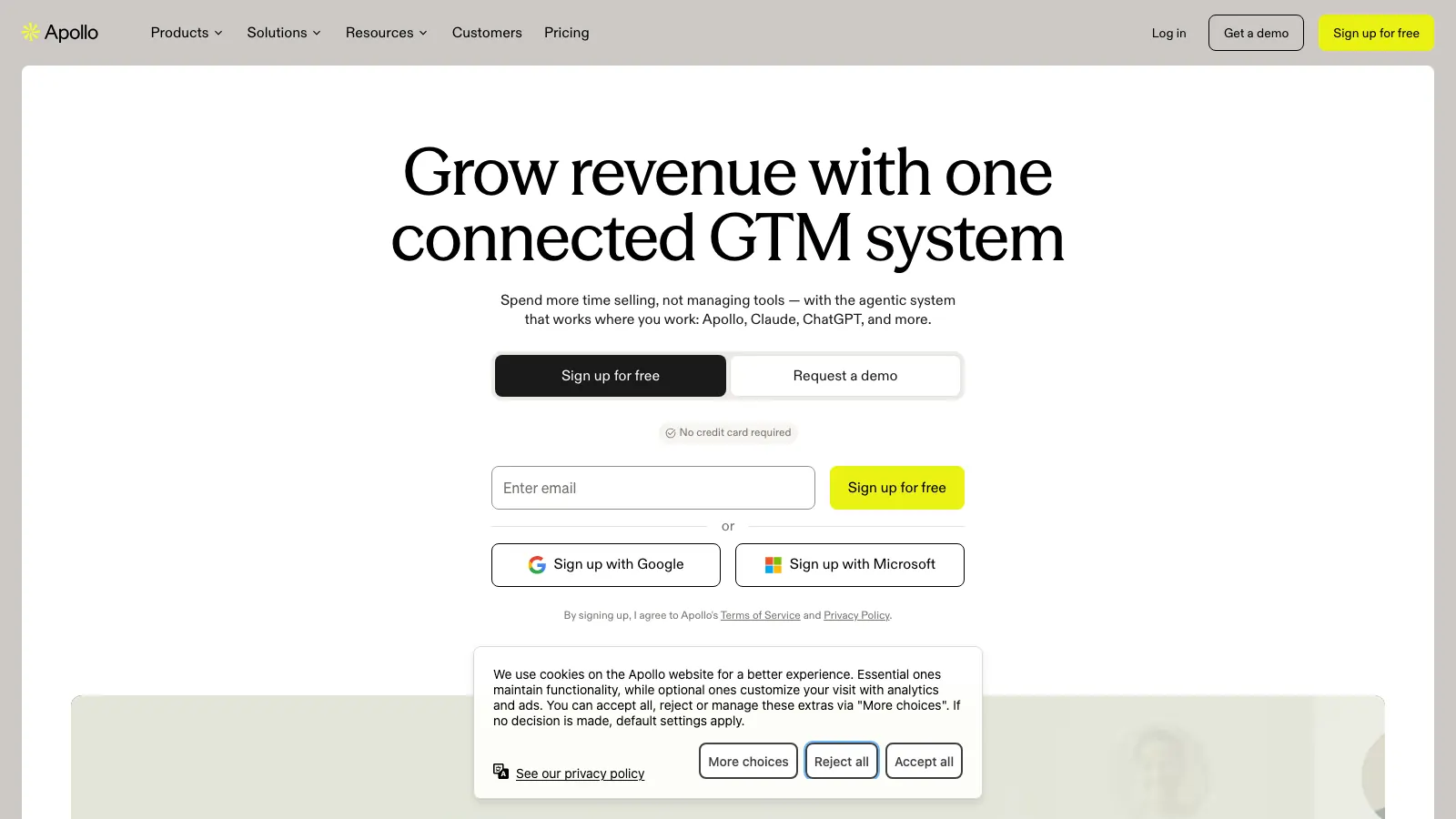
Apollo.io wins on stack consolidation across a sales intelligence platform used by over 600,000 companies. Reps search 240M+ contacts and 30M+ accounts across 65+ filters, rank leads with AI scoring, and execute email, phone, and LinkedIn steps from one view. Free includes 900 annual credits and two sequences, while Basic ($49/seat/mo annually or $65/seat/mo monthly) unlocks 30,000 annual credits per seat, unlimited sequences, CRM sync, email warmup, waterfall enrichment, and US dialing. Professional ($79/seat/mo annually or $99/seat/mo monthly) adds automated workflows, 26-variant A/Z testing, and 4,000 call recording minutes.
Apollo.io carries important coverage and billing trade-offs as outbound teams scale. Contact accuracy drops noticeably outside North America and for VP-level enterprise contacts, where Clay's 150+ provider waterfall and Claygent research outperform single-platform databases. List exports, enrichments, and calls draw from the same credit pool, and heavy calling requires the $119/team/month Advanced Dialer for parallel dialing, voicemail drop, and international calls. Organization ($119/seat/mo annually or $149/seat/mo monthly) enforces a 3-seat minimum for SSO and custom reports, AI Assistant on Basic and Professional is introductory free, and lower-tier support can feel slow.
| Plan | Price | Included limits & seats |
|---|---|---|
| Free | $0/mo | 900 credits/seat/yr, 2 sequences, 5 AI chats, 1 seat min |
| Basic | $49/seat/mo annual ($65 monthly) | 30,000 credits/seat/yr, unlimited sequences, CRM sync, waterfall, warmup |
| Professional | $79/seat/mo annual ($99 monthly) | 48,000 credits/seat/yr, A/Z testing, workflows, 4,000 call mins |
| Organization | $119/seat/mo annual ($149 monthly) | 72,000 credits/seat/yr, 8,000 call mins, custom reports, SSO, 3-seat min |
Apollo.io plans and limits, 27 Nov 2026.Apollo.io pricing
SDR pods, founders, and account executives wanting searchable B2B contacts, multichannel sequencing, and phone dialing inside one per-seat platform.
How does team pricing scale across Clay and Apollo.io?
Clay and Apollo.io scale on opposite axes as revenue headcount increases. Apollo.io starts far cheaper for one or two reps because Basic costs $49/seat/mo annually ($65/seat/mo monthly) and already includes CRM integrations, unlimited sequences, and 30,000 annual credits per seat. By contrast, Clay charges $185/mo on Launch for 15,000+ monthly actions and holds CRM sync, Salesforce integration, and ad audience syncing until Growth at $495/mo. Once five to ten collaborators share lists, however, Clay's unlimited-seat workspace model avoids per-rep license multiplication.
| Team or workload scenario | Clay | Apollo.io |
|---|---|---|
| Solo founder or 1 SDR | $185/mo on Launch (unlimited seats, 15,000+ actions/mo, no CRM sync) | $49/mo annual ($65/mo monthly) for 1 Basic seat with CRM sync |
| 3-person outbound or agency team | $495/mo on Growth (unlimited seats, 40,000+ actions/mo, CRM and ad sync) | $237/mo annual ($297/mo monthly) for 3 Professional seats |
| 10-seat enterprise governance rollout | Custom Enterprise quote (unlimited seats, custom credits, dedicated support) | $1,190/mo annual ($1,490/mo monthly) for 10 Organization seats (SSO, custom reports) |
Credit math matters as much as base subscription fees in Clay and Apollo.io. Clay lets workspaces plug in their own vendor API keys on every plan to preserve internal Data Credits when running high-volume enrichments, whereas native waterfall runs typically consume 6 to 20 Data Credits per fully enriched record. Apollo.io grants generous annual pools (30,000 to 72,000 credits per paid seat), yet exporting lists, revealing phones, and dialing draw from that single balance, and Organization's 3-seat floor sets a $357/mo annual minimum.
How do daily prospecting workflows differ in Clay vs Apollo.io?
Clay and Apollo.io center daily work on two distinct surfaces: a programmable enrichment table versus a unified rep workspace. In Clay, an operator defines an outbound play, uses Sculptor or formulas to chain 150+ providers and Claygent prompts, tracks job-change or funding Signals, and pushes enriched records to sequences, ad networks, or CRM. In Apollo.io, individual reps filter contacts, check AI lead scores, send multichannel touches, and dial prospects from one sales view.
- Clay chains 150+ providers with Claygent web research on all tiers, while Apollo.io unlocks waterfall enrichment on Basic alongside its 240M+ database.
- Apollo.io combines email warmup, LinkedIn steps, US dialing, and 26-variant A/Z testing, whereas Clay provides native email sequencing without voice calling.
- Clay Growth syncs audiences to LinkedIn, Meta, and Google ads, while Apollo.io adds website visitor identification, form enrichment, and automated lead routing.
- Clay Sculptor generates table logic from plain-text prompts, whereas Apollo.io pairs prompt-based campaign setup with 4,000 to 8,000 call recording minutes.
Operational ownership ultimately separates Clay and Apollo.io in daily practice. If a revenue operations lead designs centralized outbound systems so reps only touch pre-qualified, deeply researched accounts, Clay eliminates data bottlenecks and international or niche coverage blind spots. If individual SDRs and account executives self-source leads via the Chrome extension, cold-call US numbers, review recorded call objections, and manage multichannel follow-up tasks every afternoon, Apollo.io delivers a faster, cleaner daily sales loop without requiring dedicated table engineering.
How do Clay and Apollo.io support APIs, integrations, and MCP agents?
Clay and Apollo.io include REST APIs on every plan, including Free, without extra developer interface fees. Clay authenticates with the clay-api-key header and deducts standard workspace credits and actions, sharing 30-day search caps from 100 results on Free to 1,000,000 on paid self-serve tiers and 10,000,000 on Enterprise. Apollo.io supports API keys and OAuth 2.0, charging zero credits for record management, 1 credit per 100-result company search page, and 1 to 9 credits for standard people enrichment under 600 to 6,000 daily team requests.
Agent client compatibility and native CRM gates separate the two developer stories. Clay and Apollo.io provide official hosted MCP servers with zero connection surcharges, drawing from existing plan credits, actions, and endpoint rate limits. Apollo.io lists six supported MCP clients (Claude, Claude Code, ChatGPT, Gemini, Cursor, and VS Code), whereas Clay lists ChatGPT for hosted MCP access. On automation integrations, each platform connects with Zapier, though Apollo.io unlocks CRM sync at $49/seat/mo annually on Basic while Clay gates CRM and Salesforce sync behind Growth ($495/mo).
Developer guides: Clay API and MCP · Apollo.io API and MCP
How should your revenue team choose between Clay and Apollo.io?
Clay and Apollo.io solve different stages of outbound pipeline generation, so buyers should match the platform to their primary constraint. Pick the tool that removes today's bottleneck, whether that is incomplete multi-source account intelligence or rep-level prospecting, dialing, and sequence throughput.
- Chaining 150+ providers and Claygent AI research for international or niche signalsClay
- Equipping 1 to 3 reps with 240M+ contacts, CRM sync, and sequences under $300/moApollo.io
- Giving marketing, RevOps, and agency collaborators unlimited seats plus LinkedIn, Meta, and Google ad syncClay
- Running US cold calls, 26-variant A/Z testing, and recorded call coaching in one seatApollo.io
- Connecting prospecting data to Claude, Claude Code, Cursor, Gemini, and VS Code via hosted MCPApollo.io
Budget structure and technical appetite break any remaining tie between Clay and Apollo.io. Founders or small SDR teams without a dedicated RevOps builder get faster pipeline per dollar on Apollo.io Basic or Professional because prospecting, email warmup, dialing, and CRM sync work immediately. Conversely, teams hitting coverage gaps outside North America, researching custom triggers at scale, or collaborating across ten-plus users without per-seat fees gain stronger leverage on Clay Launch or Growth, particularly when connecting existing vendor API keys.
What is the bottom line on Clay vs Apollo.io?
Clay and Apollo.io reflect two distinct outbound models: Clay serves as an extensible data layer with unlimited seats and 150+ enrichment providers, while Apollo.io delivers per-seat prospecting, sequencing, and calling. Before committing to a paid plan, settle credit consumption, dialer add-ons, and tier gates against your monthly outbound volume. If neither fits, our guide to outbound automation tools for sales marketers ranks 7 verified options for the same job. Before you sign up, settle these questions with the vendor:
- Clay: How many Data Credits and actions will our waterfall and Claygent runs consume per 1,000 target accounts?
- Clay: Do we need the $495/mo Growth plan immediately for CRM sync, or will Bring Your Own API Key stretch Launch?
- Apollo.io: What is the verified match rate for our target region and seniority, particularly outside North America or at VP level?
- Apollo.io: Will exports, enrichments, and calling fit Basic or Professional credits without adding the $119/team/month Advanced Dialer?
How does OfferNCodes compare Clay and Apollo.io?
Clay and Apollo.io plan prices, operational limits, seat rules, and developer endpoints were verified directly from official vendor pricing, product, and API documentation. Where public pages omit an add-on or custom-tier rate, we state that gap plainly rather than estimating. Every figure follows our rules in how we check figures. Last checked .
What do buyers ask most about Clay vs Apollo.io?
Is Clay or Apollo.io cheaper for a small outbound sales team?
Apollo.io is cheaper at entry for one to three reps: Basic costs $49/seat/mo annually ($65/seat/mo monthly) with CRM sync and unlimited sequences, whereas Clay starts paid plans at $185/mo on Launch and gates CRM sync until Growth at $495/mo. Across larger teams, Clay's unlimited seats can undercut per-seat Apollo.io renewals.
Does Clay replace Apollo.io for multichannel sequences and cold calling?
Clay includes a native email sequencer on every plan and syncs audiences to LinkedIn, Meta, Google, and CRM on Growth ($495/mo) and Enterprise, yet Clay lacks a phone dialer and call recording suite. Teams needing US or international calling, LinkedIn task steps, email warmup, and A/Z testing still need Apollo.io.
How do free plans compare between Clay and Apollo.io?
Clay and Apollo.io offer permanent $0/mo Free tiers with strict production limits. Clay Free provides unlimited seats, 500 monthly actions, 1,200 annual data credits, Claygent, and waterfall enrichment, capped at 200 rows per table without CRM sync. Apollo.io Free gives one seat 900 annual credits, two sequences, Chrome prospecting, and five AI Assistant chats.
Which platform has broader MCP and API support, Clay or Apollo.io?
Clay and Apollo.io offer REST APIs and official hosted MCP servers without interface surcharges, billing calls against standard plan credits, actions, and endpoint rate limits. Apollo.io supports six MCP clients (Claude, Claude Code, ChatGPT, Gemini, Cursor, and VS Code) plus OAuth 2.0 auth, whereas Clay lists ChatGPT alongside API-key and CLI access.
 Reviewed byDanny Kirk
Founder of ReddiReach.
 Checked byAndrés Felipe
Digital designer and marketer.
Every figure is checked against the vendor's own page. Read our editorial standards.