
Key Takeaways
- Dashword provides editorial teams with an integrated search optimization platform that combines automated content brief generation, real-time grading, and continuous article performance monitoring.
- Dashword offers a Startup subscription at $99 monthly for five team seats and thirty content reports, while the Business tier starts at $349 monthly.
- Dashword provides comprehensive programmatic and artificial intelligence access by including a REST API and remote Model Context Protocol server across all plans, including verified free tiers.
- Dashword is not recommended for publishing teams whose monthly output substantially exceeds thirty briefs if their budget cannot support the $349 Business subscription.
Dashword is the pick for a content team that needs a practical monthly allowance of briefs, an editor that keeps the terms in view, and agent access without an enterprise upgrade. Its $99 Startup plan suits a five-person team producing up to 30 new reports a month. Skip it if your content operation needs more than 30 reports, because Business starts at $349 a month.
Agent access
- API
- Yes, every plan, including free accounts, with a verified email address
- MCP server
- Official, hosted, API key in a Bearer Authorization header
- Works with
 ClaudeClaude Code
 Cursor
What are the pros and cons of Dashword?
What works
- 30 reports a month and five seats for $99
- API and MCP access on every plan
- Free, unlimited draft scoring
What to watch
- Business lists bulk report creation and SSO
- Report credits, not seats, set the monthly pace
- Agent access needs a verified email and API key
What does Dashword do for your content team?
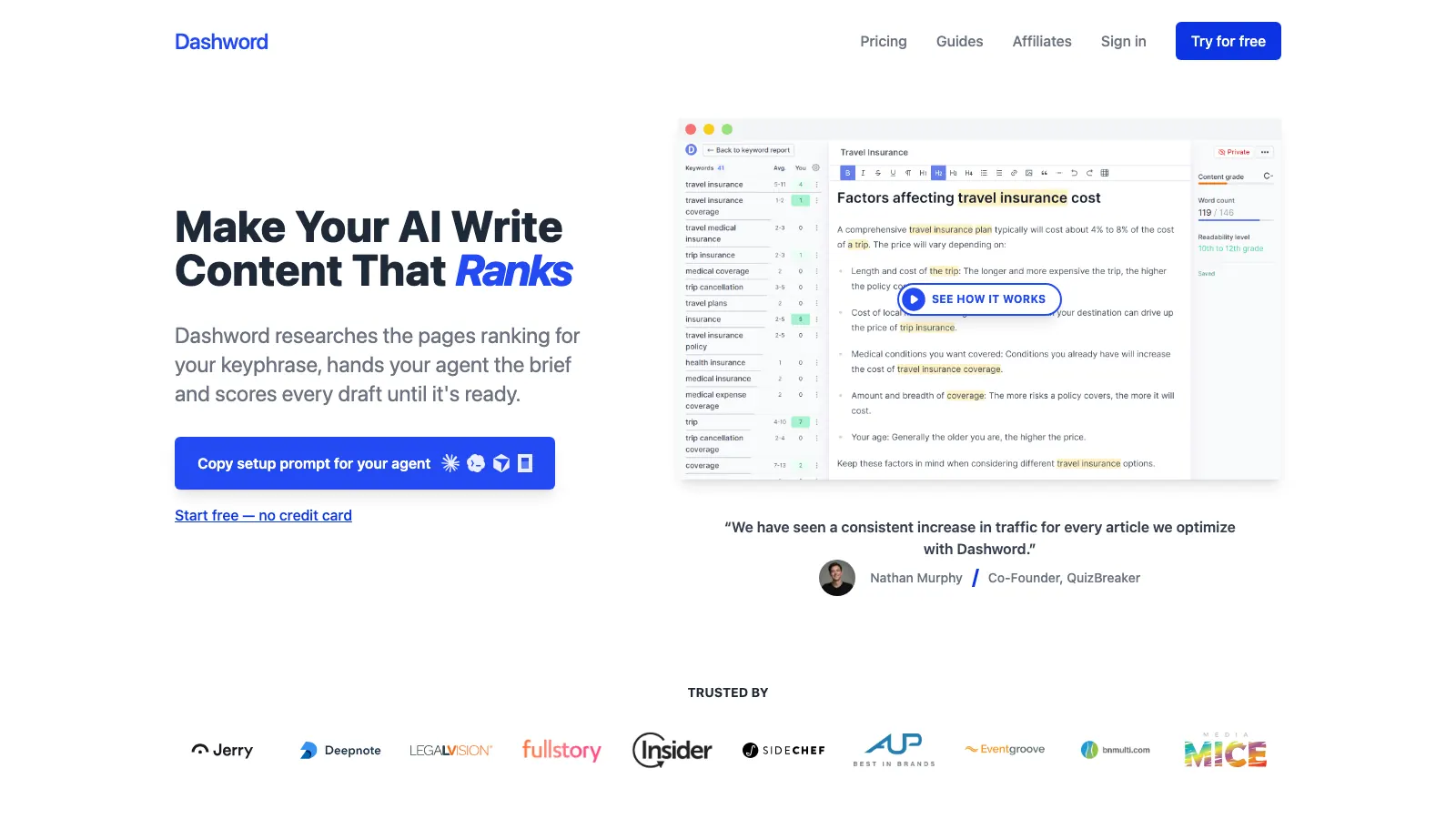
Dashword puts the content brief and the editing check in one loop. A report examines pages ranking for a keyphrase, then returns terms, questions, target length and the competing pages. The editor shows the terms and recommended use alongside your draft, while its score, word count and readability update as the draft changes. If the job is measuring how AI answers recommend a brand instead, the  AI Peekaboo review is the more relevant comparison.
That is a useful shape for a team that has already chosen its topics and needs to turn them into consistent briefs. You are not buying a sprawling SEO suite. You are buying a repeatable handoff from keyword to writer to final coverage check, plus monitoring for published content.
The practical limit is reports. Startup includes 30 each month and Business includes 100. Scoring does not consume credits, so the team can iterate on a draft without worrying about a meter. That makes Dashword a better fit for a disciplined editorial calendar than for an agency that creates a fresh research report for every small client change.
Who is Dashword designed for?
Small content teams
Turn recurring search topics into 30 structured briefs each month without manual term collection.
Editorial leads
Give writers one shared brief, then use coverage, length and readability feedback during drafting.
Agent-enabled writers
Create reports and score drafts through the API or MCP server from supported clients.
Growing agencies
Business lists 100 reports, bulk report creation and SSO for larger content programs.
It is less compelling for a one-off article or a team whose work starts with technical audits, backlink research, or broad competitive intelligence. Dashword's strongest promise is not more dashboards. It is making one kind of editorial decision, what the draft needs to cover, easier to repeat.
Which features does Dashword include?
Reports that turn a keyphrase into a brief
Create a report for a keyphrase and country, and Dashword analyzes the current ranking pages. A completed report can return competing URLs, up to 50 terms with suggested occurrence ranges, up to 20 questions, and a target word count. That is enough to establish a working brief without asking the writer to reconstruct the search results by hand.
An editor that exposes coverage gaps
Inside the editor, terms are ranked by importance; used terms are grayed out in the sidebar and highlighted in the draft. Dashword also shows the content score, word count and readability as you write. Writers can hide used keywords to focus on remaining gaps, and mute terms they judge irrelevant so those terms no longer affect the content score. I would use the score as a prompt for editorial review, not as permission to publish a weak argument.
Content monitoring after publication
Dashword says it monitors published content and notifies teams when an update is needed. Its monitoring section also lists traffic trend alerts, weekly keyword report generation, a rank tracker, and a crawler that can add pages automatically. That gives the content lead somewhere to return after the draft leaves the editor, rather than treating optimization as a one-time event.
API and MCP for an agent workflow
Dashword's API creates and retrieves reports, lists earlier reports and scores content. The remote MCP server makes the same loop available to an MCP client: create the report, retrieve the terms and questions, then score a draft repeatedly. The service says report creation uses one credit, while retrieving reports and scoring are free. The remote connection requires a verified account, an API key, and a client that supports a custom Authorization header.
How is Dashword pricing structured?
Price checked 27 Nov 2026
| Plan detail | Startup$99/mo | BusinessFrom $349/mo |
|---|---|---|
| Content reports | 30 monthly | 100 monthly |
| Content to optimize | About 30 pieces | About 100 pieces |
| User seats | 5 | 10 |
| Content briefs | ✓ | ✓ |
| API and MCP server | ✓ | ✓ |
| Free content scoring | Unlimited | Unlimited |
| Bulk report creation | Not listed | ✓ |
| Single Sign-On | Not listed | ✓ |
Dashword plans, 27 Nov 2026.Dashword pricing
For a five-person team, Startup is $99 a month for 30 reports, with all five seats already included. When the calendar needs more than 30 reports, Business is published from $349 a month for 100 reports and 10 seats. Dashword also lists a 20% discount for annual billing.
There is also a first report free, with no credit card required. Free accounts with a verified email can use the API and MCP server, but report credits remain the important capacity question. Confirm the credit allowance before treating the free account as a production plan.
Where does Dashword fall short for teams?
Dashword imposes a steep price increase between its Startup and Business tiers. Startup is $99 a month, while Business begins at $349 and lists 100 reports, 10 seats, bulk report creation and SSO. A team that needs 31 reports is not necessarily a Business team, so check whether the practical workload can be consolidated before assuming the larger plan is sensible.
The product is also focused on editorial SEO, not every marketing decision around it. The report tells you what pages rank, what terms appear important, what questions may matter and how a draft covers that brief. It does not replace a team's judgment about search intent, original reporting, brand voice or whether the resulting page deserves to exist.
Finally, its agent access is unusually open, but it is not anonymous access. You need a verified account and API key, and the MCP client must support the remote server's authorization header. That is straightforward for supported clients, but it is still configuration work that needs an owner.
Which Dashword alternatives should you consider?
AI Peekaboo review is the better next step when the question is whether AI systems recommend your brand. It starts at $30 a month, checked 27 Nov 2026, and includes API and MCP access, while Dashword is built around research briefs and draft coverage.
 Rankability review is worth reading if agency reporting and content briefs need to live together. Its Starter plan is $97 a month, checked 27 Nov 2026, and Rankability supports agency-branded reports alongside API and MCP access.
 Topic review starts from a focus keyword and uses the top 30 Google results to suggest headings, questions and keywords for a post. Browse the marketing tools directory when the work calls for a broader category comparison than these three tools.
What is the final verdict on Dashword?
Dashword Startup offers thirty reports, five seats and unlimited scoring, making it a well-contained choice for an editorial team with a predictable calendar. The brief-to-score loop gives that team enough structure to plan the work, brief it and improve drafts without adding a separate bill for machine access. The open API and MCP policy is especially welcome: agents can participate before the team has paid for Business.
The decision changes when reports become abundant. Business may be sensible for a 100-report operation, but its price means you should know your actual report count before upgrading. Dashword is strongest when you can use nearly all of the brief-to-score loop, not when you only need an occasional content grade.
Start with the free report on a topic already in your calendar. If the team can turn the resulting brief into a better draft and stay within 30 reports a month, Startup is a clear, contained purchase.
How was Dashword evaluated for this review?
Dashword pricing, product, optimization, API and MCP pages were checked directly on 27 Nov 2026. Prices use the dollar symbol Dashword displays, and every figure follows how we check figures.
- Dashword pricing for plans, report limits, seats and annual billing
- Dashword product and optimization pages for briefs, editor feedback and monitoring
- Dashword API and MCP documentation for machine access and report credits
What are common questions about Dashword?
How much does Dashword cost?
Startup costs $99 a month for 30 content reports and five seats. Business starts at $349 a month for 100 reports and 10 seats.
Does Dashword have a free trial?
Dashword offers a first report free with no credit card required. It also says free accounts with a verified email can use the API and MCP server.
Can an AI agent use Dashword?
Yes. Dashword has a REST API and remote MCP server on every plan. An agent can create a report, retrieve its brief, then score a draft against it.
What uses a Dashword report credit?
Creating a completed report uses one credit. Retrieving reports and scoring content are free, and scoring is unlimited.
 Reviewed byDanny Kirk
Founder of ReddiReach.
 Checked byAndrés Felipe
Digital designer and marketer.
Every figure is checked against the vendor's own page. Read our editorial standards.