
Key Takeaways
- DeBounce provides non-expiring prepaid verification balances for marketing teams that validate email lists periodically or during form capture.
- DeBounce sells entry-level packages starting at fifteen dollars for five thousand credits and one hundred thirty-five dollars for one hundred thousand credits.
- DeBounce delivers scaled bulk packages priced at four hundred fifty dollars for half a million credits and seven hundred fifty dollars for one million credits.
- DeBounce offers a standard JSON-over-HTTPS programmatic interface supporting up to five concurrent validation calls by default on basic accounts.
When list cleaning is an occasional job, a subscription can feel like another bill with no clear place in the workflow. DeBounce is the better fit when you want non-expiring credits for bulk cleaning or sign-up validation; skip it if catch-all checks, continuous monitoring or higher API concurrency will make credit usage hard to forecast.
Agent access
- API
- Yes, all packages, with API included
- MCP server
- Official, hosted, None
- Automation
- Zapier
What are the major DeBounce pros and cons?
What works
- 100 free credits, with no credit card required
- Credits never expire, with no monthly payments or overages
- API access and all listed features use the same credit balance
What to watch
- Catch-all validation uses 10 credits per address
- List monitoring costs twice the list size each month
- Default API concurrency stops at five validation calls
What does DeBounce do for your email deliverability?
DeBounce helps prevent invalid email addresses from creating bounce penalties and damaging sender reputation. They cloud list hygiene, put extra work into a CRM and leave a team guessing whether a failed campaign began with the copy or the contacts. DeBounce gives you a practical place to check a file before sending and to reject poor addresses as they enter a form. It belongs in the marketing tools directory as an email-validation utility, not as a replacement for the sender or the authentication layer behind your campaigns.
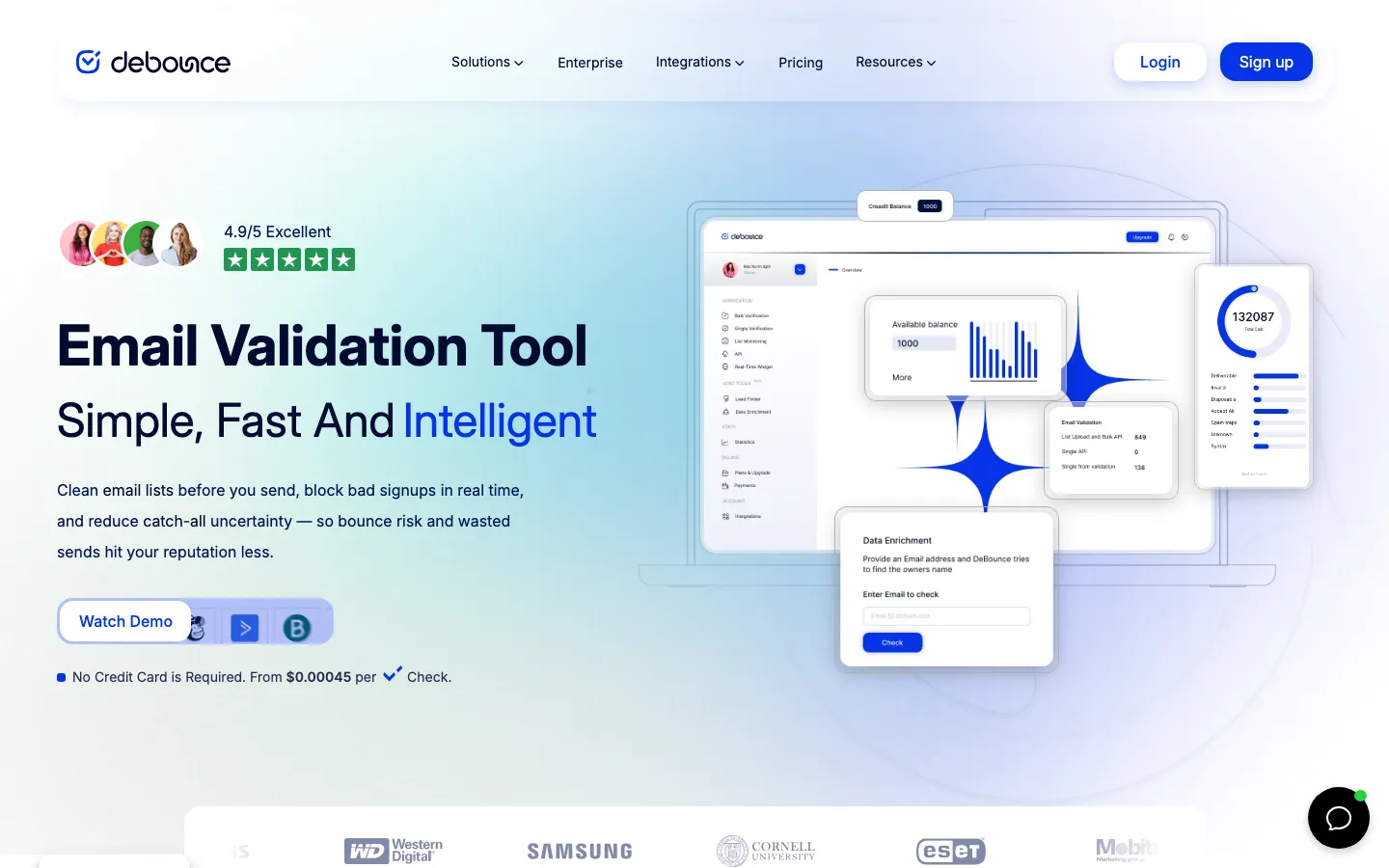
The product has two useful modes. A bulk workflow accepts a CSV or TXT upload, and the vendor also says you can connect an email service provider. A real-time workflow checks an address during sign-up, checkout, registration or lead capture. The API can also submit a large list for asynchronous processing and use a webhook when the job finishes. That split is sensible: clean old contacts in batches, then keep the next batch of bad data from entering.
The commercial model is its best feature. DeBounce sells prepaid credits, gives every package access to the full feature set, and says credits never expire. The trade-off is that one credit is not always one task, so a team must budget by the validation type it actually uses.
Who benefits most from using DeBounce?
Newsletter teams
Clean an older list before a campaign, then keep unused prepaid credits for the next send.
Product teams
Validate addresses at registration or checkout through the API or the real-time form widget.
CRM operators
Process imported contacts in bulk and retrieve cleaned results automatically after the job finishes.
High-volume senders
Buy larger credit packs when volume is steady enough to benefit from the lower per-credit rate.
It is less comfortable for a team that needs a fixed monthly bill. List monitoring is priced at twice the monitored list size per month, catch-all validation is 10 credits per validation, and enrichment costs 20 credits for each successful detection. Those rules are clear, but they mean the headline credit price is only part of the budget.
What email verification features does DeBounce provide?
Bulk cleaning and list monitoring
Start with a CSV or TXT file, or connect an email service provider. DeBounce says it removes duplicates, invalid emails, bounces and spam traps, and its free deduplication means repeated addresses do not consume paid credits. Its list-monitoring option validates a list every day and synchronizes it with the email sender. That is useful when contacts decay between campaigns, though the recurring monitoring charge deserves a separate line in your budget.
Catch-all, disposable and syntax checks
Catch-all domains accept mail for any local part, so they require a sending policy rather than blind acceptance. DeBounce identifies those domains, detects disposable providers and flags invalid syntax before deeper checks run. Its anti-greylisting process retries mailbox checks after a temporary deferral, which is meant to reduce inconclusive results. Treat those signals as workflow inputs, especially for a cold-email list, rather than a promise that every address is safe to send.
API for real-time and bulk validation
The API serves real-time validation and asynchronous bulk jobs from the same infrastructure. It returns results over standard HTTPS and JSON, and DeBounce provides examples for Shell, Node.js, Ruby, PHP and Python. Webhooks notify your application once a validation job is complete, so it need not continuously poll for a result. The default limit is five concurrent validation calls; enterprise usage can request a higher limit. That is enough for many form flows, but it is a genuine planning limit for a high-throughput importer.
Form widget
The real-time validation widget checks website forms as a person types. DeBounce says it checks whether an address is valid, deliverable and free of typos before submission. The widget is the simpler option when the need is a browser form rather than a custom integration, while the API gives a developer more control over the surrounding workflow.
Integrations and enrichment
DeBounce lists dashboard, JavaScript and  Zapier connection types, along with a WordPress plugin and a Google Sheets email-validation option. It also offers a lead finder and data enrichment. Enrichment uses 20 credits per successful detection, so it should be treated as an optional data-quality step rather than bundled into the cost of basic list cleaning.
How much do DeBounce verification credits cost?
Price checked 27 Nov 2026
| Pack detail | 5,000 credits$15 | 100,000 credits$135 | 500,000 credits$450 | 1 million credits$750 |
|---|---|---|---|---|
| Cost per credit, rounded | $0.0030 | $0.0014 | $0.0009 | $0.0008 |
| Credits expire | ✕ | ✕ | ✕ | ✕ |
| API included | ✓ | ✓ | ✓ | ✓ |
| Free deduplication | ✓ | ✓ | ✓ | ✓ |
DeBounce pay-as-you-go prices in US dollars, 27 Nov 2026.DeBounce pricing
The smallest pay-as-you-go pack costs $15 for 5,000 credits. A team cleaning 100,000 standard email addresses would buy the $135 pack, at approximately $0.0014 per credit. That is the real one-time bill for that job before any catch-all checks, enrichment or monitoring. The vendor says prices include taxes and fees, has no upfront fee or overages, and adds 100 free credits at sign-up without requiring a card.
- Basic email validation uses 1 credit per validation
- Catch-all validation uses 10 credits per validation
- Data enrichment uses 20 credits per successful detection
- List monitoring uses 2 times the list size per month
What options exist for DeBounce Enterprise customers?
Enterprise usage can receive higher API concurrency than the default five simultaneous validation calls. Ask for the concurrency limit, credit price and any minimum commitment in writing before you design a high-volume workflow around it.
Where does DeBounce fall short for high-volume users?
DeBounce features a simple credit pricing structure that can become harder to predict when factoring in catch-all verification and list enrichment. A standard validation takes one credit, while catch-all validation takes 10 and enrichment takes 20 per successful detection. If a list contains many catch-all domains or your team enriches every prospect, the amount of work per purchased credit changes sharply. Estimate the mix before you choose a pack.
Monitoring deserves the same attention. It is not included as an unlimited service: it is priced at twice the list size each month. That can be reasonable for a list that changes often, but a periodic bulk clean may be the better fit for a smaller or slow-moving database.
Finally, the API is accessible rather than automatically enterprise-scale. Five concurrent validation calls is the documented default. For an application with a large import queue or a busy registration service, confirm the enterprise limit first and make sure the surrounding system can handle asynchronous results and webhook delivery.
What are the primary DeBounce alternatives?
DeBounce solves list quality before you send. If your immediate issue is domain authentication and policy reporting instead, compare it with  dmarcian review, whose Domain Overview summarizes authentication status across domains and email sources. The right choice depends on whether the risk is bad recipient data or an unauthenticated sending domain.
For another domain-authentication route, see the  EasyDMARC review. It puts DMARC XML reports into a simplified dashboard and offers Managed DMARC, rather than contact validation.
What is the definitive DeBounce verdict?
DeBounce delivers a simple, cost-effective prepaid validation mechanism for teams handling periodic list cleaning. The credit model, free deduplication and included API make the basic decision easy. The caution is equally simple: price your actual workload, not just the pack, because catch-all checks, enrichment and monitoring draw down credits differently.
Use the 100 free credits on a representative sample, calculate the share that needs catch-all checks or enrichment, then buy the credit pack that covers that mix. Keep monitoring separate from the first bulk-cleaning decision.
How was DeBounce researched and evaluated?
DeBounce specifications, validation rates, API concurrency rules, and credit packages were confirmed directly via vendor documentation on 27 Nov 2026. Prices are in US dollars, as DeBounce shows them, and every figure follows the rules in how we check figures.
- DeBounce product and pricing pages
- DeBounce email-validation API page
- DeBounce integrations page
What are common questions about DeBounce?
Does DeBounce have a free trial?
Sign-up includes 100 free credits and does not require a credit card. The vendor says those credits can be used to test list cleaning and API capabilities.
How much does DeBounce cost?
Pay-as-you-go packs cost $15 for 5,000 credits, $135 for 100,000, $450 for 500,000 and $750 for 1 million. Credits never expire.
How are DeBounce credits used?
Standard email validation uses 1 credit. Catch-all validation uses 10 credits per validation, data enrichment uses 20 per successful detection, and list monitoring is charged at twice the list size per month.
Can an agent use DeBounce?
DeBounce has a documented HTTPS and JSON API for real-time and bulk validation, with examples in several programming languages. The documented default is five concurrent validation calls.
 Reviewed byDanny Kirk
Founder of ReddiReach.
 Checked byAndrés Felipe
Digital designer and marketer.
Every figure is checked against the vendor's own page. Read our editorial standards.