
Key Takeaways
- Encharge automates behavioral email sequences for software companies by reacting dynamically to user onboarding, in-app usage thresholds, and billing updates.
- Encharge Growth costs $99 monthly for 2,000 subscribers or $79 when billed yearly, while advanced event-driven automation requires the $159 Premium tier.
- Encharge provides a REST API on standard plans but gates programmatic API Events and real-time event-based segmenting behind its higher-tier Premium licenses.
- Encharge prohibits outbound cold email campaigns and proves unaffordable for early bootstrappers requiring complex product event triggers on tight software budgets.
If you need lifecycle email to react to product behavior, Encharge is a strong fit for your SaaS team, and Growth at $99 a month is the sensible starting point for up to 2,000 subscribers. Choose Premium when API Events or event-based segments are essential, at $159 a month or $129 a month billed yearly. Use another platform for cold sales outreach, which Encharge does not allow.
Agent access
- API
- Yes, REST API: Growth, Premium, and Enterprise. Ingest API: not available on Growth.
- MCP server
- Not found on official pages
- Automation
- Zapier
What are the core pros and cons of using Encharge?
What works
- Behavior-based flows connect product activity to lifecycle email
- Growth includes unlimited flows and unlimited team members
- Growth includes billing integrations and webhooks
What to watch
- No permanent free tier, only a 14-day trial
- API Events and event-based segments require Premium
- Enterprise pricing is available only on request
How does Encharge automate behavior-driven lifecycle messaging?
Encharge is built for the moment a SaaS customer does something that should change the next message: starts a trial, reaches a usage threshold, upgrades, or stops using a feature. That is a more focused job than a general email platform. If you are building a stack from scratch, the marketing tools directory is useful context, but Encharge earns its place when product behavior needs to shape the customer journey.
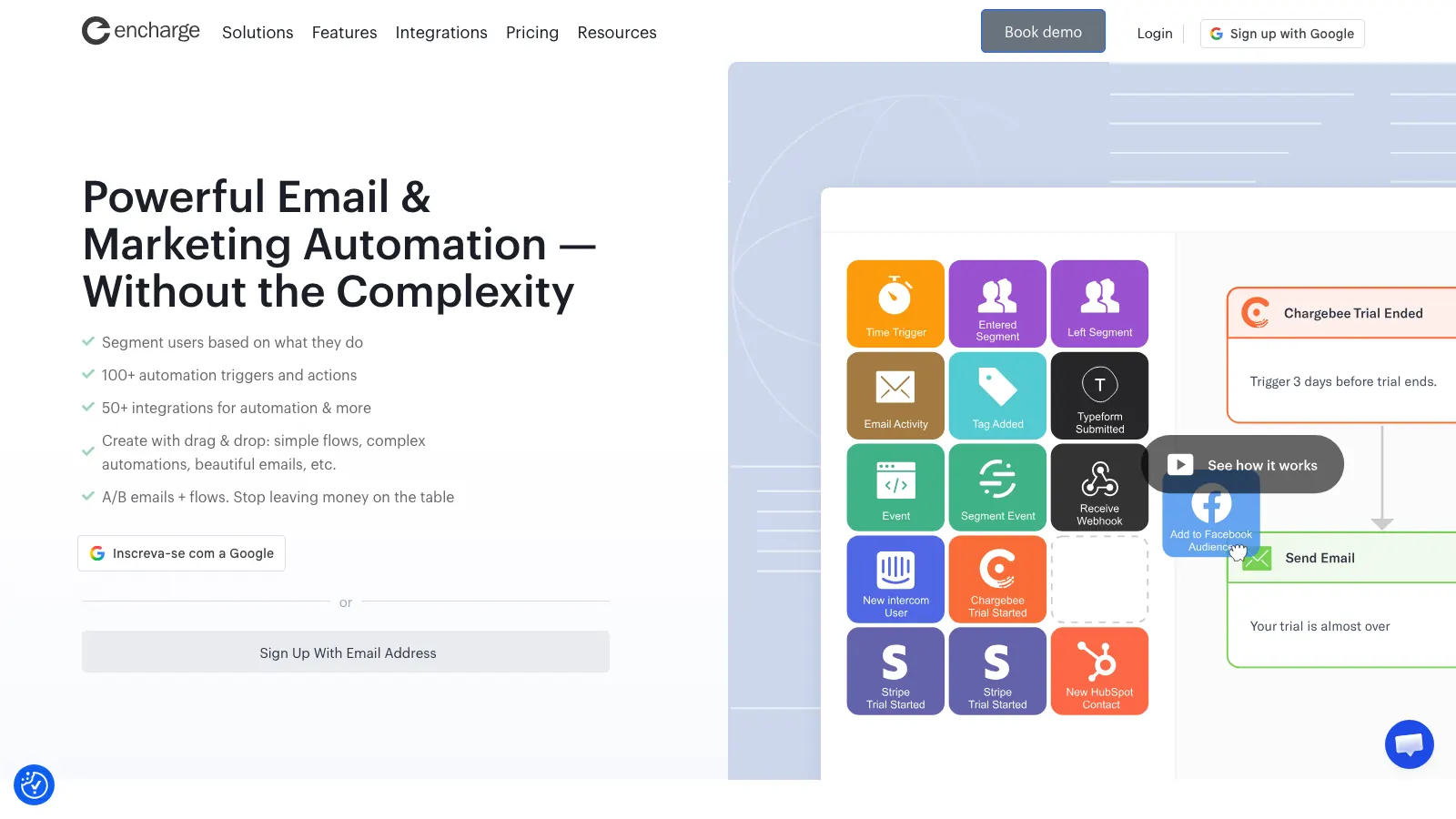
The practical center of the product is a visual flow builder. You connect triggers, filters, delays, email sends and webhooks to map the path. Its behavior email and segmentation features can use website visits, product behavior, email activity and data passed from other apps. That gives a lifecycle marketer a way to separate a new trial user from a paying customer who has gone quiet, instead of sending both the same campaign.
The line between Growth and Premium matters more than the plan names. Growth gives you the core flow builder, advanced segmentation, behavior-based emails, webhooks and billing integrations. Premium adds API Events, event-based segmentation, custom objects, transactional email and several CRM and commerce integrations. Choose Growth when the information you need already arrives through the included connections. Choose Premium when you need API Events or event-based segments, rather than all product behavior.
Who should adopt Encharge for SaaS customer marketing?
SaaS lifecycle teams
You can tie onboarding emails to activity in your product, keeping each lifecycle message relevant as customer needs change.
Lean growth teams
You can run unlimited flows with unlimited teammates, letting marketers, product staff and sales colleagues shape a shared customer journey.
Subscription businesses
Included billing data lets you send customer, upgrade and cancellation emails, removing manual steps when a routine subscription change occurs.
Premium data stacks
Premium fits teams that need API Events, event-based segments, custom objects or supported CRM and commerce connections for their data.
I would not make Encharge the first choice for a business that only sends occasional newsletters or runs an outbound sales sequence. Its value comes from reacting to a customer's changing relationship with a product. Without that product or billing context, the extra automation structure is harder to justify.
Which automation and segmenting capabilities does Encharge provide?
Flows that follow behavior
A flow can begin when an event arrives from your product, when a person enters a segment or when a time condition is met. Filters and actions let you branch the journey, and wait steps let the sequence hold until a particular date and time in a user's time zone. For SaaS onboarding, that is the difference between a fixed drip and a message that follows the customer's actions.
Segments, profiles and lead scoring
Encharge can segment people by page visits, product behavior, feature use, email activity and attributes from connected apps. User Profiles collect actions from a website or app in one view, while lead scoring can use product, website and email engagement. These are related tools: segments decide who should hear from you, and the profile gives a marketer the context to make that decision less generic.
Email work beyond broadcasts
Broadcasts support one-off newsletters and A/B testing. The platform also lists personalization with dynamic content and merge tags, a drag-and-drop email editor, native forms and free email verification. Premium adds transactional emails, which Encharge says can be sent from an app through its API. The broad point is that campaign email and lifecycle email can live in the same account, although the advanced product-event layer is not on Growth.
Billing, CRM and product connections
Growth includes billing integrations, a workflow connector and webhooks. Premium adds selected CRM and commerce integrations. Encharge also lists messaging, scheduling, form and advertising connections. I would treat the plan table as the decision-maker, though: a connection on the integrations page is not the same thing as it being included in the plan you intend to buy.
API Events for product teams
Encharge documents a REST API and an Ingest API that can create or update people and submit events from an app backend. Its Event API page describes triggering behavior-based email and in-app messages when people use product features. That is promising for an AI agent or internal workflow that needs to pass structured product activity onward. Premium is the paid starting point for API Events and event-based segmentation: $159 a month, or $129 a month billed yearly.
How much does an Encharge growth subscription cost?
Price checked 27 Nov 2026
| Plan detail | Growth$99/mo | Premium$159/mo | EnterpriseCustom |
|---|---|---|---|
| Billed yearly | $79/mo | $129/mo | Talk to sales |
| Subscribers included | Up to 2,000 | Up to 2,000 | Over 50,000 |
| Monthly email sends | 10x subscriber limit | 12x subscriber limit | Not published; ask sales |
| Unlimited flows and team members | ✓ | ✓ | ✓ |
| API Events and event-based segments | ✕ | ✓ | ✓ |
 HubSpot integration | ✕ | ✓ | ✓ |
Encharge prices in US dollars, 27 Nov 2026.Encharge pricing
A team of three pays the listed plan price, not three separate seat charges, because both published plans include unlimited team members. On monthly billing, that is $99 for Growth or $159 for Premium for the team. Annual billing brings the displayed monthly equivalent to $79 or $129, a 20% saving. Subscriber-volume repricing can still change the bill. Email overages cost $100 for every 100,000 emails sent above the plan allowance, checked 27 Nov 2026.
- Growth includes a 14-day free trial, unlimited flows and live chat support
- Premium adds extra support and selected CRM and commerce integrations
- Enterprise adds a dedicated account manager and free onboarding, with custom pricing
What does Encharge Enterprise offer high-volume email operations?
Encharge Enterprise caters to organizations managing over 50,000 subscribers or requiring custom infrastructure beyond published plans. Encharge lists unlimited team members, live chat support, everything in Premium, a dedicated account manager and free onboarding. It does not publish an Enterprise price, so treat a sales conversation as part of the purchase rather than assuming the $159 Premium rate scales unchanged.
Where does Encharge restrict access to essential automation features?
Encharge imposes its most significant limitation by locking API Events and event-based audience segmentation away from the entry Growth plan. If your developer needs the Ingest API to send events directly into Encharge and drive segments, the entry point is Premium at $159 a month, or $129 a month billed yearly. Growth remains viable when its included billing integrations or webhooks supply the data you need.
There is no permanent free tier. The 14-day trial gives you a short window to model one meaningful journey, but it is not a low-volume plan you can keep for a side project. Enterprise is similarly hard to budget because the price is private.
Encharge also has a deliberately narrow center of gravity. Its messaging and in-app integrations extend beyond email, yet the product is primarily email automation. A team that needs broad channel orchestration should define its channel and data needs before assuming those integrations make Encharge a complete customer-engagement suite.
Which marketing platforms serve as practical Encharge alternatives?
Encharge alternatives help teams whose primary growth bottlenecks sit outside product-led behavioral email sequences.  AI Peekaboo review suits teams tracking how AI answers present a brand: plans from $30 include API and MCP access. It will not replace lifecycle email, but it is the better first purchase when AI visibility, rather than customer journeys, needs attention.
 GetResponse review is worth weighing when unlimited monthly email sends matter, starting at €13.12 a month on an annual plan. If your work is cold outreach,
 Instantly review is the more relevant comparison because its Outreach plans include unlimited email accounts. Neither decision should be made from the plan headline alone: start with the events, channels and data source the workflow actually requires.
What is the final verdict on adopting Encharge?
Encharge is worth choosing when your SaaS team can name the customer actions that should trigger the next email. Growth is a good value for a 2,000-subscriber team using its included billing connections and webhooks. Premium is the honest starting plan when direct API Events, event-based segmentation or supported CRM and commerce integrations are requirements.
Map one onboarding or trial flow before you buy. Start on Growth only if its included integrations can supply the needed behavior. Otherwise budget Premium at $159 a month, or $129 a month billed yearly, then use the 14-day trial to confirm the journey fits your product data.
How was this Encharge platform review evaluated?
Encharge prices, limits and features were checked against Encharge's own pricing, feature, integration and API pages on 27 Nov 2026. Encharge prices are shown in US dollars. Alternative details were checked against each vendor's own pages on 27 Nov 2026, and GetResponse's price is shown in euros. Every figure follows how we check figures.
- Encharge pricing and plan comparison
- Encharge feature and integration pages
- Encharge API and Event API pages
What are the most frequent questions asked about Encharge?
Is Encharge for SaaS companies?
Yes. Encharge positions its marketing automation around B2B SaaS businesses and behavior-based email. Its most relevant workflows are onboarding, trial conversion, subscription changes and lifecycle communication tied to product activity.
Does Encharge have a free plan?
No. Encharge offers a 14-day free trial on paid plans, but it does not publish a permanent free tier.
How much does Encharge cost for a team?
Growth is $99 a month for up to 2,000 subscribers and Premium is $159 a month for the same subscriber limit. Both published plans include unlimited team members, so a three-person team pays the plan price rather than a per-seat total.
Does Encharge support product events?
Yes, Encharge documents an Ingest API for sending events from an app backend. API Events and event-based segmentation are listed on Premium and are not available on Growth.
 Reviewed byDanny Kirk
Founder of ReddiReach.
 Checked byAndrés Felipe
Digital designer and marketer.
Every figure is checked against the vendor's own page. Read our editorial standards.