
Key Takeaways
- Freshdesk helps growing customer support departments organize incoming customer inquiries into tracked tickets with assigned owners, service levels, and knowledge bases.
- Customer service teams can adopt Freshdesk on Growth for nineteen dollars monthly per agent or choose Pro at fifty-five dollars.
- Freshdesk offers REST API integration alongside metered Model Context Protocol actions priced at fifteen dollars per one thousand calls.
- Organizations expecting comprehensive artificial intelligence capabilities bundled within predictable per-agent pricing should evaluate unexpected consumption fees on Freshdesk.
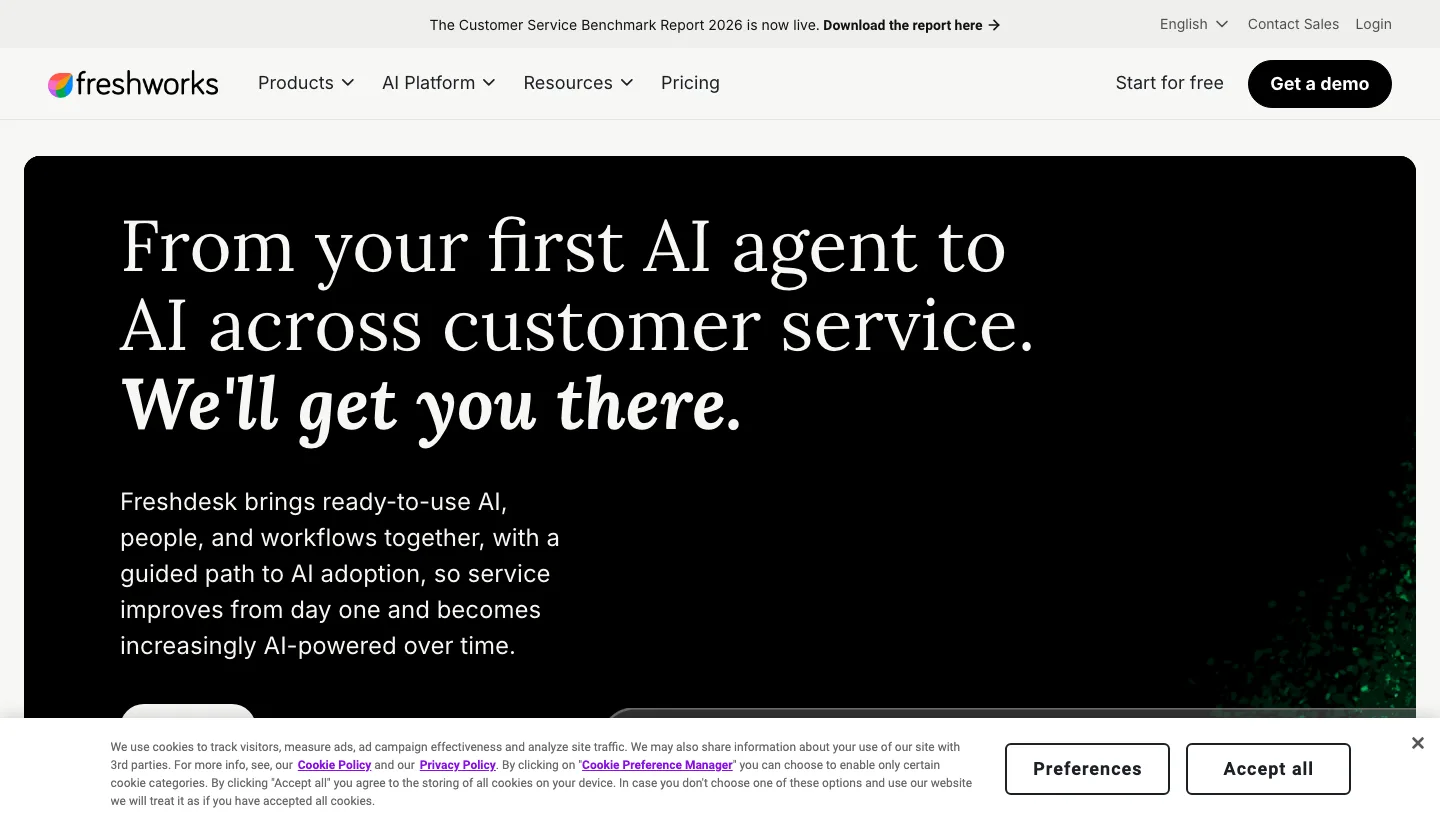
When shared email is no longer enough to keep customer requests organized, Freshdesk brings tickets, a portal and a knowledge base into one support desk. Growth starts at $19 per agent a month on annual billing for email-based service, while Pro becomes the better fit when multilingual support, routing and multiple SLA policies are part of the work.
Agent access
- API
- Yes, Growth, Pro, and Enterprise
- MCP server
- Official, hosted, API key
- Works with
 ClaudeClaude Code
 Cursor
 VS Code
What are the primary pros and cons of using Freshdesk?
What works
- Tickets, shared inbox and self-service start on Growth
- Growth, Pro and Enterprise offer 500 free AI Agent sessions once per account
- REST API covers help-desk records and actions
What to watch
- Extra AI Agent sessions cost $49 per 100
- Copilot is a $29 per-agent monthly add-on
- Enterprise lists sandbox, audit logs and IP whitelisting
How does Freshdesk organize ticketing and help desk workflows?
Freshdesk turns an incoming support request into work with an owner, a priority and a record. Its core is a ticketing desk and shared inbox, with a portal and knowledge base for customers who can solve a simple problem themselves. It also belongs in the marketing tools directory for teams that need customer conversations to be an operating process rather than an unstructured inbox.
The product’s AI layer is called Freddy. Freddy AI Agent handles customer interactions, while Freddy AI Copilot is an add-on that can be assigned only to the agents who need it. For email, Freshdesk defines a session as a 72-hour window beginning with the customer’s first email, so a run of replies inside that window counts as one session.
Growth, Pro and Enterprise are per-agent plans, and each offers 500 free AI Agent sessions once per account. The headline seat price does not cover every kind of scale: more AI sessions, Copilot, day passes, connector tasks and MCP actions are separate line items. Budget those against your ticket volume and automation plans before treating the entry price as your whole support cost.
Which support teams get the most value from Freshdesk?
Teams leaving shared email
Growth gives teams tickets, shared ownership, a portal and reporting instead of separate inboxes.
Multi-language support desks
Pro brings multilingual service, intelligent routing and multiple SLA policies to organized support operations.
Teams using flexible help
Day passes let occasional agents help without making every helper a full-time seat.
Governed support operations
Enterprise adds audit logs, a sandbox, IP whitelisting and skill-based routing for stronger controls.
Freshdesk is less attractive when the support operation is so small that ticket ownership and a customer portal would not change the work. It is also a less clean fit for a team that wants every AI expense folded into the seat price. Its session model can work well when you can estimate volume, but it needs attention as automated conversations become a material share of your queue.
What ticketing, SLA, and self-service features does Freshdesk offer?
Ticketing with shared responsibility
Freshdesk’s tickets support prioritization, assignment and tracking, while the shared inbox lets the team respond to incoming email together. Threads keep internal discussion connected to the ticket rather than the customer conversation, and linked tasks show what still needs to happen.
Portal and knowledge base
The customer portal gives customers a place to submit tickets and look for answers in the knowledge base. Growth includes both, so a small team can offer a consistent front door without buying a higher tier. Pro adds the multilingual help desk, which is the meaningful step up for a business that needs customers and agents to work in more than one language.
Freddy AI Agent and Copilot
Growth, Pro and Enterprise each offer 500 free Freddy AI Agent sessions once per account. After that, the annual-billing price is $49 per 100 additional sessions. Freddy AI Copilot is different: it is available as a $29 per-agent monthly add-on on Pro and Enterprise, and Freshdesk says you can assign it to any number of agents rather than every seat. That flexibility is useful when only a small group handles complex work, but it also means you should cost the agents who need it, not merely the plan.
Routing, service levels and control
Pro includes intelligent routing, more than one SLA policy, custom dashboards, reporting and external collaborators. Freshdesk lists 5,000 collaborators included on Pro and Enterprise. Enterprise includes skill-based routing plus Freddy AI Insights, with a sandbox, audit logs, domain controls and IP whitelisting. Choose that tier for an actual governance requirement.
API, connectors and MCP actions
Freshdesk publishes a REST API that exchanges JSON through HTTP. Its documented resources include tickets, contacts, agents and companies, so an internal tool can read and update support records through the documented endpoints. Freshworks also offers connector app tasks for data sync and workflow automation, while the pricing page lists MCP actions at $15 per 1,000 on annual billing. For a team building an automated support workflow, those metered actions deserve the same forecasting as AI sessions.
How much do Freshdesk subscription tiers and support seats cost?
Price checked 27 Nov 2026
| Plan detail | Growth$19/mo | Pro$55/mo | Enterprise$89/mo |
|---|---|---|---|
| Billing shown | Per agent/month, annual | Per agent/month, annual | Per agent/month, annual |
| Ticketing and shared inbox | ✓ | ✓ | ✓ |
| Portal and knowledge base | ✓ | ✓ | ✓ |
| Freddy AI Agent sessions | 500 free sessions, once per account | 500 free sessions, once per account | 500 free sessions, once per account |
| Multilingual help desk | Not listed | ✓ | ✓ |
| Freddy AI agent-assist add-on | Not listed | $29/agent/mo | $29/agent/mo |
| Sandbox and audit logs | Not listed | Not listed | ✓ |
Freshdesk prices in US dollars, 27 Nov 2026.Freshdesk pricing
For a three-agent desk, the annual-billing plan price is $57 a month on Growth, $165 on Pro and $267 on Enterprise. That is the stable part of the calculation. If two Pro agents also need Copilot, add $58 monthly; if the team exceeds its included AI Agent sessions, the next 100 sessions add $49. These examples make the decision clearer than a feature checklist: Pro is $108 more than Growth for three agents before any Copilot or usage cost.
On monthly billing, the 27 Nov 2026 prices were €20 per Growth agent, €63 per Pro agent and €101 per Enterprise agent each month. Additional AI Agent sessions were €45 per 100, Copilot was €35 per agent each month, and MCP actions were €13 per 1,000. Prices vary by the vendor’s displayed currency and billing selection, so keep the billing view consistent when you request a final quote.
- Day passes on annual billing cost $2 on Growth, $7 on Pro and $12 on Enterprise
- Connector app tasks cost $80 per 5,000 tasks on annual billing
- MCP actions cost $15 per 1,000 actions on annual billing
- A 14-day trial starts on the Enterprise plan before you choose a paid plan
What capabilities are included in Freshdesk Enterprise for large support operations?
Freshdesk Enterprise costs $89 per agent monthly on annual billing, unlocking advanced routing and enterprise service management. It adds Freddy AI Insights, skill-based routing, a sandbox, audit logs and IP whitelisting. Pick it when the team can name the operational or security requirement it resolves.
What limitations and drawbacks affect teams using Freshdesk?
Freshdesk restricts its entry-level Growth tier primarily to email support, requiring paid upgrades for broader multichannel coverage. It covers a good basic desk, but it does not list the multilingual help desk, intelligent routing or multiple SLA policies that a more complex support operation may need. If those workflows are already required, the real entry plan is Pro, not the $19 Growth plan.
AI cost is the second limitation. The first 500 sessions create a useful period to understand demand, but after that session use costs extra. Copilot is also separate and only listed on Pro and Enterprise. A team with irregular ticket volume should model what a busy month looks like before deciding that Freddy will lower the workload at a predictable price.
Finally, Freshdesk makes plan-specific API limits part of the implementation conversation. Its developer documentation lists account-wide limits of 100 calls per minute on Growth, 400 on Pro and 700 on Enterprise, while trial accounts default to 50. That is sufficient information to plan carefully, but an integration with heavy ticket synchronization should confirm the rate limit and any extra API-call purchase before it goes live.
Which customer help desk platforms offer alternatives to Freshdesk?
 Front review is worth reading if your team’s main problem is managing shared customer communication across channels. Compare its workspace approach with Freshdesk’s ticket, portal and knowledge-base structure before deciding whether your support work needs a conventional help desk.
 Gist review is worth comparing when you want website live chat and a team inbox, with a free plan for two users. Use the same test for both alternatives: confirm the team bill, included AI usage and API requirements before you migrate a working queue.
What is our overall evaluation and final verdict on Freshdesk?
Freshdesk is an effective choice for email-led support desks requiring reliable ticket routing and self-service portals. Growth is a credible low-cost start, and Pro justifies its higher price once language support, routing and service-level policies are real requirements. Calculate Copilot and AI-session use alongside seats, because those turn a simple plan price into a team budget.
Start with the 14-day Enterprise trial, then price Growth for a simple email desk or Pro for a multi-language, routed operation. Before annual billing, estimate monthly AI Agent sessions, Copilot users and MCP actions.
How were the features and pricing tiers of Freshdesk validated?
Freshdesk subscription rates, feature matrices, and developer specifications were confirmed from official sources on 27 Nov 2026. The annual plan table uses the US-dollar billing view the vendor displayed, while the monthly figures use its euro view. Every figure follows how we check figures.
- Freshdesk pricing page, including annual and monthly billing views
- Freshdesk product page for AI and workflow information
- Freshdesk developer documentation for API resources and rate limits
What are the most frequent questions asked about Freshdesk?
How much does Freshdesk cost?
On annual billing, Growth costs $19, Pro costs $55 and Enterprise costs $89 per agent every month. Extra AI Agent sessions cost $49 per 100, and Copilot costs $29 per agent each month on Pro and Enterprise.
Does Freshdesk offer a trial?
Yes. Freshworks says a new account gets the Enterprise plan for 14 days, then you select a plan and provide card details to continue.
What is a Freshdesk AI Agent session?
It is a distinct exchange involving a customer and an AI Agent. For email, Freshdesk counts a 72-hour window from the customer’s first email as one session.
Does Freshdesk have an API?
Yes. Freshdesk publishes a REST API that exchanges JSON through HTTP, with resources including tickets, contacts, agents and companies. Its listed plan limits are 100 calls a minute on Growth, 400 on Pro and 700 on Enterprise.
 Reviewed byDanny Kirk
Founder of ReddiReach.
 Checked byAndrés Felipe
Digital designer and marketer.
Every figure is checked against the vendor's own page. Read our editorial standards.