
Key Takeaways
- Gladly provides customer service software for retail brands, consolidating multi-channel shopping assistance, customer orders, and lifetime conversation histories into one persistent customer thread.
- Gladly requires contacting sales for private enterprise pricing and custom quotes rather than publishing self-serve entry-level subscription rates.
- Gladly supports programmatic customer data access through REST API endpoints, event webhooks, a native App Platform, and an embeddable Chat SDK.
- Gladly creates friction for smaller ecommerce companies seeking simple shared email inboxes due to its enterprise scope and unlisted commercial pricing.
When a shopper's product question becomes an order problem, your support team should not have to rebuild the relationship from scratch. Gladly is the stronger fit for retail teams that need the shopping conversation, order history, and service handoff on one customer record. Choose a simpler helpdesk if your work is mostly a shared inbox, or if a public price is essential before you evaluate a platform.
What are the primary strengths and drawbacks of Gladly?
What works
- One customer record across chat, email, voice, SMS, and social media
- Team Assist drafts replies from customer history and the knowledge base
- REST APIs, webhooks, and an App Platform for custom connections
What to watch
- No public plan price or included-seat count
- Commerce, order, and customer data are central to its stated workflow
- The broad platform may exceed the needs of a basic support inbox
How does Gladly organize lifetime customer conversations and retail orders?
Gladly resolves fragmented support by preserving conversation history across channels when shoppers transition from pre-purchase questions to post-purchase order issues. Gladly is built around that break in context: it puts past chats, calls, and emails on a customer record shared by AI and human agents. If you are mapping support software alongside the rest of your stack, the marketing tools directory gives you the wider landscape. For a retail operation, Gladly's appeal is not another chat widget. It is one place to carry the relationship from discovery through service.
The platform brings together a conversation timeline, customer profile, Team Assist, reporting, and smart routing. Gladly also presents a Shopping Assistant and Voice AI alongside its service features. That combination makes sense when the same team is accountable for helping shoppers decide and helping customers after the sale. It is less compelling when your work begins and ends with a small number of straightforward tickets.
Commerce systems are part of the design, not an afterthought. Gladly lists ready-to-install apps across ecommerce, subscriptions, and order management, and says its App Platform supports custom integrations. Its case rests on whether it can make the specific order and customer data your agents need available in the same conversation.
Which retail and ecommerce support organizations should use Gladly?
Retail support teams
Keep product questions, orders, and later service conversations tied to the same customer record.
Customer experience leaders
Use customer history, smart routing, and reporting to manage support across several communication channels.
Commerce operations teams
Connect storefront, subscription, order, and customer data through ready-made apps or the App Platform.
Teams handling exceptions
Give people contextual drafts and summaries when complicated cases need a human decision.
Gladly is for a team with a connected customer journey, particularly one where a service agent needs to see purchase context before answering. A small business that only wants email ticketing should be careful not to buy a broader operating model than it will use. The distinction matters more than a feature checklist: Gladly's value depends on putting the customer record at the center of the team's day.
What conversation management and customer context tools does Gladly include?
A conversation timeline that crosses channels
Gladly says every message, channel, resolution, and preference lands on a single lifelong customer record in real time. Its listed channels include chat, email, SMS, social media, and voice. A chat that moves to email can carry the same details, rather than leaving the next agent to reconstruct the case. That is the core feature to examine if customers routinely return, switch channel, or contact different teams.
Shopping and service in the same workflow
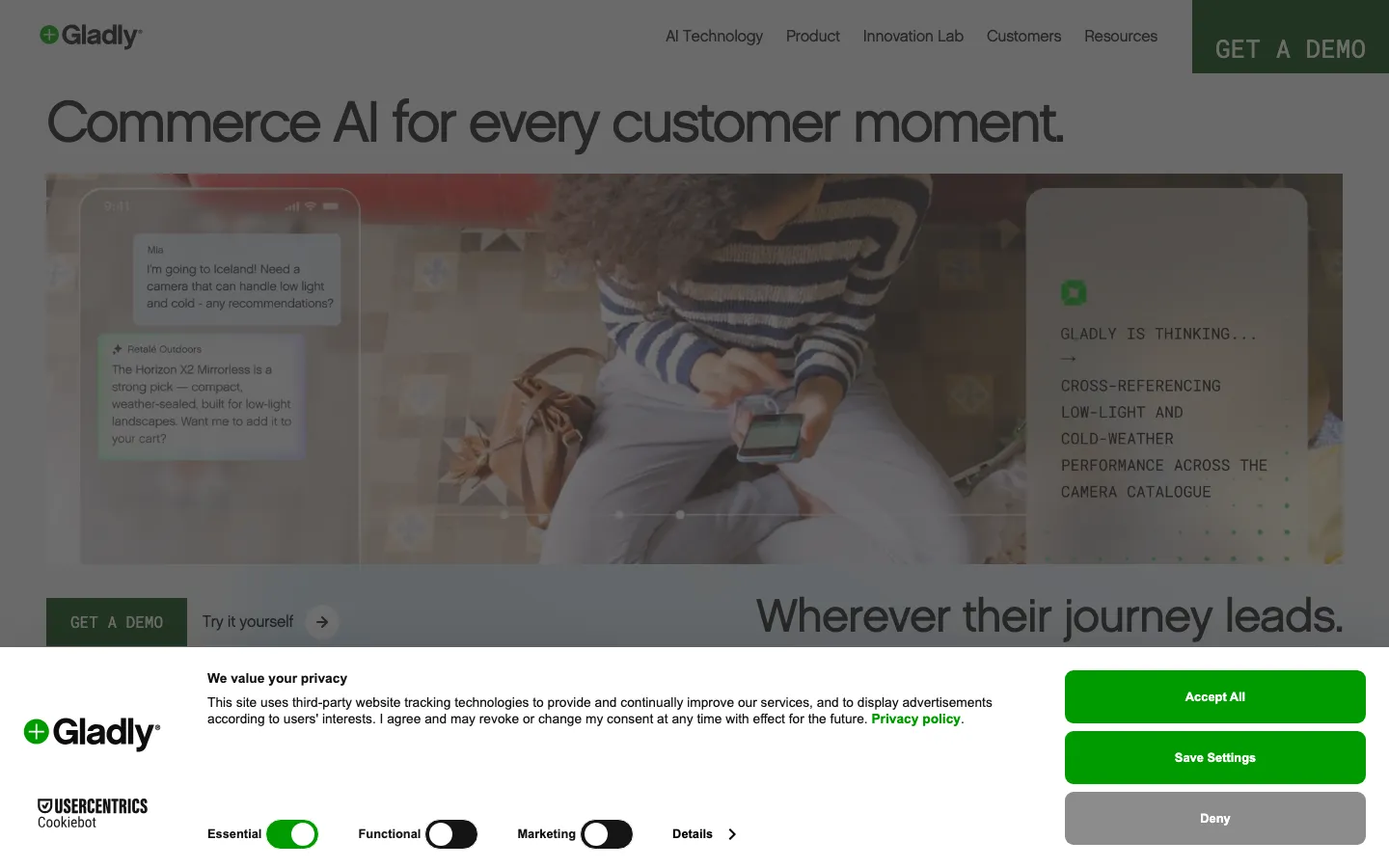
Gladly positions its Shopping Assistant as part of a wider commerce conversation, not as a separate bot. The company says the assistant answers product questions and makes recommendations, while Gladly also supports customer service. That can preserve a consistent path when a shopper asks a pre-purchase question and later needs help with an order. It also means the product and policy information behind those answers deserves the same ownership as your support knowledge base.
Team Assist keeps a person in the loop
Team Assist reads the live conversation, customer history, live order data, and the Answers knowledge base, then surfaces an answer and a ready-to-use draft. Gladly says the team member reviews and sends it, and that there is no auto-send by design. It can also summarize a conversation, suggest a disposition, and translate in real time. I see that as a better use of AI for an exception-heavy support desk than pretending every difficult conversation should be fully automated.
Routing based on context and skills
Gladly People Match routes a customer to a team member using context, history, situation, and needs. Its smart routing can use status, skills, availability, urgency, and expertise, while VIP and sentiment routing can use customer lifetime value, history, and sentiment. Dedicated assignments can send a returning customer back to the same team member. Those are meaningful controls for a team that handles priority customers differently, but they are unnecessary complexity if every request belongs in one shared queue.
Integrations, API, and custom development
Gladly says it integrates with more than 30 technology platforms and lists commerce, subscription, and order-management categories. Its developer documentation covers REST APIs, webhooks, the App Platform, data export, the Lookup API, and a Chat SDK. Gladly does not disclose API plan eligibility, usage limits, or prices. Ask for those terms before designing an internal workflow around the API.
How does Gladly approach customer service software pricing?
Checked 27 Nov 2026
| Plan detail | Published information |
|---|---|
| Plan price | Not disclosed |
| Billing period | Not disclosed |
| Included seats | Not disclosed |
| API plan eligibility | Not disclosed |
| How to start | Request a demo |
Gladly's public site, 27 Nov 2026.Gladly website
Gladly does not disclose a public plan price, billing period, included seats, add-on prices, or API eligibility. It offers a demo. Ask for pricing that covers your team size, channels, AI features, integrations, and developer access before comparing Gladly with tools that publish a starting plan.
- Ask which channels and AI features are included for the proposed team size
- Ask how implementation, integrations, and ongoing support are priced
- Ask whether REST API, webhooks, data export, and App Platform access are included
The lack of public detail does not make Gladly unsuitable. It means you cannot compare an entry plan or a three-person monthly bill before you request pricing. If transparent self-serve pricing is a hard requirement, look elsewhere first.
What are the primary operational challenges and limitations of Gladly?
Gladly presents an immediate barrier for evaluating teams due to its lack of public pricing clarity. Gladly does not disclose a plan price, billing period, included seats, or API tier. A retail organization with a clear evaluation process can request those details. A smaller team trying to compare tools quickly cannot calculate its likely bill first.
Gladly also asks you to commit to a unified customer-record approach. Its most distinctive features depend on customer history, order data, the Answers knowledge base, and the live conversation coming together. If those inputs are incomplete, the promise of continuity becomes harder to realize. That is a product fit question, not a reason to assume every support team needs to consolidate its work around one platform.
Finally, Gladly's breadth is deliberate. Shopping assistance, voice, routing, reporting, and custom integrations can suit a commerce brand with varied customer journeys. They can be too much for a team that wants only ticket assignment and email replies. Start with the conversations you must resolve, then decide whether that wider architecture earns its place.
Which ecommerce customer service tools compete directly with Gladly?
 Gorgias review is the comparison for an ecommerce support operation that wants ticket-volume pricing rather than per-agent pricing. Its helpdesk runs from 50 to 5,000 tickets a month. Choose Gladly instead when the shopping-to-service handoff and a shared customer conversation are the central requirements.
 Help Scout review is the comparison for a smaller team that needs a shared inbox and knowledge base with a public starting point: its Free plan includes five users, one Inbox, and one Docs site. Gladly makes more sense when that team needs commerce context, routing, and shopping assistance in the same platform.
Is Gladly the right customer service platform for your retail brand?
Gladly establishes its core value around bridging the shopping-to-service handoff within a single unified customer profile. Its customer timeline, smart routing, human-reviewed Team Assist, and developer options form a coherent system for retail support that needs to remember the person behind the conversation, not merely close the current ticket. I would not recommend it as a default helpdesk for every team, because Gladly does not disclose the price or the commercial limits that determine whether that system is affordable.
Bring Gladly into your evaluation when the same customer moves between product questions, order issues, and human support. In the demo, follow that handoff end to end, then ask for the price and API terms that apply to your team before comparing platforms.
How were the features and developer tools of Gladly evaluated?
Gladly platform documentation, routing tools, developer APIs, and customer context features were evaluated on 27 Nov 2026. The public pages did not publish a plan price, seat count, or API plan eligibility. Every figure and statement follows how we check figures.
- Gladly product and commerce pages
- Gladly customer-context and smart-routing pages
- Gladly integrations and developer documentation
What are the most frequent questions regarding Gladly customer service?
What is Gladly used for?
Gladly combines customer service and conversational commerce around customer profiles and conversation history. Its public pages list a timeline, Team Assist, reporting, smart routing, shopping assistance, and integrations.
How much does Gladly cost?
Gladly does not disclose a plan price, billing period, or included-seat count. It directs prospective buyers to request a demo.
Does Gladly integrate with commerce systems?
Yes. Gladly lists ready-to-install apps across ecommerce, subscriptions, and order management, and says it offers more than 30 technology-platform integrations.
Does Gladly have an API?
Yes. Its developer site documents REST APIs, webhooks, the App Platform, data export, a Lookup API, and a Chat SDK. Gladly does not disclose which commercial plan includes them.
 Reviewed byDanny Kirk
Founder of ReddiReach.
 Checked byAndrés Felipe
Digital designer and marketer.
Every figure is checked against the vendor's own page. Read our editorial standards.