
Key Takeaways
- Google Ads Transparency Center works best for paid-media strategists and compliance analysts verifying official advertiser identities, destination domains, and active Google creatives.
- Google does not publish self-serve pricing tiers, seat allowances, or commercial plan comparisons for Google Ads Transparency Center, operating it as a public web surface.
- Google documents API access for reading data about ads served in the European Economic Area, while offering no official MCP server or general commercial rate limits.
- Google Ads Transparency Center restricts non-political creative retention to one year for verified advertisers and lacks saved collections, competitor alerts, or cross-channel coverage.
When you need to verify whether a competitor or domain runs active Google campaigns before paying for third-party creative intelligence databases, Google Ads Transparency Center gives you a direct first-party lookup at no published seat cost. You should use Google Ads Transparency Center first for advertiser identity checks, European regulatory disclosures, and political ad audits, though Google does not publish commercial pricing tiers on a pricing page. Skip Google Ads Transparency Center as a standalone solution if your agency requires saved boards, recurring alerts, cross-network tracking, or automated reporting workflows.
Agent access
- API
- Yes
- MCP server
- Not found on official pages
What are the pros and cons of Google Ads Transparency Center?
What works
- First-party Google search surface lets teams look up advertisers by legal name or destination website and isolate multiple accounts pointing to one domain.
- Platform filters separate Google ads served across Search, Play, Maps, Shopping, and YouTube while distinguishing records shown since September 4, 2023.
- Political Ads Transparency Report retains eligible election-ad creatives for seven years after the last impression and exports datasets via Google Cloud BigQuery.
- Regional disclosures for ads served in Europe and Türkiye surface extra regulatory context, including ad topics and expanded audience-selection details.
What to watch
- Google does not publish self-serve subscription tiers, seat limits, or commercial feature comparisons for teams using Google Ads Transparency Center.
- Applying a platform filter inside Google Ads Transparency Center automatically excludes any historical ad records displayed prior to September 4, 2023.
- Coverage only includes supported ad formats served through Google properties, leaving blind spots across unsupported Google placements and rival ad networks.
- Google Ads Transparency Center provides pure point-in-time lookup and inspection without saved swipe files, team collaboration boards, alerting, or client reporting.
What does Google Ads Transparency Center do for your team?
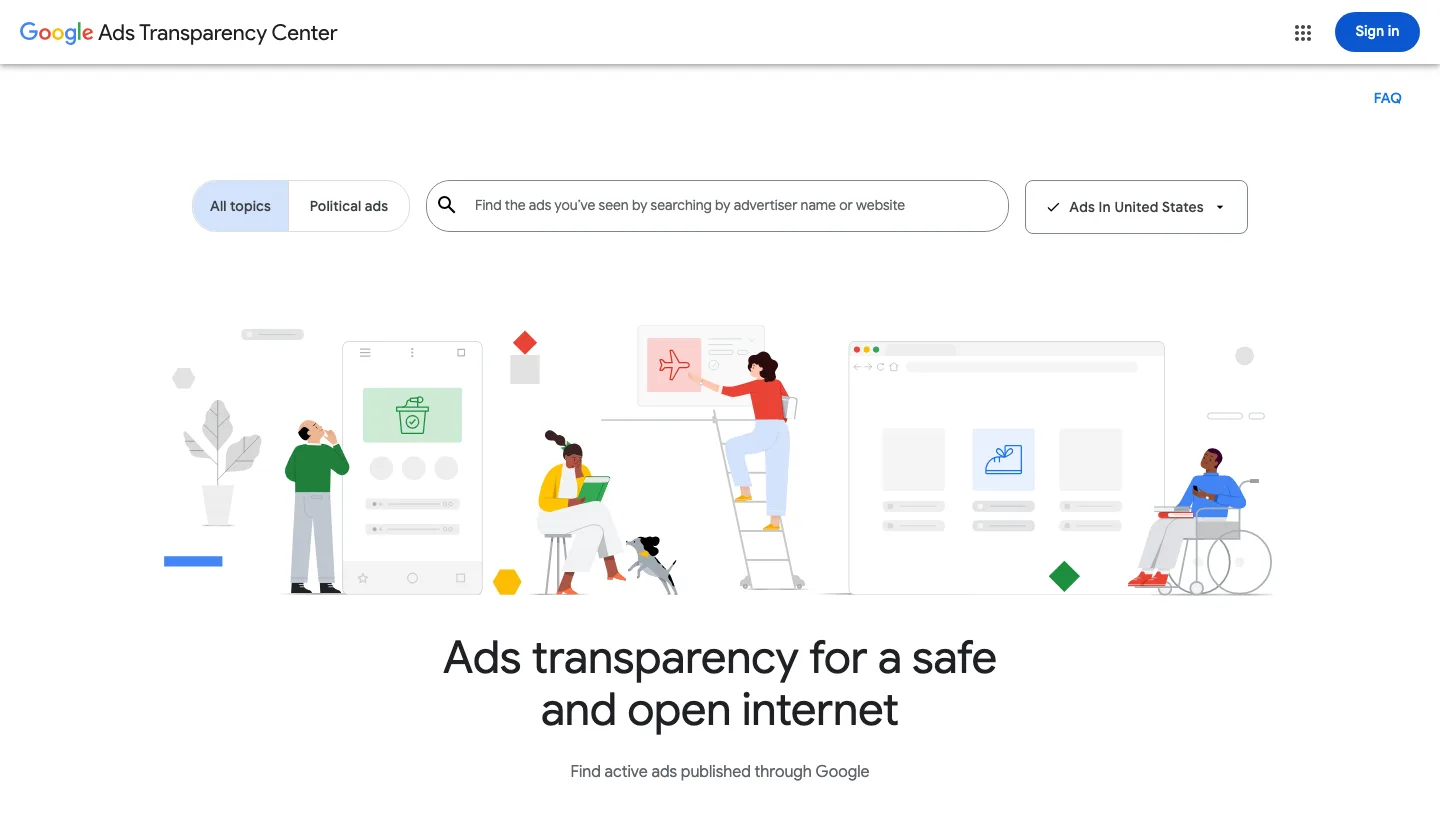
Google Ads Transparency Center functions as Google's official public search directory for inspecting advertiser records and creatives shown through Google properties. Rather than relying solely on third-party ad scrapers that miss placements or misattribute spend, your paid-media and compliance teams can start with a fast source-of-record lookup by advertiser name or destination website. When a single website attracts traffic from several distinct advertising accounts, Google Ads Transparency Center reveals every linked account pointing ads to that domain and lets researchers narrow the view down to one specific advertiser. Within our Paid Ads & Ad Intelligence directory, weigh seat caps and reporting workflows early.
Inventory coverage inside Google Ads Transparency Center spans ads from verified advertisers served across Google Search, Play, Maps, Shopping, and YouTube for one year following their last displayed impression. Google Ads Transparency Center also includes ads from unverified advertisers when served in Europe and Türkiye, though Google notes that certain ad formats remain unsupported across the directory. For teams investigating regulated campaigns, Google's separate political advertising documentation covers eligible election ads running across Search, Display, YouTube, and DV360 in supported formats.
Beyond everyday creative checks, Google Ads Transparency Center separates routine commercial lookups from strict regulatory disclosures. Ads displayed in Europe and Türkiye, alongside verified political advertisements, surface deeper metadata such as declared ad topics and granular audience-selection parameters. Election ads live inside the dedicated Political Ads Transparency Report, where creative assets remain searchable for seven years after their final impression. That archival depth makes Google Ads Transparency Center indispensable for due diligence and public claim verification, even though teams still need dedicated ad-intelligence software for ongoing monitoring and cross-network organization.
Which teams is Google Ads Transparency Center built for?
Paid-search and display strategists
Paid-search strategists use Google Ads Transparency Center to confirm whether a rival domain actively runs Google Search, Shopping, or YouTube ads before buying expensive competitive intelligence seats. It validates public creative presence without estimating campaign budgets.
Agency pitch and brief researchers
Agency researchers preparing new-business briefs rely on Google Ads Transparency Center to uncover the verified legal entity behind a prospect's website and inspect live creative angles, pairing it with separate workspace tools to save and annotate screenshots.
Compliance and public-policy analysts
Compliance analysts auditing regulated campaigns use Google Ads Transparency Center's European, Turkish, and Political Ads Transparency Report paths to review audience-selection disclosures, spend records on eligible election ads, and seven-year archival creative histories.
Data and AI research engineers
Technical analysts building automated ad-monitoring pipelines use Google Cloud BigQuery exports for political datasets or Google's EEA transparency API where eligible, working around the absence of an official MCP server or documented global API.
Which Google Ads Transparency Center features matter most in daily work?
Google Ads Transparency Center features focus entirely on verifiable advertiser discovery, inventory filtering, and statutory disclosure rather than workflow management. In daily research, three core capabilities determine how much signal your team can extract from Google's first-party ad records before switching to a paid competitive research suite.
Domain-to-advertiser search and identity records
Google Ads Transparency Center anchors daily research around a dual-purpose search bar that accepts either an advertiser name or a destination website URL. Searching by domain solves a frequent headache in B2B competitive research: knowing the landing page a competitor promotes while having no idea which parent company, regional subsidiary, or agency account actually funds the traffic. When multiple Google Ads accounts point campaigns toward the same website, Google Ads Transparency Center surfaces that multi-account relationship and lets you filter down to one advertiser.
Clicking into any result opens Google Ads Transparency Center's ad details and advertiser identity views. For advertisers that have completed Google's verification workflow, the interface displays explicit identity-status messaging alongside supplied legal names and registered locations. Those first-party records help legal, procurement, and brand-protection teams establish exactly who stands behind a live promotion, acting as an authoritative transparency record rather than a granular account-level campaign audit.
Platform filters and regional impression disclosures
Google Ads Transparency Center organizes non-political records around ads from verified advertisers served across Google Search, Play, Maps, Shopping, and YouTube over the trailing one-year window after each ad's last display, plus unverified advertiser ads shown in Europe and Türkiye. Researchers can narrow results using platform filters to isolate specific Google surfaces during creative audits. Keep the cutoff date in mind during historical reviews: applying a platform filter inside Google Ads Transparency Center excludes any ads shown before September 4, 2023.
Where regional regulations apply, Google Ads Transparency Center enriches individual ad detail pages with deeper delivery context. Ads served in Europe and Türkiye can display declared ad topics, expanded audience-selection criteria, and platform-specific impression ranges where available. Google began tracking those platform-specific impression ranges on September 4, 2023, and publishes them after a 90-day delay, meaning researchers comparing regional records must account for both geographic rules and reporting lag.
Political Ads Transparency Report and BigQuery access
While the main Google Ads Transparency Center directory covers both commercial and election-related inventory, Google maintains the dedicated Political Ads Transparency Report specifically for verified election advertising across Search, Display, YouTube, and DV360 in supported formats. Unlike standard commercial creatives that disappear one year after their final impression, election ads remain accessible in the Political Ads Transparency Report for seven years after their last impression. Only political advertisers with active ads during that trailing seven-year window appear in the report.
For public-affairs teams and investigative analysts, the Political Ads Transparency Report also unlocks quantitative disclosures that commercial records lack, including spend information for some election ads alongside advertiser names. Furthermore, Google makes the political ads dataset available through Google Cloud BigQuery for programmatic querying and bulk export. That BigQuery integration gives technical teams a structured path to analyze multi-year election messaging without scraping web pages.
How much does Google Ads Transparency Center cost for a team?
Google Ads Transparency Center costs nothing in published software subscription fees because Google operates adstransparency.google.com as a public transparency directory rather than a commercial SaaS product. Google does not publish self-serve pricing tiers, per-seat charges, monthly or annual billing cadences, or paid feature comparison tables on its official site.
| Plan | Monthly / listed price | Key limits & seats |
|---|---|---|
| Public Web Surface | No published price (public access) | No published seat limits; 1-year verified ad window (7 years for political report) |
| EEA & Regulatory API Access | Not published on vendor docs | Reads data on ads served in the EEA; outside-EEA access noted only for regulators and SROs |
| Political Ads BigQuery Dataset | Not published on transparency docs | Programmatic access and export for political ads dataset via Google Cloud BigQuery |
Google Ads Transparency Center pricing checked 27 Nov 2026.Google Ads Transparency Center official pricing
Because Google does not publish self-serve pricing tiers or team seat allowances for Google Ads Transparency Center, five media buyers or twenty compliance analysts can run manual advertiser and domain lookups simultaneously without negotiating software licenses or worrying about seat overages. However, zero license cost does not mean zero total workflow cost for a B2B marketing team. Because Google Ads Transparency Center includes no saved swipe files, shared folders, scheduled competitor alerts, or client-ready export decks, agencies invariably absorb manual labor hours or pair the public directory with paid ad-intelligence subscriptions to handle ongoing monitoring and cross-channel reporting.
On the programmatic and automation side, Google documents API access for reading Google Ads Transparency Center data about ads served in the European Economic Area, and notes it may grant API access outside the EEA to regulators and self-regulatory organizations. Google's public policy documentation does not publish an API plan tier, per-call fee, authentication setup, or rate limit, and Google offers no official MCP server or native Zapier, Make, or n8n integrations. Teams querying the political dataset through Google Cloud BigQuery should check their own Google Cloud environment, as Google Ads Transparency Center documentation does not list standalone BigQuery pricing.
Where does Google Ads Transparency Center fall short?
Google Ads Transparency Center falls short first as a collaborative research workspace. Google designed the interface strictly for point-in-time public lookup and individual ad inspection, providing no published workflow for saving creative boards, tagging competitor angles, triggering alerts when a rival launches new landing pages, or exporting formatted client reports. Every time an agency strategist checks a domain, the session starts from scratch unless your team manually copies links and screenshots into an external spreadsheet, Notion database, or paid creative-research tool.
Coverage boundaries and date cutoffs also restrict how much strategic weight you can place on Google Ads Transparency Center results. Standard coverage spans verified advertisers across Search, Play, Maps, Shopping, and YouTube for only one year after an ad's last display, plus unverified advertisers in Europe and Türkiye, while omitting unsupported Google ad formats entirely. Worse for historical analysis, turning on the platform filter automatically drops every ad shown before September 4, 2023, and platform-specific impression ranges where available carry a 90-day publication delay.
Finally, data depth and programmatic access remain uneven across geographies and ad categories inside Google Ads Transparency Center. Commercial lookups outside Europe and Türkiye lack the expanded topic and audience-selection disclosures mandated by regional regulations, and spend figures are confined to eligible records in the Political Ads Transparency Report. For engineering teams building AI agents, Google documents no official MCP server, publishes no OpenAPI spec, SDKs, authentication details, or rate limits for its EEA transparency API, and restricts non-EEA API eligibility to regulators and self-regulatory bodies.
What are the best Google Ads Transparency Center alternatives?
 AI Peekaboo is the stronger choice when tracking brand visibility across ChatGPT, Gemini, Perplexity and Google AI surfaces is the job, starting at $30 a month with API, MCP and multi-brand workspaces covered in our AI Peekaboo review.
When your team needs cross-network coverage or workflow tooling beyond Google Ads Transparency Center, start by comparing first-party peers and commercial ad-intelligence suites. Meta Ad Library and LinkedIn Ad Library serve the exact same public-record role for Meta technologies and LinkedIn placements, making them essential zero-license companions rather than direct replacements for Google inventory. For commercial B2B teams that want historical search-ad copy, domain-level keyword estimates, and competitive monitoring dashboards, paid platforms such as Semrush, SpyFu, and Similarweb cover competitive paid-search workflows that Google Ads Transparency Center never attempts to address.
Most disciplined performance agencies should pair Google Ads Transparency Center with a paid competitive suite rather than choosing one over the other. Use Google Ads Transparency Center first whenever you need ground-truth verification of who legally stands behind a domain's Google ads, whether a creative actually ran on Search or YouTube in the past twelve months, or what regulatory disclosures appear in Europe, Türkiye, or political archives. Add Semrush, SpyFu, or a creative swipe-file platform once the assignment demands saved boards, recurring alerts, or multi-network reporting.
Also compare  Meta Ad Library review and
 BigSpy review alongside our best AI visibility tools roundup.
Should your team buy Google Ads Transparency Center?
Since Google publishes no commercial license tiers for Google Ads Transparency Center, the real decision is how deeply your team embeds it into daily research. Every paid-media strategist, agency researcher, and compliance analyst should adopt Google Ads Transparency Center immediately as their primary source-of-record check for Google Search, Play, Maps, Shopping, YouTube, and seven-year political ad archives. Its domain-to-advertiser mapping and European, Turkish, and election disclosures provide unmatched first-party proof. Just do not mistake a statutory transparency portal for a full competitive-intelligence suite: budget separately for third-party software if you require saved boards, automated alerts, or commercial spend estimates.
Bookmark Google Ads Transparency Center as step one in every competitor domain check and compliance audit at no published software cost. For programmatic election analysis, connect to the Political Ads Transparency Report dataset on Google Cloud BigQuery, and pair the web portal with a dedicated paid-ad research tool whenever your team needs saved collections, alerts, or cross-network reporting.
How did we verify these Google Ads Transparency Center figures?
We verified Google Ads Transparency Center capabilities, platform retention windows, September 4, 2023 filter cutoffs, regional disclosures, and API rules against Google's official Ads Transparency Center web application (adstransparency.google.com) and Google Ads Policy Help documentation (answer 13733850), last checked 27 Nov 2026. Every figure follows our process in how we check figures. Checked 27 Nov 2026.
- Google Ads Transparency Center official web portal (adstransparency.google.com)
- Google Ads Policy Help documentation on Ads transparency (answer 13733850)
- Google Political Ads Transparency Report and EEA API policy documentation
What are common questions about Google Ads Transparency Center?
Can Google Ads Transparency Center find ads by a competitor's website in 2026?
Yes. Google Ads Transparency Center lets researchers search directly by advertiser name or destination website. When several Google Ads accounts run campaigns pointing to the same domain, Google Ads Transparency Center displays results from multiple advertiser accounts and allows you to filter those results down to one specific advertiser.
Which Google ad platforms appear in Google Ads Transparency Center results?
Google Ads Transparency Center includes ads from verified advertisers served across Google Search, Play, Maps, Shopping, and YouTube for one year after each ad was last displayed, alongside ads from unverified advertisers in Europe and Türkiye. Unsupported formats do not appear. Eligible election ads in the political report cover Search, Display, YouTube, and DV360.
Does the Google Ads Transparency Center platform filter hide older ads?
Yes. Applying a platform filter inside Google Ads Transparency Center excludes any ads shown prior to September 4, 2023 from your filtered results. In addition, Google began tracking platform-specific impression ranges on September 4, 2023, and publishes those impression ranges on eligible ad detail pages after a 90-day delay.
Does Google Ads Transparency Center offer an API or MCP server for AI agents?
Google documents API access for reading Google Ads Transparency Center data about ads served in the EEA, and notes it may grant non-EEA API access to regulators and self-regulatory organizations. However, Google publishes no API pricing, auth details, rate limits, SDKs, or official MCP server, while offering BigQuery access for political ads.
 Reviewed byDanny Kirk
Founder of ReddiReach.
 Checked byAndrés Felipe
Digital designer and marketer.
Every figure is checked against the vendor's own page. Read our editorial standards.