
Key Takeaways
- Hypotenuse AI helps ecommerce merchandising teams enrich incomplete product catalogs and generate bulk on-brand product descriptions simultaneously.
- Hypotenuse AI requires custom sales quotes across all tiers, offering single-seat entry trials alongside enterprise options without public pricing.
- Hypotenuse AI allows programmatic catalog enrichment, though technical teams must verify specific API and protocol specifications directly with sales.
- Hypotenuse AI fails to serve teams needing predictable public pricing models or general long-form editorial content rather than specialized product merchandising.
Hypotenuse AI is the right fit when your ecommerce team needs to repair product data and create on-brand catalog content at the same time. Pass if a published monthly price is non-negotiable, because both listed plans are custom-priced. Basic buyers can contact Hypotenuse AI for more seats or words; confirm API and MCP availability, documentation, permissions and pricing before planning an agent workflow.
Agent access
- API
- Yes
- MCP server
- Not found on official pages
What are the pros and cons of Hypotenuse AI?
What works
- Bulk descriptions, metadata and category content
- Attributes enriched from web, UPC, images and factsheets
- SOC 2 Type II controls, with data not used to train its AI model
What to watch
- No public rates for either listed plan
- Basic has one seat, while Enterprise features are quoted
- Confirm API and MCP terms before committing to an agent workflow
What does Hypotenuse AI do for ecommerce teams?
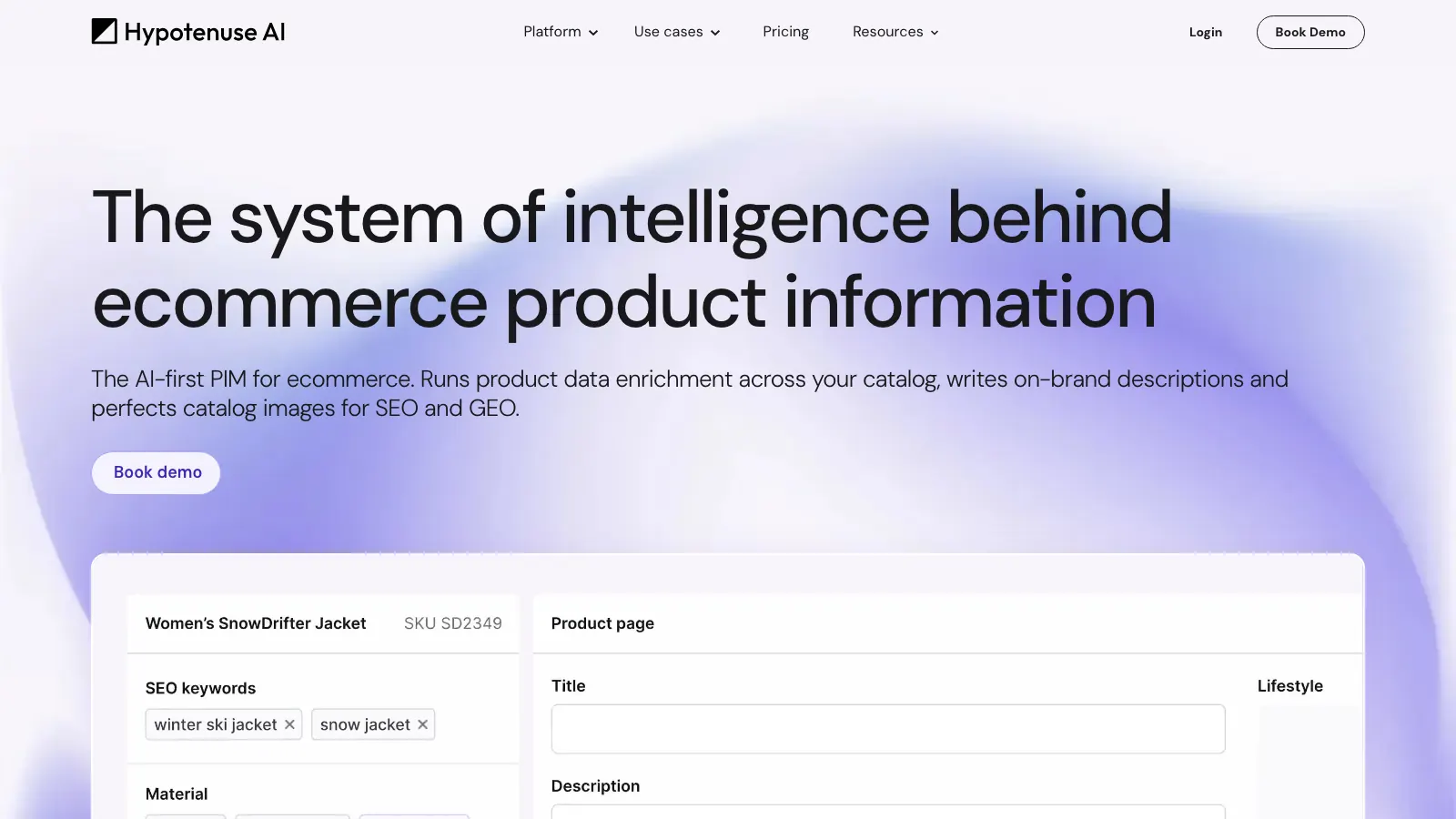
Hypotenuse AI resolves messy supplier data, missing attributes, and thin product copy more effectively than general writing tools. In the marketing tools directory, it stands apart as an AI-first PIM for ecommerce: the job begins with the product record, then moves through enrichment, standardized attributes, content and distribution. That focus makes it most useful to the catalog owner who must get thousands of listings ready without making every SKU a manual research project.
The workflow has a sensible order. You can fill missing details from the web, UPC, product images, spec sheets and PDFs, map values into the right taxonomy fields, and have the team review them before publishing. From there, Hypotenuse AI generates titles, descriptions, bullets, meta titles and meta descriptions in bulk. It can also create FAQ schema and recommend search terms for product pages.
That is a broader operational role than a text generator. Hypotenuse AI tracks product rankings across Google, Amazon, Walmart and other retailers, and its guideline checker flags content or product-data inconsistencies against brand, legal, channel and quality rules. If product discovery is part of your remit, the connection between data hygiene and copy is its strongest argument.
Who should use Hypotenuse AI for catalog content?
Catalog operations teams
Bring incomplete supplier data into one governed product workflow and review enriched values before publication.
Retailers across channels
Generate product content and keep approved data moving between commerce systems and marketplaces.
Global ecommerce teams
Localize product content in more than 40 languages while keeping brand rules and formatting consistent.
Brand teams with rules
Use bespoke brand voice, controlled terms and an AI quality checker when Enterprise requirements justify it.
I would not buy it as a replacement for an editorial content program. Hypotenuse AI includes blog, social and general-writing tools, but Hypotenuse AI is designed around products, categories, attributes and commerce channels. A team whose work begins with campaigns or articles should compare the Jasper review and Koala Writer review before committing to a catalog platform.
Which features earn Hypotenuse AI a spot in your catalog stack?
Data enrichment before writing
Hypotenuse AI can take a sparse product record and draw on webpages, UPCs, images, product data sheets and PDFs to fill attributes. It standardizes units and spelling, maps values to your taxonomy, and can extract details such as color, material, weight and care instructions. That matters because polished copy cannot rescue a listing whose filter fields are blank or inconsistent.
Bulk content with a defined voice
The bulk generator writes, rewrites or enriches product descriptions, meta titles, meta descriptions, category content and other ecommerce formats. You can set required and banned terms, formatting and keywords. Enterprise adds a Bespoke model configured for your taxonomy, attribute rules, brand voice and channel requirements, while Basic uses general ecommerce best practices.
Search and AI discovery work
Hypotenuse AI positions SEO and generative-engine optimization inside the catalog workflow. It can optimize taxonomy, attributes, feeds and product content, identify product keywords, generate structured markup and FAQ schema, then monitor product performance. Its own framing is practical: complete, structured details give search engines, marketplaces and AI assistants more to match against a shopper's request.
Publishing and integrations
The Shopify integration imports product data, lets you generate descriptions, and publishes approved copy back to a storefront in one click while retaining existing HTML, tables and formatting. The integrations directory also lists Akeneo, BigCommerce, Magento, Mirakl, NetSuite, Plytix, Salesforce Commerce Cloud, Salsify, SAP and Stibo, and Hypotenuse AI offers custom integrations for stacks not shown there.
Localization and image work
More than 40 languages are available for translated and localized product content. The platform also offers bulk image editing for standardizing backgrounds, crops, resolution and noise, though that capability is listed with Ecommerce Enterprise. It is a useful combination for a global catalog, but it is another reason to insist on the enterprise quote before treating it as part of your working stack.
How is Hypotenuse AI priced across its tiers?
Price checked 27 Nov 2026
| Plan detail | BasicCustom | Ecommerce EnterpriseCustom |
|---|---|---|
| Seats | 1 | Custom |
| Languages | 40+ | 40+ |
| Product description generator | ✓ | ✓ |
| Attribute enrichment | Not listed | ✓ |
| Tagging and categorization | Not listed | ✓ |
| Bulk AI image editor | Not listed | ✓ |
| Bespoke AI model | Not listed | ✓ |
| Custom PIM and ERP integrations | Not listed | ✓ |
Hypotenuse AI plans, 27 Nov 2026.Hypotenuse AI pricing
There is no responsible team-bill calculation to make from the published plans. Basic is custom-priced, includes one seat and says to contact Hypotenuse AI for more seats or words. Enterprise also uses custom pricing, custom seats and an account manager. Basic offers a Try for free path, while Enterprise asks for a demo, but neither card states what your monthly bill will be.
Treat the quote as part of the product decision, not paperwork after it. Ask for the seat count, word or catalog allowance, enrichment volume, image-work volume, integrations, onboarding and renewal terms in the same proposal. That is especially important because the valuable catalog controls sit on the Enterprise card.
What does Hypotenuse AI Ecommerce Enterprise add?
Hypotenuse AI Ecommerce Enterprise supports large retail organizations managing complex approval workflows, massive catalog scale, and strict compliance rules. It adds product-information and taxonomy management, attribute enrichment, tagging, the AI quality checker, bulk image editing, bespoke AI models, custom integrations, team access controls, custom seats and dedicated onboarding.
The division is sharp enough to guide the buying call. Basic is a one-seat entry into product-content generation and more than 20 ecommerce content types. Enterprise is the plan to discuss when your actual problem is governed data and content moving through several teams or systems. If that distinction does not match your work, a general writing product will likely be easier to justify.
Where does Hypotenuse AI fall short for buyers?
Hypotenuse AI presents its biggest practical drawback through the absence of transparent public pricing on its website. A catalog platform can have a strong feature set and still be impossible to budget for until sales names the commercial terms. Basic's free path reduces the initial barrier, but one seat and an unpublished price do not tell a content lead what a real team deployment costs.
Before developers design an automated workflow around it, confirm API and MCP availability, documentation, permissions and pricing with Hypotenuse AI. Its Enterprise plan does offer custom integrations with a PIM, ERP, ecommerce platform and more, but the commercial and technical terms still belong in the proposal.
Finally, Hypotenuse AI's specialization is both strength and constraint. It makes sense when content and data belong to product catalogs. It makes less sense for a team that mainly commissions articles, reports or campaign copy and does not need taxonomy, attribute and storefront workflows.
What are the top alternatives to Hypotenuse AI?
 Hypotenuse AI alternatives such as AI Peekaboo address how brands surface in AI answers rather than managing catalog copy generation. Its published plans include API and MCP access, while Hypotenuse AI focuses on improving the product data and content those answers can draw upon. The AI Peekaboo review explains that different purchase.
For an editorial workflow,  Jasper offers Brand Voice and Style Guide capabilities for keeping marketing output aligned.
 Koala Writer automatically analyzes the SERP for a keyword and includes relevant entities and keywords to help an article rank. Those are more useful comparisons when your bottleneck is brand content or search-led articles, rather than catalog accuracy.
What is the final verdict on Hypotenuse AI?
Hypotenuse AI provides substantial value for ecommerce operations where deficient product attributes and fragmented copy create unified operational hurdles. Its useful idea is that enrichment, taxonomy, content and publishing should not be separate clean-up projects. The catch is commercial clarity: the plan you are likely to need is custom-priced, and its cost cannot be evaluated from the public page.
Use Basic to judge whether the content workflow fits your catalog, then request an Enterprise proposal that spells out seats, catalog volume, enrichment, integrations and implementation. Do not approve Hypotenuse AI until those items produce a usable team bill.
How was this Hypotenuse AI review researched?
Hypotenuse AI product capabilities, custom plan options, and integration features were evaluated from official pages on 27 Nov 2026. Prices are shown as the vendor shows them, and the review follows how we check figures.
- Hypotenuse AI pricing and plan comparison
- Hypotenuse AI product, enrichment, bulk, brand-voice and SEO and GEO pages
- Hypotenuse AI integration and Shopify pages
What are frequently asked questions about Hypotenuse AI?
Is Hypotenuse AI only for product pages?
No. It includes blog, social and general-writing tools, but its main workflow is ecommerce product data and content. It is most relevant when your team needs product descriptions, attributes, taxonomy and distribution to work together.
Is Hypotenuse AI SOC 2 compliant?
Yes. Hypotenuse AI states that it is SOC 2 Type II compliant, that customers own the content they create, and that data is not used to train its AI model or public AI models.
Can Hypotenuse AI publish to Shopify?
Yes. Its Shopify integration imports product information, supports description generation, and publishes approved content to the storefront in one click.
How does Hypotenuse AI handle brand voice?
The Basic model applies general ecommerce best practices. Ecommerce Enterprise offers a Bespoke model configured for your catalog, including taxonomy, attribute rules, brand voice and channel requirements.
 Reviewed byDanny Kirk
Founder of ReddiReach.
 Checked byAndrés Felipe
Digital designer and marketer.
Every figure is checked against the vendor's own page. Read our editorial standards.