
Key Takeaways
- Keyword Keg has been incorporated into Keywords Everywhere, serving users who want keyword enrichment and shared credit pools without costly suites.
- Keyword Keg capabilities are billed through Keywords Everywhere plans, starting at $84 annually for Bronze with 100,000 credits and one seat.
- Keyword Keg functionality connects directly to the Keywords Everywhere REST API and MCP server, drawing from the unified credit balance.
- Keyword Keg no longer operates as an independent standalone tool, lacks daily rank tracking, and cannot query multiple autocomplete sources in one search.
Keyword Keg has moved into the Keywords Everywhere tools collection, so new users should evaluate that service rather than buy a retired standalone product. It is a sensible low-cost route for a team that needs keyword metrics, large list enrichment and agent access, but skip it if you need a traditional rank tracker or one interface that searches every source at once.
Agent access
- API
- Yes, any paid plan with credits, including the entry-level Bronze plan
- MCP server
- Official, hosted, OAuth or API key as a Bearer token
- Works with
 ChatGPT
 ClaudeClaude Code
 Cursor
 VS Code
What are the primary pros and cons of using Keyword Keg?
What works
- Five keyword research tools still exist at their new addresses
- Paid plans can enrich up to 10,000 pasted keywords per run
- REST API and MCP access on every paid plan
What to watch
- The standalone Keyword Keg product and pricing page are gone
- Credits, rather than a monthly allowance, set the practical cost
- The API returns research data, not position history over time
What keyword research capabilities does Keyword Keg offer via its umbrella suite?
Keyword Keg now operates under a slightly misleading standalone brand name following its suite integration. Keyword Keg was a separate keyword-research add-on, but its five tools have moved to Keywords Everywhere and the former site redirects there. That is the decision point: you are choosing a credit-backed Keywords Everywhere workflow, not subscribing to a separate application. Start from the marketing tools directory if you need to place that narrower job beside the rest of your stack.
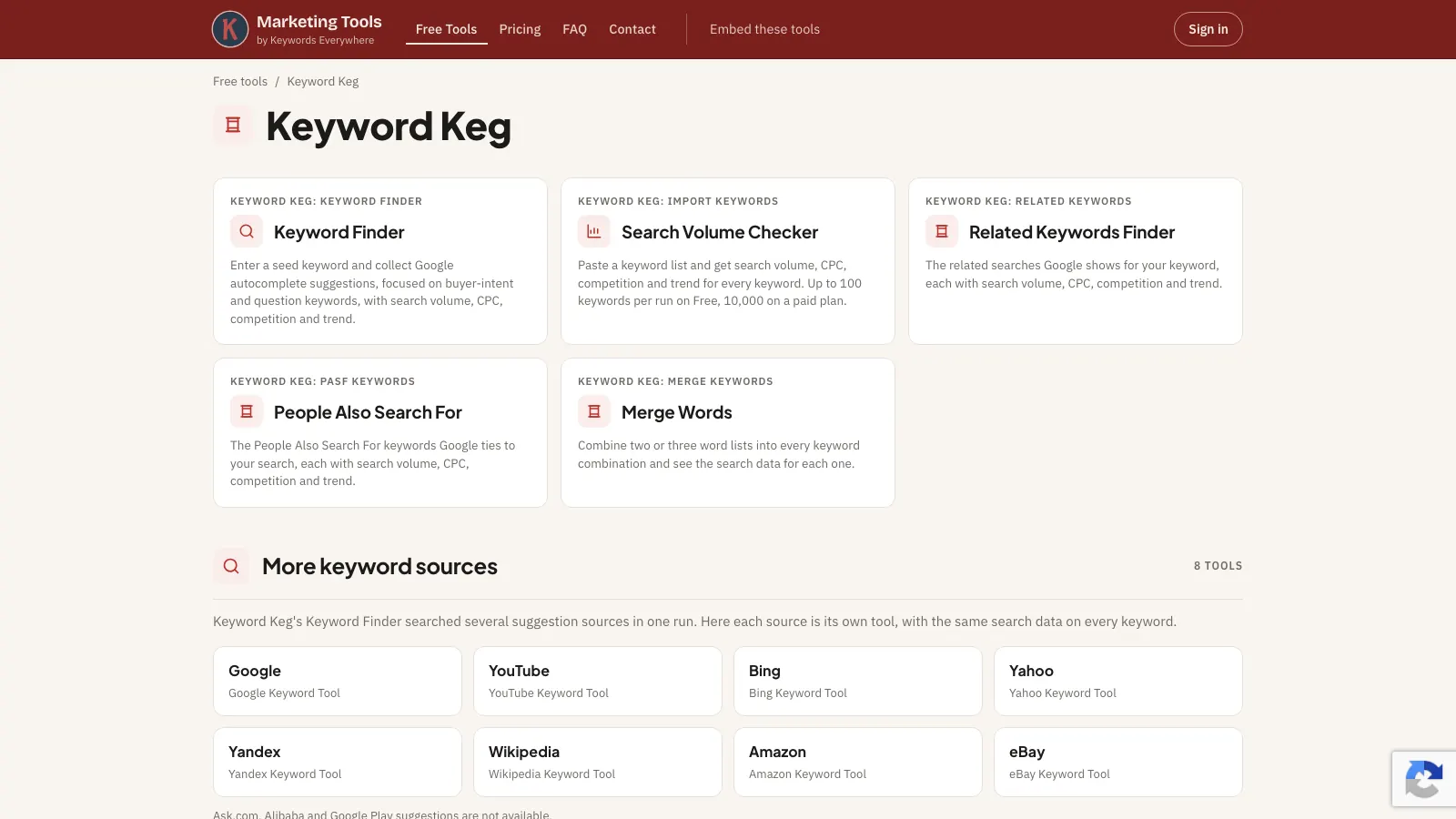
The workflow is still easy to understand. Keyword Finder expands a seed phrase from Google autocomplete. Search Volume Checker enriches a pasted list. Related Keywords Finder and People Also Search For surface two Google-derived idea sets, while Merge Words combines up to three word lists. Each tool returns search volume, CPC, competition and a 12-month trend where it provides search data.
That makes the collection more useful to a research team than the old product name suggests. You can start with a rough list, get the metrics that sort it, save promising terms to favorites, then send the same data through the API instead of retyping it into another workflow. The trade-off is fragmentation: what used to be a multi-source finder is now a set of individual tools.
Who should consider adopting Keyword Keg within Keywords Everywhere?
Keyword-list owners
Search Volume Checker accepts a pasted list of up to 10,000 terms per paid run and adds volume, CPC, competition and trend.
Small shared research teams
Silver provides three seats and 400,000 annual credits under one shared account and API key.
Agent-enabled SEO teams
Every paid plan includes the REST API and MCP server, so an assistant can request metrics and ideas directly.
Marketplace researchers
Separate tools cover Google, YouTube, Bing, Yahoo, Yandex, Wikipedia, Amazon and eBay suggestions.
It is not the cleanest fit for someone who wants a single broad SEO dashboard. The product does not monitor ranking positions over time, and Keyword Finder no longer runs several suggestion sources in one pass.  Keyword Tool review is worth reading if multi-platform autocomplete is the central requirement: it draws suggestions from 17 platforms, and every paid plan includes its web interface, API and MCP.
Which bulk data enrichment and suggestion tools remain in Keyword Keg?
Five moved research tools
Keyword Finder handles Google autocomplete suggestions and focuses on buyer-intent and question phrases. Its companion tools handle bulk volume checks, related searches, People Also Search For terms and word combinations. Source-specific tools are available for YouTube, Bing, Yahoo, Yandex, Wikipedia, Amazon and eBay. Ask.com, Alibaba and Google Play suggestions are no longer available.
Bulk list enrichment
Search Volume Checker is the practical workhorse for an existing list. The free version accepts up to 100 keywords in a run, while a paid plan allows 10,000. Every returned keyword carries search volume, CPC, competition and trend. This is a better fit for cleaning a prepared list than for deciding which pages a content strategy needs.
Related ideas with clear credit costs
Related Keywords Finder and People Also Search For can return up to 2,000 keywords per seed on a paid plan, or 100 on Free. They cost three credits per keyword because the service charges for finding the term and for its search data. Keyword Finder, Merge Words and Search Volume Checker use one credit per keyword. That distinction matters before a large discovery project.
Exports and saved terms
Every results table has Copy and CSV export. Search Volume Checker and Merge Words also export Excel, while PDF export is not offered. Signed-in visitors with credits can save terms to Keywords Everywhere favorites, which is shared with the browser extension. It is a practical handoff for an analyst, but not a white-label reporting system.
API and MCP for agents
The collection has a REST API for keyword metrics, related ideas, domain and URL keywords, traffic estimates and backlink data. Get Keyword Data accepts up to 100 keywords per request. Its MCP server connects to ChatGPT, Claude Desktop, Claude Code, Cursor, VS Code, Windsurf and Qodo Gen, using the normal API key or OAuth. The API key is free, but calls consume the plan's credits. That gives an assistant direct access to the same data, though it does not replace rank tracking.
How is Keyword Keg priced under Keywords Everywhere annual plans?
Price checked 27 Nov 2026
| Plan detail | Bronze$84/year | Silver$168/year | Gold$480/year | Platinum$1,440/year |
|---|---|---|---|---|
| Shown monthly equivalent | $7/mo | $14/mo | $40/mo | $120/mo |
| Credits per year | 100,000 | 400,000 | 2,000,000 | 8,000,000 |
| User seats | 1 | 3 | 10 | 20 |
| REST API and MCP | ✓ | ✓ | ✓ | ✓ |
| Premium prompt templates | ✕ | ✓ | ✓ | ✓ |
Keywords Everywhere prices in US dollars, 27 Nov 2026.Keywords Everywhere plans
These are annual plans, not monthly subscriptions. For a three-person team, Silver is the real entry bill: $168 a year for 400,000 credits and three seats, which the vendor shows as $14 a month. One person can use all of their own browsers and devices on a single seat, while teams share one account and API key.
- One credit buys metrics for one keyword, including volume, CPC, competition and 12-month trend
- Credits are valid for 12 months, with the oldest pool used first
- When credits run out, keyword widgets remain available but their metrics are hidden until you top up
- Custom Enterprise plans are available for teams beyond Platinum
All paid plans include the extension and API, so access is not what changes as your team grows. Credits, seats and per-website result caps do. That is refreshingly predictable, provided you estimate the credits that related-keyword research will consume.
What enterprise options exist for high-volume Keyword Keg teams?
Keyword Keg features are included in custom Keywords Everywhere Enterprise plans, though custom pricing and credit limits remain unpublished. Platinum is the last public benchmark at $1,440 a year, with 8,000,000 credits and 20 seats. Ask for the credit pool, seat count and website-research cap in writing if your team needs more than that.
Where does Keyword Keg fall short after its platform migration?
Keyword Keg faces its biggest limitation in its platform migration rather than missing tool features. The standalone product no longer has its own current plan or place to build a workflow around. The tools remain available, but every buying and support question now belongs to Keywords Everywhere. That may be fine for a new buyer, but it removes the tidy package that the old name promised.
The credit model also rewards a team that plans its research. A bulk metric check is inexpensive at one credit per keyword, but Related Keywords Finder and People Also Search For use three. Credits expire after 12 months, and exhausted credits remove the metrics that make the tools useful. Make a rough research-volume estimate before choosing a tier.
Finally, do not call it a rank tracker. The API can return the keywords a domain or URL currently ranks for, but it does not follow positions over time. Keywords Everywhere offers a separate free Website Ranking Checker that monitors positions daily with the same API key.
What alternative tools should buyers evaluate instead of Keyword Keg?
 AI Peekaboo review comes first when the question is how your brand appears in AI answers rather than which keywords to target. Its plans start at $30 a month and include API and MCP access, while Keyword Keg's moved tools focus on keyword data.
Keyword Tool review covers autocomplete suggestions from 17 platforms, with the web interface, API and MCP included on every paid plan. Paid plans start at $88 a month or $68 a month billed annually.
 Keyworddit review covers a different discovery job: it extracts keywords from a subreddit you choose and shows monthly search volume from Grepwords. A subreddit missing from its suggestion list is too small, with fewer than 10,000 subscribers.
What is the final verdict on buying Keyword Keg today?
Keyword Keg is no longer a product you should buy by name. Its five tools survive inside Keywords Everywhere, where the combination of inexpensive annual plans, large bulk checks, REST access and MCP makes sense for a lean research workflow. The honest decision is whether that credit-backed collection suits your work, not whether to hold out for the standalone service.
Start with Bronze for one researcher or Silver for three people, estimate the credits a typical discovery project needs, and use the MCP server only after you have set a sensible credit budget for automated requests.
How were Keyword Keg plans and integration limits checked?
Keyword Keg limits, tool features, and pricing details were verified against official vendor documentation on 27 Nov 2026. Prices are in US dollars as shown by the vendor, and every figure follows how we check figures.
- Keyword Keg tools and product pages
- Keywords Everywhere plan comparison
- Keywords Everywhere REST API and MCP documentation
What are frequently asked questions about Keyword Keg and its parent tool?
Is Keyword Keg still available?
Its five tools have moved into the Keywords Everywhere collection. The former Keyword Keg site redirects there, and each tool remains available at its new address.
How much does Keyword Keg cost now?
There is no separate Keyword Keg plan. Keywords Everywhere plans start at $84 a year for Bronze, with 100,000 credits and one seat. The vendor shows that as $7 a month, billed annually.
Does Keyword Keg work with AI agents?
Yes, through Keywords Everywhere. Every paid plan includes its REST API and MCP server, which use the same credit pool as the extension.
Can Keyword Keg track keyword rankings?
No. The API can return the keywords a domain or URL currently ranks for, but it does not track rank positions over time. Keywords Everywhere offers a separate free Website Ranking Checker that monitors positions daily with the same API key.
 Reviewed byDanny Kirk
Founder of ReddiReach.
 Checked byAndrés Felipe
Digital designer and marketer.
Every figure is checked against the vendor's own page. Read our editorial standards.