
Key Takeaways
- Knack enables teams to build custom web applications, internal operational tools, and external client portals backed by relational databases with unlimited authenticated user access.
- Knack pricing begins at $59 monthly for Starter, $130 monthly for Pro, and $300 monthly for Corporate on standard month-to-month subscription billing.
- Knack provides relational database modeling, custom user roles, workflow automations, and enterprise-grade security options designed for mission-critical business application deployments.
- Knack includes a REST API, a dedicated Model Context Protocol server, and monthly AI building credits ranging from 25 to 100 on paid subscription tiers.
You need to turn operational data into a customer portal or internal web app without paying for every person who logs in. Knack is the better fit when unlimited users matter more than a low entry price, provided you can size the records those users add to your database.
Agent access
- API
- Yes, Starter, Pro, Corporate, Enterprise, and Plus plans
- MCP server
- Official, hosted, OAuth 2.1 with PKCE
- Works with
 ClaudeClaude Code
 ChatGPT
 VS Code
- Automation
- Zapier, Make
What are the major pros and cons of Knack?
What works
- Unlimited users and roles on every plan
- Database, web app designer, automations, API, and AI app builder in one product
- No setup fees or contracts, and a trial without a credit card
What to watch
- Starter stops at 20,000 records and three applications
- Pro is $130/month before any annual discount
- Corporate starts at $300/month and varies with usage requirements
What does Knack do for database and portal development?
Knack starts with a relational database, then lets you place forms, pages, permissions, and workflows around that data. The result can be a custom CRM, customer portal, event system, grants tracker, inventory tool, or project application. It is built for a team that needs a working interface around a process, not a generic spreadsheet with a few automations attached.
The commercial decision turns on records rather than seats. Knack says there is no limit on the people who can optionally log in to an app, but each person counts as a stored record. That can make a broad portal easier to budget for than per-seat software, while making a growing customer list part of the capacity calculation. For more options in this category, the marketing tools directory is a sensible place to compare the job before selecting a builder.
Starter carries the basic building blocks: an online database, a front-end app designer, unlimited users and roles, Knack Flows and the API. Pro is the practical step-up for teams that need unlimited apps, scheduled tasks, a custom domain, ecommerce payments, maps, branding removal, and one month of audit logs. The pricing is not casual, so map the records, applications, and access rules before a portal becomes part of day-to-day operations.
Who is Knack best designed for in operations and development?
Portal Owners
Give many external users a role-based login while keeping Knack bill independent of their seat count.
Operations Teams
Turn grants, inventory, events, or projects into a tailored application with records, forms, and permissions in one place.
Growing Businesses
Use Pro when unlimited applications, scheduled tasks, a custom domain, and more record capacity suit a complex workflow.
Regulated Organizations
Discuss Enterprise when dedicated support, audit retention, private servers, or HIPAA and GovCloud-based options are required.
Knack is less convincing when the job is only a lightweight database. Its plan structure rewards a focused application with a known audience and a known record model. A team that cannot say how many records it will store, or whether it needs more than three apps, has not yet answered the question that determines the real plan.
Which application building features does Knack deliver?
Database and application design
Knack provides an online relational database and a front-end web app designer, with unlimited tables, fields, and pages. The key capacity limit is records: Starter has 20,000, Pro 50,000, and Corporate 125,000 before a sales conversation is needed to scale further. Enterprise lists 2.5 million or more records. Treat the total as a product requirement, because it includes people who access the app as well as operational data.
Users, roles, and access
Every plan lists unlimited users and roles. Knack says people can optionally log in without a user limit, and that each becomes a database record. This is valuable for a portal with a large but uneven audience, where per-user billing would be awkward. Pro adds two-factor authentication for app users, while the higher plans list advanced SSO. Pro's advanced SSO is a $55 add-on, and Corporate and Enterprise include it in their listed features.
Flows and connected work
Knack Flows is its automation layer. The integrations directory says it connects with more than 700 connectors and lists outgoing webhooks and HTTP requests. The pricing page presents flows and the Knack API as core capabilities, while scheduled tasks are called out on Pro. The plan must still cover the records and applications the workflow depends on.
AI builder, API, and MCP
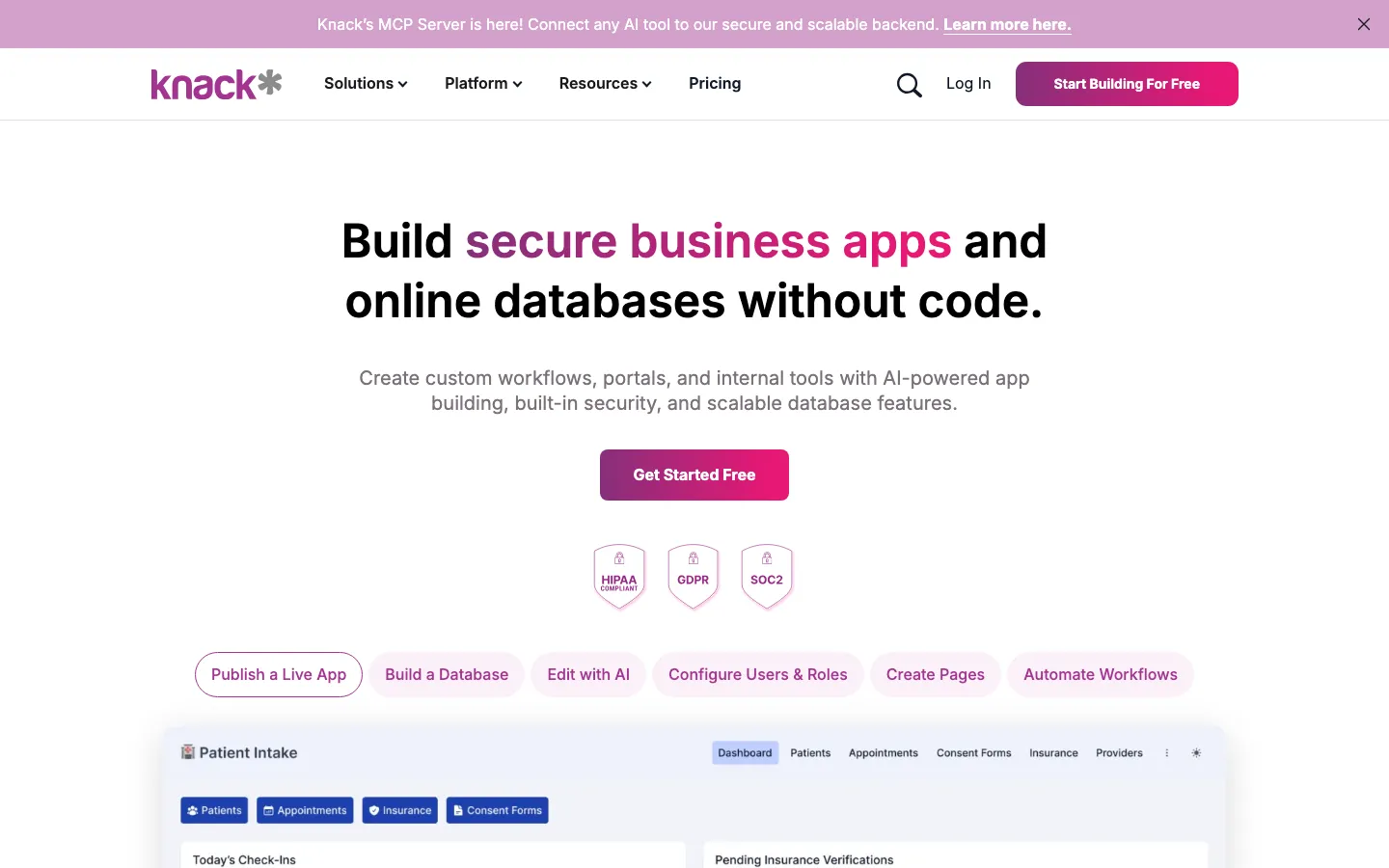
Knack lists an AI App Builder on its pricing plans, with 25 monthly AI credits on Starter, 50 on Pro, and 100 on Corporate. Its pricing page also lists the Knack API, while its home page announces an MCP Server intended to connect AI tools to its backend. Confirm MCP plan access and API limits with Knack before making either part of an automated build.
Audit and enterprise controls
Record change history can show the author, IP address, and highlights of each change. Pro lists one month of audit logs, Corporate two months, and Enterprise three months. Enterprise also lists a dedicated account manager, enhanced support, private server environment options, and HIPAA or GovCloud-based options. Those are material distinctions for a sensitive operational app, not details to leave until after the data model has been approved.
How is Knack priced across subscription tiers?
Price checked 27 Nov 2026
| Plan detail | Starter$59/mo | Pro$130/mo | CorporateFrom $300/mo |
|---|---|---|---|
| Billing basis | Monthly | Monthly | Monthly, usage affects final cost |
| Database records | 20,000 | 50,000 | 125,000; contact Sales to scale to 2.5 million |
| Applications | 3 | Unlimited | Unlimited |
| File storage | 2 GB | 10 GB | 50 GB |
| Monthly AI credits | 25 | 50 | 100 |
| Custom domains | Not listed | 1 | 3 |
| Audit logs | Not listed | 1 month | 2 months |
Knack prices in US dollars, 27 Nov 2026.Knack pricing
Annual billing changes the two published fixed prices: Starter is $49/month and Pro is $110/month. Knack says annual subscriptions represent two free months, or 17% off the monthly price. A new-customer promotion shows Starter at $19/month and Pro at $49/month for the first three months, so it is not a durable planning price.
There is no per-user line item to multiply by a team size. Each user account counts as a stored database record. Five users can use Starter at $59/month on monthly billing when the application also stays within its 20,000-record, three-app, storage, and feature limits. A portal with hundreds of accounts can use the same plan only when those combined limits still fit. Corporate begins at $300/month, but its final cost depends on usage requirements. Enterprise is quoted.
The listed add-ons and upgrade points are worth treating as part of the budget:
- Advanced SSO is a $55 add-on on Pro
- A scheduling add-on is available on Pro
- Corporate pricing is a starting price, not a fixed ceiling
- Knack accepts major credit cards, not checks, PayPal, or bank transfers
What does the Knack Enterprise tier provide?
Knack Enterprise is for mission-critical applications requiring enterprise-grade security and customer support. Knack does not publish a price. It lists a dedicated account manager, enhanced support, private server environment options, HIPAA or GovCloud-based options, three months of audit logs, and 2.5 million or more database records. Ask what applies to your deployment and data retention needs.
Where does Knack fall short for growing applications?
Knack's user model can be misunderstood. Unlimited users is not unlimited capacity, because each user is a record. A fast-growing portal can run into the same plan limit through customer accounts, transactions, and operational records at once. Start with a record inventory, then leave room for the audience you expect after launch.
Starter is also deliberately bounded. It stops at three applications, 20,000 records, and 2 GB of file storage. The $59/month price brings the basic platform, but the functions that make an externally branded application feel more complete, including a custom domain and branding removal, are listed on Pro. A team needing those from the beginning should compare against $130/month, not choose Starter on price alone.
Finally, the automation and AI story has open boundaries. Knack names the API, MCP Server, flows, and AI App Builder. Ask Knack which plan enables MCP and what API limits apply before machine access becomes part of a production workflow.
What are the primary alternatives to Knack?
 If the main job is orchestrating an automation rather than creating a portal around a database, read the Latenode review. Its free tier includes 10,000 CPU seconds each month, so it is the relevant comparison when workflow execution drives the purchase.
 For task-oriented automation, the Lindy review is the other useful contrast. Its Team plan costs $49.99 per user each month, checked 27 Nov 2026, and each paid user contributes 5,000 monthly credits to the workspace's shared pool, unlike Knack's record-based application capacity.
What is the final verdict on Knack?
Knack works best when a database-backed portal or operational application needs many logins, but its record limits still fit the expected workload. Its strength is the way data, permissions, interface, and workflow sit together. Its caution is equally clear: records, apps, domains, and audit needs force an early plan decision.
Build a record inventory before the trial. Count the operational records, expected login accounts, files, and applications, then begin on Starter only when three apps and 20,000 records leave credible room to grow. Price Pro immediately if a custom domain, scheduled tasks, or unlimited applications are requirements.
How was Knack reviewed and verified?
Prices and plan capacities in this review came from Knack's pricing pages, connector details from its integrations page, and the MCP Server announcement from its home page, all checked on 27 Nov 2026. Prices are in US dollars as Knack shows them, and every figure follows how we check figures.
- Knack pricing pages for monthly, annual, and Corporate terms
- Knack integrations page for connector, webhook, and HTTP request details
- Knack home page for the MCP Server announcement
What are common questions about Knack?
Does Knack charge per user?
No. Knack says there is no limit on people who can optionally log in to an app. Each user counts as a database record, so the record allowance remains the capacity to plan around.
How much does Knack cost?
Starter is $59/month on monthly billing or $49/month billed annually. Pro is $130/month monthly or $110/month annually. Corporate starts at $300/month, and Enterprise is quoted.
How many apps can you build with Knack?
Starter includes three applications. Pro and Corporate list unlimited applications. Enterprise directs buyers to contact Knack about application capacity.
Does Knack have an API and MCP server?
Knack lists the Knack API and announces an MCP Server that connects AI tools to its backend. Confirm MCP plan access and API limits with Knack before relying on either one.
 Reviewed byDanny Kirk
Founder of ReddiReach.
 Checked byAndrés Felipe
Digital designer and marketer.
Every figure is checked against the vendor's own page. Read our editorial standards.