
Key Takeaways
- Local Falcon tracks local ranking positions across neighborhood geo-grids on Google Maps and Apple Maps, replacing misleading single-point zip code averages with visual spatial data.
- Local Falcon prices its Starter plan at $24.99 monthly for 7,500 credits, with each credit covering one geographic scan point.
- Local Falcon bundles standard APIs, dashboard connectors, and an MCP server on Starter, while offering an on-demand scan API with separate billing.
- Local Falcon is poorly suited for organizations requiring permanent credit rollover or simple single-location rank tracking without geographic grid depth.
Local Falcon is the local SEO platform to choose when your team needs a precise map of how a business ranks across an area, rather than one average position. Its $24.99 Starter plan makes a sensible entry for targeted checks, but agencies should only commit after turning their scan schedule into credits, because every grid point draws from the allowance.
Agent access
- API
- Yes, every Local Falcon plan, starting with Starter ($24.99/month)
- MCP server
- Official, hosted or local, OAuth 2.1 with PKCE, or a Local Falcon API key
- Works with
 ClaudeClaude Code
 ChatGPT
 Cursor
 VS Code
 n8n
- Automation
- Zapier, n8n
What are the main pros and cons of using Local Falcon?
What works
- Geo-grid scans show local rank variation point by point
- Google Maps, Apple Maps and named AI platforms are covered
- Standard API, MCP, reporting and automation options support agency workflows
What to watch
- Scan volume determines how quickly a credit allowance is used
- Unused credits expire at the end of the billing cycle
- User access terms are not published alongside credit allowances
How does Local Falcon visualize local search rankings across a geo-grid?
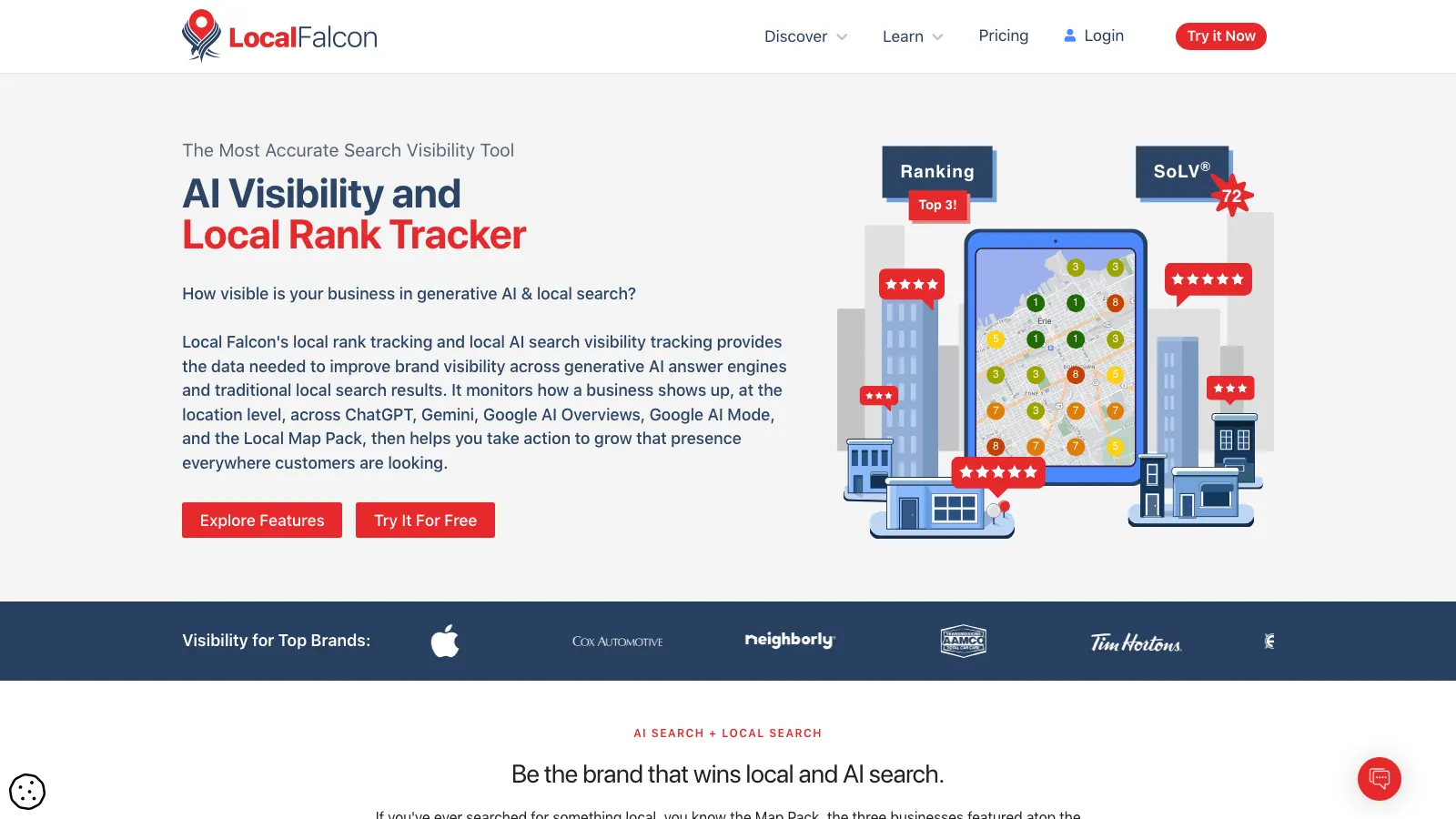
Local Falcon turns a local ranking question into a map. Instead of reporting one position for one location, it can scan a grid from 3 by 3 to 21 by 21 and show the result at each point. That matters when a restaurant, clinic or service business wins near one neighborhood and disappears a few miles away. One number can hide that difference; a grid makes the service area visible. If comparable AI answers lead the reporting job instead, the  AI Peekaboo review covers the same buyer questions across ChatGPT, Gemini, Perplexity, Google AI Mode and Google AI Overviews.
The platform covers Google Maps and Apple Maps for local rank tracking, then applies that geographic approach to AI visibility on platforms such as ChatGPT, Gemini, Google AI Overviews, Google AI Mode and Grok. It reports Share of Local Voice for map results and uses separate AI metrics for the AI scans. The result is more useful for a local account than a broad SEO dashboard when the question is where the business is surfaced.
Which agencies and multi-location brands should deploy Local Falcon?
Local SEO agencies
Campaigns, scheduled scans, public report URLs and white-label reports help agencies turn local data into a client deliverable.
Multi-location businesses
Unlimited listed keywords and locations let a team organize a wide footprint, while credits scale with the scanning plan.
Local AI visibility teams
AI scans add location-specific responses from named AI platforms to the same local search workflow.
Technical operators
The API, MCP server, Claude Connector and n8n integration provide routes to use scan data outside the dashboard.
I would not make Local Falcon the default for a business that only wants a simple rank number each month. Its value comes from seeing the spread across a place, comparing locations and choosing the right scan pattern. That detail is an advantage for an agency, but unnecessary structure for a very small reporting need.
What map scanning and local SEO reporting capabilities does Local Falcon offer?
Geo-grid local rank tracking
Google Maps and Apple Maps scans use a configurable grid and radius. The available grids run from 3 by 3 through 21 by 21, while the scan radius can run from 0.1 to 100 miles. A 5 by 5 scan uses 25 credits because every map point is a data point. That simple relationship makes it possible to plan the cost before a campaign goes live.
Local AI visibility scans
Local Falcon tracks a business on AI platforms such as ChatGPT, Gemini, Google AI Overviews, Google AI Mode and Grok. The scan view can show where the brand is mentioned, competing businesses at each point, sources referenced by the AI platform and the individual response for a sample. It is a local lens on AI discovery, not a replacement for conventional Maps results.
Campaign and reporting views
Scan, campaign, trend and competitor reports keep the work from becoming a folder of isolated heatmaps. A campaign aggregates locations, keywords and platforms, while trend reporting follows changes for a keyword and location. Reports can be shared through public URLs or exported as CSV and PDF. Agencies also get white-label reporting on the published plan comparison.
API, MCP and automation
Local Falcon includes its standard API, MCP and connectors on every plan from Starter. API scans use the credits in the account, like scans run in the app. Its MCP server can run scans, retrieve reports, analyze competitors and manage campaigns from an AI conversation. A Claude Connector and n8n integration give a team two lower-friction ways to place the data in an existing workflow. The separately billed On-Demand Scan API is different: it returns raw Google Maps results for specified coordinates without saving locations to an account.
Falcon AI and monitoring
Falcon AI can analyze scan data and produce recommendations, at 25 credits per report. Falcon Guard monitors Google Business Profile fields and sends email alerts when it detects a change. It costs $0.10 per location a month, checked 27 Nov 2026. Those tools are useful only after the core scan schedule is sound. A team that scans the wrong locations more frequently does not solve the problem by adding another layer of analysis.
How does Local Falcon calculate credit costs and plan pricing?
Price checked 27 Nov 2026
| Plan detail | Starter$24.99/mo | Basic$49.99/mo | Pro$99.99/mo | Premium$199.99/mo |
|---|---|---|---|---|
| Monthly credits | 7,500 | 15,150 | 31,250 | 63,150 |
| Annual price | $299.88 | $599.88 | $1,199.88 | $2,399.88 |
| Annual credits | 90,000 | 183,000 | 383,000 | 778,000 |
| Keywords and locations | Unlimited | Unlimited | Unlimited | Unlimited |
| API, MCP and integrations | ✓ | ✓ | ✓ | ✓ |
Local Falcon prices in US dollars, 27 Nov 2026.Local Falcon pricing
Annual plans trade monthly expiry for annual expiry. That makes the annual allocation more flexible for seasonal work, but it is still an allocation that expires. Pay-as-you-go credits cost $0.05 each and do not expire.
The published plan table states credit allowances, not user-access terms, so confirm those terms before treating a subscription as a team bill. As an illustrative 52-scan workload, one location and one keyword scanned weekly on a 5 by 5 grid uses 1,300 credits a year. Starter is $24.99 a month for 7,500 monthly credits and includes the standard API, MCP and connectors, but the right plan still depends on the grid size, locations, keywords and scan frequency you put in writing.
Two advertised extras sit outside that subscription allowance. Falcon Guard costs $0.10 per location a month. The Google Maps-only On-Demand Scan API costs $199 a month plus $0.0032 per call, separately from credits. Both prices were checked 27 Nov 2026, so include them only when that specific monitoring or raw-coordinate workflow is part of the plan.
What volume discounts and capabilities are included in Local Falcon Enterprise?
Local Falcon Enterprise provides high-volume tiers ranging from 157,000 to 1,570,000 monthly credits at published rates between $499 and $4,999. They suit a high-volume agency or a large location network whose planned scan load already exceeds Premium, not a team looking for a vague upgrade. Custom plans are available above the listed range. Falcon Agent is included with annual and enterprise plans, but it does not remove the need for a clear scan schedule.
Where does Local Falcon fall short regarding credit expiration?
Local Falcon enforces strict monthly credit expiration policies that penalize accounts with fluctuating scanning schedules. Monthly credits expire at the end of the billing cycle, and annual credits expire at the end of the year. A team that buys a bigger tier for reassurance can waste the buffer if it has not turned the campaign into a repeatable scan plan. Local Falcon is flexible when usage is understood and unforgiving when it is guessed.
The second constraint is complexity. Grid size, radius, location, keyword, platform and scan frequency all shape the result and the credit use. That is necessary for a detailed local program, but it gives a new user more operational choices than a simple rank tracker. The platform's own guidance recommends different starting radii for urban, suburban and rural areas, which underlines why one default is not right for every client.
User-access terms are another question to settle before a team rollout. Local Falcon includes the standard API, MCP and connectors from Starter, but its published credit table does not establish how many people may use a plan or what extra access costs. Confirm that part of the operating bill separately.
Which search tracking platforms serve as alternatives to Local Falcon?
Local Falcon alternatives include AI Peekaboo, which prioritizes generative AI visibility metrics over map rank tracking. It runs the same buyer questions across ChatGPT, Gemini, Perplexity, Google AI Mode and Google AI Overviews, which changes the choice if consistent cross-model answer coverage matters more than location-specific results.
 Read the Local Viking review if Google Business Profile publishing is the job beside local visibility. It can schedule recurring posts and supports Offer, Standard and Event Posts, making it the more relevant comparison for a team that needs a repeatable posting program.
 The Localith review is worth weighing if bulk Google Business Profile updates or a Google posts scheduler are more important than geo-grid detail. Once you know which local workflow leads the decision, the marketing tools directory can help you widen the comparison without treating every local tool as interchangeable.
What is the final verdict on using Local Falcon for local SEO?
Local Falcon delivers precise neighborhood-level map tracking that justifies its place in agency and multi-location marketing budgets. Its geo-grid scans, local AI visibility coverage and automation options give an agency a detailed system for managing that work. The lowest price is not the decision, though: a well-planned credit model is what makes Local Falcon affordable and useful.
Start with Starter for a deliberate set of grid checks and standard API, MCP or connector work. Price the separately billed On-Demand Scan API only if raw Google Maps results for specific coordinates are required. Move up only after the live scan plan, not an assumed workload, shows that the credit allowance is too small.
How was the data in this Local Falcon review gathered and checked?
Local Falcon plan structures, documentation specifications, and credit rules were reviewed against official resources on 27 Nov 2026. Prices are in US dollars, as Local Falcon shows them, and every figure follows how we check figures.
- Local Falcon pricing and credit explanations
- Local Falcon local rank tracking and AI visibility pages
- Local Falcon API, MCP and integration documentation
What are frequently asked questions regarding Local Falcon grid scans?
How much does Local Falcon cost?
Starter is $24.99 a month, Basic is $49.99, Pro is $99.99 and Premium is $199.99. The plans are credit-based, so scan design determines how much of that allowance a team uses.
What is a Local Falcon credit?
A credit is one data point, also called a map pin, in a geo-grid scan. A 5 by 5 grid uses 25 credits. Monthly credits expire at the end of the billing cycle.
Which AI platforms can Local Falcon track?
Local Falcon lists ChatGPT, Gemini, Google AI Overviews, Google AI Mode and Grok for AI visibility tracking. It uses geo-grid sampling to show how results can vary by location.
Can Local Falcon work with an AI agent?
Yes. Local Falcon documents a REST API, MCP server and Claude Connector. The standard API, connectors and MCP are included from Starter, while the Google Maps On-Demand Scan API is separately billed.
 Reviewed byDanny Kirk
Founder of ReddiReach.
 Checked byAndrés Felipe
Digital designer and marketer.
Every figure is checked against the vendor's own page. Read our editorial standards.