
Key Takeaways
- LowFruits helps bloggers, niche-site builders, and small content teams discover long-tail SERPs where low-authority sites already rank rather than relying on a single difficulty metric.
- LowFruits prices its Standard subscription at $20.75 per month billed yearly for 3,000 monthly credits, while pay-as-you-go packs start at $25 for 2,000 credits.
- LowFruits publishes no API, MCP server, or automated agent integration, so teams should confirm access directly with the vendor before planning custom reporting pipelines.
- Buyers should skip LowFruits if they want an all-in-one SEO suite from one subscription or if wildly fluctuating monthly research volume clashes with non-rollover subscription credits.
LowFruits is the keyword research tool I would choose when you need to find long-tail SERPs where smaller sites already have a foothold, rather than trust one difficulty score. Pass on it if your work needs a broad platform from one subscription: LowFruits is strongest at opportunity discovery, and its subscription credits reset each month.
Agent access
- API
- Not found on official pages
- MCP server
- Not found on official pages
What are the pros and cons of LowFruits?
What works
- Bulk SERP analysis flags low-authority sites in top-10 results
- Wildcard searches surface long-tail variations from Google Autocomplete
- Keyword clustering groups related queries by intent
What to watch
- Subscription credits reset each month instead of rolling over
- Domain Explorer and Rank Tracker require a subscription
- Pay-as-you-go credits expire one year after purchase
What does LowFruits do for your team?
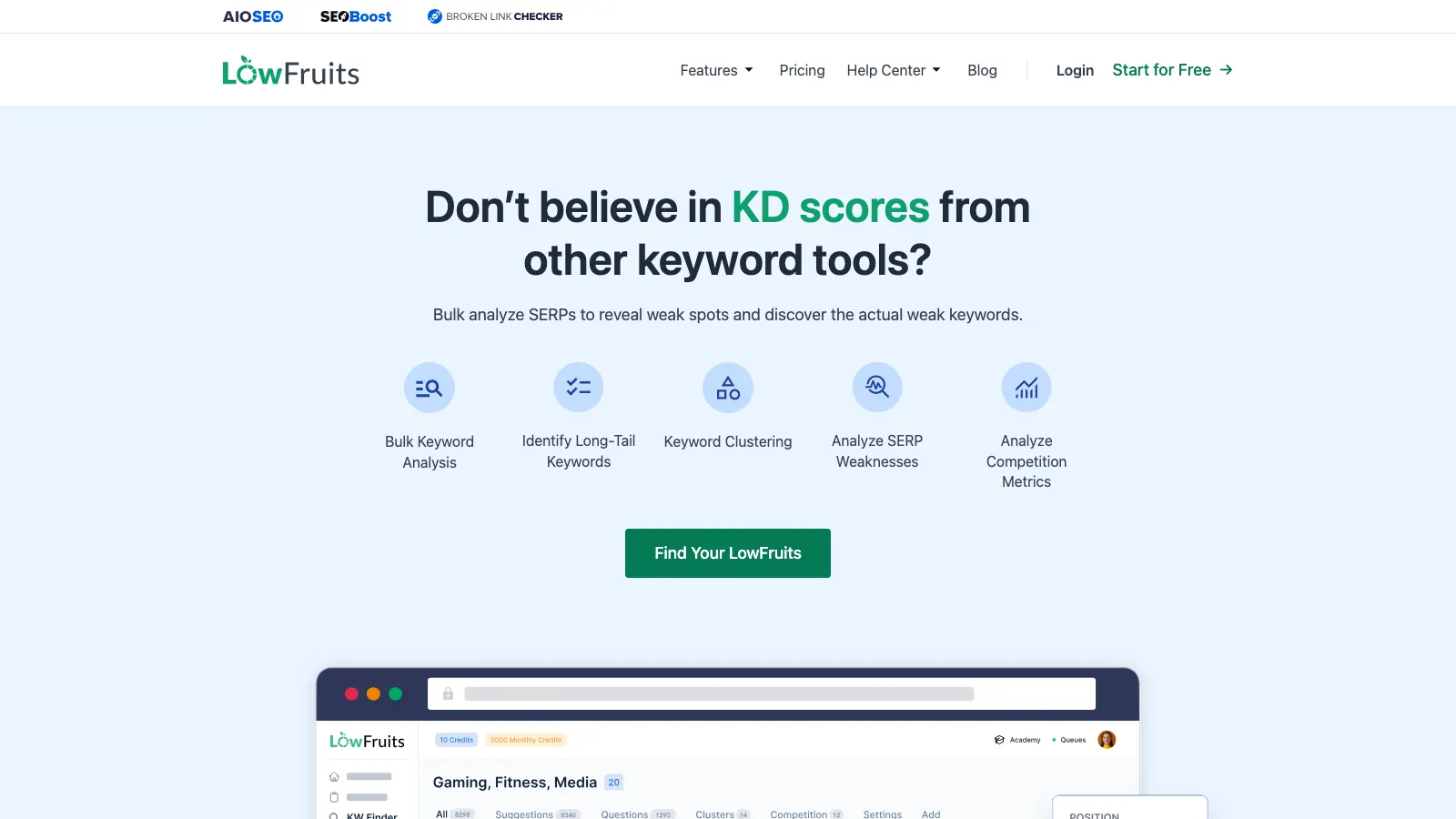
LowFruits addresses how keyword planning goes wrong when a team treats a modeled difficulty number as the decision. LowFruits gives you a different starting point: it analyzes results in bulk and highlights weak spots such as low-domain-authority sites already appearing in Google. If you are still choosing between research tools, the marketing tools directory lets you browse the other keyword research options. That is useful when your site is still building authority and the realistic question is whether the first page has room for another credible result.
The workflow is compact. Bring in a list you already have, or use wildcard searches to pull long-tail variations from Google Autocomplete. Then analyze those terms and group related queries into clusters.
LowFruits is brought to you by the same team behind AIOSEO and is a trademark of Semper Plugins, LLC.
Choosing between LowFruits plans comes down to how consistently your content team runs bulk SERP analysis, wildcard Google Autocomplete searches, and intent-based keyword clustering. The Standard subscription costs $20.75 per month billed yearly for 3,000 monthly credits, 30 competitor ranking extractions, 300 competitor keyword ideas, and 100 tracked keywords. Scaling up to Premium at $62.45 per month billed yearly raises those monthly limits to 10,000 credits, 70 competitor ranking extractions, 900 competitor keyword ideas, and 500 tracked keywords. Both annual subscriptions unlock the Domain Explorer, the boosted keyword finder, unlimited free report downloads, and a 10% discount on pay-as-you-go packs, whereas one-time Pay-As-You-Go packs starting at $25 omit competitor extractions, rank tracking, Domain Explorer, and boosted searches while limiting report downloads. Unused subscription credits never roll over between billing periods, and pay-as-you-go credits expire after one year. Teams hoping to pipe SERP opportunity data into external dashboards or AI agents hit a firm boundary: LowFruits states that it currently offers no API, and reviewed public documentation includes no vendor MCP server.
Who is LowFruits best for?
Newer sites
Use it to look for SERPs where lower-authority domains already rank, then prioritize the terms that fit your expertise.
Content planners
Wildcard discovery and clustering help turn a scattered list into related topic groups.
Project-based consultants
Pay-as-you-go packs suit a concentrated research project better than a standing monthly commitment.
Small SEO teams
Standard includes 3,000 monthly credits and 100 tracked keywords without enterprise pricing.
I would not make LowFruits the only research subscription for a large team. Its value is the decision at the start of the work, finding terms with a plausible opening. The rest of your SEO workflow may still need other software.
What features does LowFruits include?
Bulk SERP Checker
The Bulk SERP Checker is the reason to buy LowFruits. It can analyze SERPs simultaneously and identify low-authority competitors in the top 10 organic results. Rather than asking whether a score looks low enough, you can inspect whether the results already include sites that look closer to your own starting point.
Keyword Finder
The Keyword Finder uses wildcard operators and Google Autocomplete to discover variations that other keyword tools can miss. Use it when a broad seed phrase is too blunt: a wildcard can expose the modifiers and questions that make a topic specific enough to compete for.
Keyword clustering
LowFruits automatically groups related queries into keyword clusters. This is more useful than it sounds when you are planning a small site, because it helps separate terms that belong on one page from terms that deserve their own angle. The point is not to make a giant list, but to stop several pages from chasing the same intent.
Competitor and domain research
Subscription plans include competitor ranking extractions, 30 on Standard and 70 on Premium. Domain Explorer is also a subscription feature, with a database of more than 100K low-authority websites. Use those tools to find weak competitors first, then move into the keywords they already rank for.
Rank Tracker
Rank Tracker is another subscription-only feature. Standard supports 100 tracked keywords and Premium supports 500, with monitoring available daily, weekly or monthly. That makes it a useful follow-through after discovery, although the published plan limits matter more than the tracker itself when you are deciding between the tiers.
How much does LowFruits cost?
Price checked 27 Nov 2026
| Plan detail | Standard$20.75/mo | Premium$62.45/mo | Pay-as-you-goFrom $25 |
|---|---|---|---|
| Billing | Yearly $20.75/mo Monthly $29.9/mo | Yearly $62.45/mo Monthly $79.9/mo | One-time pack |
| Credits | 3,000/month | 10,000/month | 2,000, 5,000 or 10,000 |
| Competitor ranking extractions | 30/month | 70/month | Not included |
| Tracked keywords | 100 | 500 | Not included |
| Domain Explorer | ✓ | ✓ | Not included |
| Credits roll over | No | No | Expire after 1 year |
LowFruits prices in US dollars, 27 Nov 2026.LowFruits pricing
Yearly billing puts Standard at $20.75 a month and Premium at $62.45 a month. Monthly billing raises those prices to $29.9 and $79.9 a month. Standard supplies 3,000 credits a month, while Premium raises that to 10,000. Unused subscription credits reset every month, so the yearly rate works best for a team with dependable monthly work, not a team that does one large planning sprint and then goes quiet.
- Standard: 3,000 credits a month, 30 competitor ranking extractions and 100 tracked keywords
- Premium: 10,000 credits a month, 70 competitor ranking extractions and 500 tracked keywords
- Pay-as-you-go: packs from $25 with 2,000 credits, valid for one year
For a one-off project, the $25 pack is the cleaner choice. For regular work, Standard's annual-billed $20.75 monthly rate is the better starting point. The vendor also offers a first analysis at no cost, and paid plans have a 14-day money-back guarantee when fewer than 100 credits have been used.
Where does LowFruits fall short?
LowFruits runs a credit model that stays friendly only when your workload is predictable. Subscription credits do not move into the next month, while pay-as-you-go credits eventually expire. That makes a carefully scoped project easier to price than an open-ended research habit.
More importantly, the subscription gate is real. Pay-as-you-go credits can generate keyword ideas and extract SERPs, but Domain Explorer, Rank Tracker, Boosted Keyword Finder and competitor extractions sit with subscriptions. If tracking and competitor work are central, budget for Standard rather than assuming a credit pack covers the full product.
LowFruits does not publish an API, MCP server or agent integration. If your keyword research must flow directly into an automated reporting or planning system, ask before you make LowFruits part of the workflow.
What are the best LowFruits alternatives?
 AI Peekaboo review is the relevant next read when your job is AI-answer visibility rather than keyword discovery: its REST API brings prompts, scores, sources and snapshots into reports and workflows on every paid plan.
 NEURONwriter review covers an agentic content optimization and AI visibility platform whose AI monitoring includes Google AI Overviews, ChatGPT and Perplexity. Its plans also include Content Designer and unlimited team members.
 QuestionDB review covers question research from People Also Ask, Google SERP and People Also Search, with five free searches a month or 100 on the $9.99 monthly Solo plan.
Is LowFruits worth buying?
LowFruits earns its place beside a broader SEO stack when your hardest call is which keywords a smaller site can honestly pursue. Its SERP analysis, wildcard discovery and clustering give that call a useful structure, and Standard is inexpensive enough for a small team doing regular planning. Skip the subscription if you need an all-purpose suite or cannot use the credits consistently.
Start with a first analysis, then use pay-as-you-go for a defined research project or Standard for recurring monthly planning. Before upgrading, map the number of SERPs, competitor extractions and tracked keywords you actually need.
How was LowFruits verified for this review?
LowFruits' own pricing, product, feature, documentation, and company pages were checked on 27 Nov 2026. Prices are in US dollars, as LowFruits shows them, and every figure follows how we check figures.
- LowFruits pricing page
- LowFruits feature pages for SERP analysis, keyword finding, clustering, Domain Explorer and Rank Tracker
- LowFruits documentation and company page
What are common questions about LowFruits?
What does LowFruits do?
It finds keyword opportunities by analyzing SERPs in bulk and highlighting weak spots, including low-authority sites already ranking in the top 10 results.
How much does LowFruits cost?
Yearly billing is $20.75 a month for Standard and $62.45 a month for Premium. Monthly billing is $29.9 and $79.9 a month. Pay-as-you-go packs start at $25 for 2,000 credits.
Do LowFruits credits roll over?
No. Subscription credits reset each month. Pay-as-you-go credits do not reset monthly, but they expire one year after purchase.
Can I use LowFruits without a subscription?
Yes, with pay-as-you-go credits for keyword ideas and SERP extraction. Domain Explorer and Rank Tracker require a subscription.
 Reviewed byDanny Kirk
Founder of ReddiReach.
 Checked byAndrés Felipe
Digital designer and marketer.
Every figure is checked against the vendor's own page. Read our editorial standards.