
Key Takeaways
- Lumar provides enterprise digital teams with unified intelligence covering technical SEO auditing, AI search engine visibility, core web vitals, and accessibility compliance.
- Lumar operates exclusively on a custom enterprise pricing model without public self-serve plans, tailoring annual contracts to site scale and crawl complexity.
- Lumar exposes a robust GraphQL API enabling technical engineering groups to query and export site audit metrics directly into enterprise data warehouses.
- Lumar lacks native Model Context Protocol support and remains cost-prohibitive for organizations needing only basic website crawlers or isolated point solutions.
Lumar is the right call when your enterprise team needs technical SEO, AI visibility, site performance and accessibility in the same platform. Pass if your budget needs a public number before a sales conversation, or if your work only calls for a focused crawler.
Agent access
- API
- Yes, available for all users
- MCP server
- Official, hosted, OAuth for interactive connections, with bearer user-key and service-account-key options
- Works with
 ClaudeClaude Code
 ChatGPT
 Cursor
- Automation
- Zapier
What are the primary pros and cons of using Lumar at scale?
What works
- Technical SEO, GEO, performance and accessibility in one platform
- GraphQL API and integrations for your existing technical stack
- Protect can turn website checks into CI/CD gates
What to watch
- No published plan or team price
- Limits are tailored, so procurement needs a proposal
- No listed MCP server for agent workflows
How does Lumar combine technical SEO, site speed, and accessibility monitoring?
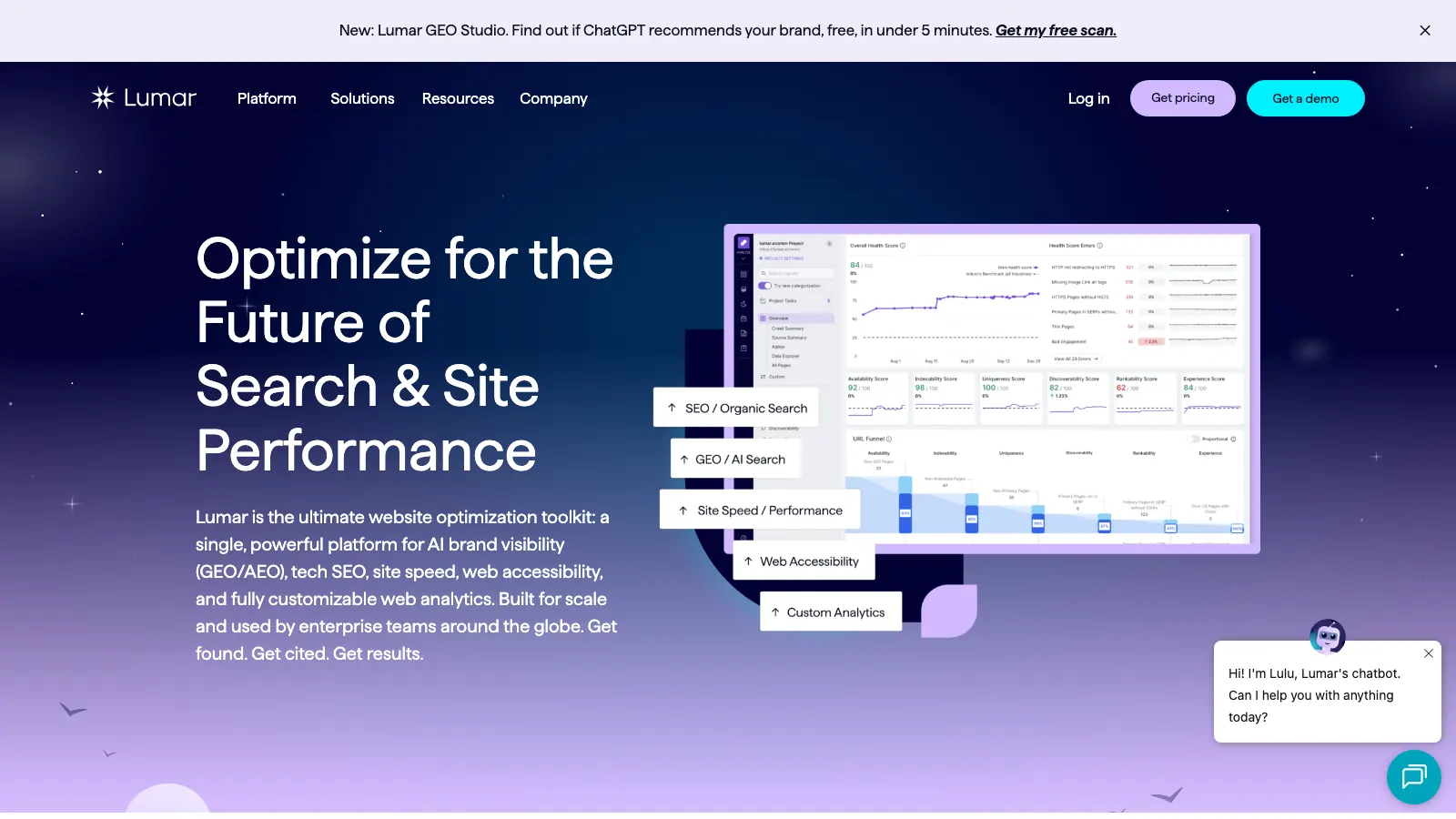
Lumar is built for the moment when a website issue belongs to more than the SEO team. It combines GEO and AEO metrics, technical SEO, site speed, web accessibility and custom analytics, then puts monitoring, testing and stakeholder reporting around that work. For a large site, the appeal is not another dashboard. It is a place where the people who find an issue, the people who fix it and the people who approve the work can work from the same evidence.
The platform is organised around four jobs. Analyze audits the site, Monitor follows changes across domains and site sections, Protect automates website QA, and Impact supplies dashboards, benchmarks and reporting. Its crawler is designed for large sites, with 250 or more built-in reports plus custom data extraction. That is a much broader remit than a one-off technical audit, and a different purchase from AI-only tracking such as the AI Peekaboo review describes.
If AI search is now part of your technical remit, Lumar's combination makes sense. Its GEO and AEO tools track brand mentions and sentiment across major platforms, alongside the crawl data that explains whether the site is ready to be found and understood.
Which organizations derive the greatest impact from deploying Lumar?
Enterprise SEO teams
Audit and monitor large sites while prioritizing fixes for the people who own them.
Web and engineering teams
Put quality thresholds in a deployment workflow instead of finding issues after release.
Accessibility teams
Run checks aligned to WCAG 2.2 and receive suggested fixes for uncovered issues.
Cross-functional leaders
Use dashboards, benchmarks and reports to make an optimization case across departments.
Lumar earns its place when several of those teams need to coordinate. A specialist who only needs a crawl report may get more software than the job calls for, while a small team may not want to start with a tailored proposal. The platform's own positioning is enterprise scale, and that is the line I would use when judging fit.
What enterprise crawling and auditing features are built into Lumar?
Technical SEO at scale
Lumar's Analyze application audits technical SEO, GEO, performance, accessibility and custom site metrics through its crawler. The platform lists hundreds of technical SEO reports, custom extractions and collaborative workflows. It also provides an AI dev ticket writer that turns discovered SEO issues into actionable tasks. That makes the product most useful when a crawl has to lead to an engineering backlog, rather than merely a list of errors.
AI visibility and GEO
GEO and AEO are not presented as a separate product bolted onto the side. Lumar tracks AI brand mentions and brand sentiment across major platforms, with content and technical GEO metrics plus AI-powered suggestions. It does not name individual AI platforms in its published description, so do not assume coverage of a particular assistant without confirming it in the proposal.
Site performance
For performance work, Lumar offers Core Web Vitals, scalable Lighthouse reporting and origin-level CrUX field data based on actual user experience. Those are useful ingredients for a technical SEO team that needs performance context alongside crawl findings. The practical advantage is having the conversation about rankings, speed and site health from the same platform instead of joining reports by hand.
Accessibility and custom analytics
Lumar's accessibility checks are aligned to WCAG 2.2 Levels A through AAA, and Lumar offers suggested fixes for issues it uncovers. Its custom analytics can create tailored metrics with AI-generated code, which gives a team room to measure questions that standard SEO reports do not answer. Use that flexibility for a clear business question, not as an excuse to collect every possible metric.
Monitoring, QA and integrations
Monitor follows changes and trends across multiple domains, site sections and geographies, with custom alerts. Protect can run automated QA through CI/CD integrations, set thresholds that stop or warn on a release, and send test notifications by email or Slack. Lumar lists integrations with tools including GitHub, Jenkins, CircleCI and Azure DevOps, and failed tests can create customizable Jira tickets.
API for technical teams
Lumar offers a GraphQL API for custom applications in your own environment, alongside its integrations. That is useful when crawl and monitoring data must land in an internal workflow or reporting system. The product pages do not list an MCP server, so an AI-agent plan should be scoped around the API rather than assumed to have a conversational connector.
How does Lumar handle custom enterprise pricing and contract quotes?
Price checked 27 Nov 2026
| Plan detail | Lumar |
|---|---|
| Published pricing | Not published |
| Pricing model | Tailored proposal |
| Domains | No limit stated, active project limits apply |
| Crawl allowance | Set for the billing period and adjusted to your needs |
| API | GraphQL API |
| Sales route | Pricing request or demo |
Lumar pricing model, 27 Nov 2026.Lumar pricing
There is no honest team bill to calculate from Lumar's public material. Lumar says it prices solutions around individual needs and delivers a tailored proposal. It does say there is no limit on different domains you can crawl, while active projects and the URLs available in a billing period are set around your requirements.
That means the proposal needs to do the work a pricing table usually does. Ask it to name the active projects, crawl capacity, applications included, API access, user access, the notification and integration setup, and the renewal terms. Without those details, two quotes cannot be compared on more than the headline total.
What enterprise architecture and support standards define Lumar deployments?
Lumar positions its architecture as a bespoke enterprise platform rather than maintaining fixed public subscription tiers. The enterprise case is scale plus coordination: audit large sites, monitor several domains, set release thresholds, add custom metrics and bring findings into technical systems. Professional Services is also available for teams that want SEO and GEO support, strategy help and regular crawl reviews alongside Lumar.
That is a sensible package for an organization that already has developers, SEO specialists and accessibility stakeholders. It is harder to justify when only one person will look at the reports. Ask Lumar to show the workflow for the teams that will act on the data, not only the dashboard.
Where does Lumar present drawbacks for budget-conscious organizations?
Lumar requires significant budget commitments, presenting an immediate barrier for small or mid-sized teams. Lumar does not publish a starting plan, a seat price or a crawl allowance, so you cannot estimate a monthly bill before talking to sales. Its flexibility is real, but it also moves the first buying decision into a proposal. That slows down a team that is still deciding whether one capability is enough.
The agent story is also less direct than the AI-visibility language suggests. A GraphQL API is a serious integration route for developers, but it is not the same as an MCP server that a team can attach to an assistant. If agent access is a requirement, make the API workflow and its permissions a demonstration item.
Finally, Lumar says it monitors major AI platforms but does not identify them on the published product page. A brand that needs a particular model, country or language should get that coverage written into the scope. The same applies to the active-project and crawl limits that shape the real price.
Which enterprise crawlers and SEO monitors are the top Lumar alternatives?
 AI Peekaboo review tracks AI answers rather than crawling a site, with paid plans from $30 a month that include its API, MCP access and Looker Studio.
 Oncrawl review adds server log analysis and AI-bot crawl tracking for OpenAI, Perplexity, Claude, Gemini and Mistral, but it sells through a demo and publishes no prices.
 RUMvision review collects real-user Core Web Vitals data from every visitor instead of waiting for the 28-day Chrome-only CrUX window, with Growth at €150 a month.
Start by deciding whether your team needs one shared website-operations platform or one specialist answer. Lumar is compelling when accessibility, performance, SEO, GEO and release QA genuinely have to meet. If they do not, the marketing tools directory is a better place to narrow the job before taking a demo.
What is the verdict on investing in Lumar for enterprise digital operations?
Lumar is a strong fit for an enterprise team that needs to keep a complex site healthy across search, AI discovery, performance and accessibility, and has the people to act on that picture. Its appeal is operational: a crawl finding can become a ticket, a release gate or a stakeholder report. Do not buy it for breadth alone. If one problem is driving the purchase, prove that the tailored package and its limits solve that problem before you sign.
A useful demo puts active projects, crawl volume, required integrations and named AI platforms on the table. Ask for each in the proposal, including GraphQL API access and the exact applications your team will use, then compare the result with a narrower tool only after the scope is visible.
How was this Lumar platform assessment verified and validated?
Lumar platform capabilities, API specifications, and integration documentation were audited against official company pages on 27 Nov 2026. Lumar publishes a tailored-pricing model rather than plan prices, so no monthly team bill is shown. The checks behind every figure follow how we check figures.
- Lumar platform and website optimization pages
- Lumar pricing and FAQ pages
- Lumar API and integrations pages
- Lumar's Deepcrawl to Lumar name-change page
What are the most frequent enterprise questions regarding Lumar?
Is Lumar the same product as Deepcrawl?
Yes. Lumar was previously called Deepcrawl. The 2022 name change reflected its move from a pure technical SEO product toward a broader website intelligence platform, while crawling remained a core part of the product.
How much does Lumar cost?
Lumar does not publish plan prices. It says its solutions are priced around individual needs and supplied through a tailored proposal.
Does Lumar track AI search visibility?
Yes. Its GEO and AEO tools track AI brand mentions and brand sentiment across major platforms. The published material does not name individual AI assistants.
Does Lumar have an API?
Yes. Lumar offers a GraphQL API for building custom applications and connecting Lumar data to your own environment. Its pages do not list an MCP server.
Can Lumar stop a release when a website check fails?
Yes. Lumar Protect can connect to CI/CD workflows, set checks to fail or warn, and stop code going to production when a configured test fails.
 Reviewed byDanny Kirk
Founder of ReddiReach.
 Checked byAndrés Felipe
Digital designer and marketer.
Every figure is checked against the vendor's own page. Read our editorial standards.