
Key Takeaways
- Mailwarm supports founders, sales teams, and agencies needing automated mailbox warmup paired with expert human deliverability consulting.
- Mailwarm prices its entry Starter tier at seventy-nine dollars monthly for one mailbox, or sixty-nine dollars billed annually.
- Mailwarm enables SMTP mailbox warming while requiring teams to verify specific API or MCP workflow availability beforehand.
- Mailwarm lacks low-cost entry points for multi-inbox scaling and offers no free trial before requiring payment.
Mailwarm is the right pick when a valuable outbound mailbox needs warmup plus someone to help diagnose deliverability, not just automated activity. Skip it if your priority is the lowest cost per mailbox: the marketing tools directory gives you a wider starting point, while Starter is $79 a month for one mailbox and Mailwarm positions its service above basic warmup tools.
Agent access
- API
- Not found on official pages
- MCP server
- Not found on official pages
What are the primary pros and cons of Mailwarm?
What works
- Expert deliverability calls on every published plan
- Spam score and inbox-versus-spam placement monitoring
- Warmup for Gmail, Outlook, Microsoft 365, Yahoo and SMTP
What to watch
- $79 monthly is for one mailbox and one user
- No traditional free trial is offered
- Extra interactions cost $0.02 each beyond the subscription allowance
What deliverability advantages does Mailwarm provide for sending mailboxes?
Mailwarm addresses the reality that a mailbox suddenly launching cold outreach faces a reputation obstacle before experiencing campaign issues. Mailwarm is built for the team that wants to establish controlled activity, watch where messages land and have an expert call available when the setup needs attention. It connects warmup with placement monitoring and authentication checks, making it more useful than a timer that merely sends extra messages.
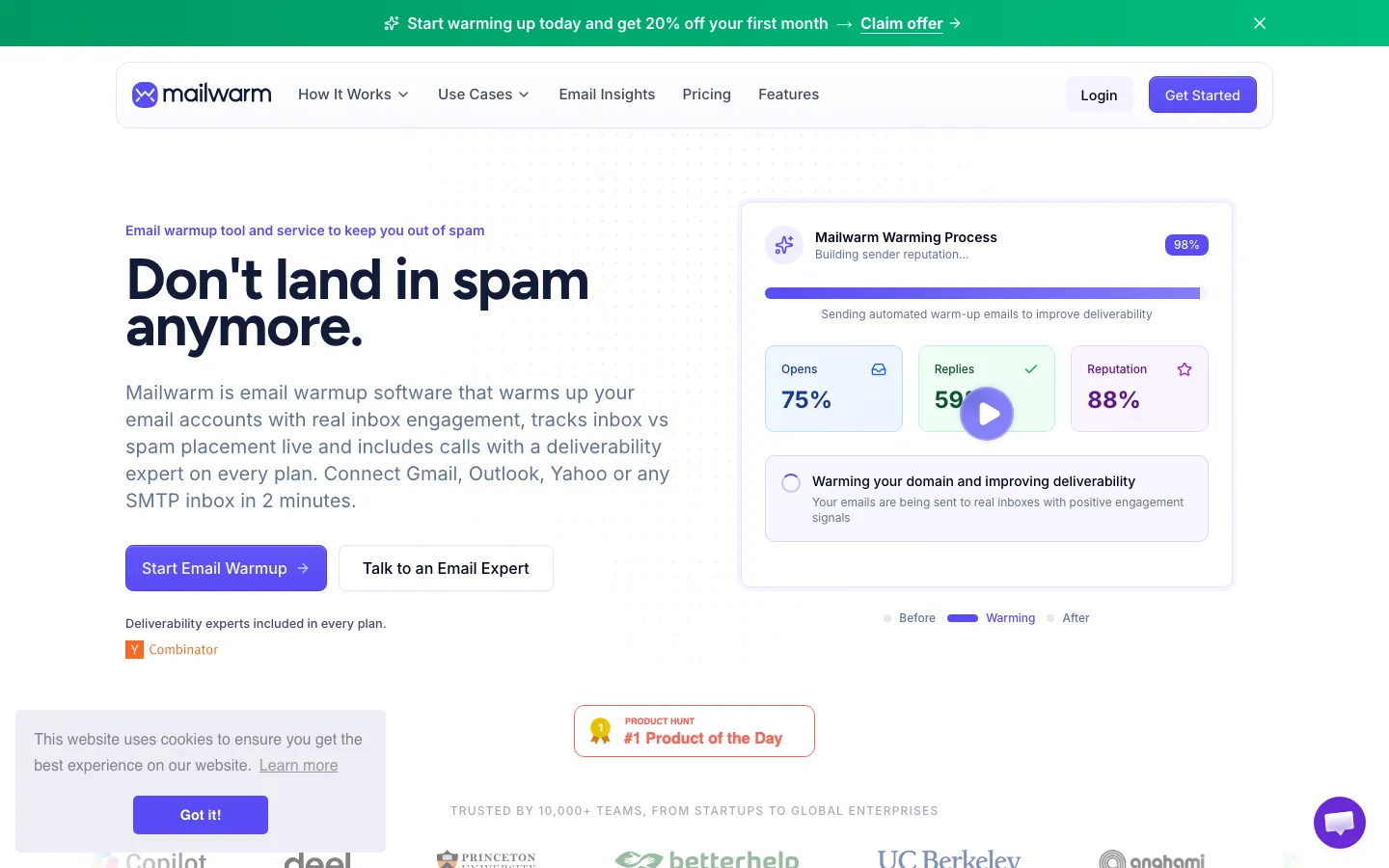
Mailwarm says its network contains more than 50,000 real accounts across Gmail, Outlook, Yahoo and Microsoft 365. The product gradually raises sending volume, then creates engagement signals such as opens, replies, non-spam actions and important marks. It also lets you select Gmail, Outlook, Microsoft 365, Yahoo or SMTP as warmup providers. That provider choice matters when the inboxes you use for prospecting do not all live in the same ecosystem.
The crucial distinction is the human layer. Every listed plan includes deliverability guidance, and the paid tiers specify calls with an expert. I would pay that premium only when a mailbox supports meaningful pipeline or a client campaign. For a disposable test inbox, the pricing is hard to justify. The decision is whether guidance is worth more than raw mailbox capacity.
Who benefits most from adopting Mailwarm?
Outbound founders
Protect one important sending mailbox with Starter’s warmup, monitoring and monthly expert call.
Sales teams
Growth supports three mailboxes and two users when outbound responsibility is shared.
Agency operators
Use Tailored when client inboxes need unlimited mailboxes, users and dedicated expert support.
Technical senders
Use SMTP warmup and infrastructure checks when new transactional sending patterns need reputation care.
Mailwarm is a weaker fit for a buyer who wants to run a broad, low-cost warming fleet. Its published tiers are deliberately compact: one mailbox on Starter, three on Growth and 10 on Scale. The Tailored plan removes those limits, but it replaces a visible price with a conversation. It is a service-led purchase, not a commodity mailbox add-on.
Which deliverability and warmup tools does Mailwarm provide?
Warmup that follows provider choice
Mailwarm supports automated warmup for Gmail, Outlook, Microsoft 365, Yahoo and SMTP. Its stated process ramps volume progressively and schedules activity to resemble normal email behavior. You can set the reply rate, while the product describes the surrounding engagement as opened, marked important, moved out of spam and replied-to messages. New domains and inboxes are the obvious use case, but the same controls also suit a mailbox that has been inactive or has started landing in spam.
Inbox placement and reputation monitoring
Warmup without a way to see inbox versus spam placement leaves the team guessing. Mailwarm monitors spam score and placement, with provider-level insights for Gmail, Outlook, Microsoft 365 and Yahoo. It also presents sender-reputation changes over time, early issue detection and recommendations. That is the feature set to focus on when a campaign is live: the volume cap tells you what can run, while the placement view tells you whether that activity is helping the mailbox.
Authentication and configuration checks
Mailwarm validates SPF, DKIM and DMARC, checks SMTP and IMAP configuration, and looks for blacklist listings across major databases. Those checks make a sensible first stop before increasing any outreach volume. The site also offers a free spam checker and other free diagnostic tools. They do not replace a paid warmup plan, but they give a cautious team a useful starting point when the question is whether the infrastructure is ready.
Expert calls rather than a support-only plan
Starter includes one deliverability expert call each month. Growth includes four, and Scale lists on-demand calls. The Tailored plan adds a dedicated deliverability expert to manage strategy end to end. That progression makes the pricing easier to read: Mailwarm is not selling the same self-serve warmer at three different capacities. It sells more room to operate and more access to delivery expertise as the operation grows.
What automation teams should confirm
Mailwarm supports SMTP warmup and describes integration with mailboxes and email platforms, which may be relevant to a sending workflow. Before making it part of a programmatic sending system, ask Mailwarm to confirm API or MCP availability, access requirements and the security options your stack needs.
How is Mailwarm priced across mailbox tiers?
Price checked 27 Nov 2026
| Plan detail | Starter$79/mo | Growth$189/mo | Scale$549/mo | TailoredCustom |
|---|---|---|---|---|
| Billed annually | $69/mo | $159/mo | $479/mo | Talk to an expert |
| Mailboxes or SMTPs | 1 | 3 | 10 | Unlimited |
| Warmup emails daily | Up to 50 | Up to 200 | Up to 500 | Unlimited |
| Users | 1 | 2 | 5 | Unlimited |
| Expert calls | 1 monthly | 4 monthly | On demand | Dedicated expert |
| Spam monitoring and authentication tools | ✓ | ✓ | ✓ | ✓ |
Mailwarm prices in US dollars, 27 Nov 2026.Mailwarm pricing
The annual figures cut Starter from $79 to $69 a month, Growth from $189 to $159 and Scale from $549 to $479. That discount is meaningful only after the service is part of a stable sending routine. Monthly billing is the safer first move when you are still establishing a mailbox’s setup and working out whether the expert calls change decisions for your team.
A team of three cannot simply buy one Starter plan. Starter has one user and one mailbox. Growth gives you three mailboxes but two users, so a three-person operation needs to confirm the right tier or ask about Tailored. A three-user team that fits within 10 mailboxes can use Scale for $549 a month on monthly billing, or $479 a month billed annually, before extra interactions. Scale is the first listed plan with five users and 10 mailboxes. Extra interactions beyond the subscription allowance cost $0.02 each, another reason to model your sending volume before choosing a plan.
There is no traditional free trial. Mailwarm shows a 20% discount on the first month through its pricing page and offers a free deliverability audit. Treat the audit as a way to clarify the problem and the paid plan as the commitment, not as a substitute for a trial account.
Where does Mailwarm fall short for budget-conscious outreach teams?
Mailwarm features premium pricing that represents its clearest operational limitation for high-volume outreach teams. Starter costs $79 monthly for one mailbox, and each increase in mailbox capacity is a large jump: $189 for three or $549 for 10. That can be a reasonable deal when an expert helps rescue a material outbound program. It is not a forgiving entry point for a small team experimenting with a few inboxes.
Technical teams should confirm API or MCP availability, connection method, permissions and retrievable data before making Mailwarm a central dependency. SMTP warmup may fit the sending setup, but confirmed automation access should be a purchase requirement when the workflow depends on it.
Finally, warmup needs patience. Mailwarm says early improvement can appear in the first days or weeks, while stronger placement and stable sender reputation typically take two to four weeks of continuous warmup. That makes it a poor last-minute fix for a campaign launching tomorrow. Solve authentication and reputation work before the sending calendar becomes urgent.
What are the leading alternatives to Mailwarm?
Mailwarm is for the buyer who wants warmup plus a more guided deliverability conversation. If your decision is really about whether to verify addresses before you send, the MillionVerifier review gives you the adjacent verification lens. That is a different job from Mailwarm’s mailbox preparation and placement monitoring, but both can affect the quality of an outreach operation.
For a team investigating DNS, blacklist and mailbox-health signals alongside warmup, read the  MxToolbox review. Use the two reviews to separate infrastructure diagnosis from Mailwarm’s ongoing warmup service, rather than expecting one subscription to answer every deliverability question.
What is the final verdict on Mailwarm?
Mailwarm earns its premium when a small number of sending mailboxes carry substantial revenue or client risk. The monitoring, authentication checks and included calls create a more complete safety net than basic warmup alone. Pass when mailbox count and lowest unit cost matter more than a service layer, or when your workflow requires confirmed automation access before purchase.
Start monthly with the mailbox that matters most, use the free audit to settle the infrastructure questions, and only move to annual billing after the placement monitoring and expert calls become part of your team’s operating routine.
How were the features and pricing of Mailwarm verified?
Mailwarm published pricing, product specifications, agency documentation, developer guides, and company disclosures provided the facts checked on 27 Nov 2026. Prices are in US dollars, as Mailwarm shows them, and every figure follows the rules in how we check figures.
- Mailwarm pricing pages for monthly and annual billing
- Mailwarm feature and email warmup pages
- Mailwarm agency, developer and company pages
What are frequently asked questions about Mailwarm?
How much does Mailwarm cost?
Starter is $79 a month or $69 a month when billed annually for one mailbox. Growth is $189 monthly for three mailboxes, and Scale is $549 monthly for 10. Tailored pricing is custom.
Does Mailwarm have a free trial?
No. Mailwarm says it does not offer a traditional free trial. It shows 20% off the first month on its pricing page and offers a free deliverability audit.
Which email providers can Mailwarm warm up?
Mailwarm lists Gmail, Outlook, Microsoft 365, Yahoo and SMTP. Its developer page also describes support for other SMTP-based platforms.
How long does Mailwarm take to work?
Mailwarm says early improvements may appear in the first days or weeks. It says stronger inbox placement and stable sender reputation typically build over two to four weeks of continuous warmup.
 Reviewed byDanny Kirk
Founder of ReddiReach.
 Checked byAndrés Felipe
Digital designer and marketer.
Every figure is checked against the vendor's own page. Read our editorial standards.