
Key Takeaways
- MentionDrop tracks brand names, competitor actions, and industry terms across public online sources for lean startups and automated agents.
- MentionDrop starts at twenty-nine dollars monthly for five tracked keywords and ninety days of searchable data history.
- MentionDrop provides an account-level HTTP API and a hosted Model Context Protocol server capped at sixty requests per minute.
- MentionDrop excludes free plans and omits published information regarding team seat allotments, broad source networks, and annual discounts.
MentionDrop is the sensible first monitor for a lean team that needs public-source brand signals and wants an agent to work from them, not another dashboard to remember. Starter costs $29 a month, includes the HTTP API and MCP server, and fits a focused five-keyword watch; move to Pro only when 20 keywords, longer history and webhook delivery change the job.
Agent access
- API
- Yes, Starter and Pro, with HTTP API + MCP included
- MCP server
- Official, hosted, API key in an Authorization: Bearer header
- Works with
 ClaudeClaude Code
 ChatGPT
 Cursor
 VS Code
What are the main pros and cons of MentionDrop?
What works
- HTTP API and MCP server on both paid plans
- AI summaries, sentiment and reply drafts for human review
- Published monthly prices with no sales call
What to watch
- No free plan, only a 14-day money-back guarantee
- Starter has five keywords and 90 days of history
- Seats and annual prices are not published
How does MentionDrop monitor brand signals and competitor mentions?
MentionDrop captures early brand mentions across comparisons, product complaints, news coverage, and search results before internal teams discover them manually. MentionDrop watches Reddit, Google News, search results and selected public web results for your brand, competitors and configured market terms. It filters the result into a summary, sentiment, relevance score, evidence and a suggested action, so the useful conversation can reach the person who owns it. The marketing tools directory is a better starting point if you are still deciding whether monitoring belongs in your stack.
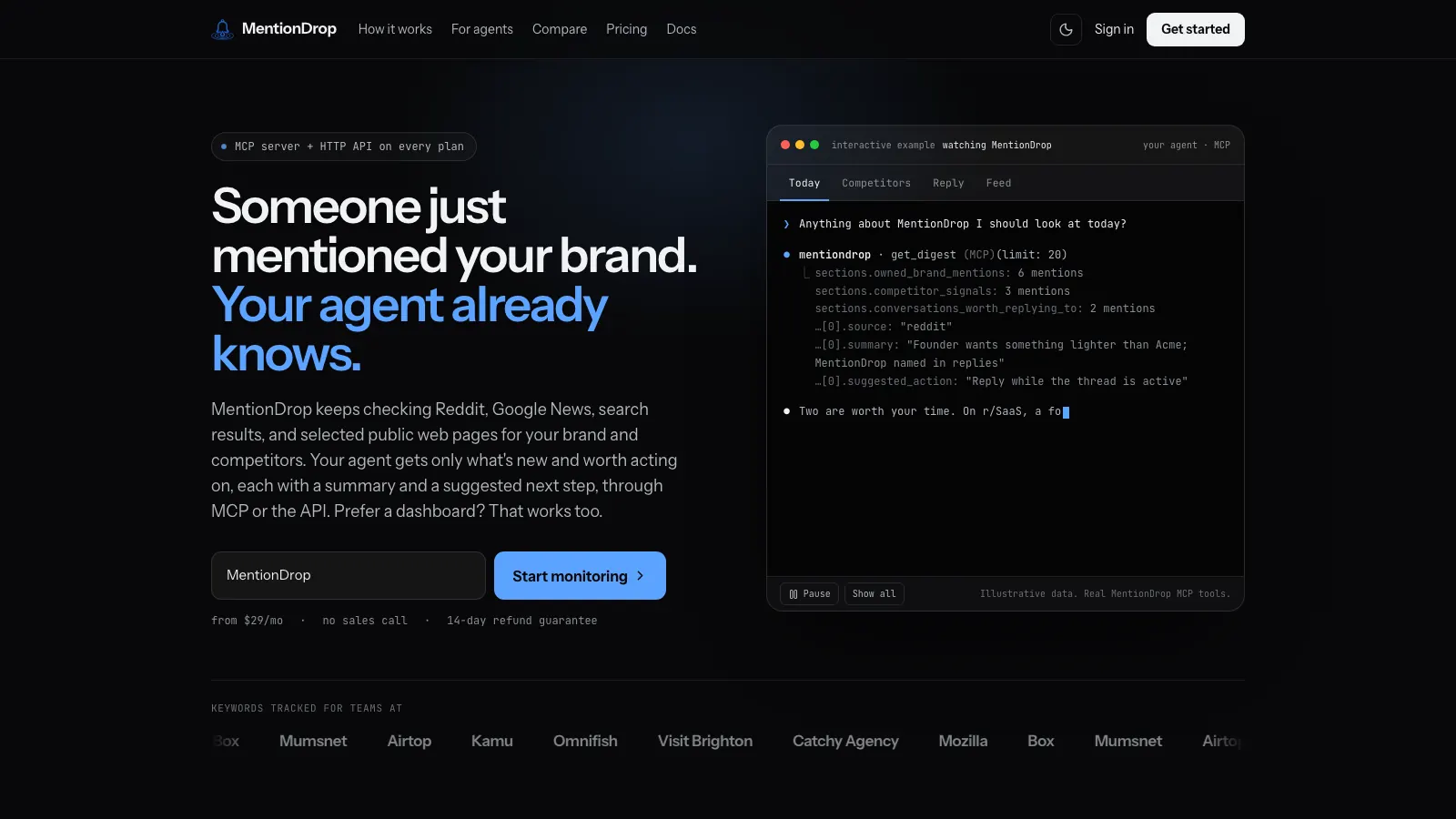
The unusual part is where that information can go. MentionDrop offers a dashboard, email and Slack delivery, but it also puts the same account-scoped signals behind an HTTP API and hosted MCP server. An MCP-aware client can retrieve recent mentions, search them, pull a digest, inspect competitor signals and generate a reply draft for review. The product says it never posts a public reply on your behalf.
That makes MentionDrop more useful for a small team with an actual triage routine than for a company collecting reports. You decide the keywords and relevance threshold, then either review the queue yourself or let an agent prepare a concise brief around it. The vendor describes its sources as bounded and selected, not a claim to monitor every public conversation.
Who benefits most from adopting MentionDrop?
Small marketing teams
Track a focused set of brand and market terms without a sales-led contract.
Agent builders
Give an MCP client account-scoped signals, then keep public responses under human approval.
Competitive researchers
Monitor competitor-role mentions and share-of-voice signals beside your own brand terms.
Hands-on founders
Receive summaries and suggested actions through the dashboard, Slack, email or API.
I would pass if the buying decision depends on exact source breadth, seat limits or a documented annual bill. The vendor publishes a monthly price, keyword allowance and history window, but not those other details. This is a product to choose for a deliberately narrow monitoring setup, not a substitute for a fully specified listening-suite procurement.
Which signal tracking and API features does MentionDrop provide?
Selected public-source monitoring
Each monitor can cover a brand, product, campaign, market term or competitor. MentionDrop says it checks Reddit, Google News, search results and selected public web sources on the configured schedule. Its monitoring view separates owned-brand, competitor, demand and reply-worthy items rather than placing everything in time order.
Summaries, sentiment and human-reviewed drafts
A surfaced mention can carry an AI summary, sentiment label, relevance score, evidence and suggested next action. The product can also generate a reply or outreach draft, but its own documentation is clear about the boundary: the draft comes back for review and nothing is sent or posted automatically. That boundary is a good fit when speed matters but a person still owns the brand voice.
HTTP API and hosted MCP
The API exposes account-scoped signals for agents, scripts and automation tools. Its documented endpoints cover keyword lists, mention search, individual mentions and a digest that groups owned-brand, competitor, demand and reply-worthy results. Both plans include the API and MCP server, using the same account-scoped key and a published rate limit of 60 requests a minute per key. MentionDrop lists Claude, Claude Code, Cursor, VS Code and ChatGPT among compatible MCP clients, along with other clients that support a remote HTTP server and authorization header.
Delivery and workflow connections
Starter includes  Slack and email alerts. MentionDrop labels its
 n8n entry “Templates first” and says it can route high-intent mentions into Slack,
 HubSpot, Gmail,
 Linear,
 Notion, Airtable and custom workflows. Pro explicitly includes webhook delivery. The Starter card labels webhook delivery but does not mark it included, so confirm that capability before treating Starter as an event-triggered automation plan.
Noise controls and feedback
Both pricing cards list noise filters. Within the account, a human can mark a mention relevant or not relevant, while keyword settings can update role, context, relevance threshold, filters and active state. Those controls matter because a low monthly price is only a saving if the team can keep the monitored stream useful.
How much does MentionDrop cost across subscription plans?
Price checked 27 Nov 2026
| Plan detail | Starter$29/mo | Pro$59/mo |
|---|---|---|
| Keywords | 5 | 20 |
| Mention history | 90 days | 180 days |
| AI summaries and sentiment | Surfaced mentions | Surfaced mentions |
| Competitor share of voice | ✓ | ✓ |
| Reply drafts | ✓ | ✓ |
| Team-chat and email alerts | ✓ | ✓ |
| Webhook delivery | Confirm before buying | ✓ |
| HTTP API and MCP | ✓ | ✓ |
MentionDrop plans, 27 Nov 2026.MentionDrop pricing
The pricing page says there are no contracts or hidden fees, monthly or yearly billing is available, and each plan has a 14-day money-back guarantee. MentionDrop offers yearly billing but does not state an annual total; confirm the annual charge before comparing costs. There is no free plan.
A team bill cannot be calculated from the published material because neither plan states included seats, per-seat charges or a seat limit. What is clear is the working split: Starter is for one team monitoring a focused set of terms, while Pro raises the allowance from five to 20 keywords, doubles history to 180 days and explicitly adds webhook delivery. Start with Starter if five monitored terms is a real constraint you can live with; otherwise the $30 monthly difference is the practical cost of more coverage and a documented webhook path.
Where does MentionDrop fall short in feature documentation?
MentionDrop presents operational drawbacks due to unlisted product specifics around seat allocations and crawling coverage. MentionDrop names its source types but does not publish a source-by-source coverage list, a seat model or the annual amounts behind its billing toggle. A buyer who needs those terms for procurement will have to ask before treating the published plan cards as a complete quote.
There is no free workspace for keeping a low-stakes watch open indefinitely. The 14-day guarantee reduces the commitment, and the vendor says cancellation is available in a click, but that is different from a free tier. Five Starter keywords also disappear quickly once you separate your brand, products, competitors and market terms.
Automation needs care too. The API and MCP server are included on both plans, yet write actions can create or update monitors and record relevance feedback. The vendor recommends keeping action tools behind human intent, and reply drafts still need review. That is the right guardrail, but it means an agent workflow needs a clear owner rather than being left to run unchecked.
What are the leading alternatives to MentionDrop?
 AI Peekaboo review is the relevant comparison when your question is how a brand appears in AI answers rather than where it is mentioned on public sources. Its published plans start at $30 a month and include API and MCP access, but it is not a public-source mention monitor.
 Okara review takes a broader route: it presents an AI CMO with 10+ marketing agents running 24/7, and its AI CMO Lite plan includes 2,000 credits a month.
 PainOnSocial review focuses on discovering customer pain points from Reddit conversations. Its Starter plan includes 20 pain-point scans a month, making it the more direct read when research begins with a specific customer problem.
What is the final verdict on MentionDrop?
MentionDrop offers an ideal entry monitor for small teams needing five keywords, REST API access, and hosted MCP capabilities. The $29 Starter plan has the important capabilities already included: summaries, sentiment, Slack and email alerts, the HTTP API and MCP server. The strongest reason to move is the Pro plan’s 20 keywords, 180-day history and explicitly included webhook delivery.
Set up five real terms and one person who will review the digest before choosing Starter. Pick Pro when those terms need to expand, 180 days of history matter, or a webhook is part of the workflow. Ask about seats, annual billing and source coverage before putting either plan through formal procurement.
How was this MentionDrop review fact-checked and verified?
MentionDrop pricing sheets, product descriptions, API guides, MCP specifications, and integration portals were reviewed on 27 Nov 2026. Every figure follows how we check figures.
- MentionDrop pricing page, monthly and yearly views
- MentionDrop product, brand-monitoring and integrations pages
- MentionDrop HTTP API, MCP launch page and MCP documentation
What are common questions about MentionDrop?
How much does MentionDrop cost?
Starter is $29 a month for five keywords and 90 days of mention history. Pro is $59 a month for 20 keywords and 180 days of history. Both plans have a 14-day money-back guarantee.
Does MentionDrop include an API and MCP server?
Yes. Both paid plans include the HTTP API and hosted MCP server. They use the same account-scoped API key and are rate limited to 60 requests per minute per key.
What sources does MentionDrop monitor?
MentionDrop lists Reddit, Google News, search results and selected public web results. It describes these as bounded, high-signal public sources and does not publish a fuller coverage inventory.
Does MentionDrop automatically reply to mentions?
No. It can generate a reply or outreach draft for human review, but the vendor says it does not post a public reply on your behalf.
 Reviewed byDanny Kirk
Founder of ReddiReach.
 Checked byAndrés Felipe
Digital designer and marketer.
Every figure is checked against the vendor's own page. Read our editorial standards.