
Key Takeaways
- Mentionkit tracks buyer intent conversations for small software teams and records team member follow-up actions across active threads.
- Mentionkit costs forty-nine dollars monthly, or four hundred ninety dollars annually, for one project supporting ten keywords and trackers.
- Mentionkit equips software development workflows with an HTTP application programming interface, automated webhooks, and remote Model Context Protocol connectivity.
- Mentionkit restricts users to a single project workspace and omits broader multi-client agency tools and general media scanning.
When you need to find buyer conversations and track who handled them, Mentionkit is the pick for a small SaaS team, not a broad brand-monitoring feed. At $49 a month, it gives one project 10 keywords, 10 trackers, API and MCP access. Look elsewhere if several client brands need separate workspaces or your priority is wider media coverage.
Agent access
- API
- Yes, Base plan; API documentation also permits an active trial or billing exemption.
- MCP server
- Official, hosted, OAuth or API key
- Works with
 ClaudeClaude Code
 ChatGPT
 Cursor
What are the core pros and cons of Mentionkit?
What works
- AI scoring and automatic tags put actionable conversations first
- API, webhooks and remote MCP are on the public Base plan
- Unlimited mentions, with a 14-day trial and no card to start
What to watch
- Base includes only one project for every brand or client you monitor
- Each project has 10 keywords and 10 trackers; extra keywords cost US$5 each per month on monthly Base
- Platform changes and deleted posts can leave gaps in coverage
How does Mentionkit track and route buyer intent conversations?
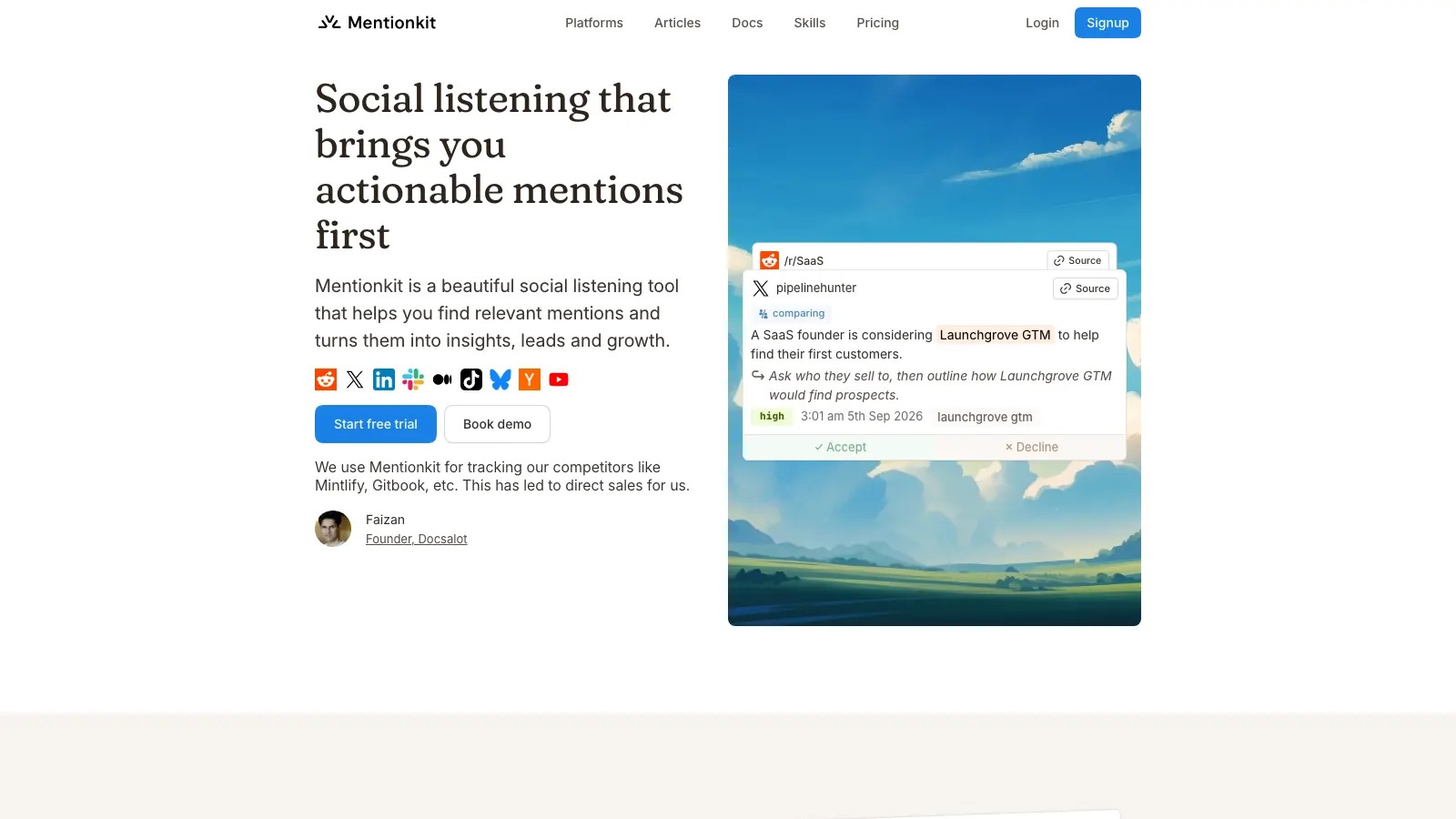
Mentionkit watches brand names, competitors and keywords, then sorts the conversations toward the ones a person can actually act on. It tracks public discussion across platforms including LinkedIn, X, TikTok, Bluesky, YouTube, GitHub and Hacker News, while its trackers can follow Reddit communities and connected Slack workspaces. For teams browsing the marketing tools directory, that is a useful distinction: Mentionkit is designed around the response queue, not a passive listening dashboard.
The core loop is straightforward. A relevance score helps you open higher-priority mentions first; tags divide the feed into brand mentions, requests, recommendations and competitor conversations; teammates, VAs or clients can be invited, and the team can track who handled each mention. That makes sense for a product team where a conversation asking for an alternative is worth more than a dashboard total.
I would judge it as a focused operating tool, not an all-purpose reputation platform. One Base project is enough for a single SaaS product with a clear set of buying signals. A consultancy managing several clients reaches the project boundary before it reaches the mention limit, so it should settle the workspace model before adopting it.
Who gets the most value from using Mentionkit?
Founder-led SaaS teams
Find buyer conversations, invite teammates, then assign ownership for each relevant product mention.
Growth teams
Track competitor names, product terms, and subjects that influence your buyers' decisions.
Community managers
Use automatic tags to assign mention ownership among teammates, VAs, and clients.
Teams with AI workflows
Retrieve mention data through remote MCP, API, or webhook-driven internal automations.
It is less suitable for an agency that needs a separate workspace for every account, because Base has one project. It is also a poor fit when the decision depends on an exhaustive media-monitoring view: Mentionkit says broad monitoring across many channels may still need a wider listening stack.
Which conversation tracking and webhook features does Mentionkit include?
Relevance scoring and tags
The feed is built to reduce the time spent sorting. Mentionkit scores each mention by relevance and tags every mention automatically, so a team can filter for the type of conversation that deserves a reply. That is more useful when your job is pipeline discovery than when your only question is how often a brand appeared.
Trackers for communities and workspaces
Keywords cover the terms you care about, while trackers focus on places where the conversation happens. Mentionkit documents trackers for Reddit subreddits and connected Slack workspaces. Slack monitoring requires a workspace connection, which is an important setup detail if an internal community is central to your watchlist.
Shared follow-up
Base supports inviting teammates, VAs or clients and recording who handled each mention. For a small team, that makes it practical to see whether a saved mention was handled. It also makes the soft five-seat limit easier to evaluate: the default may cover a compact group, and support says it can raise that limit at no extra cost.
API and webhooks
The API can retrieve mentions, projects, keywords and organization usage, and it can update a mention’s review status. Webhooks can notify your server when a new mention appears. That gives a technical team a clean path to send the useful part of the feed into an existing workflow instead of moving people between tabs.
Remote MCP for agents
Mentionkit’s remote MCP endpoint works with clients that support MCP over HTTP. An agent can read mention data and workflow context, select relevant conversations and inspect source links before proposing an action. OAuth starts read-only; creating or reactivating a keyword needs additional approval. That permission boundary is sensible, because the latter action starts collecting public mentions.
How is Mentionkit priced for SaaS teams?
Price checked 27 Nov 2026
| Plan detail | Base$49/mo |
|---|---|
| Monthly billing | $49/mo |
| Yearly billing | $490/yr |
| Projects | 1 |
| Keywords per project | 10 |
| Trackers per project | 10 |
| Mentions | Unlimited |
| API, MCP and webhooks | ✓ |
| Workspace and email alerts | ✓ |
| Trial | 14 days, no card |
Mentionkit prices in US dollars, 27 Nov 2026.Mentionkit pricing
There is no complicated seat calculation for a five-person product team: Base is $49 a month for the workspace, with up to five seats as a soft limit. The cost levers are project count and keywords, not the number of mentions. With an active monthly Base plan, each additional keyword costs $5 a month.
- Annual billing costs $490, equivalent to about $40.83 a month before any tax
- The trial lasts 14 days and does not need a card to begin
- Subscribing during the trial starts paid billing immediately
- Mentions are retained for up to one year
The real bill question is therefore structural. If one project is one product, a startup can budget a known $49 a month. If each client or product needs its own project, ask Mentionkit for the resulting plan before promising a client rollout.
Where does Mentionkit fall short for agencies?
Mentionkit restricts operations to a single project workspace, creating a clear operational boundary that prevents agency multi-client management. It makes Base easy to understand for a single product, but it does not establish a public price for an agency that needs several isolated client spaces. Nor can the $5 keyword add-on solve a project boundary: it simply gives the existing project more terms to monitor.
Coverage needs a more careful expectation too. Mentionkit supports a useful range of public platforms and connected communities, but it says no social-listening system can guarantee every mention. Network restrictions, platform changes and deleted content can all create misses. Treat it as a way to surface and work the conversations it finds, rather than a complete record of every public reference.
Finally, its own positioning narrows the use case. The tool is built for lead-intent conversations and follow-up. A communications team that needs broad media intelligence across many channels should validate its source requirements before replacing an established monitoring stack.
What are the top alternatives to Mentionkit?
 Mentionkit alternatives like AI Peekaboo serve teams wanting to understand brand positioning inside artificial intelligence search platforms rather than social buyer conversations. It starts at $30 a month, with API and MCP service available across its plans. The AI Peekaboo review explains that reporting model in more detail.
 Consider Mentionlytics if sentiment across 200+ languages changes the monitoring decision. Consider
 Octolens when each tier provides API, webhooks and MCP, or Scale coverage of podcasts, news, newsletters and the web, matter more. Read the Mentionlytics review and the Octolens review before committing your client process to one workspace model.
What is the final verdict on Mentionkit?
For one product team, Mentionkit is a sensible way to turn a ranked feed of buyer conversations into a repeatable follow-up practice. The Base plan has an unusually direct price, a practical trial and machine access without an enterprise conversation. Its limitation is equally direct: it is one project, so do not treat it as an agency-wide solution until you have settled how clients will be separated.
Use the 14-day trial with your highest-value brand and competitor terms. If the scored feed produces conversations your team can act on, keep Base for that product. If several client workspaces are essential, confirm that cost before rollout.
How was this Mentionkit review compiled and verified?
Mentionkit pricing tables, product feature overviews, API documentation, and MCP protocol pages provided the source data on 27 Nov 2026. Prices are in US dollars, as Mentionkit shows them, and every figure follows the rules in how we check figures.
- Mentionkit pricing and billing pages
- Mentionkit product and social-listening documentation
- Mentionkit API and remote MCP documentation
What are common questions regarding Mentionkit?
How much does Mentionkit cost?
Mentionkit Base costs $49 a month or $490 a year. It includes one project, 10 keywords and 10 trackers per project, unlimited mentions, API, MCP and webhook access.
Can you try Mentionkit without a card?
Yes. Start the 14-day trial without entering card details. If you subscribe to Base during the trial, the paid subscription starts immediately.
How many people can use Mentionkit Base?
Base has a soft limit of five seats. Mentionkit says support can increase the seat limit at no extra cost, and it retains mentions for up to one year.
Can Mentionkit replace a broad social-listening tool?
It is designed for actionable buyer conversations and follow-up. Teams that need broad monitoring across many channels should validate their required sources before replacing their existing stack.
 Reviewed byDanny Kirk
Founder of ReddiReach.
 Checked byAndrés Felipe
Digital designer and marketer.
Every figure is checked against the vendor's own page. Read our editorial standards.