
Key Takeaways
- PathFactory transforms marketing content assets into personalized buyer journeys while capturing account-level engagement signals following its acquisition by Kaltura.
- PathFactory routes all customer acquisition through sales calls, keeping enterprise pricing models, subscription limits, and feature packages unlisted online.
- PathFactory maintains documented developer APIs and webhooks for data delivery, but avoids publishing public Model Context Protocol integration guidelines.
- PathFactory provides no public pricing or self-serve trials, creating obstacles for teams requiring quick software testing or clear upfront cost disclosures.
PathFactory is the pick for a B2B revenue team that needs to turn content engagement into account-level pipeline signals and guided buyer journeys. Pass if you need a published price or a self-serve way to compare PathFactory: PathFactory is now part of Kaltura and its public route is a demo conversation.
Agent access
- API
- Yes, Purchased PathFactory API add-on or a package that includes the Public API
- MCP server
- Not found on official pages
What are the core strengths and limitations of PathFactory?
What works
- Personalized destinations, playlists, and calls to action
- ChatFactory turns static pages into guided conversations
- Account-level engagement can connect to pipeline and revenue
What to watch
- No public prices or named plan comparison
- Public pages do not state an MCP offering
- Some buying details require a demo conversation
How does PathFactory transform content consumption into sales pipeline data?
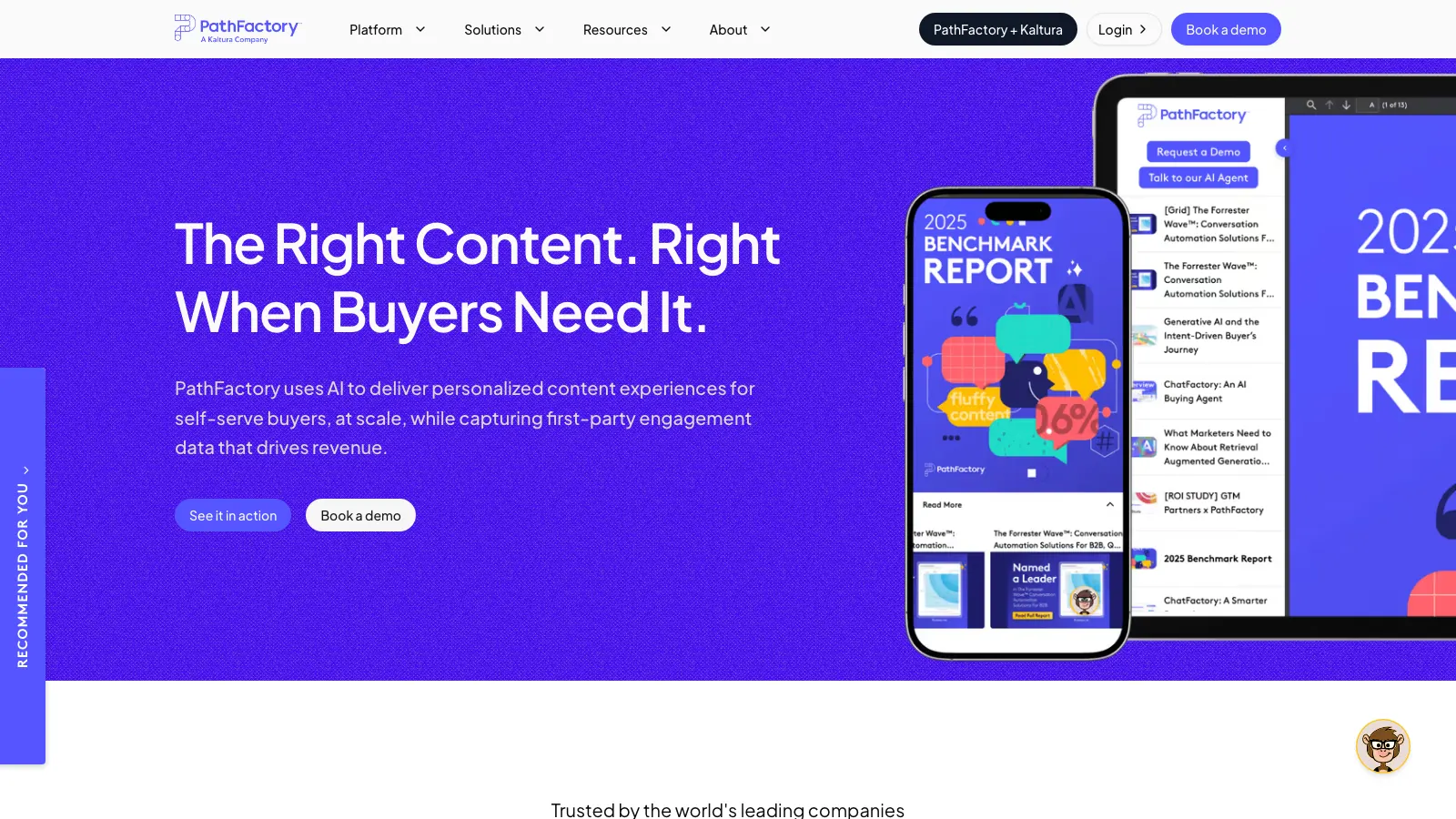
PathFactory is a content-intelligence layer for the moment after you have made the asset. It organizes material into buyer journeys, changes the experience by industry, account, and individual behavior, then brings the engagement back to the revenue team. The promise is not more content. It is a clearer view of who spent time with what, and a better next experience for that buyer.
That makes it a different decision from choosing another editor or planning board. A demand team can use one template rather than hundreds of account-specific pages, while sales sees the same engagement signals. If you are building a vendor stack from scratch, start in the marketing tools directory to separate content production from the systems that personalize and measure what happens after publication.
PathFactory has been acquired by Kaltura. Its acquisition FAQs say the PathFactory platform, data, integrations, configurations, and supporting team continue, with no forced migration for existing customers. For a buyer, that is a useful continuity statement, but it does not replace a conversation about the contract you would sign today.
Which B2B enterprise marketing organizations benefit most from PathFactory?
Demand generation teams
Guide buyers through tailored content journeys while connecting engagement signals to pipeline conversations.
ABM programs
Personalize destinations and calls to action by industry, account, and individual buyer behavior.
Revenue leaders
See buying-committee engagement at account level instead of relying on clicks and lead scores.
Website conversion teams
Build self-guided content paths that help visitors find relevant answers more quickly.
I would put PathFactory in front of teams whose content already supports a complex buying journey and whose revenue discussion needs more than a form fill. It is less compelling for someone who simply wants a public monthly price and a quick comparison between a few small plans, because the public site does not provide either.
What content journey builders and buyer intelligence tools does PathFactory provide?
Personalized content experiences
Experience Templates create personalized content destinations, with curated playlists and an intelligent conversation agent. PathFactory says teams can apply rules or let its AI learn which experience a buyer needs. The practical appeal is consistency: one template can adapt content and calls to action instead of forcing a team to maintain a separate page for every account.
ChatFactory buying assistant
ChatFactory is PathFactory’s AI-powered buying assistant. It turns static pages into guided conversations and uses existing assets, FAQs, and campaign material for context-aware answers. PathFactory says each interaction feeds first-party engagement signals back into go-to-market systems. That makes the conversation useful only when it belongs alongside the journey data, not as an isolated website chatbot.
Engagement intelligence
PathFactory measures time spent on every asset, follows the content path, and rolls engagement up to an account. Its Intelligence product connects content, data, and AI to measure pipeline, revenue, and ROI. This is the feature to prioritize when the recurring internal question is whether content actually influenced a buying committee, rather than whether a single page drew a click.
AI search optimization
AI Search Optimization is PathFactory’s effort to make a B2B site answerable as well as searchable. The company positions it around the AI-driven buyer journey. Treat it as part of the same content-intelligence bet, not proof of a specific AI-answer result: the public page describes the direction, not a published measurement guarantee.
Integrations and machine access
PathFactory lists 17 integrations across CRM, marketing automation, ABM and intent, content, data, and sales engagement. Its directory names Salesforce, HubSpot, and Marketo, and it says a public API and webhooks can connect other tools. That is enough to make data flow a serious evaluation question. The public pages do not document MCP, so do not make it an architectural assumption.
How does PathFactory quote its enterprise software packages?
Price checked 27 Nov 2026
| Buying detail | What PathFactory publishes |
|---|---|
| Public plan prices | Not published |
| Named public tiers | Not published |
| Evaluation route | Book a demo |
| Personalized experiences | ✓ |
| ChatFactory | ✓ |
| Public API and webhooks | ✓ |
PathFactory plans page, 27 Nov 2026.PathFactory plans
There is no honest team bill to calculate from the public information. PathFactory’s pricing and plans URLs invite a demo rather than showing a rate card, and the company does not publish seats, usage allowances, package names, or add-ons. Existing customers are told that their contract terms and pricing remain in effect after the Kaltura acquisition, but that is not a public quote for a new customer.
Use the demo to get the number that matters: the full monthly or annual commitment for your expected experiences, integrations, and users. If comparing vendors, ask for the same scope from each one. Otherwise a low-looking platform fee can hide the part of the purchase that actually changes your budget.
Why does PathFactory require a sales consultation for pricing and tiers?
PathFactory targets enterprise B2B revenue operations without publishing named tiers or detailed feature matrices online. That leaves several decision-making details outside the website:
- The price and contract length for your configuration
- Which features are included in the proposal
- Seat, usage, and experience limits
- Whether your API use needs a separate agreement
That is not automatically a reason to reject it. It is a reason to run the evaluation with a written requirements list. A platform built around revenue data should be bought with the same care you would use for the CRM records it will touch.
What are the primary transparency and evaluation hurdles with PathFactory?
PathFactory presents an absence of transparent pricing as its primary operational hurdle. Without a published starting plan, a new buyer cannot compare PathFactory’s cost against the scope of a smaller tool before booking a demo. The site also does not let you turn the public pricing page into a team estimate, because it supplies no included seats, limits, or add-ons.
Machine access needs the same caution. PathFactory says it has a public API and webhooks, which is a meaningful integration option, but it does not publish MCP material. Teams planning an agent workflow should confirm the exact API permissions, rate limits, authentication, and data available in the contract rather than infer them from the integration directory.
Finally, the product is specialized. Its strength is the connection between experiences and engagement intelligence. If your immediate job is simpler, such as planning content or reviewing a smaller workflow, that specialization can be more system than you need.
Which content intelligence and search tracking platforms compete with PathFactory?
 PathFactory alternatives like AI Peekaboo apply when assessing brand citations across conversational engines rather than personalizing content experiences. Its published plans include API and MCP access, as the AI Peekaboo review explains.
 Rankdots clusters thousands of search terms by user intent into a hierarchy for execution; the Rankdots review covers that content-planning workflow.
 SEOBoost provides real-time SEO scoring and tailored recommendations for optimizing content, as the SEOBoost review explains.
Is PathFactory the premier choice for account-level content intelligence?
PathFactory is the right conversation when your B2B team wants content experiences and revenue intelligence to operate as one system. Personalized destinations, ChatFactory, account-level engagement, and CRM or MAP connections give it a coherent role in a mature demand program. The Kaltura acquisition comes with a public assurance that the product and existing customer setup continue.
Do not treat the demo as a formality. It is where you will discover the price, configuration, and access terms that decide fit. If transparent pricing or self-serve evaluation is a hard requirement, choose a tool that publishes those details instead.
Bring a map of your content journeys, CRM or marketing-automation requirements, and reporting questions to the demo. Ask for a written proposal that names the features, limits, API access, and total contract cost.
How were PathFactory features and corporate updates investigated?
PathFactory official product materials, integration documentation, and Kaltura acquisition announcements were reviewed on 27 Nov 2026. The review uses published capabilities and excludes details the company does not state publicly. Our approach to prices and factual claims is set out in how we check figures.
- PathFactory platform pages for Experiences, ChatFactory, Intelligence, and AI Search Optimization
- PathFactory integrations directory and its API and webhook statement
- PathFactory plans page and Kaltura acquisition FAQs
What are the common sales and implementation questions about PathFactory?
How much does PathFactory cost?
PathFactory does not publish plan prices or named public tiers. Its plans and pricing pages direct prospective customers to book a demo.
Does PathFactory have a free trial?
PathFactory invites you to book a demo. It does not state whether a self-serve trial is available, so confirm the evaluation terms directly with PathFactory.
What does ChatFactory do?
ChatFactory is PathFactory’s AI-powered buying assistant. It gives context-aware answers using existing assets, FAQs, and campaign materials, and PathFactory says its engagement signals flow into go-to-market systems.
Does PathFactory work with AI agents?
PathFactory documents a public API and webhooks for connecting other tools. Its public pages do not document an MCP offering, so confirm the access model for an agent workflow before you build on it.
 Reviewed byDanny Kirk
Founder of ReddiReach.
 Checked byAndrés Felipe
Digital designer and marketer.
Every figure is checked against the vendor's own page. Read our editorial standards.