
Key Takeaways
- Pirsch Analytics delivers privacy-first web traffic measurement without storing personal data, relying on tracking cookies or requiring website consent banners.
- Pirsch Analytics offers entry-level Standard plans from $6 monthly for 10,000 page views, with Plus available at $12 monthly or $120 annually.
- Pirsch Analytics includes RESTful APIs and developer SDKs on Standard tiers to support automated custom data collection and programmatic report generation.
- Pirsch Analytics reserves enterprise access control and on-premise installation behind custom quotes, limiting large organizations needing immediate self-serve SAML SSO.
Pirsch Analytics is the right pick when you want straightforward web reporting without cookies, personal-data storage or a consent banner, especially if your team needs an API alongside the dashboard. Choose a fuller business-intelligence tool instead when governed enterprise sign-on or on-premise deployment cannot wait for an Enterprise quote.
Agent access
- API
- Yes, Standard
- MCP server
- Community, local, OAuth client with read permissions
What are the key pros and cons of Pirsch Analytics?
What works
- Cookieless tracking without storing personally identifiable information
- REST API, SDKs and CSV export on Standard
- Unlimited members, with billing based on usage rather than seats
What to watch
- Events and session extensions count toward the monthly limit
- Custom domains and extensive white labeling start on Plus
- Self-hosting and SAML SSO require Enterprise
What tracking capabilities does Pirsch Analytics offer?
Pirsch Analytics gives digital teams clear traffic insights without forcing them to deploy complex consent-management banners. It is made and hosted in Germany, works without cookies, and says it does not store visitors' personally identifiable information. For visibility into whether AI answers recommend you, read the AI Peekaboo review, because web analytics answers a different question. That makes Pirsch's privacy model the product, not an extra setting tucked into a larger analytics suite.
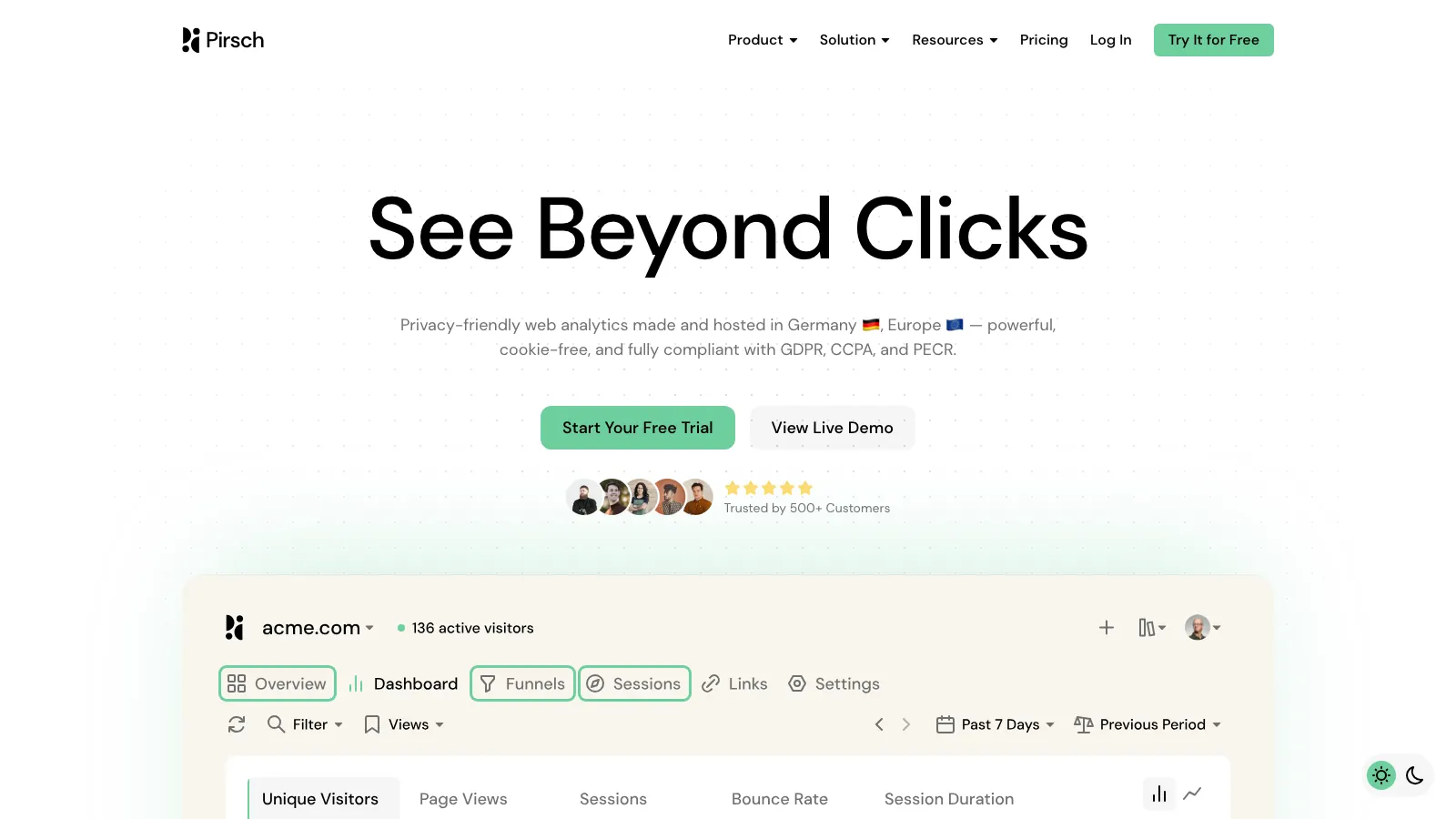
The dashboard covers the questions most marketing teams return to: page views, referrers, UTM parameters, session duration, device categories and countries. You can also track custom events, conversion goals, downloads, outbound links and 404 pages. The value is not a vast menu of reports. It is a lean reporting surface that keeps the useful measures close together, then lets your team export or call the data when the dashboard is not enough.
That is why Pirsch makes sense for a privacy-first website, a small product team or an agency with many uncomplicated client sites. It is a sensible boundary: visitor behavior belongs in analytics, while the broader marketing stack can use the same data in reporting and planning.
Who benefits most from deploying Pirsch Analytics?
Privacy-led site teams
They need cookieless reporting without storing personal data or adding consent-banner friction.
Small product teams
They want event and conversion reporting, API access, and unlimited members without seat-based billing.
Client-service agencies
They need private dashboard links, email reports, and Plus branding for many client properties.
Technical marketers
They want SDKs and server-side collection to build reports around their own workflows.
I would not start with Pirsch for a company that must enforce SAML single sign-on from day one, or for a team that already knows it needs to run analytics on its own infrastructure. Those capabilities exist, but only in the Enterprise package, where price and scope are set by quote.
Which reporting features does Pirsch Analytics include?
Cookieless visitor recognition
Pirsch generates a hash for each page visit from the visitor's IP address, User-Agent header, date and a salt. It says the IP address is never stored or logged. That approach supports Pirsch Analytics's no-cookie and no-consent-banner position, while its German hosting and stated GDPR, CCPA, PECR and Schrems II coverage give privacy-conscious teams a clear basis for evaluation.
Sessions, funnels and tags
Standard includes session analysis, where you can see pages visited and events triggered in an individual session. Plus adds funnels, which calculate drop-off and conversion rate at each step. It also adds A/B testing and segmentation through tags attached to page views, so a marketing team can separate audiences or campaign variants without abandoning its core analytics record.
Agency sharing and branding
Private access links let a client view a dashboard without creating an account, and automatic email reports are available on Standard. Plus is the point where the presentation changes: it adds custom domains, themes, logos and extensive white labeling. That split matters. Standard is good for sharing a useful report; Plus is the honest choice when the report needs to look like part of your agency's service.
API and developer options
Every paid plan lists a RESTful API and SDKs. Pirsch documents official JavaScript, Go and PHP SDKs, and says its API can store page views and events, manage access and read statistics. Its API guide also describes using statistics to create custom reports, dashboards, exports or client access. Script proxies and server-side use offer practical ways to fit tracking around a technical team's architecture.
Migration and reporting continuity
Pirsch can import data from Google Analytics, Plausible Analytics and Fathom Analytics. It also offers a Google Search Console plugin, native webhooks and CSV export. For a team moving away from another traffic dashboard, these are the features that protect continuity: historical data can come across, Search Console can sit beside traffic data, and reporting does not have to stop at the standard interface.
How does Pirsch Analytics price its traffic tiers?
Price checked 27 Nov 2026
| Plan detail | Standard$6/mo | Plus$12/mo | EnterpriseCustom |
|---|---|---|---|
| Starting allowance | 10,000 monthly page views | 10,000 monthly page views | Variable |
| Websites | 50 | Unlimited | Unlimited |
| Members and retention | Unlimited | Unlimited | Unlimited |
| REST API and SDKs | ✓ | ✓ | ✓ |
| Funnels and segmentation | Not listed | ✓ | ✓ |
| White-labeling | Not listed | Extensive | Extensive |
| SAML SSO and on-premise | Not listed | Not listed | ✓ |
Pirsch prices in US dollars, 27 Nov 2026.Pirsch pricing
Before applicable sales taxes such as VAT, Standard is $6 a month or $60 a year at the starting 10,000-view allowance, and Plus is $12 a month or $120 a year. That annual choice saves $12 on Standard and $24 on Plus. Both plans include unlimited members, so a three-person team still pays the plan price, not three subscriptions, before applicable taxes.
The headline view allowance is not the entire consumption calculation. Custom events and 10% of events for session extensions count toward the monthly limit, and deleted domains continue to count until the billing cycle resets. If the cap is reached, dashboard access is limited from that day while collection continues for five further days. To regain access and avoid gaps, upgrade within those five days or wait until the usage limit resets.
There is a 30-day trial without a credit card. That is long enough to establish whether your actual event volume fits the allowance, which is the only pricing question I would settle before committing to annual billing.
What features are included in Pirsch Enterprise?
Pirsch Analytics Enterprise targets organizations requiring advanced infrastructure control and governance capabilities. It includes Plus, managed cloud setup, on-premise installation, SAML-based single sign-on, raw data access, onboarding, training, consulting, custom features and dedicated support.
Do not treat Enterprise as a larger Standard plan. It is for requirements unavailable lower down. If data residency, identity governance or self-hosting are firm requirements, ask for deployment details and a quote early, because the published page gives no price or usage allowance.
Where does Pirsch Analytics fall short for power users?
Pirsch Analytics enforces a strict plan division between simple dashboards and fully branded agency reporting. Standard provides access links and automatic emails, but custom domains, themes, logos and extensive white labeling start on Plus. An agency promising branded reporting should budget for Plus rather than discover the limit after a client asks for a custom domain.
The second limitation is predictability on event-heavy sites. Pirsch calls the allowance a monthly page-view limit, yet custom events and a portion of session-extension events consume that same pool. A product with many interactive events should model usage before treating $6 or $12 as its likely monthly bill.
Finally, Enterprise-only SAML SSO and on-premise installation make Pirsch less convenient for teams with immediate governance mandates. It is not a missing capability, but it is a price-and-procurement unknown until sales replies.
What are the top alternatives to Pirsch Analytics?
 Pirsch Analytics pairs with or yields to AI Peekaboo when reporting focuses on AI engine mentions rather than website analytics.uency. For privacy analytics you can run on your own infrastructure,
 Plausible Analytics review covers its free, self-hosted Community Edition. If your job is joining operational data into business dashboards, the Power BI review is the more relevant comparison: Power BI Desktop is a free download for data exploration and report authoring.
Pirsch wins when the decision starts with website analytics and privacy. The alternatives win when your first requirement is AI visibility, a free self-hosted edition, or free Desktop report authoring.
Browse the marketing tools directory when the reporting problem reaches beyond visitor traffic.
What is the final verdict on Pirsch Analytics?
Pirsch Analytics represents a sensible privacy-first choice for teams seeking traffic data without tracking cookies. The $6 Standard plan includes the core reporting, API access, unlimited members and a 50-site limit that many small teams will never approach. Plus at $12 is a very clear upgrade for unlimited sites, funnels, segmentation and branded delivery.
My recommendation is to use the 30-day trial to measure a normal month of traffic and events, then select Standard for internal reporting or Plus when client branding and conversion analysis matter. Hold off if Enterprise-only deployment or sign-on requirements are already mandatory.
Start on Plus if your agency needs white labeling or more than 50 websites. Otherwise, Standard is the sensible first plan, provided your event usage stays within the allowance.
How was this Pirsch Analytics review verified?
Pirsch Analytics product, pricing, security and API documentation were reviewed on 27 Nov 2026. Prices are in US dollars and figures follow how we check figures.
- Pirsch pricing and feature pages
- Pirsch privacy and API documentation
- Pirsch agency and Enterprise pages
What are frequently asked questions about Pirsch Analytics?
Does Pirsch use cookies?
No. Pirsch says it works without cookies and does not store visitors' personally identifiable information. Its visitor hash uses the IP address, User-Agent header, date and a salt, and it says the IP address is never stored or logged.
How much does Pirsch Analytics cost?
Standard starts at $6 a month for 10,000 monthly page views and Plus starts at $12 for the same allowance. Annual prices are $60 and $120 respectively, while Enterprise is priced by quote.
Does Pirsch have an API?
Yes. Standard lists a RESTful API and SDKs, and Pirsch documents official JavaScript, Go and PHP SDKs. The API can store page views and events, manage access and read statistics.
What counts toward the Pirsch monthly limit?
The limit includes page views, custom events and 10% of events for session extensions since the start of the billing cycle. Deleted domains also count until the cycle resets.
Can Pirsch be self-hosted?
On-premise installation is listed on the Enterprise plan. Standard and Plus use Pirsch cloud hosting in Germany, and the published Enterprise price is custom.
 Reviewed byDanny Kirk
Founder of ReddiReach.
 Checked byAndrés Felipe
Digital designer and marketer.
Every figure is checked against the vendor's own page. Read our editorial standards.