
Key Takeaways
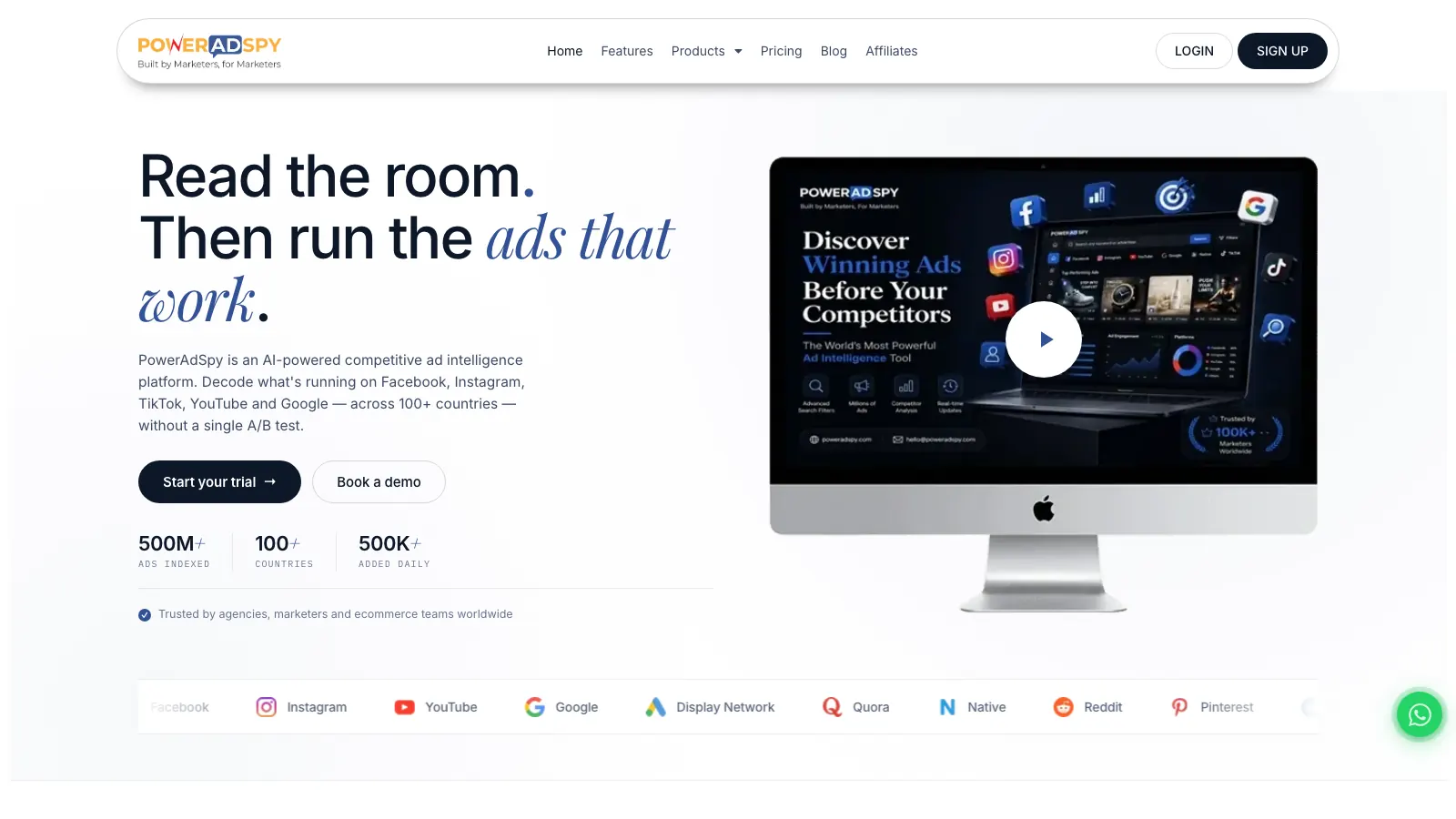
- PowerAdSpy consolidates active advertisements across Meta, display, video, native, and Google Search into a single searchable research database for multi-channel creative teams.
- PowerAdSpy plans start at sixty-nine dollars monthly, though accessing YouTube, native, and Google Search coverage requires upgrading to Platinum at two hundred seventy-nine dollars.
- PowerAdSpy advertises business intelligence delivery through a dedicated API connection, although published documentation leaves exact quota allocations and plan entitlements unconfirmed for development teams.
- PowerAdSpy focuses exclusively on creative intelligence discovery and historical pattern research rather than active campaign management, automated publishing, or verified competitor analytics tracking.
If your paid-media brief spans Meta, display, video, native and Google Search, PowerAdSpy brings those visible ads into one research library. Platinum is the sensible tier when that cross-channel work needs YouTube, Native, Google Search and deeper filters. Pass if your work lives in one social channel or you need campaign controls, because this is a library for finding creative and patterns, not an ads manager.
Agent access
- API
- Not found on official pages
- MCP server
- Not found on official pages
What are the main advantages and drawbacks of using PowerAdSpy?
What works
- Clear network gates from two networks to all 11
- Keyword, advertiser and domain search on every paid plan
- Unlimited ad trackers from Standard upward
What to watch
- Google Search and deeper filters start at $279 a month
- Four networks need the $399 Palladium plan
- API terms and campaign controls are not published
What cross-channel advertising research capabilities does PowerAdSpy provide?
When a creative brief needs examples from more than one channel, PowerAdSpy gives your team one place to search them. Its plans begin with Facebook and Instagram, then add Pinterest and Google Display Network, then YouTube, Native and Google Search. For a wider view of what is available, the marketing tools directory covers other research products alongside PowerAdSpy.
The useful distinction is between discovery and proof. You can search by keyword, advertiser or domain, then narrow the results with category, call to action, country and sorting controls. PowerAdSpy also lists fields for placement, engagement, age and format. Those controls can speed the first pass through competitor creative, then guide questions to validate with your own campaign data.
I would treat the product as a research desk for a paid-media team. Standard is the first plan with tracker access. Platinum is the first plan that brings together the channels and filters a generalist buyer usually expects. Palladium is for a team that genuinely needs LinkedIn, TikTok, Quora or Reddit, which the vendor calls niche coverage.
Which marketing and creative teams get the most value from PowerAdSpy?
Cross-channel media teams
Platinum combines video, native, search and display examples in one research workflow.
Agencies tracking competitors
Standard adds unlimited ad trackers for recurring research checks across five brands.
Ecommerce creative researchers
Platinum adds ecommerce, affiliate and funnel filters for studying visible ad patterns.
Creative strategists
AI metadata helps group visible ads by hook, intent, colors and offer.
It is a poor match for a solo operator who only needs Meta examples, because $69 a month buys just two networks and one brand. If an estimate influences a buying decision, treat the estimated-budget field, available from Platinum, as a research input and validate decisions with your own campaign data.
Which search filters and creative discovery features are included in PowerAdSpy?
Eleven networks, with meaningful plan gates
PowerAdSpy names 11 networks in its plan comparison. Basic covers Facebook and Instagram. Standard adds Pinterest and Google Display Network. Platinum adds YouTube, Native and Google Search. Palladium adds LinkedIn, TikTok, Quora and Reddit. The last four are labeled niche coverage, so they warrant a trial before they become the reason to commit to the top plan.
Search and filters for a creative angle
Every tier lists keyword, advertiser and domain search, plus core filters for category, call to action, country and sorting. At Standard, you can also filter by type, placement, gender and age. Platinum opens filters for device, affiliate activity, ecommerce, marketing and funnels. That is a useful progression: Basic finds an example, while Platinum gives a strategist enough ways to frame a genuine research question.
AI metadata filters
PowerAdSpy says it parses an ad into ad type, intent, hook, offering type, offer type and colors. Those labels are available as AI Metadata Filters on every listed plan. They are most useful when you are looking for a pattern, such as a particular promise or visual treatment, rather than already knowing the advertiser or phrase to search.
Trackers and continuing research
Basic has a one-brand limit, compared with five on Standard, 10 on Platinum and 30 on Palladium. Standard and higher plans list unlimited ad trackers. The site also describes folders, saved searches, team sharing and alerts for watched advertisers launching new creative. That makes Standard the practical starting line for an agency or in-house team returning to the same competitors week after week.
Exports and agent access
PowerAdSpy describes PDF and CSV reporting for creative comparisons, ad-life timelines and competitor benchmarks, with an option to send reports to a BI stack through an API. The published plan table does not say which plan includes API access, what its quotas are, or whether an API is separately priced. Do not design an AI-agent workflow around it until those terms are confirmed in writing.
How much do monthly and annual subscriptions cost for PowerAdSpy?
Price checked 27 Nov 2026
| Plan detail | Basic$69/mo | Standard$99/mo | Platinum$279/mo | Palladium$399/mo |
|---|---|---|---|---|
| Networks | 2 core networks | Adds 2 networks | Adds 3 networks | All 11 listed networks |
| Brand limit | 1 | 5 | 10 | 30 |
| Keyword, advertiser and domain search | ✓ | ✓ | ✓ | ✓ |
| Targeting filters and unlimited trackers | ✕ | ✓ | ✓ | ✓ |
| Funnel filters and estimated budget | ✕ | ✕ | ✓ | ✓ |
| Three-day trial | $1 | $7 | $7 | $7 |
PowerAdSpy prices in US dollars, 27 Nov 2026.PowerAdSpy pricing
Standard is a five-brand research subscription at $99 a month, with unlimited ad trackers. PowerAdSpy does not publish included seats or extra-user charges, so confirm those before treating it as a team bill. Annual billing is a separate upfront charge. The vendor displays Standard at $39 a month, billed as $475 upfront yearly, which works out to about $39.58 a month when divided across 12 months. Basic is $331 a year and Palladium is $1,436 a year. The site says annual plans are 58 to 70% lower than monthly rates.
- Basic starts at $1 for three days, then becomes $69 a month
- Standard, Platinum and Palladium start at $7 for three days
- PowerAdSpy says a plan can be upgraded from account settings
- Cancel before day three to avoid the full plan rate
Where does PowerAdSpy fall short for modern media buyers?
PowerAdSpy ties comprehensive network breadth to an abrupt price climb. Standard costs $99 a month but has neither Google Search nor YouTube, Native, funnel filters or estimated budget. Adding those capabilities takes the bill to $279 a month. The four niche-coverage networks then require $399 a month, so the top tier is best treated as a channel-specific purchase rather than the automatic default.
PowerAdSpy is positioned as an ad-intelligence research tool, with discovery, filters, trackers, alerts and exports named on its own pages. If campaign building, bidding or publishing is part of your brief, confirm those capabilities before buying.
The estimated-budget field starts at Platinum. Treat it as a research input, then validate decisions with your own campaign data.
Which competitor tools offer practical alternatives to PowerAdSpy?
 PowerAdSpy alternative AI Peekaboo belongs beside this decision only when AI-answer visibility is also part of the brief: every plan includes API and MCP access from $30 a month. The AI Peekaboo review explains its reporting and agent access.
 Spytrend is better suited to a tightly focused Meta and TikTok research workflow: its Webmasters view connects Pixel IDs, landing domains, Page IDs and IP addresses into one profile. Read the Spytrend review if connected advertiser activity matters more than broad network coverage.
 SwipeHarbor takes the opposite route, covering NewsBreak, Rumble and YouTube with available landing-page evidence and MCP access. The SwipeHarbor review explains why it fits channel-specific video and native-ad research rather than an all-purpose library.
Is PowerAdSpy worth the investment for multi-channel creative research?
PowerAdSpy earns its place when the task is comparing creative across several ad environments without hopping between libraries. Start at Standard only if trackers and five brands are enough. Move to Platinum when YouTube, Native, Google Search or the deeper filters will change your research every week. Otherwise, the price jump is hard to defend.
Use the three-day trial on the tier that contains your must-have network, verify the coverage for that channel, and make sure the search and tracker limits fit the number of brands you actually monitor.
How was this PowerAdSpy review researched and fact-checked?
PowerAdSpy documentation, pricing tables, feature lists, and annual billing terms were checked directly on 27 Nov 2026. Prices are in US dollars, as PowerAdSpy shows them, and each figure follows how we check figures.
- PowerAdSpy home and features pages
- PowerAdSpy pricing page
- PowerAdSpy annual-pricing page
What are the most frequently asked questions about PowerAdSpy?
How much does PowerAdSpy cost?
PowerAdSpy lists Basic at $69 a month, Standard at $99, Platinum at $279 and Palladium at $399. Basic has a $1 three-day trial; the other paid tiers have a $7 three-day trial.
Which plan includes Google Search and YouTube ads?
Platinum and Palladium include YouTube, Native and Google Search. Standard adds Pinterest and Google Display Network, while Basic is limited to Facebook and Instagram.
Does PowerAdSpy include ad tracking?
Yes, Standard, Platinum and Palladium list unlimited ad trackers. Basic has a one-brand limit and does not list ad trackers.
Does PowerAdSpy provide API access for AI agents?
PowerAdSpy says reports can go to a BI stack through an API, but it does not publish the API plan entitlement, quotas or a separate price. Confirm those terms before relying on it for an AI-agent workflow.
 Reviewed byDanny Kirk
Founder of ReddiReach.
 Checked byAndrés Felipe
Digital designer and marketer.
Every figure is checked against the vendor's own page. Read our editorial standards.