Key Takeaways
- Radarkit monitors brand positioning across ChatGPT, Copilot, Perplexity, Gemini, and Google AI results while deploying automated agents to generate content.
- Radarkit structures self-serve plans from $29 for Lite up to $139 monthly for Pro, including a seven-day free trial.
- Radarkit provides native Model Context Protocol tools and developer REST API credits across every subscription tier.
- Radarkit refreshes keyword rankings only once every 72 hours on its entry plan and excludes Claude engine monitoring entirely.
You have a small budget, a handful of prompts that matter, and nobody free to act on what the tracking finds. Radarkit is the budget pick for that situation: from $29 a month it tracks six AI engines, includes MCP and API access, and adds agents that draft content and find outreach targets. Choose something else if Claude is where your buyers ask, because it is not on Radarkit's model list, or if you need daily data on the entry plan, since Lite refreshes every 72 hours.
Agent access
- API
- Yes, Lite ($29/month), Growth ($79/month), Pro ($139/month), or Enterprise (custom annual)
- MCP server
- Official, hosted, OAuth
- Works with
 ChatGPT
 ClaudeClaude Code
 Cursor
What are the primary strengths and trade-offs of Radarkit?
What works
- MCP and API access from the $29 plan
- Content, outreach and chat agents included
- Local, shopping and ads tracking on all plans
What to watch
- Lite checks prompts every 72 hours, not daily
- Claude is not on the tracked model list
- No extra seats on the Lite plan
Which AI search engines and conversational models does Radarkit track?
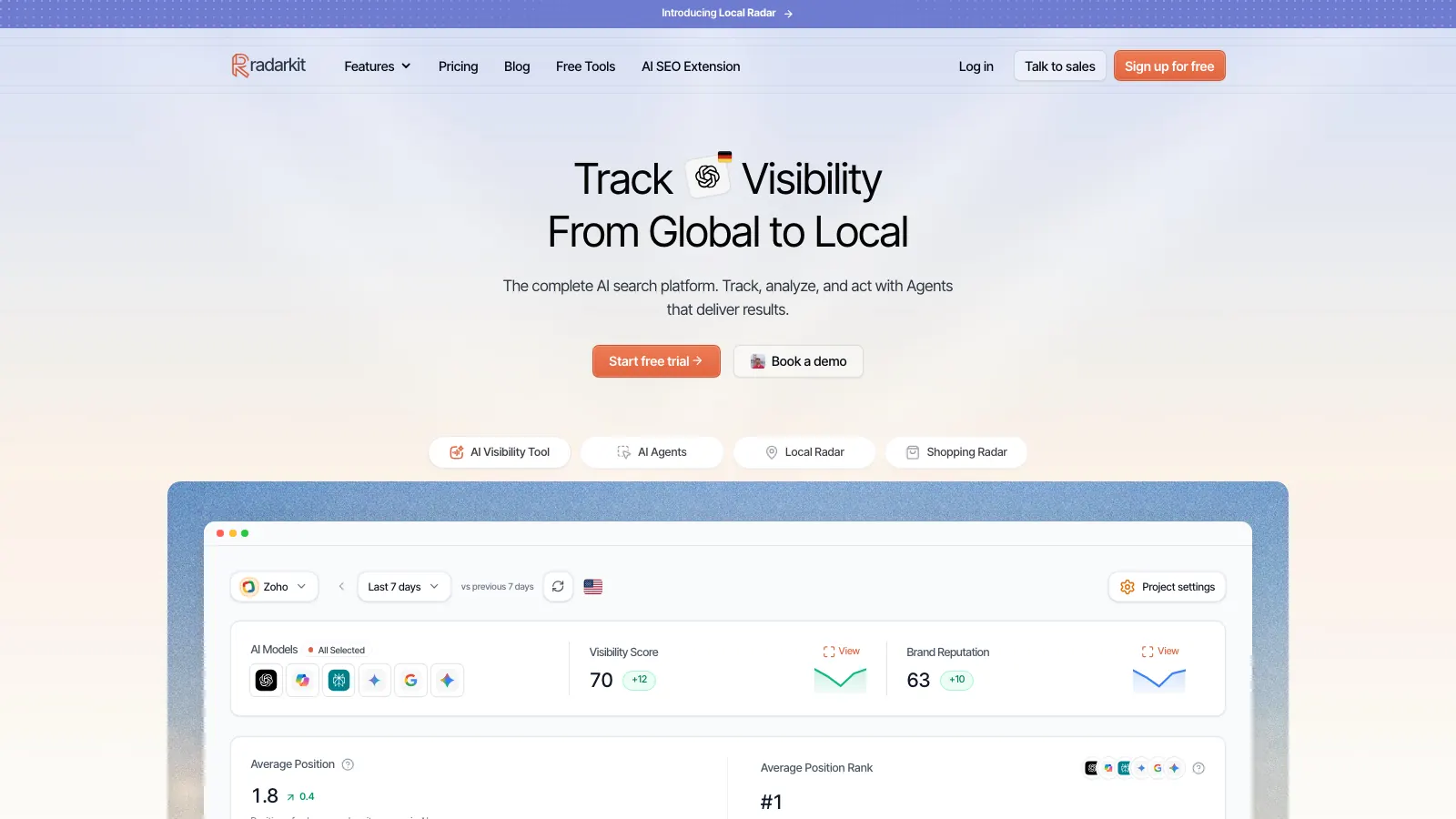
Radarkit runs your prompts through ChatGPT, Google AI Mode, Google AI Overviews, Microsoft Copilot, Perplexity and Gemini, and records every answer about you and your competitors. It does this by opening the real chat interfaces like a customer would, not by calling model APIs, so the answers it stores are closer to what a buyer sees. Among the best AI visibility tools, it stands out for packing that tracking, machine access and working agents into a $29 plan.
The plans differ mainly in volume. All six models, competitor monitoring, local, shopping and ads tracking, the client portal and MCP and API access appear on every tier. What you buy with a bigger plan is more projects, more prompts, a faster refresh and more agent output.
I read that as a tool built for people who will act on the data themselves. The agents are the reason to choose it over a plain tracker, and the API makes it easy to pull the numbers somewhere else when you outgrow the dashboard.
Who gets the highest value from Radarkit AI monitoring?
Solo marketers
Lite covers 2 projects and 15 prompts on all six models, with agents and API access included.
Developers and builders
Every plan ships MCP and a REST API, metered in credits, with exports for large pulls of data.
Local businesses
Local Radar runs prompts from residential IPs in a chosen city and shows where AI ranks you.
Online shops
Shopping Radar captures the product carousel in AI answers, with position, price and winning store.
Radarkit fits less well for a team that needs broad coverage at a high cadence on day one. Lite tracks 15 prompts every three days, and the step to daily tracking with 50 prompts is the $79 Growth plan.
Which automated agent and search tracking capabilities does Radarkit include?
Six models from real chat interfaces
Each plan tracks the same six models, and Enterprise adds model selection on top. Results include a visibility score, brand reputation, average position and sentiment, per model and over time, with full historical data kept on every plan. Radarkit tracks from 50+ locations on the self-serve plans, so you can see how answers change by country.
Sources, competitors and query fan-out
Radarkit records which websites each answer relied on and which competitors it named, with share of voice against your competitor set. It also shows the searches a model ran behind the scenes to build its answer. That fan-out data is useful for a content team, because it shows the exact sub-questions a page has to cover to be picked up.
Local Radar, Shopping Radar and Ads Radar
Local Radar runs prompts from a city-level residential IP to show which businesses AI recommends there, with rank and rating. Shopping Radar captures the product carousel AI answers now show, and Ads Radar records every sponsored placement on your prompts, with advertiser and headline. Having all three on the $29 plan is unusual and makes Radarkit a good fit for local and retail brands.
Content, outreach and chat agents
The agents read your Radarkit data and your brand kit before they act. The Content Agent optimizes or writes articles anchored to tracked prompts and connects to WordPress. The Outreach Agent finds sites that cite competitors but not you, drafts emails and sends them through Gmail. A Reddit Agent reads the threads AI cites in your space, and a Plan agent turns Search Console and citation data into a task list. Treat their output as drafts that need an editor, not finished work.
MCP and API for your agents
The REST API returns visibility, responses, sources, share of voice, rankings, query fan-out and sentiment as JSON, and can add prompts, run a prompt on demand or ask the Content Agent for an article. MCP exposes the same calls as tools for Claude or Cursor. Both spend API credits, most calls cost 1 and heavier ones 2, and a call that fails on Radarkit's side is refunded.
How does Radarkit price its Lite, Growth, and Pro tiers?
Price checked 27 Nov 2026
| Plan detail | Lite$29/mo | Growth$79/mo | Pro$139/mo |
|---|---|---|---|
| Projects | 2 | 5 | 10 |
| Prompts tracked | 15 | 50 | 100 |
| Refresh | Every 72 hours | Daily | Daily |
| Responses analyzed a month | 900 | 9,000 | 18,000 |
| Content Agent articles a month | 6 | 19 | 32 |
| Branded PDF reports | 2 | 10 | 20 |
| API credits a month | 250 | 750 | 1,500 |
| Extra seats | None | 2 | 5 |
Radarkit plans in US dollars, 27 Nov 2026.Radarkit pricing
For a team, seats are the hidden line. Lite has no extra seats and Growth adds two, so a team of five needs Pro at $139 a month before anything else. The other limits that shape the real bill:
- Outreach and Reddit agents share 10, 20 or 40 action credits a month, depending on plan
- The Chat Agent allows 15, 25 or 50 messages a month
- Google Search Console, Google Analytics and WordPress connect on every plan
- Every plan starts with a 7-day free trial, and a refund is offered within 48 hours of a charge
What custom features are available on Radarkit Enterprise?
Radarkit reserves custom annual contracts and high-volume tracking capacities for enterprise brands and marketing agencies. It makes sense once you need tracking at state or city level, or more people in the account than Pro allows.
- Unlimited projects, custom prompt tracking and model selection
- 70+ locations, with state and city level tracking
- Single sign-on, unlimited seats and a dedicated manager
- Custom contract terms and priority access to new features
What are the main drawbacks and limitations of Radarkit?
Radarkit restricts data availability on its entry plan by scheduling prompt refreshes only once every three days. Fifteen prompts checked every 72 hours give you 900 responses a month, which is enough to see whether you appear but not enough to report a trend with confidence. Most teams will need Growth to get daily tracking and a prompt set that covers a real market.
Model coverage has a clear gap. Claude is not among the six models tracked on any self-serve plan, and Enterprise model selection does not name it, so a business whose buyers favour Claude should look elsewhere.
The agents need supervision too. An outreach agent that sends from your Gmail and a content agent that writes articles can save time, but both act in your name, so set the review steps before you switch them on. API credits are also tight on Lite at 250 a month, since each list call returns at most 25 rows.
How does Radarkit compare to competing AI visibility trackers?
 Radarkit rivals include AI Peekaboo for teams requiring comprehensive analytics dashboards rather than built-in drafting agents. It starts at $30 a month with the API, MCP and Looker Studio included, and white-label reports and share links from $100, though it does not draft articles. The AI Peekaboo review sets out its plans.
 Rankscale covers 17+ engines, Claude among them, on every plan, which fixes Radarkit's biggest gap; the Rankscale review explains its credit system.
 Ranksmith tracks Claude and Grok from $69 a month while in public beta, and the Ranksmith review covers what it includes.
What is our overall evaluation of Radarkit for marketing teams?
Radarkit stands out for teams seeking affordable AI visibility across leading conversational engines paired with automated drafting agents. Growth at $79 a month is where it becomes a serious tracker, with daily checks and 50 prompts. Look elsewhere if Claude matters, or if you need a large team in the account without paying for Pro.
Start the 7-day trial on Growth rather than Lite, so you judge the daily data, and keep the outreach agent on manual review until you trust its emails.
How did we verify Radarkit pricing data and API credit limits?
Radarkit feature lists, API credit limits, and subscription prices were verified against official documentation on 27 Nov 2026. Prices are in US dollars, as Radarkit shows them, and every figure follows the rules in how we check figures.
- Radarkit pricing page, plan comparison and pricing FAQ
- Radarkit home page and feature pages for agents, Local Radar, Shopping Radar and Ads Radar
- Radarkit API documentation, including credits and rate limits
What are the common questions about Radarkit AI prompt tracking?
Does Radarkit have a free plan?
No permanent free plan is listed. Every plan starts with a 7-day free trial and no payment upfront, and Lite costs $29 a month after it.
Which AI models does Radarkit track?
ChatGPT, Google AI Mode, Google AI Overviews, Microsoft Copilot, Perplexity and Gemini, on every plan. Enterprise adds model selection.
Is the Radarkit API included on the cheapest plan?
Yes. MCP and API access are on every plan, with 250 API credits a month on Lite, 750 on Growth and 1,500 on Pro.
How often does Radarkit check prompts?
Every 72 hours on Lite, daily on Growth and Pro, and daily or weekly on Enterprise.
 Reviewed byDanny Kirk
Founder of ReddiReach.
 Checked byAndrés Felipe
Digital designer and marketer.
Every figure is checked against the vendor's own page. Read our editorial standards.