Key Takeaways
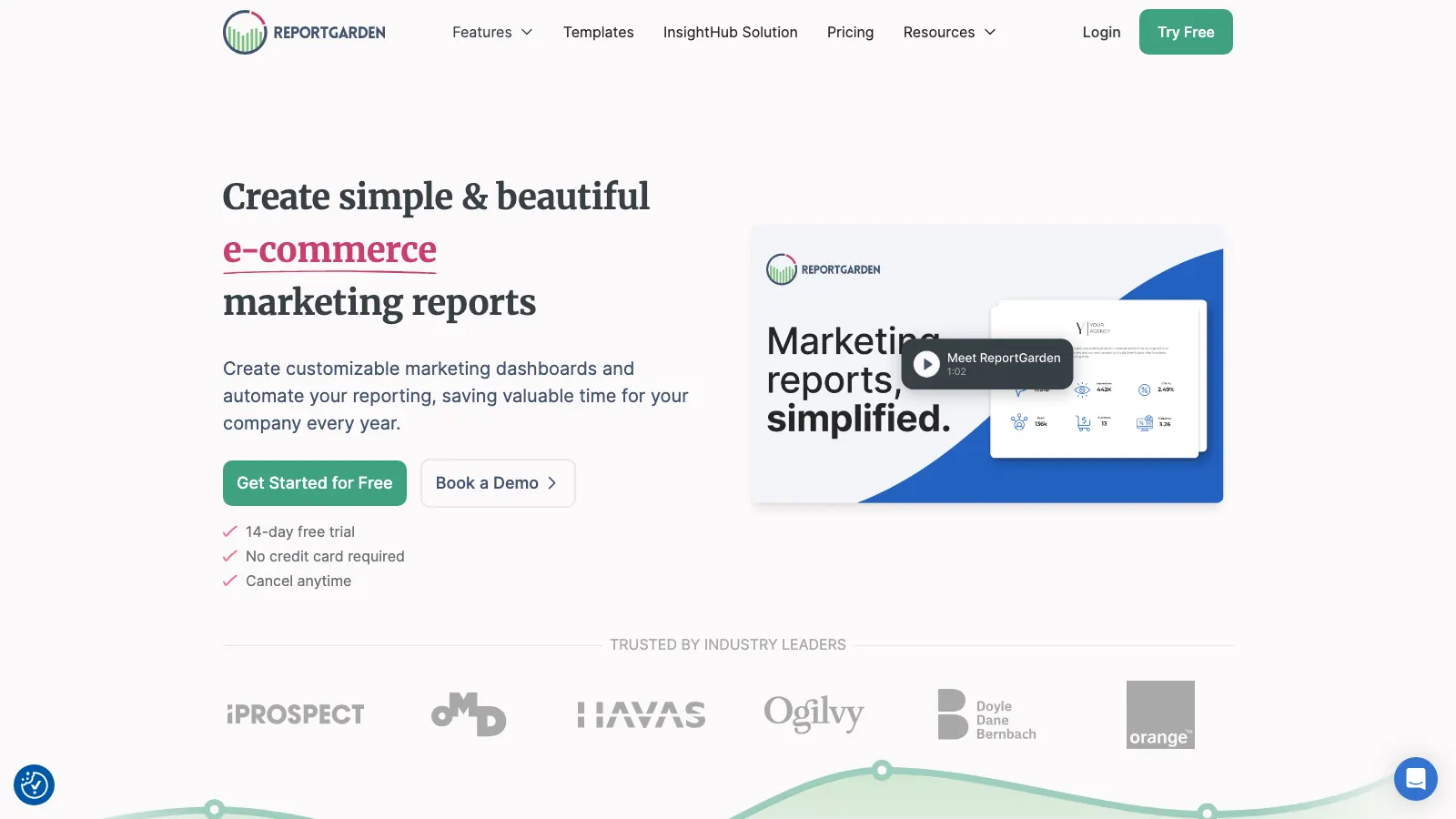
- ReportGarden aggregates multi-channel marketing metrics into automated, white-label client reports and dashboards for digital agencies.
- ReportGarden starts at $75 per month with fair-use limits, offering a 14-day trial without requiring credit card registration.
- ReportGarden advertises an MCP connector on public pages but lacks public documentation for a developer-facing REST data extraction API.
- ReportGarden maintains less public transparency regarding detailed account tier limits compared to competitors in the reporting software market.
For an agency comparing the marketing tools directory, ReportGarden is a good fit when you need to turn marketing data into branded client reporting without starting every report from a blank canvas, and published plans start at $75 a month. Skip it when a documented REST data API or plan-by-plan limits are non-negotiable: the public product pages announce an MCP connector but do not document a customer REST reporting API.
Agent access
- API
- Not found on official pages
- MCP server
- Official, hosted, Browser sign-in and approval
- Works with
 ClaudeClaude Code
 ChatGPT
What are the primary pros and cons of ReportGarden?
What works
- Plans start at $75 a month
- White-label portal with your branding and domain
- Scheduled reporting and cross-platform data blending
What to watch
- Plan-level limits are not published
- Customer REST API documentation is not public
- Annual discount requires a sales conversation
How does ReportGarden automate agency client reporting?
ReportGarden replaces manual client screenshots with automated, professional cross-channel marketing reports and scheduled dashboards. They need a coherent account of what happened across paid, social, analytics and other sources. ReportGarden is built around that job: it connects data sources, blends data for cross-platform reporting, lets you shape reports, then schedules delivery to clients or team members.
The practical attraction is repeatability. The template library includes report types for paid media, web analytics, call tracking, video, local SEO and multi-channel PPC. An agency with a familiar service mix can begin from a relevant structure, then put its own measures and branding around it. That gives a team whose reporting work has outgrown manual exports a repeatable operating model.
I would not choose it because the site promises a huge template count. It does say it has more than 1,000 templates, but the more useful buying signal is simpler: templates, data blending, white labeling and automated reporting appear together in the published offer. Your decision is whether that bundle matches the reports you sell each month.
Which agencies should consider ReportGarden?
Growing agencies
Send recurring, branded updates without rebuilding the reporting structure for every client.
Paid media teams
Bring advertising and analytics sources into one reporting workflow for clearer client conversations.
Multi-channel marketers
Blend data across sources when separate platform views obscure the full performance picture.
AI-assisted operations
Use the MCP connector when your reporting workflow needs an approved agent connection.
It is less compelling for a team that treats reporting data as infrastructure. The published pages do not set out a customer REST API for pulling or pushing report data, and they do not show which usage limits sit behind the starting price. If those are your procurement gates, get answers before you migrate client reporting.
What reporting and dashboard features does ReportGarden provide?
Reporting across connected marketing sources
ReportGarden says plans have access to 100+ integrated data sources across paid advertising, analytics, social and email marketing. The point is not merely putting source widgets beside each other. Cross-platform reporting with data blending helps you frame one account of performance for a client running activity across several channels.
Templates that give reports a starting point
The template collection covers familiar agency assignments, including Google Ads, local SEO and multi-channel PPC. That reduces the blank-page problem when your service packages repeat. You can choose a shape that resembles the work you do, then focus the conversation on the measures that matter to that client rather than on reassembling a report shell.
Your brand on the client portal
ReportGarden says you can white-label the portal with your branding and domain. This matters when reporting is part of the service you are selling, not a back-office handoff. A client sees an experience that belongs to your agency, while ReportGarden handles the reporting system underneath it.
Scheduled report delivery
The platform supports automated reporting scheduled to clients or team members regularly. That is the feature I would value most after the template library: it creates a dependable reporting rhythm without making an account manager recreate the delivery job every time the calendar turns.
MCP, Ask AI and API limits
ReportGarden’s support area announces an MCP connector, and its terms permit authorized MCP Connections. Its terms also describe optional AI features including Ask AI and an AI Chatbot. That gives an agent-oriented team a defined connection route. ReportGarden does not publicly document a customer REST API for pulling or pushing report data. Treat those as different requirements.
What are the subscription prices and terms for ReportGarden?
Price checked 27 Nov 2026
| Plan detail | Published offerFrom $75/mo |
|---|---|
| Starting price | $75 a month, fair usage limits apply |
| Free trial | 14 days, no credit card required |
| Billing terms | Monthly or yearly |
| Annual discount | Available, amount not published |
| Data sources | 100+ integrated sources |
| White-label reporting | ✓ |
| MCP connector | Available; plan eligibility and fees not stated |
ReportGarden pricing, 27 Nov 2026.ReportGarden pricing
The $75 figure is a starting price, not a reliable team bill, and ReportGarden states that fair usage limits apply. ReportGarden explains that a data source is an external platform used for analysis and reporting, and that only sources used to create reports count toward billing. One advertising account, another advertising account and a social page can count as three sources. The price page does not publish the included source count, seats or higher plan prices, so you cannot responsibly calculate a three-person, ten-client bill from the public information.
- Ask which fair usage limits apply to the $75 plan
- Ask how many used data sources the $75 plan includes
- Ask whether client access, team seats or report volume change the bill
- Ask for the annual price and discount in writing before committing
Monthly and yearly contracts are available, and ReportGarden says you can upgrade at any time or downgrade for the next billing cycle. The trial lasts 14 days and needs no card, which is enough time to see whether your core sources and report format fit ReportGarden. It is not enough information to infer the bill once client volume grows.
What are the main drawbacks of ReportGarden?
ReportGarden limits public transparency by omitting granular metric caps and plan-by-plan feature restrictions from its pricing page. A starting price is useful, but agency reporting costs are shaped by the sources you put into active reports. Without a published allowance, seats or report-volume limits, you cannot compare the real monthly cost across a team from the website alone. That makes the trial and a precise sales quote more important than the headline number.
The agent story also needs a careful read. MCP access is documented, and that is meaningful for teams working with compatible AI tools. But the public pages do not document a customer REST API for reporting data. Do not assume an MCP connector supplies the same programmatic control, exports or workflow options that your engineering team expects from a documented API.
Finally, a library of pre-designed templates can accelerate familiar work, but it is not a substitute for deciding what each client should see. ReportGarden provides the structure and delivery machinery. Your team still needs a reporting point of view, good source selection and an agreed definition of the measures that belong in the report.
What software tools serve as alternatives to ReportGarden?
 AI Peekaboo review is worth reading first when the client question is AI visibility rather than general marketing reporting. Its monthly starting price is $30, checked 27 Nov 2026, and its published pricing includes MCP and API access, which makes it the more specific option when those connections are central to the job.
 Reporting Ninja review is the better comparison when unlimited users and REST API or MCP access on every plan are deciding requirements.
 Swydo review is worth comparing when unlimited users, dashboards and reports, plus AI-powered report summaries, matter more to your agency.
What is the final evaluation of ReportGarden?
ReportGarden is a solid platform for digital agencies seeking templated report generation, automated client delivery, and branded client portal dashboards. The $75 starting price and no-card trial lower the barrier to finding out whether it fits. Its weak point is not reporting capability, it is the information left between the headline price and your real operating bill.
Run the 14-day trial on a normal client reporting setup, then ask for a written quote that names used data sources, seats, report volume and the annual discount. Confirm the MCP workflow separately if agent access is part of the purchase.
How was the data for this ReportGarden review verified?
ReportGarden features, pricing guidelines, and integration details were verified using official product and terms pages on 27 Nov 2026. Prices are shown in US dollars, as ReportGarden presents them, and every figure follows how we check figures.
- ReportGarden pricing and trial terms
- ReportGarden product, template and integration pages
- ReportGarden support, security and terms pages
What are common questions about ReportGarden?
How much does ReportGarden cost?
ReportGarden publishes plans starting at $75 a month. It does not publish the source allowance, seats or higher plan prices needed to calculate a team bill.
Does ReportGarden offer a free trial?
Yes. The published trial lasts 14 days and does not require a credit card. ReportGarden does not advertise a permanent free tier.
Which data sources does ReportGarden connect?
ReportGarden says it has 100+ integrated data sources across paid advertising, analytics, social and email marketing.
Does ReportGarden work with AI agents?
ReportGarden offers an MCP connector and describes optional AI features. The public pages do not document a customer-facing REST API for pulling or pushing reporting data.
 Reviewed byDanny Kirk
Founder of ReddiReach.
 Checked byAndrés Felipe
Digital designer and marketer.
Every figure is checked against the vendor's own page. Read our editorial standards.