
Key Takeaways
- RivalSense provides corporate strategy and marketing teams with curated weekly competitor intelligence digests and a searchable historical archive covering competitor website updates.
- Monthly subscriptions for RivalSense begin at €39.99 on flexible billing or €33.99 per month billed annually, covering tracking for an initial four competitor companies.
- External integrations with RivalSense deliver automated digest summaries over email and Slack, though the vendor does not publish developer APIs or MCP server support.
- Strategic analysts should skip RivalSense if their operations require real-time alerts for immediate competitor price changes, product deployments, or same-day market movements.
RivalSense is the best fit when you need a calm, weekly view of competitor activity rather than another live-alert feed. It is especially useful for product, strategy and marketing teams reviewing changes over time, while teams that must react the same day should choose a faster monitoring setup.
Agent access
- API
- Not found on official pages
- MCP server
- Not found on official pages
What are the main pros and cons of using RivalSense?
What works
- Monitors 80+ source types, from websites to company registers
- Weekly delivery keeps competitor watching from becoming another noisy feed
- Searchable archive makes past signals useful during planning
What to watch
- Weekly delivery can miss the moment for urgent changes
- Each plan starts with a company allowance, then charges per extra company
- Public plans do not document API or MCP access
What competitive intelligence monitoring does RivalSense perform automatically?
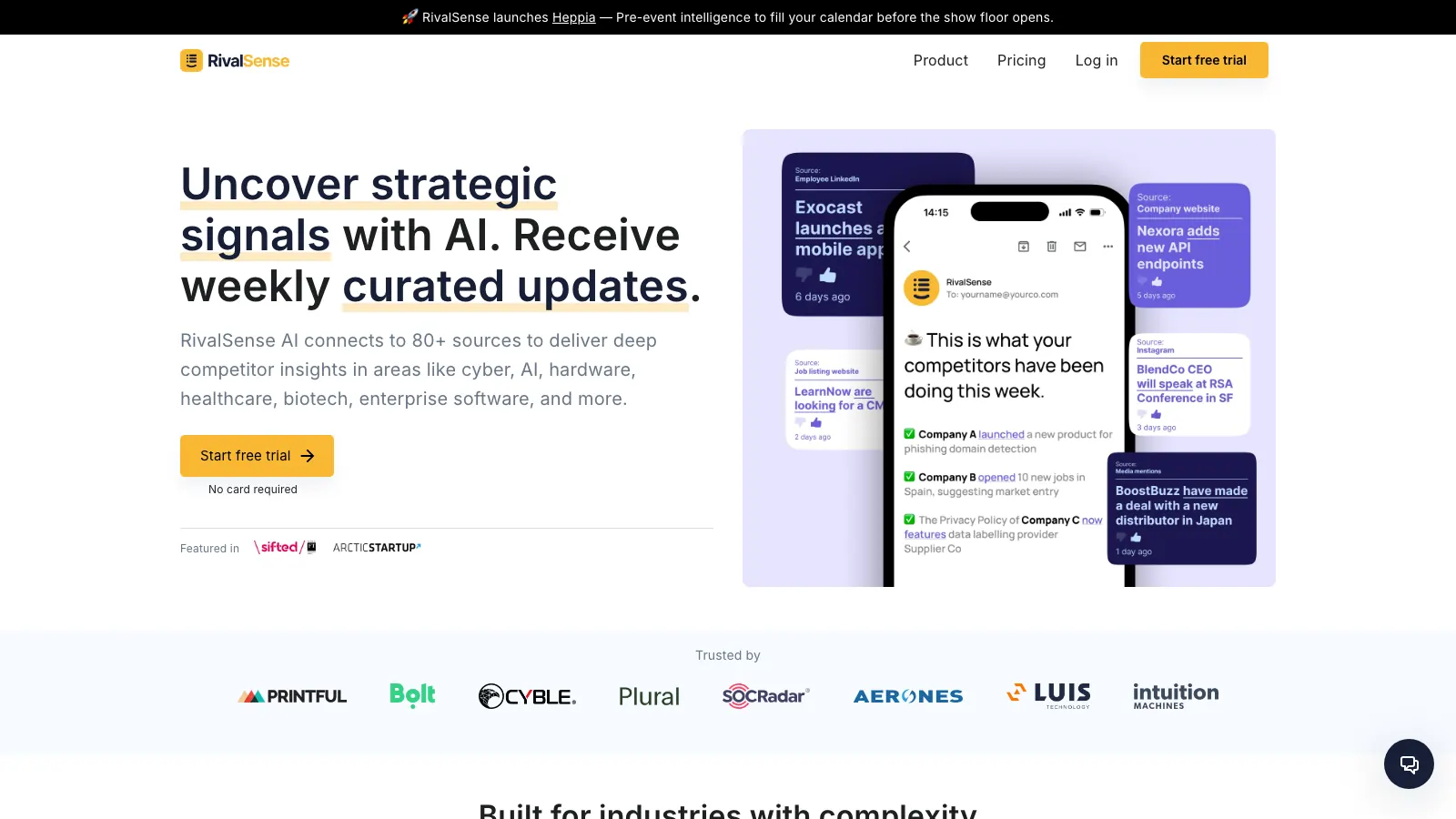
RivalSense establishes a structured rhythm for competitive intelligence when teams lack the time to audit competitor websites, job listings, and press releases continually. It follows more than 80 sources, then sends the developments it considers relevant as a weekly email or Slack update. It belongs in a marketing tools directory beside broad research platforms, but its narrower promise is useful: turn scattered competitor signals into one briefing people will actually read.
The coverage is broader than a simple page-change tracker. RivalSense says it monitors competitor websites, social accounts, company registers, job listings and news sites each day. That means a team can watch product and feature changes alongside hiring, partnerships, client activity, finance and legal developments, without treating every source as a separate research project.
I think the delivery schedule is the real decision point. A weekly briefing suits a team that discusses the market in planning meetings or product reviews. It will feel too slow if a sales team needs to know about a new price page before its next call. RivalSense is deliberately a weekly intelligence habit, not an incident-response console.
Which product and strategy teams derive the most benefit from RivalSense?
Strategy teams
Keep a searchable record of rival moves for quarterly planning and annual reviews.
Product managers
Watch product, hiring, and technology signals without visiting each competitor website manually.
Marketing teams
Follow messaging, distribution, and content changes in one weekly briefing for planning.
 Slack-based teams
Receive weekly Slack updates without adopting another dashboard routine for competitor monitoring.
It is a poor fit for teams whose work depends on immediate alerts. A change discovered during daily monitoring may still arrive in the weekly digest, and that delay is material when a competitor launches, changes a price or announces a partnership. Choose RivalSense when reflection is more valuable than speed.
What competitor tracking and briefing features does RivalSense include?
Monitoring across 80+ sources
RivalSense connects to more than 80 sources. Its published examples include websites, social media, job listings, company registers and news sites. The product categories on its site cover product and features, distribution and partnerships, events and content, clients and markets, hiring and team activity, and legal, financial and M&A developments. That spread lets one competitor record hold more than marketing messages alone.
A weekly brief instead of a raw stream
RivalSense monitors sources daily, then delivers a curated weekly update by email or Slack. You select the monitoring topics that matter to your business and can downvote insights that are not useful, which RivalSense says it uses to adjust prioritization. For a small team, that is the point: the output is a readable briefing, rather than a long queue of individual alerts to sort through.
Searchable archive and filters
Every plan lists a searchable archive of past updates and archive filters. That makes the weekly format more useful after several months, when a strategist can trace how a competitor's messages, team or market activity changed over time. It is a better fit for preparing a review than relying on memory or searching through old notifications.
Email, Slack and roles
All published plans include weekly email updates, Slack integration and role management. Basic includes one company email recipient, Pro includes up to five, and Business lists unlimited company email recipients. That is enough structure for a shared competitor-watch process, but the public pricing does not spell out API, MCP or other broader integration access. Treat those as questions for the vendor, not included functionality.
Topics that match the decision
The tool is strongest when you define the questions before adding competitors. A product lead may care about features, hiring and technical developments. A commercial lead may focus on new markets, clients, distribution and partnerships. RivalSense lets you select relevant topics, so a weekly update can be shaped around the decision the team is trying to make rather than a generic pile of mentions.
How is RivalSense priced across tracked companies and billing cycles?
Price checked 27 Nov 2026
| Plan detail | Basic€39.99/mo | Pro€94.99/mo | Business€199.99/mo |
|---|---|---|---|
| Billed annually | €33.99/mo | €79.99/mo | €166.99/mo |
| Monitored companies | Starts at 4 | Starts at 10 | Starts at 20 |
| Additional company, monthly billing | €9.99/mo | €7.99/mo | €4.99/mo |
| Additional company, annual billing | €8.49/mo | €6.99/mo | €3.99/mo |
| Email recipients | 1 | Up to 5 | Unlimited |
| Weekly updates | ✓ | ✓ | ✓ |
| Searchable archive and filters | ✓ | ✓ | ✓ |
| Chat delivery and role management | ✓ | ✓ | ✓ |
RivalSense prices in euros, 27 Nov 2026.RivalSense pricing
The published price is not a per-seat price. It starts with a monitored-company allowance, then adds a monthly charge for every company over that allowance. For example, a team watching six companies on Basic pays €39.99 plus two additional companies at €9.99, or €59.97 a month. The same team on annual billing pays €33.99 plus two at €8.49, or €50.97 a month.
That makes Basic the clear starting point for a small set of direct competitors. Pro makes more sense when the ten-company allowance and five email recipients fit a wider team. Business earns its price only when the larger company set, unlimited email recipients and lower marginal company cost actually match the scope you monitor.
RivalSense lets you begin a trial without entering card details. Its public pages do not describe a permanent no-cost plan, so budget for a paid plan if the weekly brief becomes part of your planning routine.
Where does RivalSense fall short for urgent competitor alerts?
RivalSense creates its primary operational limitation through the same weekly cadence that makes its briefings manageable. The product says it monitors sources daily, but the published delivery promise is a weekly update. If a competitor price change, launch or executive move needs a response before the next planning meeting, that may be too late.
The second constraint is machine access. Email and Slack are documented in every public pricing tier, while API access and broader integrations are not. A team that needs competitor data inside its own warehouse, reporting system or agent workflow should confirm those capabilities in writing before it commits.
Finally, company count is the number to watch, not just the headline plan price. A watchlist can grow quickly once you include direct rivals, adjacent products and market entrants. Map the competitors you truly need before choosing a tier, then price the extras rather than assuming the monthly figure covers the full market.
What are the most notable market alternatives to RivalSense?
 AI Peekaboo review covers a tool that compares the same buyer questions across five supported AI search surfaces.
 SERPrecon review covers a tool that builds content outlines from topics, questions, entities, keywords and intent extracted from top-ranking pages.
 SimilarWeb review covers Traffic & Engagement and a Marketing Channels Overview. RivalSense remains the more focused choice when the weekly curated update and archive are the job to be done.
What is the final purchasing recommendation for RivalSense?
RivalSense earns its place with teams that want competitor intelligence to become a steady planning input, not an endless alert stream. The combination of 80+ sources, weekly delivery and a searchable archive is practical for a team that needs to understand the direction of a market over time.
Start the no-card trial with the four competitors that affect your next planning cycle. Keep RivalSense if the weekly brief gives your team useful context; look elsewhere if the work requires same-day action or documented API access.
How were the features and pricing tiers of RivalSense confirmed?
RivalSense product specifications, pricing details, and published terms were verified on 27 Nov 2026. Prices are shown in euros as RivalSense publishes them, and the calculations above follow how we check figures.
- RivalSense product and pricing page
- RivalSense annual pricing view
- RivalSense terms and conditions
What are the most common questions regarding RivalSense?
How often does RivalSense send updates?
RivalSense sends curated weekly updates by email or Slack. It says it monitors the listed sources daily, then turns relevant developments into the weekly briefing.
What does RivalSense monitor?
RivalSense says it connects to more than 80 sources, including competitor websites, social accounts, company registers, job listings and news sites.
Is there a free RivalSense plan?
RivalSense offers a no-card free trial. Its public pages make no claim of a permanent free tier.
Can I search RivalSense history?
Yes. Every published plan includes a searchable archive of past updates and archive filters.
Does RivalSense offer an API?
RivalSense documents email delivery and Slack integration on public plans. Its public plan details do not document API or MCP access.
 Reviewed byDanny Kirk
Founder of ReddiReach.
 Checked byAndrés Felipe
Digital designer and marketer.
Every figure is checked against the vendor's own page. Read our editorial standards.