
Key Takeaways
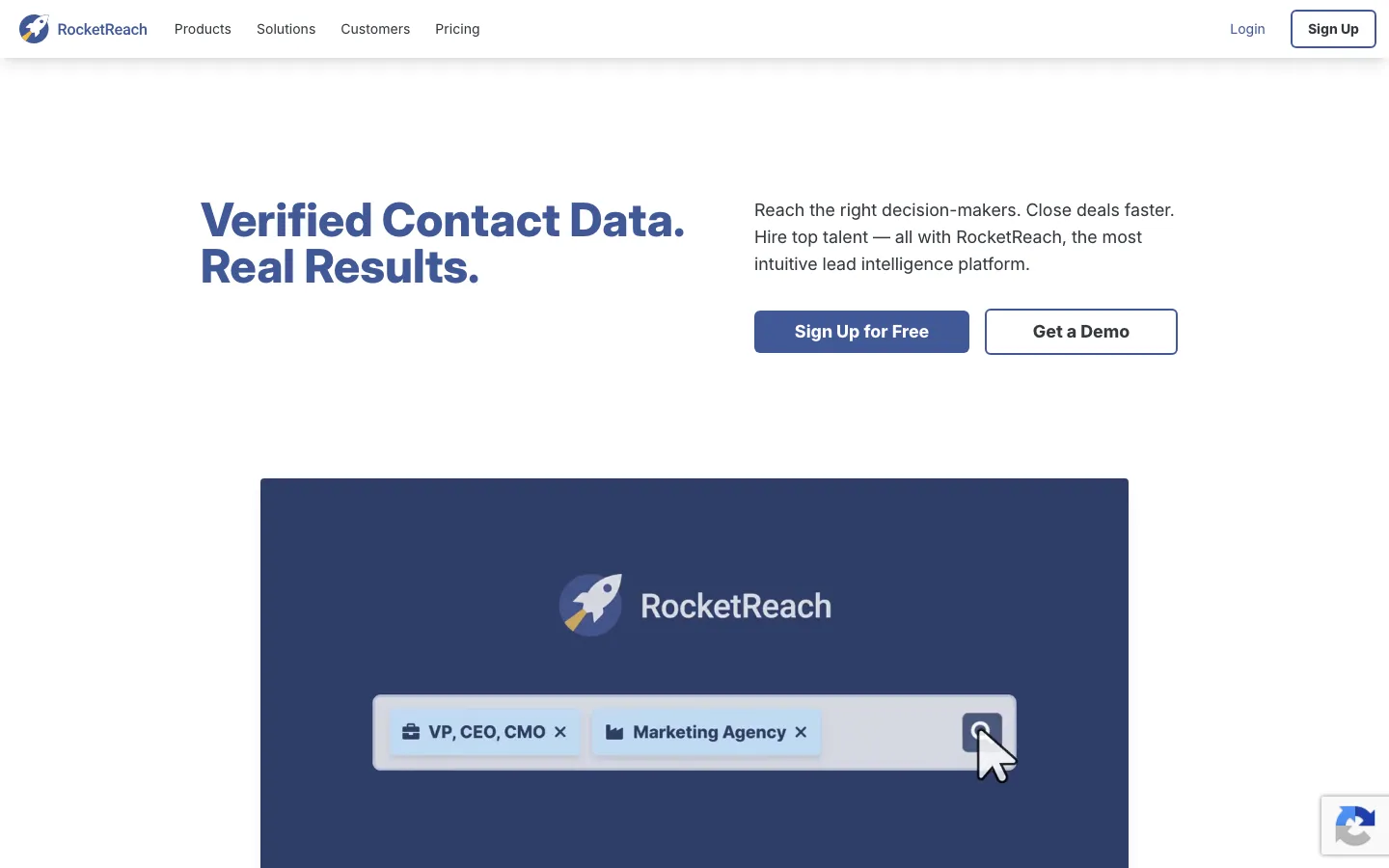
- RocketReach equips sales and recruiting professionals to discover verified work emails, direct dial numbers, and company intelligence within an integrated search interface.
- Users can test five free lookups on RocketReach before subscribing to annual plans billed at $229 for Essentials, $619 for Pro, or $1,379 for Ultimate.
- Engineering teams can connect AI agents directly to RocketReach using documented REST API endpoints and native MCP access across Essentials, Pro, and Ultimate tiers.
- Outbound organizations should skip RocketReach if their primary goal is complex opportunity deal tracking, as the platform focuses on contact discovery rather than full CRM functionality.
When your sales team needs named contacts before it can start a conversation, RocketReach is a practical fit for finding work emails, phone numbers and company context in one place. Start with five free lookups, then choose the email-only Essentials plan or the phone-enabled Pro plan based on the records your motion actually needs. The marketing tools directory is useful when relationship management, rather than prospect discovery, is the next purchase.
Agent access
- API
- Yes, any RocketReach plan on the pricing page, for smaller data needs
- MCP server
- Official, hosted, OAuth 2.1 with PKCE
- Works with
 ClaudeClaude Code
 ChatGPT
 Gemini
 Cursor
 VS Code
 n8n
- Automation
- Zapier
What are the primary pros and cons of using RocketReach?
What works
- Five free lookups with no credit card required
- API and MCP access listed on Essentials, Pro and Ultimate
- Pro and Ultimate add verified mobile and direct phone numbers
What to watch
- Essentials is an email-only plan
- Export allowances vary sharply between paid tiers
- Intent data and Salesforce custom mapping sit on Ultimate
What lead intelligence and contact discovery tools does RocketReach provide?
RocketReach describes itself as a lead intelligence platform. Its documented work starts with locating people at a target company, checking available contact fields, creating a list and connecting that data to CRM or marketing automation platforms. Teams whose main gap is prospect data can use that focus to judge whether it fits alongside their existing sales process.
The product combines contact and company search with lists, CSV enrichment, a browser extension, Messages and Autopilot. RocketReach says its search covers 700 million professionals and 60 million companies, and it describes filters for work, industry and location. Those numbers establish the stated scale, but the decision should still come from a small sample of your own roles, territories and account types.
The plans make the buying decision relatively plain. Essentials is for email outreach, while Pro and Ultimate add phone data. Pro also lists technographics, news and org charts, 10 active Autopilot jobs and named CRM and sales-engagement integrations. That makes Pro the meaningful comparison point for a multi-channel sales motion, not merely the middle plan in a price table.
Who gets the greatest prospecting efficiency from RocketReach?
Email-first prospectors
Essentials suits people who need verified personal and professional emails, structured exports and a defined annual allowance.
Multi-channel sales teams
Pro adds verified mobile and direct phone numbers for teams whose outreach includes calls alongside email.
Revenue operations teams
API, CSV enrichment and named integrations suit teams that need prospect data moved into controlled workflows.
Automated prospecting teams
Pro and Ultimate list Autopilot jobs for teams with clear rules for finding and engaging prospects.
I would not buy RocketReach first when the immediate problem is managing known accounts after a lead arrives. Its documented strengths are contact discovery, enrichment and connections to other systems. If pipeline stages, next actions and customer history are the deciding requirement, confirm how RocketReach supports that work before choosing it.
Which search filters and enrichment tools are included in RocketReach?
Contact and company search
RocketReach describes search for professional and company information, with more than 50 filters including work, industry and location. The pricing page separates Essentials, which is email-only, from Pro and Ultimate, which show email and phone lookups. That split is a useful guardrail: teams should decide whether a verified email is enough for their outreach before paying for phone records they will not use.
Lists, exports and enrichment
Essentials, Pro and Ultimate publish annual export allowances: 1,200 exports per year for Essentials, 3,600 for Pro and 20,000 for Ultimate. The product comparison also lists Lists and Enrich CSV. Export volume matters more than a broad feature list when several reps are building targeted account lists, because it determines how much prospecting work the subscription can support before a team needs a custom plan.
Messages and Autopilot
RocketReach lists Messages, sequences and a 500-per-day email sending limit across its displayed plans. Autopilot is the automation layer: Essentials lists five active jobs, Pro 10 and Ultimate 25. Automation should follow a clear target-account definition and owner for follow-up. More jobs can create more activity, but they do not solve the harder decision about who deserves a message.
CRM and sales-workflow connections
Pro and Ultimate list integrations with Salesforce, HubSpot, Outreach, Salesloft and Bullhorn. RocketReach's integrations page says its HubSpot connection can map RocketReach data to HubSpot properties, while its Salesloft Quick Sync can send leads from RocketReach into Salesloft. Those are useful connections when the team agrees in advance which fields are authoritative and which records should be updated.
API and MCP access
MCP and API access are listed on Essentials, Pro and Ultimate. The developer documentation lists endpoints for people lookup and search, company lookup and search, email verification, bulk lookup and webhooks. That gives an AI agent or internal workflow a documented route to contact and company data, although API usage limits are not stated in the public plan comparison. Confirm those limits before automating large enrichment or list-building jobs.
How is RocketReach priced across Essentials, Pro, and Ultimate tiers?
Price checked 27 Nov 2026
| Plan detail | Essentials$19/mo, billed annually | Pro$52/mo, billed annually | Ultimate$115/mo, billed annually |
|---|---|---|---|
| Annual price displayed | $229 USD | $619 USD | $1,379 USD |
| Lookup type | Email and phone | Email and phone | |
| Exports per year | 1,200 | 3,600 | 20,000 |
| Active Autopilot jobs | 5 | 10 | 25 |
| MCP and API access | ✓ | ✓ | ✓ |
| Intent data | Not listed | Not listed | ✓ |
RocketReach prices in US dollars, 27 Nov 2026.RocketReach pricing
The no-cost entry is real but narrow: RocketReach says a free account receives five lookups without a credit card. From there, the cheapest published paid route is Essentials at $229 USD billed annually. That is a sensible way to test an email-only workflow, but not a substitute for checking whether the roles you target actually return usable contact details.
- Essentials: email-only lookup, 1,200 annual exports and five active Autopilot jobs
- Pro: email and phone lookup, 3,600 annual exports, 10 jobs and listed workflow integrations
- Ultimate: 20,000 annual exports, 25 jobs, intent data, healthcare data and Salesforce custom mapping
- Custom team plan: RocketReach says plans start at $6,000 annually and can add pooled credits, company exports and higher API limits
Three separately purchased Pro subscriptions would total $1,857 USD annually, or $154.75 a month when spread across the year, if each is available at the displayed $619 annual price. Ask RocketReach to confirm the team quote, the 5% seat discount and how export allowances apply before using that figure for a group purchase.
What features and allowances are included in RocketReach custom team plans?
RocketReach offers a custom team plan for larger organizations and says those plans start at $6,000 annually. The published features include company exports, custom exports, pooled credits, customizable packages, a dedicated account manager and higher API limits. The vendor does not publish the included credits, users or usage limits for that plan, so request those numbers in writing before comparing a custom proposal with self-serve seats.
Where does RocketReach fall short on entry-level phone credits?
RocketReach limits its entry-level Essentials tier strictly to email lookup, requiring an upgrade for phone access. A team that relies on phones has to move to Pro, so the $19 monthly display, billed annually, cannot represent its real starting point. Conversely, a team that sends email only should not assume the more expensive records and automation will produce a better sales process.
The public plan comparison does not state API limits, even though it lists API access. That matters for an agent-led workflow, because a bulk lookup or enrichment process can consume far more data than a human searching one account at a time. Ask about limits, rate controls and usage treatment before production automation begins.
RocketReach can connect to Salesforce and other sales tools, while its documented focus is contact discovery and enrichment. A buyer deciding between prospect data and a system for deal stages should confirm which workflow each product supports before purchasing.
What are the most effective CRM and data alternatives to RocketReach?
For a sales system that reduces manual record keeping, the  Salesflare review covers a CRM that captures data from inboxes, email signatures, websites and calendars, and logs conversations on a timeline. The Salesforce Sales Cloud review is the better comparison when sales quoting and forecasting are the requirements. RocketReach's documented contact discovery and enrichment fit a different starting point, so confirm the workflow you need before choosing.
What is the final buying verdict on RocketReach?
RocketReach purchasing decisions center on whether your outbound prospecting motion requires direct phone numbers alongside verified emails. Choose Essentials for email-only prospecting, or Pro when phone data, named integrations and a larger export allowance genuinely change how your team reaches people. Begin with the five free lookups before treating either tier as a default purchase.
Sample five target contacts, then compare Essentials' email-only workflow with Pro's phone access and 3,600 annual exports. For a three-person team, calculate the annual commitment from the exact seat configuration before connecting an API or Autopilot process.
How were the features and developer endpoints of RocketReach verified?
RocketReach pricing packages, product tools, integrations, and developer documentation were checked on 27 Nov 2026. Prices are in US dollars as RocketReach shows them, and every figure follows how we check figures.
- RocketReach pricing page for plans, lookups, exports, Autopilot jobs and custom team plans
- RocketReach homepage for contact search, Messages, Autopilot, browser extension and stated database scale
- RocketReach integrations and developer pages for data connections, API endpoints and MCP documentation
What are the most frequent user questions about RocketReach?
Is RocketReach free?
Creating an account is free. RocketReach says the free account includes five lookups with no credit card required.
What does RocketReach cost?
The annual-billing display shows Essentials at $19 a month, Pro at $52 and Ultimate at $115. The annual charges are $229, $619 and $1,379 USD respectively.
Does RocketReach include phone numbers?
Pro and Ultimate list unlimited verified mobile and direct phone numbers. Essentials is described as an email-only plan.
Does RocketReach support API and MCP workflows?
Essentials, Pro and Ultimate list MCP and API access. RocketReach also publishes people, company, email verification and bulk-lookup API documentation.
 Reviewed byDanny Kirk
Founder of ReddiReach.
 Checked byAndrés Felipe
Digital designer and marketer.
Every figure is checked against the vendor's own page. Read our editorial standards.