Key Takeaways
- SEOmonitor aggregates daily Google SERP rank tracking, commercial revenue forecasting, and weekly generative AI search visibility into a unified analytics dashboard.
- SEOmonitor offers entry Starter plans at €79 monthly for 500 keywords, while Pro starts at €299 for 3,000 keywords and 1,000 AI tracking units.
- SEOmonitor reserves full API integration for its Pro plan while showing contradictory documentation regarding whether MCP capabilities extend to Starter subscribers.
- SEOmonitor suits agencies managing multi-client portfolios but proves overly complex and restrictive for brands requiring real-time, high-volume AI answer auditing.
SEOmonitor is the best fit when you need one working view of daily Google rankings, AI answers and an SEO forecast your client or leadership team can understand. It is especially compelling for agencies with a portfolio, while a single site can begin at €79 a month if weekly tracking on one AI model is enough.
Agent access
- API
- Yes, Pro
- MCP server
- Official, hosted, OAuth
- Works with
 ClaudeClaude Code
 ChatGPT
 Cursor
- Automation
- Zapier
What are the core pros and cons of SEOmonitor?
What works
- Daily tracking through the full Google top 100 on both plans
- Unlimited users, exports and tracked competitors
- Forecasting, content auditing and AI article allowance in the published plans
What to watch
- Starter follows only one chosen AI model weekly
- API requires Pro, while SEOmonitor's pages conflict on MCP availability
- Google Analytics and Search Console connections add €10 per campaign website on Pro
How does SEOmonitor combine rank tracking with financial forecasting?
SEOmonitor makes the most sense when the question behind your SEO work is commercial: what changed, what is worth fixing, and what could the improvement be worth? Among the SEO suites, its strongest point is the route from keyword tracking to a forecast and then to a client-facing account view. That is a better match for a team explaining work than for someone who only needs another rank-position chart.
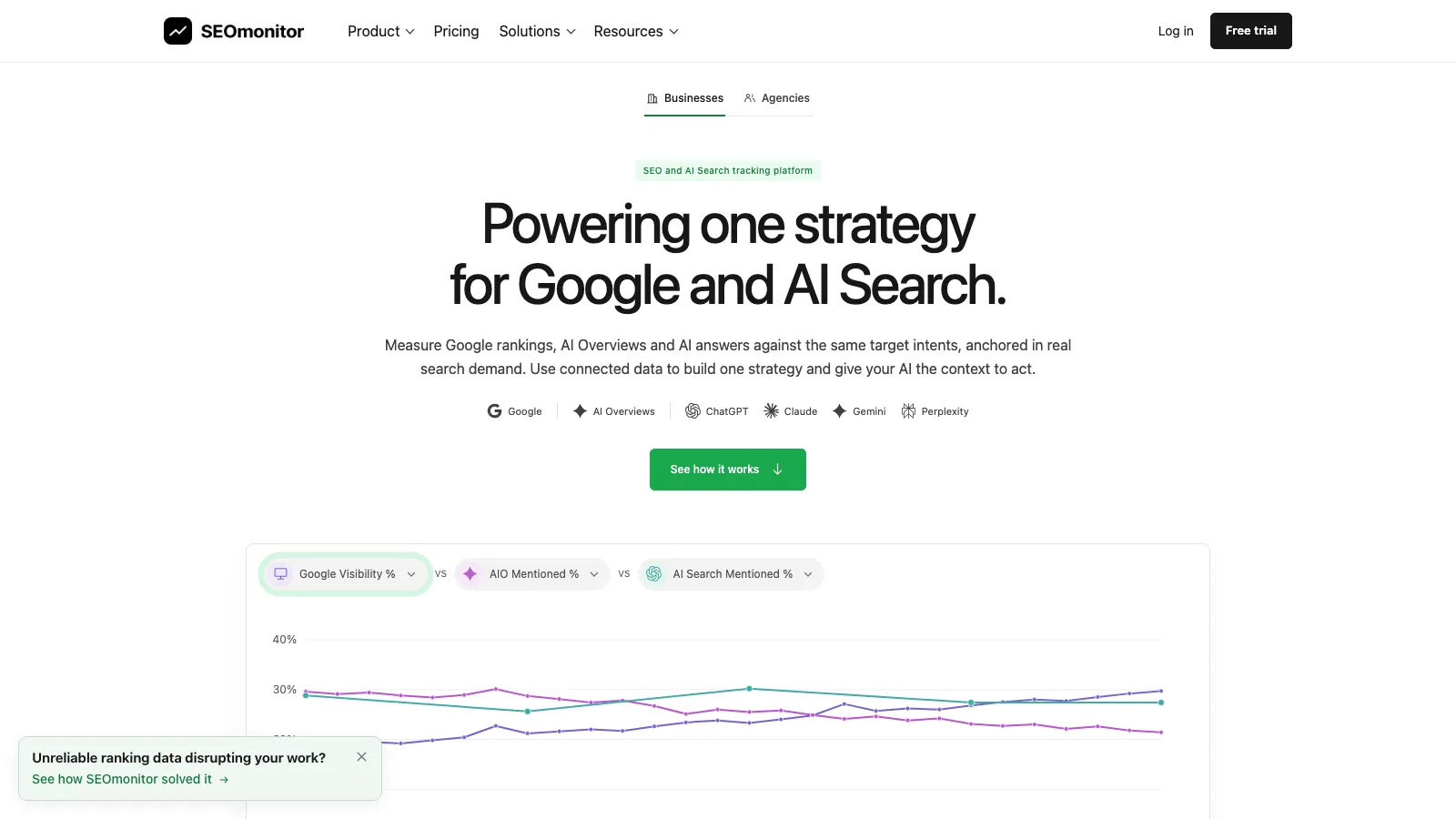
The platform applies one keyword strategy across Google rankings, Google AI Overviews and AI Search. Google tracking is daily, while AI Search follows ChatGPT, Claude, Gemini and Perplexity weekly. You can see mentions and citations beside the traditional search data instead of trying to reconcile reports with different keyword lists.
That integrated approach has a practical tradeoff. Starter is deliberately narrow: one tracked website, one GA and GSC connection, one selected AI model and up to 3,000 keywords. Pro pools capacity across unlimited websites, adds the Agency Dashboard and permits the data connection features that a larger operation usually needs.
Which agency teams and SEO leaders benefit most from SEOmonitor?
Agency teams
Pro combines shared capacity, an Agency Dashboard, unlimited draft campaigns and client-ready reporting connections.
SEO leads making a business case
Forecast scenarios connect ranking goals with projected traffic, conversions and revenue.
Content teams prioritizing updates
Content Audit identifies pages and changes to prioritize from rankings, search volume and expected clicks.
Teams needing an API
Pro provides API access to campaign data for custom dashboards and BI tools.
I would choose SEOmonitor for an account manager or in-house lead who needs a defensible narrative around organic performance, not just raw search data. It fits poorly if AI visibility is the entire job, because the entry plan follows one model once a week, or if a solo operator needs API access at the lowest possible price.
What forecasting algorithms and rank tracking features power SEOmonitor?
Full-depth daily rank tracking
SEOmonitor calls its method Dynamic Depth Crawling. It looks for each tracked site throughout the first 100 Google positions every day, without asking you to pick a crawl depth or reserve deeper positions for selected keywords. Both plans include daily top-100 tracking on the primary device, with the secondary device checked weekly. For a team that cares about pages moving into contention rather than only page-one winners, that is a meaningful design decision.
AI Search beside organic search
AI Overviews are tracked daily, and the AI Search layer reports weekly on the chosen model or models. The product pages name ChatGPT, Claude, Gemini and Perplexity, with brand mentions, citations, visibility and competitor data. The important caveat is frequency: the AI Search data is weekly, so it supports a strategic review rather than a same-day incident report.
Forecasting and content priorities
Forecasting turns target rankings into projections by month, including traffic, conversions and revenue. It accounts for keyword-level SERP conditions, device, seasonality and related terms. The Content Audit then identifies potential changes based on existing rankings, search volume and organic click-through rate. In my view, this pair is why an agency may prefer SEOmonitor over a tracker with a larger grab bag of research tools: it creates a clearer argument for what to do next.
Agency Dashboard and reporting
Pro includes an Agency Dashboard that lists campaigns together with portfolio health, objectives, reporting status and MRR impact. It also includes Looker Studio integration, unlimited exports and data migration. Starter includes unlimited users and exports too, so seat count does not distort the basic bill. The difference is whether you need to manage a portfolio rather than one site.
API and MCP
The API returns campaign, keyword, group, landing-page, traffic, research and forecast data in JSON, and it is available on Pro only. The beta MCP connection works with compatible clients including Claude, Claude Code, ChatGPT and Codex CLI, and can retrieve rankings, AI visibility, research, traffic and forecasts from tracked campaigns. It does not read Content Audit or draft campaigns. SEOmonitor's pricing page lists MCP on Starter and Pro, but its MCP page names Pro. Confirm MCP availability before building on it.
What does SEOmonitor cost across its Starter and Pro tiers?
Price checked 27 Nov 2026
| Plan detail | StarterFrom €79/mo | ProFrom €299/mo |
|---|---|---|
| Google keywords | 500 included, up to 3,000 | 3,000 included |
| Tracked websites | 1 | Unlimited, within account capacity |
| Google rank tracking | Daily, top 100 | Daily, top 100 |
| AI Search | Weekly, one chosen model | 1,000 weekly AI tracking units |
| AI articles included | 10 monthly | From 15 monthly |
| API access | ✕ | ✓ |
| MCP access | Listed ✓, but MCP page names Pro | ✓ |
| Agency Dashboard | ✕ | ✓ |
SEOmonitor prices in euros, 27 Nov 2026.SEOmonitor pricing
The team bill is unusually simple because both plans include unlimited users. A two-person Starter team pays the same €79 monthly starting price as a five-person team, provided one site and 500 tracked keywords fit. The price changes with tracking capacity, not seats.
- Starter tiers cost €79 for 500 daily keywords, €113 for 1,000, €181 for 2,000 and €249 for 3,000
- Pro adds Google keywords at €49 per 1,000 and AI tracking units at €19 per 1,000
- Pro has 1,000 AI tracking units included, while a Claude keyword uses five units
- GA and GSC connections on Pro are optional and cost €10 per connected campaign website
A 14-day trial requires no card and covers Google tracking, AI Overviews, AI Search, keyword research, forecasting, content audit and the Content Writer. AI Search during the trial applies to the first campaign and up to 1,000 keywords.
How does SEOmonitor scale across agency portfolios on Pro?
SEOmonitor configures its Pro tier specifically for agencies, consultants, and enterprise teams managing portfolios of client websites. Its resources are shared across unlimited tracked sites, which is more flexible than paying for a separate workspace for every client. However, Pro capacity, AI units and paid analytics connections are configurable, so a larger agency should price its real campaign mix before treating €299 as its monthly bill.
Where does SEOmonitor face feature and quota limitations?
SEOmonitor exhibits its primary limitation in restricted AI Search allowances rather than standard Google keyword tracking. Starter covers one chosen model weekly. Pro's 1,000 units can be spread across engines and keywords, but tracking Claude uses five units for one keyword. A broad program across every model and market will quickly turn the displayed starting price into a capacity decision.
Machine access also needs a closer reading. SEOmonitor describes its API as unrestricted for data in tracked campaigns, but the API is available on Pro only. Its pricing page lists MCP on Starter and Pro, while its MCP page names Pro. Confirm MCP availability before building on it. MCP remains beta and only reads tracked campaigns, excluding Content Audit and draft campaigns.
Finally, its strength in forecasting can be a mismatch for a purely tactical workflow. If your team neither sets ranking objectives nor reports on projected traffic and revenue, paying for this planning layer may add process rather than value.
Which tracking platforms serve as alternatives to SEOmonitor?
 AI Peekaboo review is the better first read when your work begins and ends with AI answers. Its plans begin at $30 a month and include a read and write API and Looker Studio on every paid plan, while SEOmonitor's API begins with Pro.
 Serpstat review starts at $69 a month for Individual, or $50 a month billed annually with $600 upfront. It covers 230 countries, while API and MCP start at Team rather than Individual.
 Sistrix review helps when long-running Google visibility history and a tiered API are the priorities. SISTRIX starts at €119 a month, but full API access starts at €419, compared with API access on SEOmonitor Pro from €299.
What is the final agency evaluation of SEOmonitor?
SEOmonitor earns its price when your team needs to turn tracking into an accountable plan. Daily full-depth Google positions, weekly AI Search and forecasting are not separate products bolted together, which makes the story to a client or a leadership team far clearer. Start on Starter for one site with a modest AI Search need. Move straight to Pro when you need a portfolio view, API access or capacity across multiple sites.
Use the 14-day trial to build one forecast from your real keyword targets and inspect the AI Search data against it. Then price Pro around actual Google keywords, AI units and connected sites before putting it into an agency workflow.
How were SEOmonitor plan limits and features verified?
SEOmonitor pricing, forecasting tools, API specifications, and MCP pages were cross-checked directly against official vendor documentation on 27 Nov 2026. Prices are in euros as shown by SEOmonitor, and every figure follows how we check figures.
- SEOmonitor pricing and plan comparison
- Rank Tracker, SEO Forecasting and Agency Dashboard pages
- API 3.0 documentation and MCP product page
What are common agency questions about using SEOmonitor?
Is there a free version of SEOmonitor?
No permanent free plan is listed. SEOmonitor offers a 14-day trial with no credit card required, including tracking, AI Search, forecasting, Content Audit and the Content Writer.
How much does SEOmonitor cost for a team?
Starter begins at €79 a month for 500 daily keywords and includes unlimited users. Pro begins at €299 a month for 3,000 Google keywords and 1,000 AI tracking units, also with unlimited users.
Does SEOmonitor track AI visibility?
Yes. It tracks AI Overviews daily and has weekly AI Search tracking for ChatGPT, Claude, Gemini and Perplexity. Starter covers one chosen model; Pro has 1,000 AI tracking units included.
Does SEOmonitor work with AI agents?
Its beta MCP connection can read tracked-campaign rankings, AI visibility, research, traffic and forecast data in compatible assistants. SEOmonitor's pricing page lists MCP on Starter and Pro, but its MCP page names Pro, so confirm availability before building on it. The API is Pro only.
 Reviewed byDanny Kirk
Founder of ReddiReach.
 Checked byAndrés Felipe
Digital designer and marketer.
Every figure is checked against the vendor's own page. Read our editorial standards.