Key Takeaways
- STAT Search Analytics delivers enterprise-scale rank tracking, granular SERP feature analysis, and emerging AI brand visibility metrics across extensive keyword portfolios.
- STAT Search Analytics begins at $360 monthly for a 3,000 weekly prompt and daily keyword quota, utilizing customized enterprise packaging via sales demos.
- STAT Search Analytics provides developer API endpoints alongside structured exports to Google Data Studio, BigQuery, and CSV files for automated reporting pipelines.
- STAT Search Analytics is poorly suited for small businesses needing low-cost self-serve plans or basic tracking across a small, uncomplicated keyword set.
You run SEO for a large set of keywords and need daily SERP data plus AI brand visibility in the same workflow. STAT Search Analytics is the right pick for enterprise teams and agencies that need that depth, but its $360 monthly starting point and demo-led purchase route make it a poor fit for a low-commitment tracker.
Agent access
- API
- Yes
- MCP server
- Not found on official pages
What are the pros and cons of STAT Search Analytics?
What works
- Daily rank data for locations, desktop and mobile
- More than 75 tracked SERP feature types, including AI Overviews
- AI visibility across ChatGPT, Gemini, AI Mode, Perplexity and Claude
What to watch
- The published starting price is $360/month
- Evaluation and custom packages begin with a demo
- STAT frames the product around a thousand keywords or a million pages
What does STAT Search Analytics do for enterprise SEO?
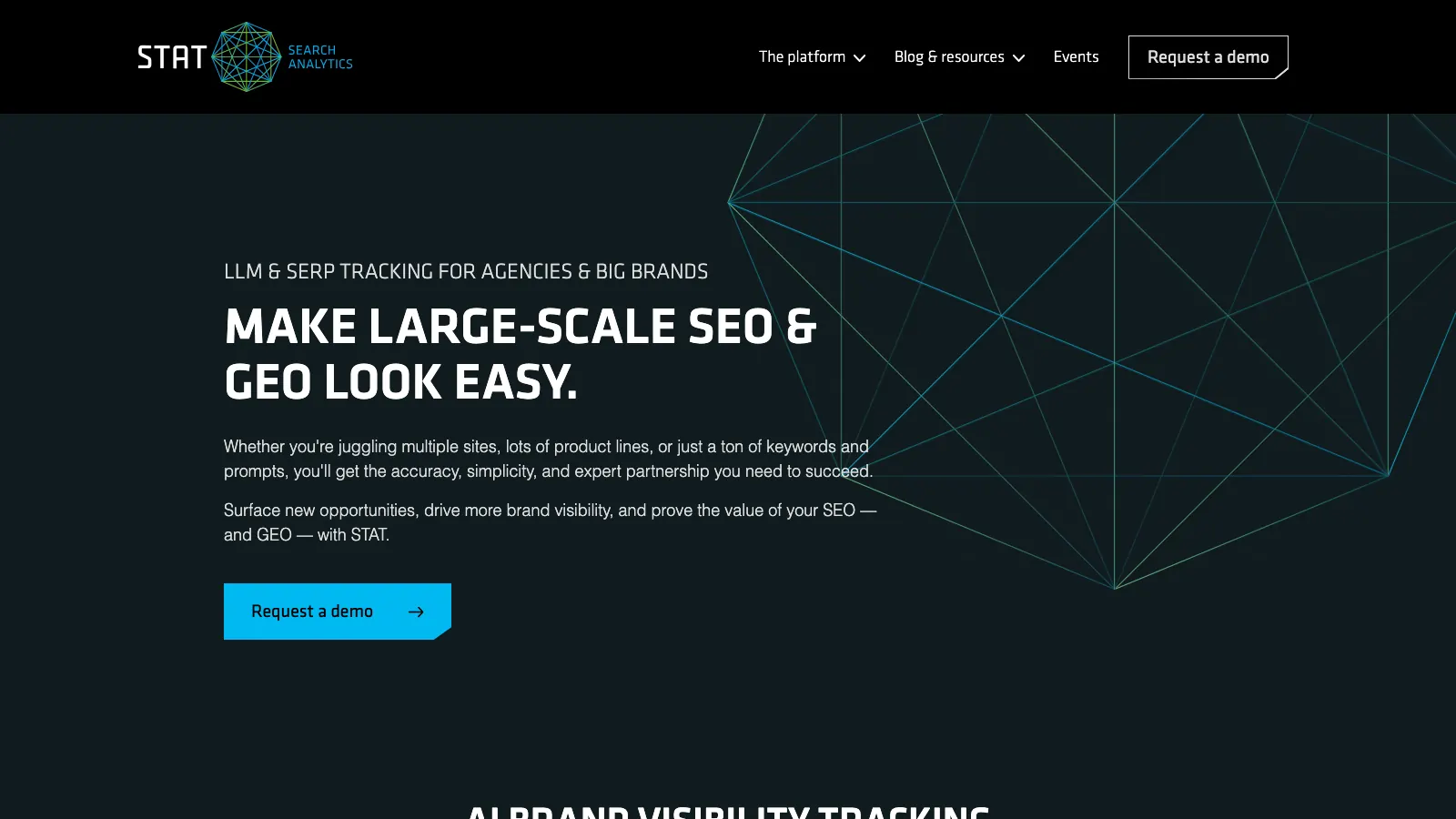
STAT Search Analytics solves the challenge that occurs when rankings spread across products, markets, devices, and locations turn simple trackers into messy exports. STAT offers daily ranking data at scale, including full HTML SERPs, so your team can study the result page as well as the position. TrueRanker review covers rank tracking plus ChatGPT and Gemini monitoring, with Claude monitoring on Pro and Agency plans, from $12.49 a month billed yearly for Rank Tracker.
The useful distinction is not simply keyword volume. STAT lets you examine sites, individual SERPs and pages, then organize data with custom and dynamic tags. You can create segments by product characteristic, topic or searcher intent, and dynamic tags can populate from rules as values change. For a team that reports by market or business unit, that structure is more valuable than one long rankings list.
STAT is a Moz Holdings Canada product, within a Ziff Davis company. Its platform also gives access to 1.25 billion keyword suggestions from Moz Keyword Explorer. Choose it when the reporting question is broad enough to include ranking movement, SERP features, pixel position, share of voice and AI answers. A narrower tracker is easier to justify when the job stops at a compact set of positions.
Who is STAT Search Analytics designed for?
Enterprise SEO teams
Track thousands of keywords or a million pages across sites, markets, locations and devices with daily data.
Large agencies
Use separate projects, segments, scheduled exports and account support for complex client work.
Data-focused SEO teams
Send SERP and AI visibility data to a warehouse, dashboard or reporting workflow through API and connectors.
AI search owners
Compare brand presence, cited sources, sentiment and competitor brands across five named AI engines.
The best fit has a real need for daily detail and many ways to slice it. STAT says accounts can cover a thousand keywords or a million pages, one site or several, and its sales flow calibrates the product to that scope. If you primarily want an accessible monthly tracker for a small keyword list, the capabilities are likely more infrastructure than you need.
What features does STAT Search Analytics offer?
Daily rank data and full SERPs
STAT tracks rankings daily across locations, desktop and mobile. It supplies the full HTML SERP for each keyword, and its historical data can be used to spot changes and seasonal patterns. You can report weekly or monthly averages from daily data when executives do not need the day-by-day detail. That gives a large program a more useful view than a single weekly snapshot without forcing every audience to consume a daily chart.
SERP features, share of voice and pixels
STAT identifies more than 75 SERP feature types and lets you tailor the feature dashboard to the set that matters to your market. Its AI Overview tracking shows when AI Overviews appear, which keywords trigger them and the cited content. Pixel tracking adds the amount of SERP space above a result, while share of voice combines ranking data with search volume and CTR. Together, those tools help answer whether a change in position changed real visibility.
AI brand visibility
The AI visibility product covers ChatGPT, Gemini, AI Mode, Perplexity and Claude. It shows a brand's appearances in generated responses, the text around each mention and cited sources; it also tracks competitor brands for the same prompts. This is an advantage for a team that wants conventional Google reporting and AI answer visibility in one platform, rather than a separate dashboard for each.
Segmentation and keyword discovery
Custom segments can be as granular as you need, while dynamic tags automatically collect keywords that meet a rule. STAT also makes 1.25 billion Moz Keyword Explorer suggestions available without a stated limit. That combination is practical when the next reporting view needs to follow a product line, intent or market instead of the way a keyword list happened to be imported.
Reporting, API and connectors
STAT supports customizable CSV reports, scheduled spreadsheet exports and an API for higher-volume export into internal data warehousing. Its official reporting pages name Google Data Studio and BigQuery connectors, and say the API covers SERP analytics and AI brand visibility metrics. STAT documents an API and connectors; ask whether it offers MCP access before you plan agent workflows.
How does STAT Search Analytics price its tracking?
Price checked 27 Nov 2026
| Plan detail | Published starting point | How you proceed |
|---|---|---|
| Price | $360/month | Request a demo |
| Published quota | 3,000 weekly prompts / daily keywords | Custom packages available |
| Rank tracking | Daily data | Calibrated to your needs |
| AI visibility | Quota: 3,000 weekly prompt/daily keyword | Demo-led evaluation |
| API and reporting | API offered | Discuss data requirements |
STAT prices and quota, 27 Nov 2026.STAT AI visibility pricing
The $360 figure is a starting price, not a complete public tier table. It covers a 3,000 weekly prompt/daily keyword quota, while STAT asks prospective customers to schedule a one-to-one walkthrough. Specialty services can add a daily archive of raw HTML or parsed SERPs, plus Google Ads data. STAT does not publish a price for those additions; get the scope and cost in writing.
How does STAT Search Analytics serve enterprise programs?
STAT Search Analytics uses an enterprise-oriented published model that is demo-led, calibrated to the account, and designed across multiple sites. Its daily tracking page explicitly frames the product around a thousand keywords or a million pages, and STAT Search Analytics pairs that scale with account management, onboarding and training. This is not a hidden plan above a public menu. It is the primary buying route.
For an agency, the question is whether the data feeds the work you already sell. STAT can export reports and connect to Google Data Studio, BigQuery and internal warehousing. Build the client delivery requirement, including branded reporting, into the demo conversation.
Where does STAT Search Analytics fall short for buyers?
STAT Search Analytics states only one starting price alongside a demo-led purchase process. That is sensible for a program with many sites, markets and reporting views, yet it adds friction if you want to begin immediately with a small trial. The demo requirement is part of the product's commercial model, and the published $360 starting point is already a meaningful commitment for a narrow rank-tracking use case.
It also asks you to value depth. Pixel position, full HTML SERPs, feature ownership and custom segmentation are powerful when they change a decision, but they are unnecessary if you only need a simple position report.
What are the best alternatives to STAT Search Analytics?
 AI Peekaboo review is the first alternative to consider when AI visibility is the entire job: its plans start at $30 a month, with API and MCP access included. STAT is the better fit when the same team must also operate daily Google rank and SERP reporting at a larger scale.
 TrueRanker review covers rank tracking plus ChatGPT and Gemini monitoring, with Claude monitoring on Pro and Agency plans. Its Rank Tracker plan starts at $12.49 a month billed yearly, while its full Starter plan starts at $39 a month billed yearly.
 Whatsmyserp review covers daily rank tracking, unlimited on-demand keyword refreshes and white-label client reporting from $19.99 a month.
What is the overall verdict on STAT Search Analytics?
STAT Search Analytics justifies an enterprise conversation when a large SEO program must explain visibility rather than merely report rank. Daily data, full SERPs, feature coverage, pixel position, share of voice and AI brand visibility form a coherent system for that job. The $360 monthly starting point is reasonable only when those layers are actively used.
Bring a real keyword, market and reporting inventory to the demo. Ask STAT to map the 3,000 weekly prompt/daily keyword quota, API needs and any raw-SERP archive against that workload. If the scope is much smaller, choose a simpler tracker and keep the budget for the analysis that follows.
How was STAT Search Analytics evaluated?
STAT Search Analytics platform, daily tracking, AI visibility, SERP feature, reporting, pixel, and share-of-voice pages were examined on 27 Nov 2026. Prices, quotas and capabilities on this review follow how we check figures.
- STAT platform and daily rank tracking pages
- STAT AI visibility and SERP feature pages
- STAT reporting, pixel tracking and share-of-voice pages
What are common questions about STAT Search Analytics?
How much does STAT Search Analytics cost?
STAT says pricing starts at $360/month for a 3,000 weekly prompt/daily keyword quota. It offers a one-to-one walkthrough and custom packages, rather than a public self-serve plan list.
Does STAT track AI search visibility?
Yes. STAT tracks brand visibility in ChatGPT, Gemini, AI Mode, Perplexity and Claude. It also shows response text around brand mentions, cited sources, sentiment and competitor brands for the same prompts.
Does STAT have an API?
Yes. STAT offers an API for SERP analytics and AI brand visibility metrics. It also supports CSV reporting, scheduled spreadsheet exports, Google Data Studio and BigQuery connectors. Ask whether it offers MCP access before you plan agent workflows.
What can STAT track besides rankings?
STAT tracks more than 75 SERP feature types, including AI Overviews. It also offers pixel position tracking, share of voice, custom segmentation, full HTML SERPs and AI brand visibility.
 Reviewed byDanny Kirk
Founder of ReddiReach.
 Checked byAndrés Felipe
Digital designer and marketer.
Every figure is checked against the vendor's own page. Read our editorial standards.