
Key Takeaways
- Triple Whale unifies multi-touch attribution, ecommerce intelligence, and Moby AI into a synchronized data platform to resolve competing channel acquisition claims.
- Triple Whale offers a free baseline package, while its paid Foundation, Automate, and Enterprise tiers scale dynamically based on annual gross merchandise value.
- Triple Whale integrates deeply into automation workflows using MCP connectivity, dedicated data-in and data-out APIs, and Slack-connected Moby agents.
- Triple Whale is unsuited for stores requiring transparent upfront public pricing, flexible month-to-month contracts, or non-ecommerce analytics tracking.
Triple Whale is the best fit for your ecommerce team when an order has competing claims from your channels: it brings multi-touch attribution, business intelligence and Moby into one operating model. Look elsewhere if you need a published paid price before a sales conversation: Triple Whale's paid packages are based on annual GMV, while the Free plan is the only package with a published price.
Agent access
- API
- Yes
- MCP server
- Official, OAuth2 or an MCP: Read API key
- Works with
 Claude
 ChatGPT
 Cursor
 n8n
- Automation
- n8n
What are the main Triple Whale pros and cons?
What works
- Free plan combines a real-time business view, Moby and first and last-click attribution
- Foundation adds multi-touch attribution, custom metrics and a SQL editor
- Enterprise combines attribution, MMM and incrementality through Compass
What to watch
- Paid packages have no published starting price
- Every paid package is a 12-month subscription
- MMM and incrementality sit with Enterprise, not Automate
What does Triple Whale do for ecommerce brands?
Triple Whale tackles multi-channel attribution disputes by harmonizing tracking data into a single verified ecommerce source of truth. You need a measurement model your growth team can use to decide what to fund next. Triple Whale centers that job on multi-touch attribution, a unified ecommerce view and Moby, its AI operator. It belongs in the marketing tools directory for teams whose reporting starts with store, advertising, email and customer data rather than website visits alone.
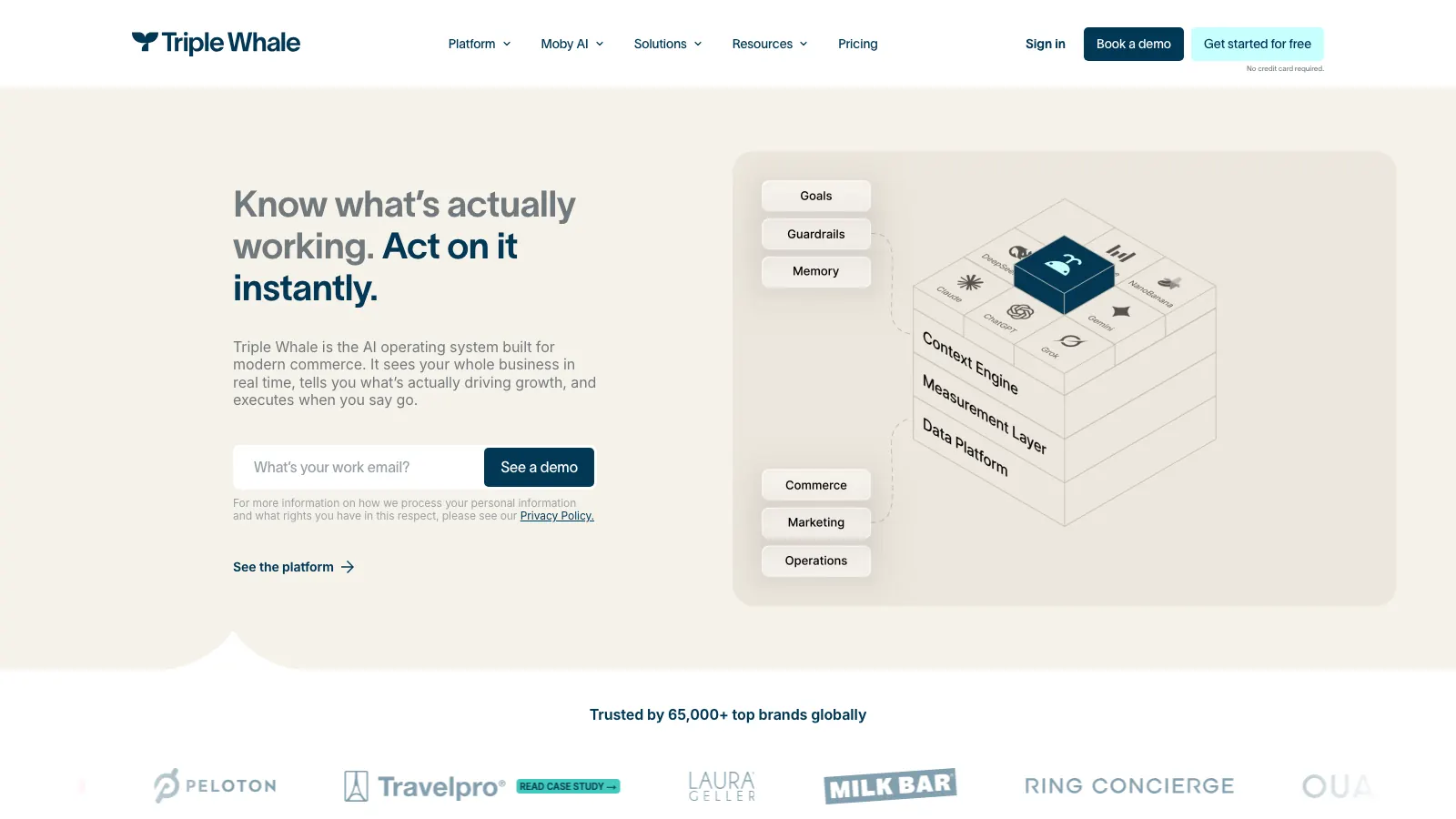
The platform's foundation is Triple Pixel, which connects behavior across devices, sessions and channels into a first-party data base. That feeds attribution, customer intelligence and data activation. The practical payoff is a fuller path from marketing touchpoint to order, instead of treating every channel report as the final word.
From there, the choice is about how much action you want around the measurement. Foundation packages the core attribution and business-intelligence tools. Automate adds recurring work and Moby actions. Enterprise adds Compass, where attribution, marketing mix modeling and incrementality sit together. That is a more coherent progression than bolting an AI chat window onto a generic analytics account.
Who benefits most from adopting Triple Whale?
Ecommerce operators
Unify store, channel and customer signals before making daily budget and merchandising decisions.
Paid media teams
Use multi-touch attribution and creative analysis to investigate performance beyond platform-reported conversion credit.
Data-minded growth teams
Build tailored views with custom metrics, dashboards, segments and the SQL editor.
Complex retail brands
Connect attribution, MMM and incrementality when enterprise planning needs broader measurement methods.
It is a poor fit if your only requirement is lightweight traffic measurement or routine report distribution. Triple Whale is designed around ecommerce operations and paid-media decisions, so its value rises with the number of channels, orders and budget choices your team needs to reconcile.
Which analytics features does Triple Whale provide?
Triple Pixel and attribution
Triple Pixel connects behavior across devices, channels and sessions using a first-party data foundation. Triple Whale's attribution product supports multi-touch models, and it also offers Total Impact Attribution, which combines multi-touch data with post-purchase survey responses. The useful distinction is that a team can choose an attribution lens for a decision instead of forcing every question through last-click reporting.
A business view, not just a channel view
The Free package brings paid, owned, subscription and organic data into one real-time business view. Foundation adds no-code dashboards, customer segments, custom metrics and a SQL editor. For a team that already exports from several systems, those are the features that determine whether the account becomes a working source of truth or another tab to check.
Moby for questions and recurring work
Moby can answer questions about the business and generate on-brand creative on the Free plan. Every paid plan includes daily Moby capacity sized to the business, while Automate and Enterprise add more capacity. Automate also adds scheduled automations, Moby Actions, landing pages, Creative Studio and the full AI model library. Triple Whale says Moby can work in Slack, so the better question for a team is where its approval boundaries should sit before actions are allowed.
Compass for Enterprise measurement
Compass is not an Automate feature. It is included on Enterprise and brings multi-touch attribution, marketing mix modeling and incrementality together for online and retail-channel decisions. Enterprise also lists multi-brand reporting, retail and wholesale data and custom integrations. It associates SSO and comprehensive audit logs with Enterprise, but its Enterprise description says they are coming soon, so confirm their availability before relying on them. That scope makes sense when a single ecommerce store has become a portfolio or a more complex retail operation.
Integrations and machine access
Triple Whale lists Shopify, WooCommerce and BigCommerce, and its Pixel documentation says the Pixel works on all commerce platforms. The package comparison also lists data-in and data-out APIs plus Triple Whale MCP. A custom-stack team should confirm the depth of the specific integration, rather than assuming that platform support means every workflow is identical.
How does Triple Whale price its GMV packages?
Price checked 27 Nov 2026
| Plan detail | FreeFree | FoundationGMV quote | AutomateGMV quote | EnterpriseCustom |
|---|---|---|---|---|
| Users | 10 | Unlimited | Unlimited | Unlimited |
| Attribution | First and last click | Multi-touch | Multi-touch | Multi-touch |
| Triple Pixel | Partially included | ✓ | ✓ | ✓ |
| Moby | Explore | Use daily | Run at scale | Enterprise usage |
| SQL editor | ✕ | ✓ | ✓ | ✓ |
| MMM and incrementality | ✕ | ✕ | ✕ | Compass included |
Triple Whale package comparison, 27 Nov 2026.Triple Whale pricing
Triple Whale does not publish a paid starting price, so there is no honest team bill to calculate from the public information. It bases paid pricing on annual GMV and the package, and every paid package supports unlimited users and as many stores as needed. Foundation, Automate and Enterprise run on 12-month subscriptions, billed monthly or annually, with two months free on annual prepayment.
The first commercial conversation should cover the GMV tier, package, billing choice and any add-ons. Retention and Conversion are included on Automate and Enterprise, so do not budget for a separate charge on those plans. Other add-ons are optional unless marked Included: Data Warehouse Sync and Moby Concierge are also offered as add-ons, so a headline quote alone will not describe the full operating bill.
What does Triple Whale Enterprise offer high-volume brands?
Triple Whale Enterprise serves large retailers requiring unified measurement across multiple storefronts, wholesale channels, and offline touchpoints. It includes everything in Automate, then adds Compass, multi-brand reporting and enterprise controls. Retail and wholesale data, custom integrations, onboarding and migration support are also part of the Enterprise description.
- Compass unifies attribution, MMM and incrementality
- Multi-brand reporting for a more complex organization
- SSO and comprehensive audit logs are associated with Enterprise, but its description marks them coming soon
- Retail and wholesale data alongside ecommerce data
The package FAQ calls out SSO, comprehensive audit logs and custom security review as Enterprise controls, while the Enterprise description says the first two are coming soon. Confirm their availability before making them a procurement requirement. I would not start an ordinary ecommerce team on Enterprise just to access every feature. The reason to move is a measurement problem that spans brands, channels or retail data, not curiosity about AI automation.
Where does Triple Whale fall short during evaluation?
Triple Whale limits self-directed buyer evaluation by withholding public pricing across its core paid software tiers. The public page explains the packages and the GMV-based model, but it no longer publishes the former dollar starting points. That prevents a small team from knowing whether Foundation is affordable before it shares commercial details.
The contract shape also deserves attention. Paid plans are 12-month subscriptions, even when billed monthly. Annual prepayment gives two months free and locks the revenue tier for the year, but that is a commitment to assess before you move meaningful reporting into Triple Whale.
Finally, some of the most consequential measurement features are not a gradual add-on to the middle tier. Marketing mix modeling and incrementality are tied to Compass on Enterprise. If those methods are central to your budget process, ask for the Enterprise scope early rather than assuming Automate is enough.
Which Triple Whale alternatives are worth considering?
 AI Peekaboo review is the useful comparison when your reporting problem is AI-answer visibility rather than ecommerce attribution: its plans start at $30 a month, price checked 27 Nov 2026, and include API, MCP and Looker Studio access. It is not a replacement for Triple Whale's ecommerce measurement stack, but it makes the divide between those jobs clear.
For agencies that need to route marketing data into reports,  Two Minute Reports review covers 30+ sources and lists Google Sheets and Google Data Studio among its destinations.
 Usermaven review is for B2B SaaS teams connecting marketing, product and CRM data for attribution. Neither should be treated as a substitute for Triple Whale's attribution model without checking the measurement job first.
What is the overall verdict on Triple Whale?
Triple Whale delivers clear attribution and business intelligence for ecommerce teams seeking to identify profitable paid advertising channels. Triple Pixel, multi-touch attribution, the business-intelligence layer and Moby make the case. The trade-off is a sales-led paid price and a one-year commitment.
Start on Free to establish whether the unified view fits your daily decisions. Before moving to a paid package, get the GMV tier, package scope, add-ons and billing terms in writing, then decide whether Foundation, Automate or Enterprise solves the actual measurement gap.
How was this Triple Whale review evaluated?
Triple Whale product pages, attribution documentation, Pixel details, and integration guides were reviewed on 27 Nov 2026. Published package details are included, while former paid starting prices are not, because Triple Whale no longer publishes them. Every figure follows how we check figures.
- Triple Whale pricing and package comparison
- Triple Pixel and attribution pages
- Moby, integrations and data platform pages
What are frequently asked questions about Triple Whale?
Is Triple Whale free?
Yes. The Free package has no commitment. It brings paid, owned, subscription and organic data into one real-time view, with first and last-click attribution, limited Triple Pixel coverage and the ability to explore Moby.
How does Triple Whale pricing work?
Paid pricing is based on annual GMV and the package you choose: Foundation, Automate or Enterprise. Triple Whale does not currently publish paid starting prices. Paid packages are 12-month subscriptions, billed monthly or annually, with two months free on annual prepayment.
Does Triple Whale work beyond Shopify?
Yes. Triple Whale lists Shopify, WooCommerce and BigCommerce integrations, and says Triple Pixel works on all commerce platforms. Confirm the exact integration depth for a custom stack.
What is Moby?
Moby is Triple Whale's AI operator for ecommerce. It can answer questions from connected business data, and paid packages include daily Moby capacity. Automate and Enterprise add greater capacity and automation features.
Is marketing mix modeling included with Automate?
No. Triple Whale places marketing mix modeling and incrementality in Compass, which is included with Enterprise.
 Reviewed byDanny Kirk
Founder of ReddiReach.
 Checked byAndrés Felipe
Digital designer and marketer.
Every figure is checked against the vendor's own page. Read our editorial standards.