Key Takeaways
- Wordtracker merges search keyword research, competitor domain queries, weekly position tracking, and conversational AI visibility auditing within an accessible dashboard.
- Wordtracker pricing starts at $49 monthly or $33 annually on the Starter tier, while the three-brand package costs $99 monthly or $66 annually.
- Wordtracker integrates Model Context Protocol endpoints for Claude, ChatGPT, and Cursor, while keyword API access requires an independent $60 monthly subscription.
- Wordtracker updates rankings on a weekly cycle rather than daily, making it less practical for agencies demanding real-time SERP volatility data.
When you need to explain both Google rankings and what ChatGPT says about the business, Wordtracker is the pick for a small team that wants those checks in one workspace from $49 a month. Skip it if your work needs daily tracking, a published seat model or a confirmed API bundle, because those details are not in the current subscription table.
Agent access
- API
- Yes, Standard API plan: USD 60 per month
- MCP server
- Official, hosted, Wordtracker account sign-in, with no API key
- Works with
 Claude
 ChatGPT
 Cursor
What are the primary pros and cons of Wordtracker?
What works
- Keyword research, domain lookups and weekly rank tracking in one workspace
- AI visibility across five named answer engines
- MCP connection for Claude, ChatGPT and Cursor
What to watch
- Rank tracking is weekly, not daily
- Current plans name businesses, not seats or user limits
- API pricing is separate from the subscription table
What search and AI visibility capabilities does Wordtracker offer?
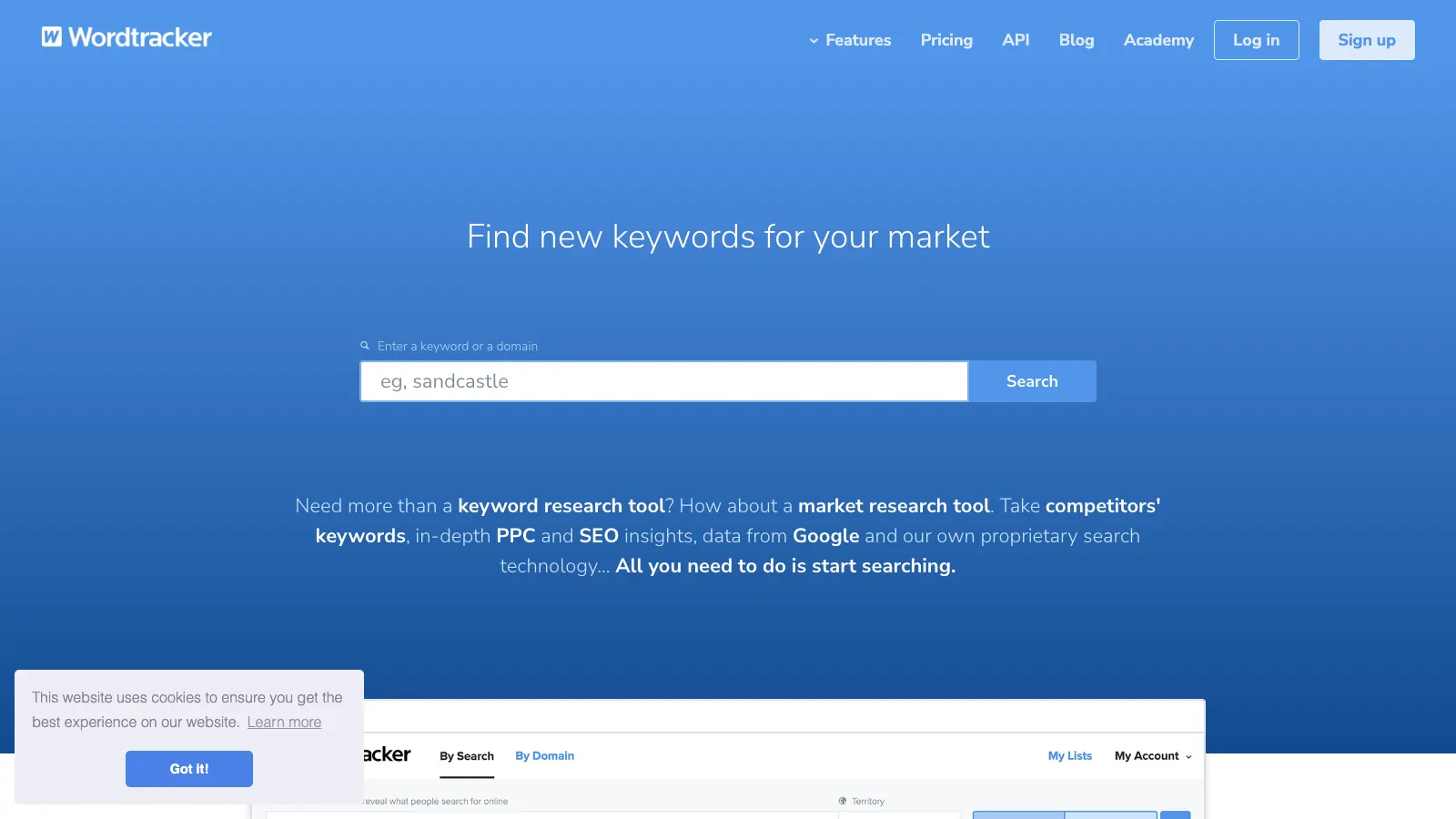
Wordtracker gives a lean marketing team one place to move from a search term to a competitor check, a rank trend and a question about AI answers. Paid plans combine research, rankings and AI visibility around a business workspace. Browse the marketing tools directory if you want other keyword research tools next to it.
The keyword side starts with Wordtracker's own data. It shows volume, a 12-month trend where available, competition, related searches and questions. Paid searches return up to 2,000 results, which you can sort, filter, save and export. You can then look up another domain's keywords, positions and linking sites, and keep your own Google positions on a weekly check.
The more unusual part is the AI view. Wordtracker asks your questions across ChatGPT, Gemini, Claude, Perplexity and Google AI Mode, then reports whether your business is named. That makes it a credible fit if you want traditional search work and an early AI visibility baseline in the same routine, rather than adding a separate dashboard immediately.
Who should use Wordtracker for keyword discovery and competitor tracking?
Small marketing teams
Starter covers one business, three tracked sites and 100 tracked keywords per site, checked weekly.
Teams comparing competitors
The domain view shows another site's keywords, positions and linking sites beside your own research.
Teams beginning AI tracking
The $99 plan checks up to 25 AI questions every week across five named engines.
Developers building tools
The separate keyword API provides search and fetch calls for custom products and services.
Choose Wordtracker for a compact marketing operation that wants a joined-up weekly picture, not for a reporting-heavy agency. The plan labels tell you how many businesses fit, but not how many colleagues can work in an account, and weekly checking will not satisfy a team asked to explain day-to-day movement.
Which keyword research and SERP monitoring tools does Wordtracker include?
Keyword research built around questions
Keyword research surfaces volume, trend and competition data, alongside related searches and the questions people type. Paid plans remove the daily search limit and return up to 2,000 results at a time. That is enough to take a broad seed, narrow it by market language and save the terms that deserve a page or campaign.
Domain research and weekly rankings
The domain view is where Wordtracker becomes useful for a competitor conversation. It shows any site's keywords, positions and backlinks, while your own tracked positions are checked weekly. Starter covers 100 tracked keywords per site across three sites; Wordtracker covers 200 tracked keywords with history. Treat that cadence as a planning signal, not a daily alert system.
AI visibility
Wordtracker measures whether your business is named when buyers ask questions in ChatGPT, Gemini, Claude, Perplexity and Google AI Mode. Each paid-plan question is asked five times on each engine every week. Starter includes 20 AI questions checked weekly, while Wordtracker includes 25. That repetition is the meaningful difference between a one-off prompt and a number you can compare week to week.
MCP connection for your AI
Wordtracker documents a connection for Claude, ChatGPT and Cursor through its MCP address, using a Wordtracker sign-in rather than an API key. Its listed workspace data includes keyword research, domains, rank tracking, keyword lists and AI visibility. For a small team, that makes Wordtracker easier to query from an assistant without copying figures into every conversation.
Separate keyword API
The keyword API is a separate developer product, not a stated subscription feature. Its Standard plan costs $60 a month, includes 500 calls and permits up to 1,000 results per call. The documentation lists search and fetch endpoints, SEO competition metrics and seasonal data by territory. It is the route to a custom dashboard or product, but price it separately from the $49 or $99 workspace plan.
How much does Wordtracker cost across Starter and multi-brand tiers?
Price checked 27 Nov 2026
| Plan detail | Free$0 | Wordtracker Starter$49/mo | Wordtracker$99/mo |
|---|---|---|---|
| Billed yearly | Free | $33/mo, $392 once a year | $66/mo, $792 once a year |
| Businesses | 1 | 1 | 3, kept apart |
| Searches | 3 a day | No daily limit | No daily limit |
| Keyword results per search | 3-row preview | Up to 2,000 | Up to 2,000 |
| Tracked keywords | Not listed | 100 per site, 3 sites, weekly | 200, weekly, with history |
| AI questions | 3, once at setup | 20, weekly | 25, weekly |
Wordtracker prices in US dollars, 27 Nov 2026.Wordtracker pricing
Annual billing is the only published saving: Starter falls from $49 to $33 a month, billed as $392 once a year, and Wordtracker falls from $99 to $66, billed as $792 once a year. To cover three businesses with the Starter plan's one business each costs 3 × $49 = $147 a month, compared with $99 for the Wordtracker plan that keeps three businesses apart. On yearly billing, that is 3 × $392 = $1,176 compared with $792. The annual price is not a monthly contract, so it only makes sense once the weekly workflow is established. Wordtracker does not publish a seat or user count.
- The free plan keeps one report, gives three searches a day and asks three AI questions once at setup
- Starter covers one business, while Wordtracker covers three businesses kept apart
- The separate Standard API plan costs $60 a month, includes 500 calls and charges $0.05 for each additional call
- Both paid workspace plans can be cancelled at any time and carry a 14-day full-refund period
Where does Wordtracker fall short regarding tracking frequency and seat limits?
Wordtracker limits its rank updates to a weekly schedule rather than offering daily position refresh rates. Your rankings and AI questions update weekly on paid plans, which is enough to see direction but not enough to explain a sudden movement in a client meeting. The free plan goes further in the other direction: its three AI questions run once at setup, so it is a first look rather than ongoing monitoring.
Team economics are also opaque. Wordtracker publishes business limits but no seats, user roles or extra-user price on the current table. If several people need access, get that detail before you make the annual commitment. The same caution applies to the API: the vendor documents an MCP connection and a separately priced API, but does not say that the API is bundled with either workspace plan.
Finally, choose the plan for its working limits, not just the entry price. Twenty AI questions, 100 tracked keywords per site and one business can be enough for a focused team. Once you work across clients or brands, the $99 plan's three separate businesses become the deciding difference, not a cosmetic upgrade.
What are the leading Wordtracker alternatives for modern search intelligence?
 Wordtracker alternatives such as AI Peekaboo address dedicated AI engine visibility when keyword volume is secondary. Its plans start at $30 a month and include API, MCP and Looker Studio access, as the AI Peekaboo review explains.
 AlsoAsked review suits question mapping because it provides live People Also Asked data with Google intent clustering. Its Basic plan is $12 a month billed annually, or $15 monthly, with unlimited users and all regions, so it costs less than Wordtracker Starter when question mapping is the job.
 Answer The Public review is worth considering when you want autocomplete data from search engines such as Google and Bing, organized into questions, prepositions and comparisons. Its free account allows three searches a day, while API access is available on active paid plans.
What is the final verdict on adopting Wordtracker for search workflows?
Wordtracker earns its place when research, competitor context, weekly rank tracking and AI visibility need to live in one modestly priced workspace. The $49 Starter plan is the right entry point for one business, and the $99 plan earns its step up only when three separate businesses or 25 weekly AI questions are part of the work. Pass if daily tracking, defined team access or included API access are non-negotiable.
Start on the monthly Starter plan for one business, settle on the questions and keywords your team reviews every week, then move to annual billing only after confirming the people who need access and whether the separate API is necessary.
How were Wordtracker keyword limits and API integrations verified?
Wordtracker pricing details, feature specifications, and API access limits were verified from vendor pages on 27 Nov 2026. Prices are in US dollars, as Wordtracker shows them, and every figure follows the rules in how we check figures.
- Wordtracker product and pricing pages, monthly and yearly
- Wordtracker's AI visibility and MCP connection information
- Wordtracker API pricing and documentation
Frequently asked questions about Wordtracker search and AI monitoring?
Is Wordtracker free?
Yes. The Free plan costs $0, keeps one report, gives three searches a day and asks three AI questions once at setup. No card is required.
How much does Wordtracker cost?
Wordtracker Starter costs $49 a month, or $33 a month billed yearly as $392 once a year. Wordtracker costs $99 a month, or $66 a month billed yearly as $792 once a year.
Does Wordtracker track AI answers?
Yes. Paid plans check questions weekly across ChatGPT, Gemini, Claude, Perplexity and Google AI Mode. Starter includes 20 questions and Wordtracker includes 25.
Does Wordtracker work with AI agents?
Wordtracker documents an MCP connection for Claude, ChatGPT and Cursor. It also sells a separate keyword API from $60 a month for developers building their own tools.
 Reviewed byDanny Kirk
Founder of ReddiReach.
 Checked byAndrés Felipe
Digital designer and marketer.
Every figure is checked against the vendor's own page. Read our editorial standards.