
Key Takeaways
- AdProtektor protects Google Ads and Meta paid traffic campaigns by providing customizable fraud filtering rules, IP address exclusions, and auditable click evidence.
- AdProtektor prices its Standard package from 84 dollars monthly covering one domain and 5,000 clicks following an initial seven-day evaluation period.
- AdProtektor supports a proprietary ConversionOS API to capture conversion events, but developers should verify broader programmatic data feeds and MCP availability.
- AdProtektor is ineffective for media buyers unwilling to inspect flagged click records or who expect fully automated fraud prevention without false-positive oversight.
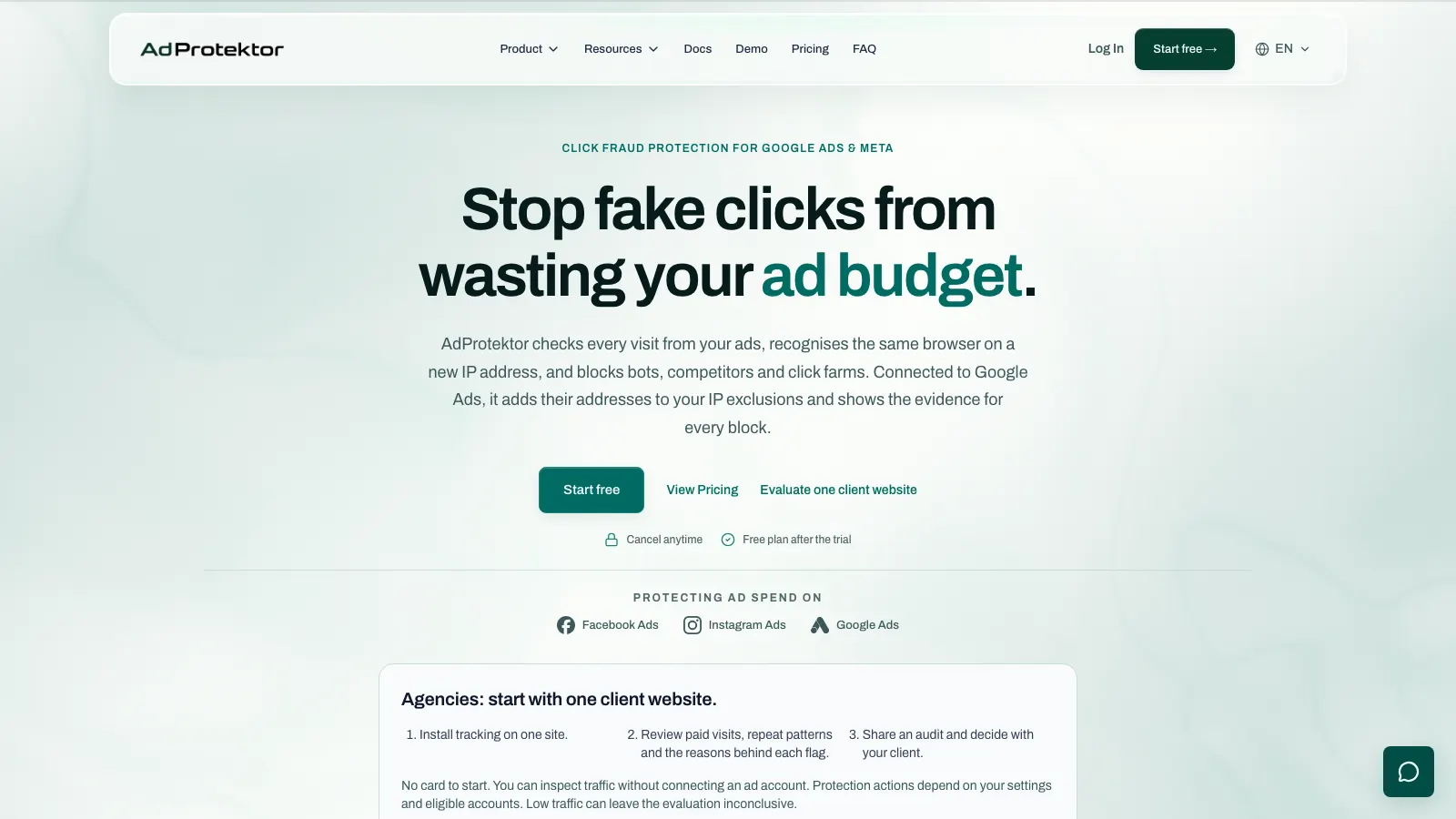
When suspicious Google Ads or Meta clicks keep draining a budget, you need evidence before a protection rule changes campaign treatment. AdProtektor suits advertisers willing to set those rules, inspect the record, and accept that platform delivery is separate from its own block decision. If you are comparing specialist products in the marketing tools directory, that distinction matters more than a dashboard estimate.
Agent access
- API
- Yes, ConversionOS add-on, available on any plan, or standalone True Tracking
- MCP server
- Not found on official pages
What are the primary pros and cons of AdProtektor?
What works
- Google Ads submissions have an exclusion log
- Meta audience membership updates hourly
- Paid plans include session recordings for review
What to watch
- False positives still need threshold tuning
- Platforms decide whether exclusions take effect
- ConversionOS pricing appears only at checkout
What does AdProtektor do to combat click fraud?
AdProtektor addresses the problem of rising paid traffic costs that become difficult to audit against invalid automated clicks. AdProtektor puts a persistent visitor identity on one browser and one device, then uses device, behavior and network signals as fraud evidence. That is a more practical starting point than treating an IP address as a complete answer, especially when an address changes or a network is shared. It does not turn the identity into proof of a real-world person, and it should not be presented that way.
The product has two jobs. First, it lets a team configure protection for each website and inspect the reasons, evidence and exceptions behind an action. Second, it sends eligible blocked IPs to a connected Google Ads account or selected campaigns. Google Ads is connected through a manager-account invitation and Customer ID, so there is no OAuth token to maintain. The exclusion log says what was written and when, without changing manual exclusions.
Meta follows a different route. AdProtektor maintains eligible blocked visitors in a Custom Audience hourly, including removals after expiry or unblocking. Your team still has to apply that audience to the campaigns it wants to protect. The local decision, the audience submission and a matched campaign exclusion are separate steps. That restraint is the reason to consider it: the product gives you an auditable workflow, not a promise that every suspicious click becomes an exclusion or a refund.
Who benefits most from deploying AdProtektor?
Google Ads operators
Set traffic rules, inspect evidence, and submit eligible IP exclusions to selected campaigns.
Meta advertisers
Maintain a blocked-visitor audience and apply it deliberately to chosen campaign exclusions.
Store growth teams
Check supported conversion events before delivery to Google, Meta, and GA4 destinations.
Client-account agencies
Use Enterprise capacity when twenty domains and ten seats match active client work.
It is a poor fit for an advertiser that wants a set-and-forget savings claim. The documentation says false positives are possible and tells customers to inspect the reason, adjust settings and whitelist known legitimate visitors when appropriate. That is sensible product behavior, but it means somebody on the team must own the decisions. The entry plan is also narrow: it is one domain, one seat and 5,000 clicks a month.
Which click protection features does AdProtektor deliver?
Persistent visitor identity and configurable action
The detection model ties a visit to a browser on a device. An IP, VPN or network change does not automatically create a new identity, while clearing site data or moving to another browser or device does. Device characteristics, engagement patterns and network history contribute signals, but short visits and shared networks require care. Protection is configured per website; AI analysis and its influence on blocking are separate settings. Opening an AI explanation is not itself authorization to block someone.
Google Ads exclusion sync
Once the manager connection is active, eligible blocked IPs can be submitted at account or selected-campaign scope. The log gives the operator an audit trail for submissions. Keep expectations measured: Google controls whether an exclusion is applied, and campaign IP-exclusion limits still exist. AdProtektor also documents invalid-click evidence for a refund claim, but it does not make Google issue a refund automatically.
Meta audience protection
For an active Meta connection, AdProtektor maintains a Custom Audience of eligible blocked visitors hourly. That includes removing people whose block expires or is reversed. Meta matching, processing and campaign audience settings affect whether and when an exclusion has coverage. The product makes the audience maintenance less manual, but does not replace campaign setup or Meta's own processing.
Session evidence and installation options
Every paid fraud-protection plan includes session recording. Standard lists 7-day replays and 30-day fraud evidence, Pro lists 30 and 60 days, and Enterprise lists 60 and 90 days. The vendor documents an installation path for WordPress and WooCommerce, Shopify, Wix, Squarespace, Webflow, BigCommerce, Google Tag Manager and custom HTML. Recording is useful only if the team has a privacy notice and a process for reviewing it.
ConversionOS
ConversionOS is the related conversion-tracking product. It records supported events from store integrations, browser events or a custom API; checks configured fraud signals; and sends eligible events to Meta, Google Ads and GA4. Event IDs and supported order identifiers help prevent duplicate submissions. Its event-level delivery status is more useful for investigating mismatched reporting than treating one dashboard as a universal source of truth, because attribution rules, consent, time zones and platform processing can still produce different totals.
How is AdProtektor pricing structured across click volumes?
Price checked 27 Nov 2026
| Plan detail | Standard$84/mo | Profrom $120/mo | Enterprisefrom $316/mo |
|---|---|---|---|
| Monthly clicks | 5,000 | 10,000 to 40,000 | 50,000 to 150,000 |
| Domains | 1 | 5 on the starting tier, up to 10 above | 20 |
| Team seats | 1 | 3 | 10 |
| Replay / evidence retention | 7 / 30 days | 30 / 60 days | 60 / 90 days |
| AI Person Analysis | ✕ | ✓ | ✓ |
| ConversionOS | Paid add-on | Paid add-on | Paid add-on |
AdProtektor pricing, 27 Nov 2026.AdProtektor pricing
Every displayed paid plan includes a 7-day free trial. After a trial, the vendor says one website can remain on a free plan that checks up to 10,000 visits a month and shows attacks in the dashboard; blocking and exclusions remain paid features. ConversionOS is available on any plan as an add-on, but its price is shown in the billing dashboard at checkout. Treat that as a real budget unknown before you commit.
For a small two-person team, Standard is not a two-seat purchase. It includes one seat, so the first named plan does not cover that team as listed. Pro is the first published tier with three seats, from $120 a month on the smallest click tier, where it includes five domains. Higher click tiers can reach ten domains, and the vendor says both price and domains scale with the selected click tier.
What does AdProtektor Enterprise provide for agencies?
AdProtektor Enterprise begins at $316 per month, accommodating 20 tracked domains and 10 team seats. Selectable tiers range from 50,000 to 150,000 monthly clicks; confirm the price for your chosen tier before budgeting. It adds benchmark analysis, AI fraud reports, the longest displayed retention and Enterprise support. An agency should map those limits to live client sites rather than assume every site receives the same traffic or review time.
Where does AdProtektor fall short in scope?
AdProtektor encounters its chief limitation in channel scope, focusing strictly on paid search and social click traffic. Its paid protection is built around Google Ads and Meta, not a broad paid-media control room. Even inside those platforms, exclusion delivery has dependencies outside the product. Google decides how it processes exclusions; Meta matching and campaign settings shape audience coverage. A dashboard record can show what AdProtektor did without proving AdProtektor produced a commercial outcome.
False-positive controls are not a footnote. The vendor explicitly says they can occur. A team should establish who checks the reason and evidence, adjusts a threshold, and whitelists a known customer. Without that operating habit, automatic action can create a new customer-acquisition problem while trying to solve an invalid-traffic one.
ConversionOS is another qualified purchase. It can be bought as an add-on or as standalone True Tracking, but the add-on price is only presented at checkout. ConversionOS supports conversion capture through store integrations, browser events or a custom API. Confirm general data access, MCP support, the exact integration and billing scope with the vendor before building a workflow around it.
What are the main alternatives to AdProtektor?
 AI Peekaboo review covers a different marketing question, how a brand appears in AI answers, rather than paid-click fraud protection. It belongs beside this decision only when the same team owns both reporting jobs.
 Ads Lighthouse review monitors paid Google and Bing text ads for configured brand keywords. Its Growth plan and above also monitor Google Shopping listings, including product, merchant, price, destination and position.
 Adspread review is a different job: it books approved Telegram channel placements or manages Telegram Ads campaigns, rather than protecting clicks after they arrive.
What is the final verdict on AdProtektor?
AdProtektor earns consideration when suspected invalid traffic is an operational issue, not just a line on a report. Its strongest quality is the separation between detection, configured blocking and platform delivery. That creates a better basis for a human decision than a tool that implies every flag has already saved money.
Start with the 7-day Standard trial on one lower-volume site. Review the evidence, the Google exclusion log and your false-positive process before upgrading. Move to Pro only when its additional seats, domains, retention or AI Person Analysis are a defined need.
How was the data in this AdProtektor review checked?
AdProtektor documentation, integration guidelines, product sheets, and pricing pages formed the verified data set on 27 Nov 2026. Prices retain the vendor's displayed dollar symbol, and every figure follows the rules in how we check figures.
- AdProtektor pricing and product pages
- Google Ads and Meta protection documentation
- Detection, integrations and ConversionOS pages
What are frequently asked questions about AdProtektor?
Can AdProtektor exclude Google Ads traffic?
It can submit eligible blocked IP addresses to a linked Google Ads account or selected campaigns and record the submission in an exclusion log. Google controls how exclusions and invalid-traffic refunds are ultimately processed.
How does Meta protection work?
AdProtektor maintains eligible blocked visitors in a Meta Custom Audience hourly. The advertiser applies that audience to campaigns, while Meta matching, processing and campaign settings affect coverage.
How much does AdProtektor cost?
Standard is $84 a month for one domain, 5,000 clicks and one seat. Pro starts from $120 a month with three seats and five domains on its smallest click tier, rising to up to 10 domains on higher tiers. Enterprise starts from $316 a month.
Does AdProtektor have an API for AI agents?
ConversionOS documents a custom API for supported conversion capture. Confirm general data access and MCP support with the vendor before you depend on them.
 Reviewed byDanny Kirk
Founder of ReddiReach.
 Checked byAndrés Felipe
Digital designer and marketer.
Every figure is checked against the vendor's own page. Read our editorial standards.