
Key Takeaways
- ChatAdsWatch lets competitive intelligence and paid media researchers inspect commercial advertisements captured directly alongside corresponding ChatGPT prompt conversations.
- ChatAdsWatch Pro costs $49 monthly plus tax, providing users with an ongoing monthly allowance of 1,000 analysis credits.
- ChatAdsWatch documents an internal data API for automated queries, though programmatic access requires explicit technical authorization beyond standard Pro.
- ChatAdsWatch provides historical snapshot observation data rather than live coverage, demographic targeting records, or programmatic advertising spend metrics.
When ChatGPT ad appearances are part of your research brief, ChatAdsWatch is the strongest fit for inspecting the advertiser, creative, destination and associated prompt together. Choose a broader paid-media intelligence platform instead when the decision depends on spend, targeting, geography or performance data.
Agent access
- API
- Yes, Separate, restricted internal access
- MCP server
- Not found on official pages
What are the primary advantages and data limitations of ChatAdsWatch?
What works
- Public catalog makes the sample, dates and headline counts visible
- Methodology separates observed records from inferred labels and estimates
- Pro unlocks full creatives, buyer prompts, evidence and saved reports
What to watch
- The catalog is a dated sample, not a live census
- No geography, targeting or performance information is available
- Unused Pro credits expire at the end of each billing period
How does ChatAdsWatch document advertising creatives inside generative AI conversations?
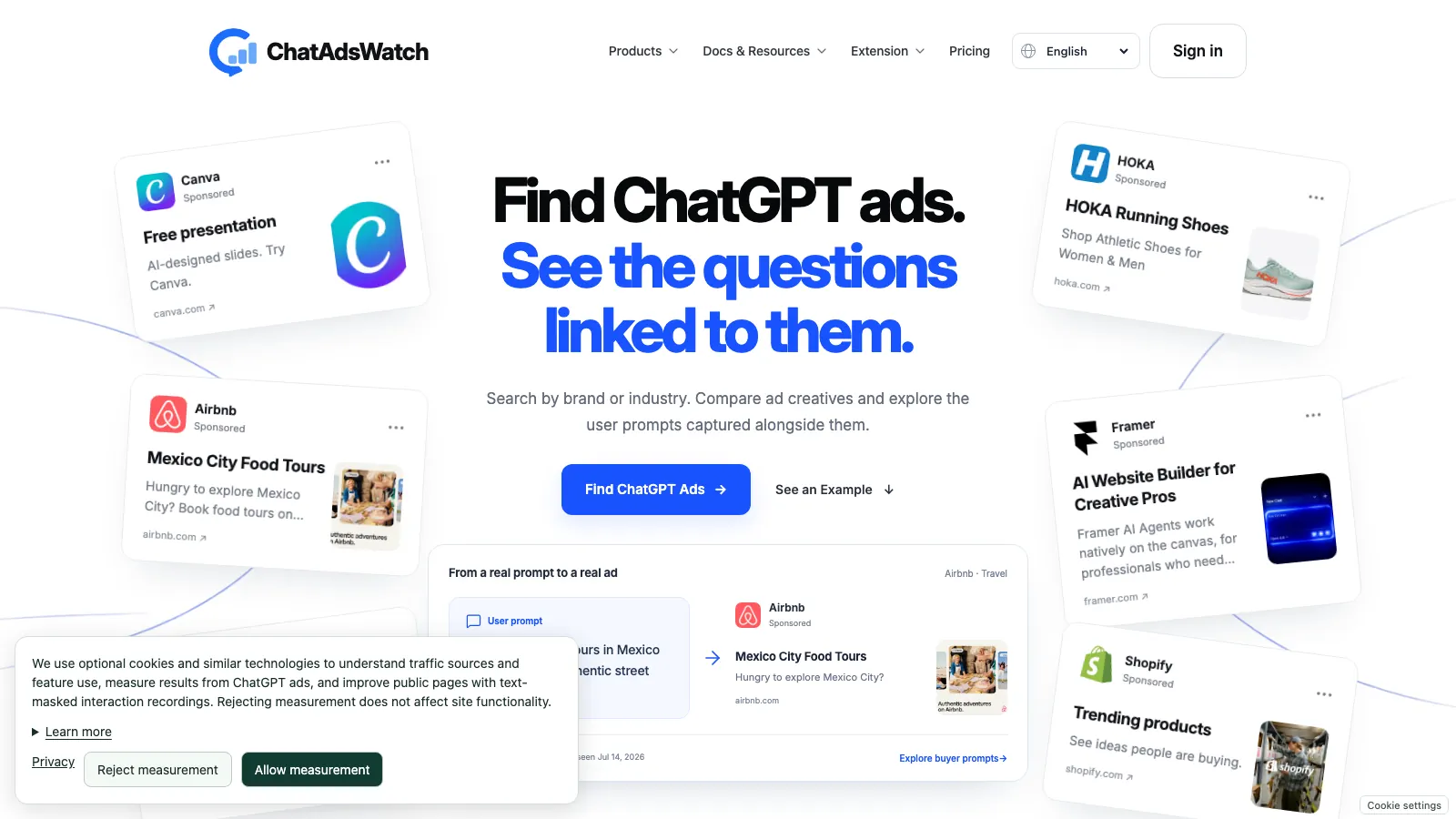
ChatAdsWatch gives your team a place to inspect advertisements observed beside captured ChatGPT prompts, then follow the advertiser, creative, destination and associated question around each record. The public catalog reports its scope plainly: 45,315 observed ads from 11,433 advertisers, associated with 34,360 buyer prompts in the September 17, 2026 snapshot. Visit the marketing tools directory when you are deciding whether an emerging surface has enough visible activity to merit more attention.
That framing is the product's best quality. Captured appearances are not impressions, clicks, reach, spend or proof that a campaign worked. The catalog preserves source records while treating industry, topic and buyer-intent labels as separate classifications. For a market researcher, that makes the record more useful than a bold but opaque number. For a media buyer trying to explain cost or return, it means ChatAdsWatch stops before the decisive evidence begins.
ChatAdsWatch earns its place when the question is what has appeared around a buyer need, how rivals phrase an offer and what supporting context exists. It is not an ad account, a campaign-management tool or a replacement for conventional competitive intelligence.
Which competitive intelligence and paid media researchers need ChatAdsWatch?
Paid-media teams
Review observed ChatGPT ads and prompt context before planning creative research work.
Competitive analysts
Compare advertiser records, creative material and evidence without mistaking appearances for performance.
Research agencies
Prepare market reports from full creatives, prompts, and saved research views.
Context-conscious researchers
Keep local ChatGPT observations alongside questions and answers using the extension.
The practical fit is narrow in a good way. A small growth or strategy team can use it to turn a vague suspicion about ChatGPT advertising into materials worth discussing. A performance marketer who needs audience controls, regional delivery, campaign spend or attribution should not make it a reporting dependency, because those fields are explicitly unavailable rather than merely hard to find.
What ad tracking, creative inspection, and prompt analysis tools are in ChatAdsWatch?
Observed ad library
The catalog can be explored through ads, advertisers, buyer prompts and landing pages. Public pages show industry aggregates and short, dated creative examples. Pro opens complete creative copy, associated buyer prompts, source evidence, advanced filters, competitor views and saved market reports. That division makes the free layer a sensible relevance check and the paid layer the place for recurring analysis.
Evidence labels that change the interpretation
ChatAdsWatch labels fields as observed, inferred, estimated, demo or unavailable. An observed appearance means an ad record was found beside a captured prompt in an imported source sample. The distinction matters because a high captured-appearance count can guide where to look next, but it cannot establish market share, media investment or a winning creative.
Credits for new analysis
Pro includes 1,000 analysis credits each paid month. Opening collected ads, narrowing the Pro catalog and storing reports use no credits. A quoted new provider-backed analysis does, and failed provider analysis releases its reserved credits. The catch is simple: unused monthly credits expire, so the plan best suits teams maintaining a recurring research rhythm rather than those needing an occasional look around.
AdContext Chrome extension
AdContext is a separate Chrome extension for collecting labeled ad placements, product suggestions and identified brand references within ChatGPT. It keeps nearby questions and answers with each saved observation, then lets you search, tag, edit and export filtered records as CSV or JSON. Its records and optional screenshots stay in the browser profile, with no extension sign-in, online synchronization, telemetry or third-party AI calls. They do not sync to ChatAdsWatch, which is a useful privacy boundary but means you should treat it as a separate local library.
API access for approved internal users
The API documentation describes read access to stored ads, advertisers, prompts, landing pages and related data. It is not a self-serve integration: API V1 requires an active internal-access grant, an authorized browser session or a bearer key owned by an approved user. Pro does not include API access. That makes ChatAdsWatch a human research workspace for ordinary subscribers, not a dependable data feed for an agent workflow.
How much does the ChatAdsWatch Pro subscription and credit tier cost?
Price checked 27 Nov 2026
| Plan detail | Public previewFree | ChatAdsWatch Pro$49/mo + tax |
|---|---|---|
| Catalog access | Aggregates and small creative sample | Full available evidence |
| Creative and prompt detail | ✕ | ✓ |
| Advanced filters and competitor views | ✕ | ✓ |
| Saved market reports | Not specified | ✓ |
| Analysis allowance | Limited market preview | 1,000 credits per paid month |
| Data API | Restricted internal access | Restricted internal access |
ChatAdsWatch pricing, 27 Nov 2026.ChatAdsWatch pricing
The cost is uncomplicated: three separate Pro subscriptions total $147 a month plus applicable tax, before any decision about whether the available credits fit the work. The pricing page does not state a per-seat charge. The bill is predictable, but credit expiry means $49 is only good value when your team will return to new analysis every month.
Where does ChatAdsWatch lack live spend estimates and geographic tracking?
ChatAdsWatch openly acknowledges that its catalog represents a dated snapshot rather than an exhaustive live record of every ChatGPT ad. A missing advertiser, prompt or creative does not prove absence. The catalog changes as records are added, while historical catalog versions are not archived. Treat it as observable evidence, not a complete competitive map.
The delivery gap is wider. ChatAdsWatch does not provide geography, targeting or performance information. The associated prompt is a recorded relationship, not the advertiser's targeting specification. That makes it poor evidence for deciding where an ad ran, which audience it reached or whether a placement delivered profitable traffic.
Finally, Pro is not an automation plan. The API remains restricted to authorized internal users, and the extension's local records do not sync to the web product. If a repeatable pipeline matters more than a researcher reading the source context, put that requirement ahead of the attractive $49 entry price.
Which AI monitoring and competitive intelligence tools compete with ChatAdsWatch?
 ChatAdsWatch alternatives like AI Peekaboo track organic brand mentions across generative answer engines instead of archiving paid promotional units. Its plans start at $30 a month, price checked 27 Nov 2026, and include API and MCP access, while ChatAdsWatch's API is restricted. The AI Peekaboo review explains the reporting and agent-access trade-off.
 ClickCease makes more sense when the job is protecting paid campaigns from invalid clicks, rather than researching competitor creative and prompt context. Read the ClickCease review for its plan limits and campaign-protection fit.
 Foreplay is the closer match when your team needs a broad creative-research workspace for paid social, rather than a catalog dedicated to ChatGPT observations. It automatically tracks competitors, so it better fits a team that needs recurring competitor research alongside creative planning. The Foreplay review sets out its creative-library approach and costs.
Is ChatAdsWatch an essential investigative tool for tracking AI ads?
Use ChatAdsWatch when you need a disciplined way to investigate what has been observed in ChatGPT, with the prompt and evidence context preserved beside the creative. The $49 Pro plan is reasonable for regular market research, especially because the product does not pretend a captured appearance is an impression. Pass on it when your decision depends on media delivery, measured results or self-serve API access.
Start in the public catalog with your market and the buyer questions you care about. Move to Pro only when complete creatives, prompts, evidence and saved market reports will shape a recurring research routine before the monthly credits expire.
How were ChatAdsWatch catalog data, methodology, and pricing audited?
Every price, limit and feature in this review comes from ChatAdsWatch's own public catalog, pricing, methodology, product guide, API guide and extension pages, read on 27 Nov 2026. Prices use the vendor's $ notation, and every figure follows the rules in how we check figures.
- ChatAdsWatch public catalog and methodology
- ChatAdsWatch pricing and product-guide pages
- ChatAdsWatch API guide and AdContext extension page
What are common practical questions about researching with ChatAdsWatch?
What does ChatAdsWatch measure?
It records ads observed beside captured ChatGPT prompts, then shows related advertiser, creative, prompt, industry and captured-appearance information. Captured appearances are not impressions, clicks, reach, spend or campaign performance.
How much does ChatAdsWatch Pro cost?
ChatAdsWatch Pro costs $49 a month plus applicable tax. It includes 1,000 analysis credits each paid month, renews monthly and lets you cancel renewal at any time. Unused credits expire at the period end.
Does ChatAdsWatch include an API?
ChatAdsWatch has a restricted internal API; Pro does not include access. It requires authorized internal access, and there is no public self-service key issuance.
Does the AdContext extension upload conversations?
No. AdContext says it stores records and optional screenshots in your browser profile, without an extension account, cloud sync, analytics trackers or external AI calls. Its records do not sync to ChatAdsWatch.
 Reviewed byDanny Kirk
Founder of ReddiReach.
 Checked byAndrés Felipe
Digital designer and marketer.
Every figure is checked against the vendor's own page. Read our editorial standards.