
Key Takeaways
- Collaborator operates as a direct marketplace connecting digital public relations teams with verified website publishers and Telegram channels for paid guest placements.
- Collaborator pre-attaches third-party traffic metrics and audience authority signals directly to marketplace media listings to simplify editorial publisher evaluation.
- Collaborator utilizes pay-per-placement commercial transactions with entry pricing around forty dollars, while requiring free user registration to browse full catalog inventory.
- Collaborator provisions a developer application programming interface for registered corporate customers to integrate placement purchases into customer relationship management and accounting systems.
If you need to buy placements without negotiating with each publisher, Collaborator is the better fit. Choose JustReachOut instead when you need its database of 700k+ journalists and manual email verification.
Agent access
- API
- Yes, any registered user
- MCP server
- Not found on official pages
- Automation
- Zapier, Make, n8n
What are the core advantages and drawbacks of Collaborator?
What works
- 45,664 websites and 3,153 Telegram channels, shown on 27 Nov 2026
- 8,500+ websites share Google Analytics data and 7,500+ are verified through Search Console
- Team Account separates employee and client access while keeping budgets together
What to watch
- You must sign up to see all websites and the full filtering options
- There is no subscription price to compare, because every publisher sets a placement price
- API documentation is available only to registered users
How does Collaborator streamline paid guest posts and link building?
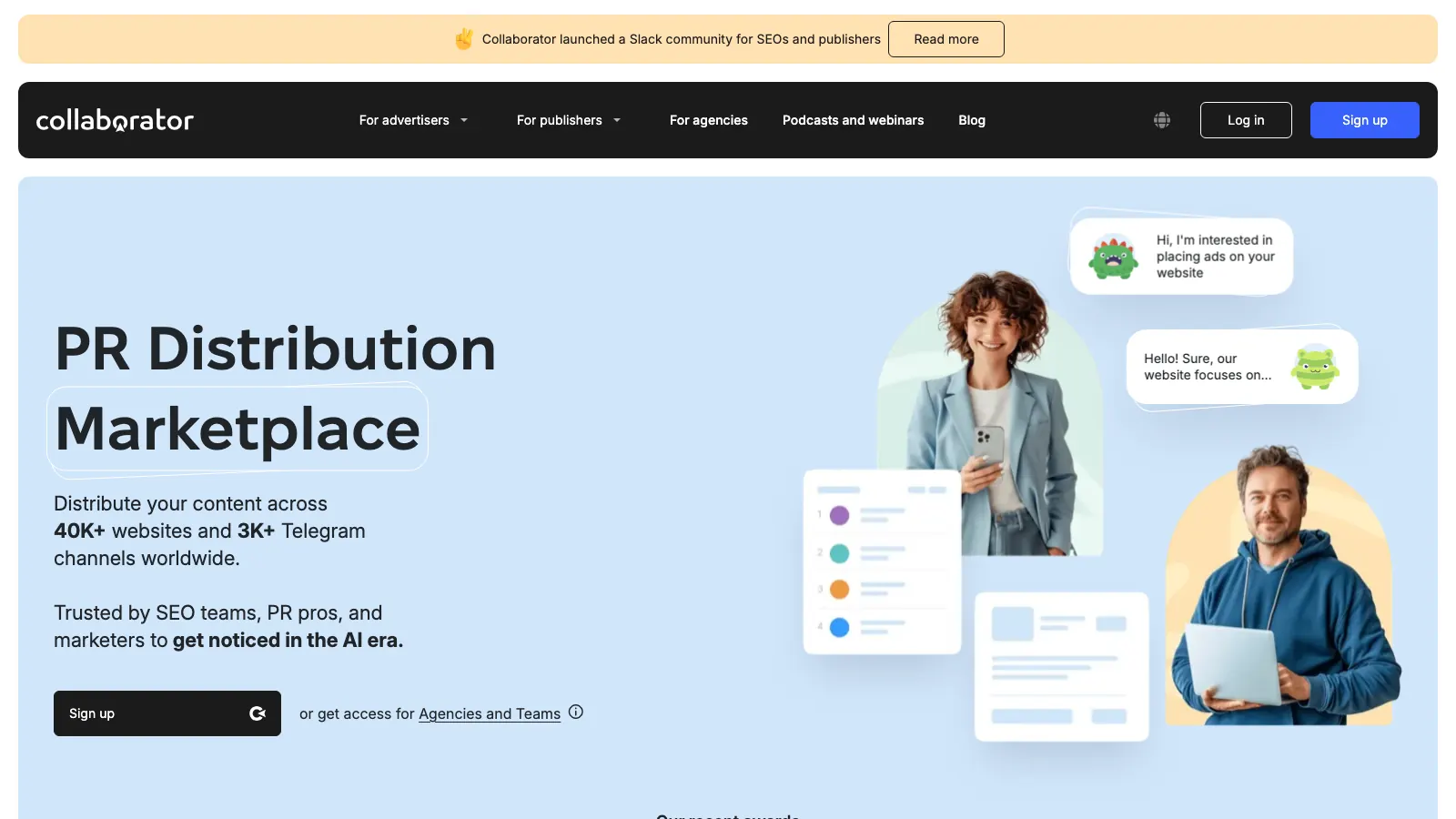
Collaborator eliminates outreach bottlenecks by providing an open marketplace where teams purchase guest post placements without conducting manual negotiations. Collaborator takes a different route: it is a PR distribution marketplace where advertisers choose website or Telegram placements from a catalog. The practical appeal is not that it replaces editorial judgment, but that it puts the market, visible listing data and an order route into one place. For teams comparing paid distribution options, it earns a place in a marketing tools directory because it presents orderable placements, not analytics software alone.
The catalog is the reason it can work for a busy team. Collaborator showed 45,664 websites and 3,153 Telegram channels on 27 Nov 2026. Its public catalog presents up to ten websites before sign-up, while the vendor says the advanced filter has more than 70 parameters. That makes the account step part of the product, not an optional extra.
For a team that has to explain a placement choice, the traffic signals matter more than a broad catalog number. Collaborator says 8,500+ websites share Google Analytics data and 7,500+ are verified through Google Search Console. Listings can show monthly traffic, country distribution, Domain Authority, Trust Flow and Ahrefs Rank. I would use those fields to narrow a campaign brief before considering a price.
Which digital PR and SEO agencies benefit most from Collaborator?
Digital PR teams
Choose from website and Telegram opportunities when a campaign needs paid distribution.
Multi-client agencies
Team Account brings budgets, projects, employee roles and client access into one workspace.
SEO teams buying placements
Compare available listings through traffic, country and SEO metrics before adding one to a plan.
Operational teams
Use the API when a registered account needs Collaborator data in a CRM or financial system.
I would pick Collaborator for a team with a defined brief, a budget and a need to place content across several markets. It is less compelling when the core work is pitching a small, hand-picked press list. In that case the conversation itself is the asset, and a marketplace is not the main operating system.
What marketplace filters and publisher metrics does Collaborator provide?
Catalog filters and listing signals
Collaborator describes more than 70 advanced-filter parameters, while another vendor page describes 40+ filtering options. The public catalog displays category, monthly traffic, DR and price, and the wider platform describes country distribution, Trust Flow and Ahrefs Rank. That breadth is useful only if the team agrees its non-negotiables first: market, topic, audience signal and maximum placement cost.
Traffic data before placement
The vendor says more than 8,500 websites provide Google Analytics data and over 7,500 are verified through Google Search Console. This does not turn traffic into a promise of campaign results, but it gives you more to work with than a single authority metric. A placement buyer can assess the listed traffic source mix and country data alongside the price.
Website and Telegram distribution
Collaborator lists websites for guest posts and press releases, alongside Telegram channels. The Telegram catalog showed 3,153 channels on 27 Nov 2026 and exposed data such as followers, post coverage, involvement and price. That makes the channel catalog a distinct distribution option, not merely a checkbox attached to the website marketplace.
Team Account controls
Agencies can use Team Account to keep employee and client access separate, set customized access levels and manage projects and budgets in one place. Collaborator also lists branded client reports, a personal support manager and a 2.5% agency commission on its agency page. Those are agency-specific details, so a solo buyer should not assume they apply to an ordinary account.
API for registered users
Collaborator says its API can integrate with a CRM or financial system, or make its data available in another workflow. Any registered user can get access to the API and documentation. For an agent workflow, start with that documented API route and confirm the permissions and data you need before building on it.
Placement protection
The marketplace describes guarantees against deletion and non-indexing, including a free three-month guarantee and an additional paid one-year guarantee. Treat the applicable guarantee as a placement detail to confirm before purchase, especially when a campaign has a fixed reporting window.
How do Collaborator per-placement marketplace fees work?
Price checked 27 Nov 2026
| Pricing detail | Marketplace |
|---|---|
| Visible website listing | $40 USD |
| Website catalog access | Sign-up to view all listings |
| Telegram channels on 27 Nov 2026 | 3,153 |
| Agency option | Team Account available |
Catalog figures and visible prices in US dollars, 27 Nov 2026.Collaborator marketplace
There is no monthly plan price to use as a team bill. The cost is the sum of the placements you choose, and a visible website listing was priced at $40 USD. The $40 USD is a visible website listing, not a published minimum or a promise that a suitable placement will cost the same.
For an agency, the real budget conversation should separate placement spend from the Team Account arrangement. Collaborator advertises a 2.5% agency commission and low deposit fees, but it does not publish a standard monthly Team Account price. Ask for the applicable commission, deposit fee, currencies and access terms before you put it into a client estimate.
How does Collaborator serve marketing agencies through Team Accounts?
Collaborator calls its agency product Team Account rather than Enterprise. It is aimed at SEO, GEO and PR agencies that need sub-accounts, project management, employee controls and unified client budgets. The vendor also says a client can be connected without sharing the agency account credentials. That is meaningful control for a multi-client operation, but the published pages do not provide a standard Team Account subscription price.
What are the primary disadvantages of Collaborator?
Collaborator conceals complete publisher catalog inventory, website domain names, and individual pricing details behind mandatory account registration. The public catalog is enough to show its shape, but Collaborator asks visitors to sign up to see all websites and use the complete filter set. That is reasonable for a marketplace, though it prevents a clean before-and-after budget comparison for a team that has not opened an account.
Placement prices are listing-specific. A $40 website listing was visible, but there is no vendor-published starting plan or fixed monthly bill. If your procurement process needs a predictable tool cost, get a representative placement basket and the agency fees in writing before presenting a forecast.
The API route also starts after registration. Collaborator says users can obtain API documentation, but the public API page does not set out the permissions or fields a particular workflow will need. Confirm those details before making it a dependency for reporting or automation.
Which digital PR marketplaces provide alternatives to Collaborator?
 AI Peekaboo review is the first stop when the decision begins with how often a brand appears in AI answers, rather than which publisher can carry a paid placement. Its paid plans include API and MCP access, a clearer route for agents that need AI-visibility data.
 Hunter review is the better comparison when finding and verifying contact information is the immediate job. Its Free plan includes 50 credits per month with no card needed, and every plan includes unlimited team members at no extra cost. JustReachOut review provides a database of 700k+ journalists and manual verification of email addresses, while Collaborator is organized around a catalog of purchasable placement opportunities.
Is Collaborator the best marketplace for sponsored content distribution?
Collaborator makes the strongest case for an agency or PR team that is ready to purchase distribution and wants a large selection with traffic signals already attached. The useful distinction is its marketplace model: you are choosing listings and managing placements, not subscribing to a generic SEO package. Its Team Account and documented API give it more operational depth than a one-off placement board.
Open an account only after your team has written the campaign filters it will use, then price a small representative set of listings and confirm the guarantee and agency terms that apply. That will tell you whether the marketplace saves enough time to justify the placement spend.
How were Collaborator publisher metrics and API access verified?
Collaborator pricing figures, agency workflow accounts, API documentation, and platform policies were verified on 27 Nov 2026. Prices are in US dollars where the vendor shows them, and every figure follows how we check figures.
- Collaborator website and Telegram catalogs
- Collaborator agency and Team Account page
- Collaborator API, FAQ and company pages
What are common buyer questions regarding Collaborator?
What does Collaborator show for a website listing?
The public catalog shows fields including category, monthly traffic, DR and price. Collaborator also describes platform data such as country distribution, Trust Flow and Ahrefs Rank.
How does Collaborator verify traffic?
Collaborator says 8,500+ websites share Google Analytics data and 7,500+ are verified through Google Search Console. It also displays traffic and country information for listings where those data are available.
Can an agency manage clients in Collaborator?
Yes. Team Account is designed for agencies and lists separate client and employee access, customized access levels, project management and budget control.
Does Collaborator offer an API?
Yes. Collaborator says registered users can access its API and documentation for integrations with CRM or financial systems. Confirm the permissions and fields needed for your workflow before you build on it.
What does Collaborator cost?
It is a pay-per-placement marketplace, not a published monthly subscription. A visible website listing was $40 USD on 27 Nov 2026, but listing prices vary and the vendor does not state that as a formal minimum.
 Reviewed byDanny Kirk
Founder of ReddiReach.
 Checked byAndrés Felipe
Digital designer and marketer.
Every figure is checked against the vendor's own page. Read our editorial standards.