
Key Takeaways
- Customer.io enables technical lifecycle marketers to trigger automated email, push notifications, and in-app messages based on user behavioral events and complex multi-object relationships.
- Customer.io pricing starts at $100 monthly for Essentials with 5,000 profiles, while Premium begins at $1,000 monthly billed annually for advanced data modeling.
- Customer.io supports sophisticated technical integrations across all tiers, providing unlimited monthly API calls, Model Context Protocol server capabilities, and core artificial intelligence agent skills.
- Customer.io is not suited for simple mailing lists or organizations needing custom collections, anonymous messaging, or more than two object types on lower budgets.
When your messages need to follow what people, accounts or other objects do, Customer.io is the right pick for a technical lifecycle team. Essentials starts at $100 a month with 5,000 included profiles, while Premium starts at $1,000 a month, billed yearly, for teams that need anonymous messages or custom collections.
Agent access
- API
- Yes, Essentials, Premium, and Enterprise
- MCP server
- Official, hosted, OAuth
- Works with
 ClaudeClaude Code
 ChatGPT
 Gemini
 Cursor
 VS Code
- Automation
- Zapier
What are the pros and cons of Customer.io?
What works
- Unlimited people attributes and API calls on every plan
- Email, SMS, push, in-app, WhatsApp and LINE support
- MCP server and core AI Agent skills from Essentials
What to watch
- Premium begins at $1,000 a month, billed yearly
- Essentials includes 5,000 profiles and two object types
- Anonymous messages and custom collections start at Premium
What does Customer.io do for lifecycle marketers?
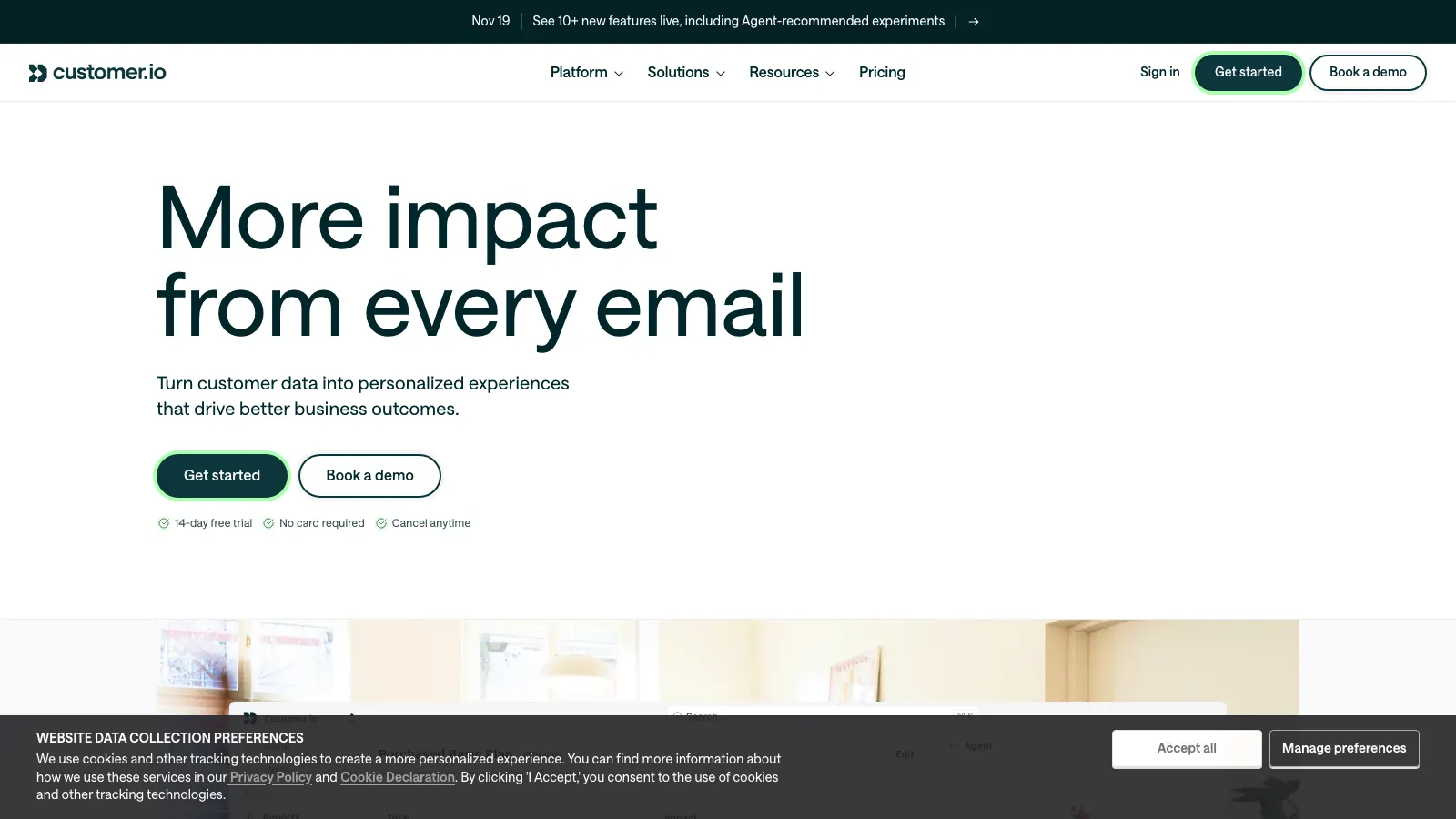
Customer.io turns customer data and behavioral triggers into personalized experiences. The useful distinction is that a journey can follow what a person, account, subscription or other custom object does, rather than waiting for a marketer to assemble a static campaign list. That is why it belongs in a marketing tools directory for product and lifecycle teams, not just email senders.
The platform places journeys, audiences, design tools, data connections and analytics in one system. It supports email, transactional messages, SMS, web and mobile push, in-app messages, WhatsApp, LINE and webhooks. Push and in-app volume is unlimited on every listed plan, while Essentials includes one million emails a month.
That breadth is a strong reason to pick it when your team is already collecting meaningful customer events. It is less persuasive when the work is simple broadcast email. The price step from Essentials to Premium is substantial, so the data model matters most when it saves you from stitching several messaging tools together.
Who is Customer.io designed for?
Product-led teams
Use customer behavior and attributes to tailor journeys around activation, retention and product use across relevant messaging channels.
Lifecycle marketers
Coordinate email, push, in-app and messaging channels from one visual workflow builder, keeping each customer journey connected to its trigger.
Technical marketing teams
Connect APIs, SDKs, webhooks and MCP tools while retaining data access controls, then use those connections for coordinated journey work.
Eligible startups
Companies raised under $10 million can apply for up to twelve free months, easing commitment for eligible startups.
I would not treat Essentials as a low-commitment version of every Customer.io feature. It gives a real workflow, unlimited attributes and agent access, but it intentionally leaves out anonymous messages and custom collections. Check whether your lifecycle model needs those before you build the first campaign around a plan you will quickly outgrow.
Which features does Customer.io offer?
Journeys, audiences and objects
The visual workflow builder is included on all plans, alongside cross-channel campaign automation, segments and an AI-powered segment builder. Customer.io also supports custom objects, which can represent things customers create, buy, schedule or interact with. An object can have its own attributes and relate to people, so an account, course, appointment or job posting can provide the context for a message. Essentials includes two object types, Premium includes ten and Enterprise is custom.
Messages across the customer journey
Every plan includes transactional email, web and mobile push, in-app messages, native WhatsApp, LINE and unlimited send-and-receive webhooks. SMS volume is custom. This lets a team keep one journey logic while choosing the channel that fits the moment, rather than recreating an audience for each message tool. Anonymous messages are a Premium and Enterprise feature, which matters for teams that want to reach visitors before they identify themselves.
Data connections and APIs
Customer.io documents three APIs and webhooks: Pipelines and Track APIs to bring data in, and the App API for broadcasts, transactional messages and data lookup. It also offers libraries and SDKs, mobile SDKs, integrations and connected forms. The pricing grid lists unlimited monthly API calls on every plan. For a custom integration, the documentation recommends the Track API when data goes only to Customer.io, and Pipelines when the same data also goes to other destinations.
AI Agent and your own agent
The built-in AI Agent is included on every plan with persistent memory and core execution skills. Essentials has up to three custom execution skills and weekly Routines; Premium raises that to ten custom skills and daily Routines; Enterprise is custom. Customer.io also provides an MCP server, CLI and APIs for your own tools. The MCP route can build segments, launch automations and analyze results from an MCP-compatible environment, with data access controls.
Permissions and compliance controls
Customer.io lists two-factor authentication, single sign-on and role-based permissions, plus US and EU data centers. Its security page says Customer.io is GDPR compliant and SOC 2 Type II certified. HIPAA is not included in Essentials and is listed as custom on Premium and Enterprise, so regulated teams need that requirement named in their commercial terms rather than assuming it comes with a paid plan.
How is Customer.io pricing structured?
Price checked 27 Nov 2026
| Plan detail | Essentials$100/mo | Premium$1,000/mo | EnterpriseCustom |
|---|---|---|---|
| Billing basis | Monthly, 5,000 profiles | Billed yearly | Talk to sales |
| Profiles, people plus objects | 5,000 included, then $0.009 each | Custom | Custom |
| Monthly email sends | 1 million | Custom | Custom |
| Object types | 2 | 10 | Custom |
| Anonymous messages | ✕ | Unlimited | Unlimited |
| API calls and MCP server | Unlimited, included | Unlimited, included | Unlimited, included |
| User seats | Unlimited | Unlimited | Unlimited |
| Workspaces | 2 | Unlimited | Unlimited |
Customer.io prices in US dollars, 27 Nov 2026.Customer.io pricing
The plan price is only part of the decision. All plans have unlimited user seats; Essentials has two workspaces, while Premium and Enterprise have unlimited workspaces. A five-person Essentials team with 6,000 total profiles and no email or AI-credit overage pays $109 a month: $100 plus 1,000 additional profiles at $0.009 each. Additional 1,000-email blocks cost $0.12 on Essentials and Premium, and Essentials AI credits cost $10 per 100,000. Those amounts are in US dollars and were checked 27 Nov 2026.
Essentials has basic data integrations, while Premium and Enterprise have basic and Premium integrations. Premium also adds elevated Agent limits, five daily Routines, 90-day onboarding support and premium chat and email support. The comparison grid lists a dedicated customer success manager, migration support and a dedicated technical implementation specialist on both Premium and Enterprise, with the starred services marked as additional cost.
There is a 14-day free trial with no credit card required, but no listed free-forever plan. Early-stage companies that have raised under $10 million can apply for the Startup Program, which offers up to 12 months free. That can change the first-year bill more than a small monthly discount, if the company qualifies.
What does Customer.io Enterprise provide large organizations?
Customer.io Enterprise is for an organization that needs its limits, support and infrastructure scoped around the account instead of a published package. It has custom profile and email pricing, custom Agent limits and execution skills, plus priority throughput and sending capacity, which is marked as an additional cost. Confirm the commercial terms for that capacity. The pricing grid lists migration support, a dedicated customer success manager and a dedicated technical implementation specialist on both Premium and Enterprise, with the starred services marked as additional cost. A shared Slack channel is Enterprise-only and is also marked as an additional cost.
Audit logging and data governance are available by consultation, not a bundled Enterprise entitlement. Treat dedicated infrastructure in the same way: Customer.io positions Enterprise for organizations that need it, so confirm the scope and cost with sales. If those needs are not material, Premium is the first plan with anonymous messages and custom collections, making it the clearer comparison point.
Where does Customer.io fall short for buyers?
Customer.io exhibits a steep price jump between Essentials and Premium that creates a clear buying constraint. Essentials starts at $100 monthly with 5,000 included profiles, and additional people and object profiles cost $0.009 each. Premium starts at $1,000 monthly on yearly billing, so that move is about features such as anonymous messages and custom collections, not simply exceeding the included profile allowance.
Some of the advanced parts also need a deliberate operating model. Customer.io offers a broad set of APIs, object relationships, integrations and agent actions, which is valuable only if your team can define what data belongs in a journey and who approves live changes. The Agent does not touch live automations, segments in use or sends by default, and an admin must enable live edits.
Finally, its channel range does not mean every channel has the same commercial treatment. SMS volume is custom, and HIPAA is custom on Premium and Enterprise. Put those requirements into the quote before comparing annual costs.
Which Customer.io alternatives should you evaluate?
 Customer.io alternative AI Peekaboo belongs in the conversation when the primary job is measuring how AI answers mention your brand rather than sending customer journeys. See the AI Peekaboo review when that visibility work needs its own tool.
For an eCommerce store, Drip is the more focused alternative. Its plans begin at US$39 a month for up to 2,500 people, checked 27 Nov 2026, and every plan includes its features rather than separating them by tier. The Drip review is the useful next read when  Shopify or WooCommerce behavior is the core data source.
 Encharge is a SaaS-focused option: Growth starts at US$99 a month for up to 2,000 subscribers, checked 27 Nov 2026, while API Events and event-based segmentation begin on Premium. Read the Encharge review if you want product-event email automation with a more narrowly defined plan structure.
What is the final verdict on Customer.io?
Customer.io stands out for its object relationships when a simple contact record alone cannot determine the right lifecycle message. Its cross-channel journeys, unlimited API calls and MCP access start on Essentials, which gives a technical lifecycle team a practical entry point. Premium becomes relevant for anonymous messaging, custom collections and more object types, rather than merely when the included profile allowance is exceeded.
Use the 14-day trial to map one product event, one object relationship and one cross-channel journey. Price Essentials with the profiles you expect to exceed 5,000, at $0.009 each. Consider Premium for anonymous messages, custom collections, compliance terms, data warehouse destinations, unlimited workspaces or higher Agent limits.
How was Customer.io evaluated for this review?
Customer.io prices, limits and features in this review come from the company's own pricing, product, security and API documentation, read on 27 Nov 2026. Prices are in US dollars, as Customer.io shows them, and every figure follows the rules in how we check figures.
- Customer.io pricing page and feature comparison
- Customer.io Agent, custom objects and security pages
- Customer.io API and integration documentation
What are common questions about Customer.io?
Is there a free version of Customer.io?
No free-forever plan is listed. Customer.io offers a 14-day trial without a credit card, and eligible early-stage companies can apply for up to 12 months free through the Startup Program.
How much does Customer.io cost?
Essentials starts at $100 a month with 5,000 included profiles, billed monthly. Additional people and object profiles cost $0.009 each on Essentials. Premium starts at $1,000 a month, billed yearly, and Enterprise is priced through sales.
Does Customer.io work with AI agents?
Yes. Every plan includes the built-in AI Agent’s core skills, an MCP server and unlimited monthly API calls. Essentials includes three custom skills and weekly Routines.
Which Customer.io plan has anonymous messages?
Anonymous messages are not included on Essentials. Premium and Enterprise list unlimited anonymous messages, while custom collections also begin on Premium.
 Reviewed byDanny Kirk
Founder of ReddiReach.
 Checked byAndrés Felipe
Digital designer and marketer.
Every figure is checked against the vendor's own page. Read our editorial standards.