Key Takeaways
- Intercom combines human support agents and the Fin AI Agent within a unified inbox designed to manage omnichannel customer conversations efficiently.
- Intercom charges $19 per seat monthly billed annually on the Essential plan, with additional Fin AI Agent usage billed at $0.99 per resolution.
- Intercom supplies developer platform APIs and SDKs that enable engineering teams to create custom applications and automated Messenger experiences.
- Intercom proves less practical for organizations seeking predictable monthly overheads due to usage-based AI fees or teams desiring minimal support ticketing infrastructure.
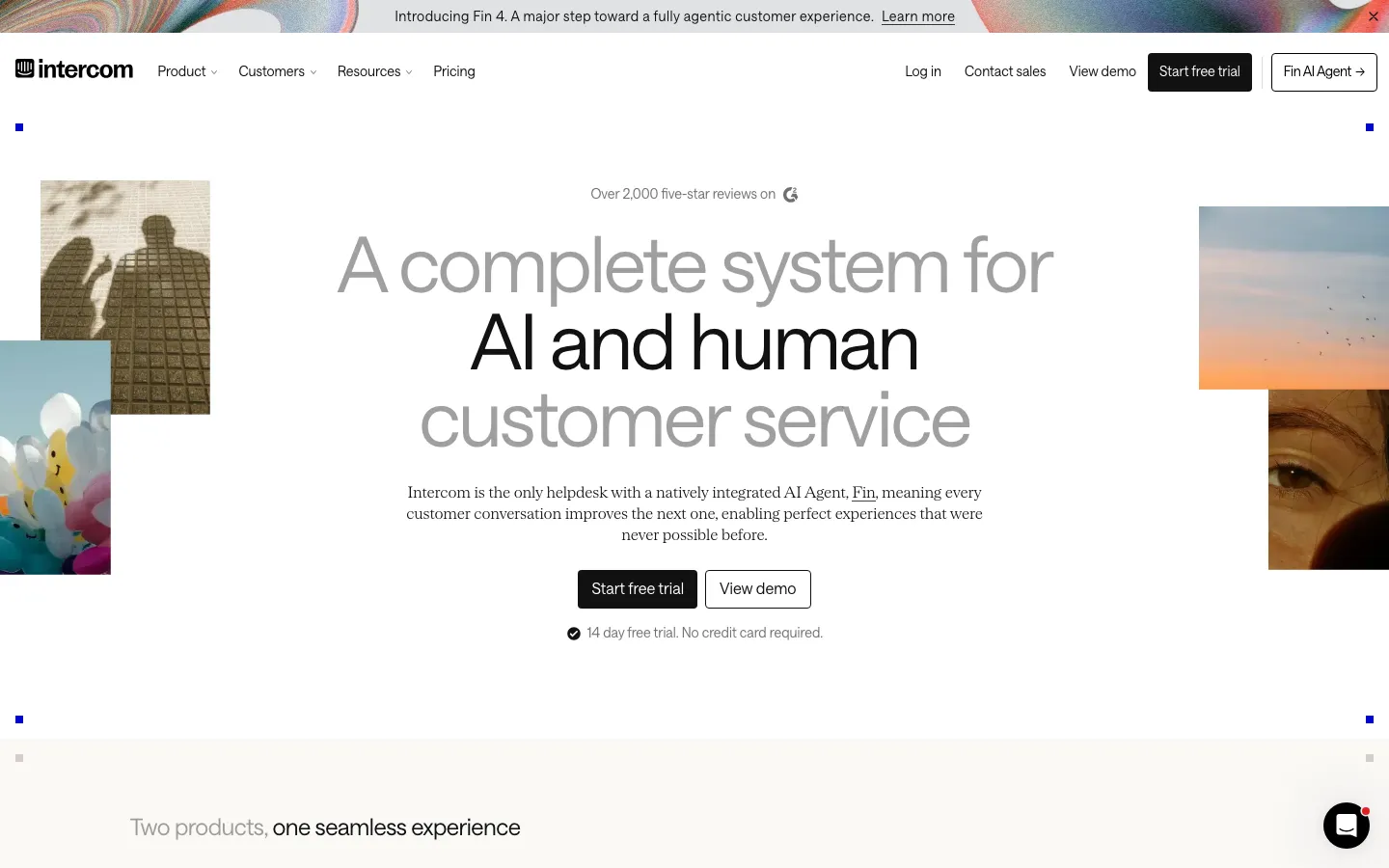
Intercom is the customer support system to choose when you want Fin AI Agent and your human team working from the same inbox, with Essential seats from $19 a month billed annually. Look elsewhere if you need one fixed monthly figure: Fin's standard rate is $0.99 per outcome, so the bill rises with resolved conversations and channel usage.
Agent access
- API
- Yes
- MCP server
- Official, hosted, OAuth (recommended) or Bearer token
- Works with
 ClaudeClaude Code
 Cursor
 VS Code
- Automation
- Zapier
What are the primary pros and cons of Intercom?
What works
- Fin AI Agent is available on every plan
- Seven support channels route into one inbox
- APIs, SDKs and 450+ connected apps
What to watch
- Fin adds $0.99 for each non-voice outcome
- Advanced rises to $85 per seat a month, billed annually
- Several useful features are paid add-ons
What support capabilities does Intercom provide for customer service teams?
Intercom organizes customer communications when inquiries cross multiple channels, require external data lookups, and escalate to human agents. Intercom brings that chain into a shared helpdesk: live chat, tickets, a help center and Fin work alongside the people answering customers. It belongs in the marketing tools directory because support conversations are also where product questions, sales handoffs and retention problems surface first.
The practical appeal is continuity. Email, live chat, phone, SMS, WhatsApp, Instagram and Facebook land in the same Inbox. When Fin passes a conversation to your team, the history remains with it. Tickets can cover customer issues, internal collaboration and tracker tickets for broader problems, while no-code workflows can route, snooze and close conversations.
I think Intercom makes most sense when consolidation is the objective. Its pricing is not a low flat fee: you pay for teammate seats, Fin outcomes and some communication channels. That arrangement rewards a team that knows where automation will do useful work, and it deserves a closer estimate before a large rollout.
Who gets the most value out of Intercom?
Small support teams
Start with one Essential seat, shared Inbox, live chat and Fin handling routine conversations.
Growing SaaS teams
Use Advanced workflows, multiple Inbox views and round robin assignment as request volumes grow.
Complex organizations
Expert brings SSO, HIPAA support, service agreements and multibrand Messenger to larger operations.
Teams with another helpdesk
Use Fin with an existing helpdesk, paying only for outcomes without platform seat costs.
The boundary is not team size alone. A small company with frequent, repeatable questions can have a stronger case than a larger one with unusual cases that always need a specialist. Estimate both the seats and the likely outcomes, then decide whether the combined system replaces enough separate tools.
What are the core ticketing and messaging features in Intercom?
Fin AI Agent
Fin can answer across chat, email, social, Slack and API. You can train it on a help center, website or PDFs, and connect sources including Notion, Confluence and Box. Its standard rate is $0.99 per outcome. Fin Voice is available through sales at $1.99 per voice outcome, checked 27 Nov 2026. Billing applies when a customer accepts Fin's answer, leaves the conversation without another request, or Fin completes a workflow. A request for a human, an unanswered issue or a reopened resolved conversation is not charged.
An inbox for AI and people
Every channel arrives in the same Inbox, rather than requiring an agent to reassemble the conversation from separate tools. Intercom also says instant translation lets agents support customers in more than 45 languages. Copilot is the separate inbox assistant for human agents: it pulls context and handles administrative work, while Workflows deal with repeated routing and closure.
Apps and custom work
Intercom connects to more than 450 apps, with integrations for Jira, Slack, Salesforce, Shopify and Stripe. For a team with its own workflow, the developer hub provides APIs and SDKs for customized helpdesk and Messenger experiences, plus a no-cost workspace for building and releasing an app. That is useful when account, billing or order context needs to appear beside the support request.
Help content and proactive support
Every plan includes a public help center. Advanced adds a private and multilingual help center. Proactive Support Plus is the optional layer for posts, checklists, product tours, surveys, series campaigns and mobile push. It gives a product-led team room to prevent a support request, but it is an additional workspace charge rather than a reason to assume the base seat price covers everything.
How does Intercom structure its subscription and resolution pricing?
Price checked 27 Nov 2026
| Plan detail | Essential | Advanced | Expert |
|---|---|---|---|
| Seat, billed annually | $19/mo | $85/mo | $132/mo |
| Seat, billed monthly | $29/mo | $99/mo | $139/mo |
| Fin AI Agent, excluding Voice | $0.99/outcome | $0.99/outcome | $0.99/outcome |
| Shared inbox and ticketing | ✓ | ✓ | ✓ |
| Public help center | ✓ | ✓ | ✓ |
| Free Lite seats | Not specified | 20 | 50 |
Intercom prices in US dollars, 27 Nov 2026.Intercom pricing
For a three-person team on Essential with annual billing, the fixed seat portion is $57 a month. Add 100 non-voice Fin outcomes and the month becomes $156 before any channel usage. That is the team bill to use as a planning baseline: it makes clear why seat price alone is not the useful comparison.
The published add-ons can move that number further:
- Copilot costs $29 per teammate a month billed annually, with 10 free Copilot and 10 AI Auto-translation conversations per agent each month
- Pro starts from $100 per workspace a month and includes Operator
- Proactive Support Plus starts from $99 per workspace a month
- WhatsApp, SMS, bulk email campaigns and phone usage have their own usage charges
There is a 14-day trial with no card required, including Fin and add-ons. Qualifying early-stage companies can apply for a program with up to 93% off.
When should enterprise organizations choose the Intercom Expert plan?
Intercom Expert caters to organizations that need advanced security, regulatory compliance, and brand governance beyond basic ticket volume increases. It adds SSO and identity management, HIPAA support, service level agreements, a multibrand Messenger and Help Center, plus 50 free Lite seats. Those are meaningful capabilities, but at $132 per paid seat a month billed annually, they are best justified by a clear operating requirement.
Where does Intercom fall short in budget predictability?
Intercom introduces internal financial friction because its hybrid seat and resolution-based pricing model can be difficult to forecast. Essential starts at $19 a seat each month on annual billing, but Fin outcomes, paid add-ons and some channels sit alongside it. Intercom offers spending limits and alerts for Fin, which helps, but your budget owner still needs an expected resolution volume before they can judge the likely total.
The gap between Essential and Advanced is also substantial: $19 versus $85 per paid seat a month on annual billing. Advanced adds workflow automation, multiple team inboxes, round robin assignment, a private multilingual Help Center and 20 Lite seats, so the upgrade can be warranted. It should be a deliberate decision, not something a growing team discovers after building its process around a feature it has not bought.
Finally, Fin can work with an existing helpdesk, but it does not turn Intercom into a zero-cost support experiment. The standard rate remains $0.99 per non-voice outcome and a minimum monthly commitment applies. Keep the existing platform only when the handoff and knowledge setup suit your support operation.
What are the most competitive alternatives to Intercom?
 If live chat is the starting point for your team, the JivoChat review is worth reading: JivoChat has a free plan and a built-in CRM, which may suit a team that needs chat and deal context before a broader helpdesk.
 The Kayako review is the more direct usage-pricing comparison. Kay costs $1 per resolved ticket, with no seat or setup fees, checked 27 Nov 2026, while Kayako One's full helpdesk price is not published.
Is Intercom the right support platform for modern teams?
Intercom presents a compelling solution for support teams seeking to unify human agent workflows and Fin automated ticket resolutions in one interface. Fin, the omnichannel inbox and the developer platform form a coherent system. A completed Procedure that hands a case to your team can still count as a billable outcome, while a direct request for a human or a failed resolution does not. The tradeoff is a bill with more moving parts than a seat-only support tool.
Start the 14-day trial with real help content, count the outcomes you would expect in a normal month, then price Essential against your actual team size before adding Copilot or proactive support.
How were the specifications and pricing for Intercom verified?
Intercom documentation, pricing calculators, helpdesk specifications, and developer portal pages were audited directly on 27 Nov 2026. Prices are in US dollars, as Intercom shows them, and every figure follows how we check figures.
- Intercom pricing page and calculator, annual and monthly billing
- Helpdesk and Fin AI Agent product pages
- Intercom developer documentation for APIs and SDKs
Where can teams find practical how-to guides for Intercom?
What are frequently asked questions regarding Intercom implementation?
How much does Intercom cost?
Essential starts at $19 per paid seat a month billed annually, or $29 monthly. Advanced is $85 per seat a month billed annually or $99 billed monthly, and Expert is $132 per seat a month billed annually or $139 billed monthly. Fin costs $0.99 per non-voice outcome on every plan, while Fin Voice costs $1.99 per voice outcome through sales.
What counts as a Fin outcome?
Fin is charged when a customer confirms resolution, does not ask for more help after its answer, or it completes a workflow. Intercom does not charge when a customer asks for a human, Fin cannot resolve the issue, or a resolved conversation reopens.
Is there an Intercom free trial?
Yes. The 14-day trial includes all features, Fin and add-ons. You only pay once you choose a plan and add payment details.
Can Fin work with another helpdesk?
Yes. Intercom says Fin can work with an existing helpdesk, including Salesforce, HubSpot or Freshdesk, for $0.99 per outcome and without seat costs. A minimum monthly commitment applies.
 Reviewed byDanny Kirk
Founder of ReddiReach.
 Checked byAndrés Felipe
Digital designer and marketer.
Every figure is checked against the vendor's own page. Read our editorial standards.