
Key Takeaways
- Kordiam equips newsrooms, broadcasters, and corporate communications departments to orchestrate editorial story runs, staff assignments, and multi-channel publication schedules centrally.
- Kordiam sets pricing starting at $263 monthly for up to five team members on monthly billing, reducing to $237 on annual terms.
- Kordiam maintains a robust read and write API, with official support roadmaps documenting planned Model Context Protocol server capabilities.
- Kordiam is ill-suited for businesses seeking low-cost content calendars, simple marketing schedulers, or lightweight workflows that do not warrant enterprise coordination.
Kordiam is the right pick when you run a newsroom or communications operation that has to coordinate stories, assignments and publishing across several channels every day. Skip it if you need a light marketing calendar or a low-cost plan for a tiny team: its first paid band is $263 a month for up to five users.
Agent access
- API
- Yes
- MCP server
- Not found on official pages
- Automation
- Zapier, Make, n8n
What are the core pros and cons of using Kordiam?
What works
- Story Cards hold tasks, channels, deadlines and supporting context together
- Every standard plan includes the full planning suite and standard integrations
- Pricing covers a team band, rather than charging for each individual seat
What to watch
- The entry band is $263 a month, before the optional support package
- As of 12 Nov 2026, support listed “MCP to come in 2026”; confirm availability before relying on it
- The product is built around editorial story flow, not SEO campaign planning
How does Kordiam coordinate cross-channel editorial newsroom operations?
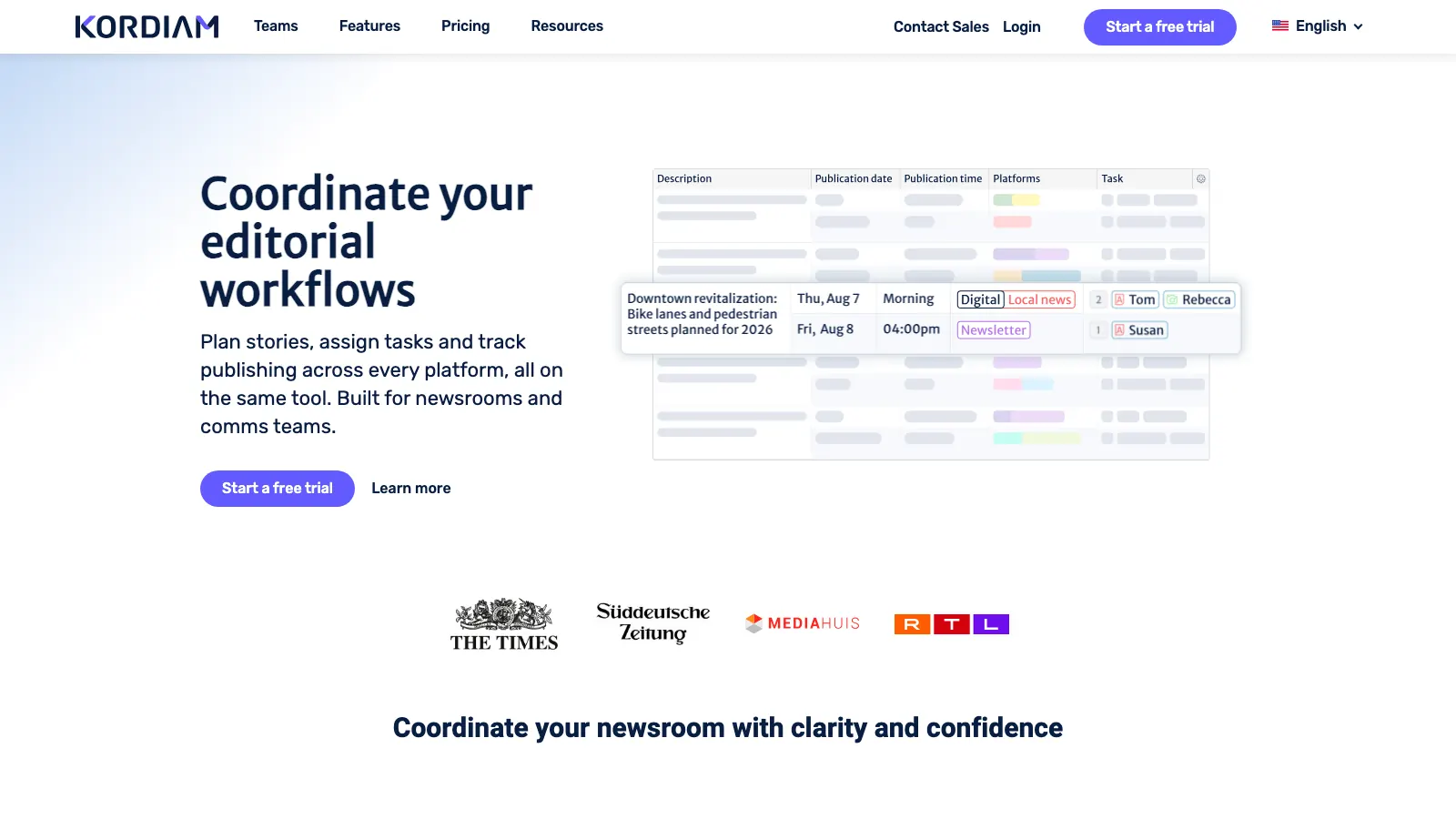
Kordiam turns the daily editorial run sheet into a shared operating space. Stories, tasks, platform destinations and publication work sit together, so an editor can see what must move today without reconstructing the plan from email and spreadsheets. It belongs in the marketing tools directory because communications teams can use it too, but its center of gravity is unmistakably the newsroom.
That distinction matters. Kordiam says it is built for newsrooms and communications teams, with planning across digital, print and other platforms. It was called Desk-Net until 2024, when the company renamed it Kordiam to reflect its broader content-coordination role. The product still organizes work around a story, rather than around a generic project board or a keyword list.
For the right operation, that is a useful constraint. The person assigning a reporter, the desk setting a publication slot and the producer checking a platform handoff can work from the same record. For a conventional content marketing team, the same focus can feel like too much machinery before a single brief is written.
Who is the ideal audience for Kordiam?
Digital newsrooms
Daily stories, assignments and publishing destinations need one shared planning view.
Magazine teams
Print and digital editions need coordinated schedules without separate planning silos.
Broadcasters
Fast-moving teams need story-level status, dates, approvals and platform destinations in one view.
Communications teams
Multiple departments need assigned work and progress visible across channels and publishing platforms.
I would not choose Kordiam just because your team publishes content. Choose it when stories move through an editorial desk, when several formats are live at once, or when staffing and publication timing have become the real coordination problem. A small blog, an SEO program led by search demand, or an agency handing work to clients needs a different center of gravity.
What story coordination and editorial features does Kordiam provide?
Story flow and planning views
The Story List is Kordiam's daily control surface. It tracks a story's workflow status, publication time, platform, owner and delays in one place. Teams can view multiple days or issues side by side, including channels that publish at different frequencies, then drag stories to a new day or slot as the plan changes. A monthly calendar gives a wider view and filters by platform or story status.
Story Cards and task context
The Story Card is the useful unit of work. Kordiam says it can hold tasks, platforms, connected events and deadlines, with attachments, versioning and location available in a side panel. That lets an assignment stay connected to the story it serves instead of becoming a disconnected task in another system. Editors can also define templates with the fields, defaults and production tasks a desk needs.
Staff coordination
Workload is not just a list of names. Kordiam's availability pages can show a day through a month, while shift management assigns users to coverage and can sync with calendar apps. For a newsroom that works nights, weekends or multiple desks, that makes the schedule part of editorial planning instead of a separate administrative exercise.
CMS and workflow integrations
Kordiam lists direct integrations with WordPress and Drupal, alongside editorial systems such as CUE, Aptoma and Livingdocs. Its wider integrations page also lists Slack, Zapier, calendar export, Okta SSO and story-list exports. Separately, Kordiam's support site documents connecting webhooks to automation tools. The important question is not whether an integration exists in the abstract, but whether it covers your publishing stack and the handoff you need. Confirm that before you commit to a workflow.
API for connected systems
The current API uses client credentials and bearer tokens, with separate read and write scopes. Its documentation covers stories and events, tasks, publications, users, platforms, custom fields, shifts and absences, which makes it a serious integration surface rather than a one-way export. As of 12 Nov 2026, Kordiam's support site listed “MCP to come in 2026”; confirm availability before relying on an MCP-based agent workflow.
How much does Kordiam cost across small and enterprise newsroom tiers?
Price checked 27 Nov 2026
| Plan detail | Extra-Small$263/mo | Small$588/mo | Medium$919/mo | Large$1,250/mo |
|---|---|---|---|---|
| Users covered | Up to 5 | 6 to 20 | 21 to 40 | 41 to 60 |
| Annual monthly equivalent | $237/mo | $529/mo | $827/mo | $1,125/mo |
| Full planning suite | ✓ | ✓ | ✓ | ✓ |
| Standard integrations | ✓ | ✓ | ✓ | ✓ |
Kordiam prices in US dollars, 27 Nov 2026.Kordiam pricing
This is team pricing, not seat pricing. A five-person editorial group pays $263 a month on monthly billing, which is the full bill for the plan before optional extras. Annual billing reduces it to $237 a month, a 10% reduction. That is a clean price structure if every person in the band works in the product; it is expensive when only one or two people need it.
- Unlimited freelancers with restricted access are included at no extra cost
- Portal and email support are listed with the standard plans
- The Support & Security Package adds 40% to the plan price
- A 30-day free trial or a sales demo is available, with no published free plan
What services does Kordiam Enterprise include for sixty or more users?
Kordiam Enterprise begins at sixty seats and requires custom quoting to accommodate large-scale media operations. The standard plan ladder is already broad enough for a large editorial group, so Enterprise is about a tailored rollout rather than a different everyday planning model. Kordiam lists custom training, phone support, custom testing and rollout scenarios, custom integration support and enhanced security features for this tier.
That makes sense when you are connecting a newsroom system to several other operational systems, or when the implementation itself needs a managed plan. It is not a reason for a smaller team to start with a quote. Start with the band that fits the people who will actively plan and publish, then adjust billing if the group grows beyond the limit.
Where does Kordiam show its practical workflow limitations?
Kordiam centers tightly on complex multi-channel editorial operations, which creates unnecessary complexity and cost for straightforward marketing teams. It centers on editorial planning. If keyword research, SEO optimization or client reporting is your main requirement, confirm those capabilities separately before choosing it. If your editorial calendar begins with search demand and ends with an organic performance report, make sure the surrounding tools and workflow cover that work.
The published entry cost deserves scrutiny too. $263 a month covers five users, so it can be sensible for an active five-person desk. It is much harder to justify for a two-person operation, especially when a support and security package adds 40%. The trial lets you evaluate fit, but it does not change the cost of the first paid band.
Finally, Kordiam has a documented API. As of 12 Nov 2026, its support site listed “MCP to come in 2026”, which does not establish current availability. Confirm availability before relying on MCP if automation is part of your buying decision.
What software solutions offer viable alternatives to Kordiam?
 Kordiam alternatives like AI Peekaboo are preferable for teams prioritizing artificial intelligence brand visibility analysis over newsroom scheduling. It has a read/write API and white-label delivery, which is a different job from newsroom planning. Read the AI Peekaboo review if AI visibility, rather than story flow, is the reporting problem you need to solve.
 The OmniBound review is the better next read when your question is AI citation visibility: OmniBound tracks the buyer questions that appear across ChatGPT, Perplexity, Gemini, Claude and Google AI Mode.
 The PathFactory review fits a different job, personalized content experiences for self-serve buyers while capturing first-party engagement data.
What is the final verdict on adopting Kordiam?
Kordiam provides an organized solution for media organizations managing live story flows, contributor assignments, and cross-channel distribution in one environment. The strongest case is a newsroom, broadcaster, magazine team or communications group with enough daily complexity to make a shared Story Card and staffing view valuable. For that reader, the team-band pricing and documented API are credible reasons to look closer.
Do not force it onto a small marketing team just because it has a calendar. Kordiam's value arrives when the plan is truly editorial and multi-platform. When search strategy, client reporting or AI answer visibility is the primary job, choose a tool designed around that work instead.
Run the 30-day trial with a real publishing week, include the people who assign, produce and publish, then compare the $263 monthly band with your current planning stack before moving to annual billing.
How was this Kordiam product review evaluated and confirmed?
Kordiam pricing tiers, seat allowances, API documentation, and product specifications were verified on 27 Nov 2026. Prices are in US dollars, as Kordiam shows them, and every figure follows how we check figures.
- Kordiam pricing and pricing FAQ pages
- Kordiam product pages for planning, staff coordination and integrations
- Kordiam API documentation and support pages
What are frequently asked questions concerning Kordiam?
Is Kordiam for newsrooms or marketing teams?
Kordiam is built for newsrooms and communications teams. Marketing teams can use it, but its planning model is centered on stories, assignments, publishing destinations and editorial workflows.
How much does Kordiam cost for a team?
Extra-Small is $263 a month for up to five users on monthly billing, or $237 a month with annual billing. Small is $588 a month for six to 20 users.
Does every Kordiam plan include the same features?
Kordiam says every plan includes the full suite of planning features and existing standard integrations. The plan bands primarily change with the number of users covered.
Does Kordiam have an API or MCP?
Kordiam documents a read/write API using client credentials and bearer tokens. As of 12 Nov 2026, its support site listed “MCP to come in 2026”; confirm availability before relying on it.
 Reviewed byDanny Kirk
Founder of ReddiReach.
 Checked byAndrés Felipe
Digital designer and marketer.
Every figure is checked against the vendor's own page. Read our editorial standards.