
Key Takeaways
- Mailforge gives outbound teams and agencies shared cold-email infrastructure to provision multiple domains and mailboxes with automated authentication setup.
- Mailforge charges $3 per mailbox slot per month on monthly billing with a 10-slot minimum, while a displayed .com domain example costs $14 per year.
- Mailforge lists API, MCP, and CLI capabilities for infrastructure management, though buyers should verify qualifying plan terms before building automated workflows.
- Teams should skip Mailforge if they require dedicated IP isolation, need transactional application email like Mailgun or Mailjet, or want fewer than 10 mailbox slots.
Mailforge is the sensible shared-infrastructure choice when you need several cold-email domains and mailboxes without setting up authentication records one by one. For application email delivery, the Mailgun review covers Mailgun's transactional email API and SMTP relay, while the Mailjet review covers Mailjet's API and SMTP relay for marketing and transactional email.
Agent access
- API
- Yes
- MCP server
- Official, hosted or local, Mailforge API key in the X-Mailforge-Key header
- Works with
 ClaudeClaude Code
 Cursor
What are the pros and cons of Mailforge?
What works
- DMARC, SPF, DKIM and tracking setup for each domain
- Bulk DNS updates, domain transfers and multiple workspaces
- Mailbox slots can be reused after a mailbox is deleted
What to watch
- Infrastructure uses shared IPs
- At least 10 mailbox slots are required
- Domains and masking add to the mailbox subscription
What does Mailforge do for your team?
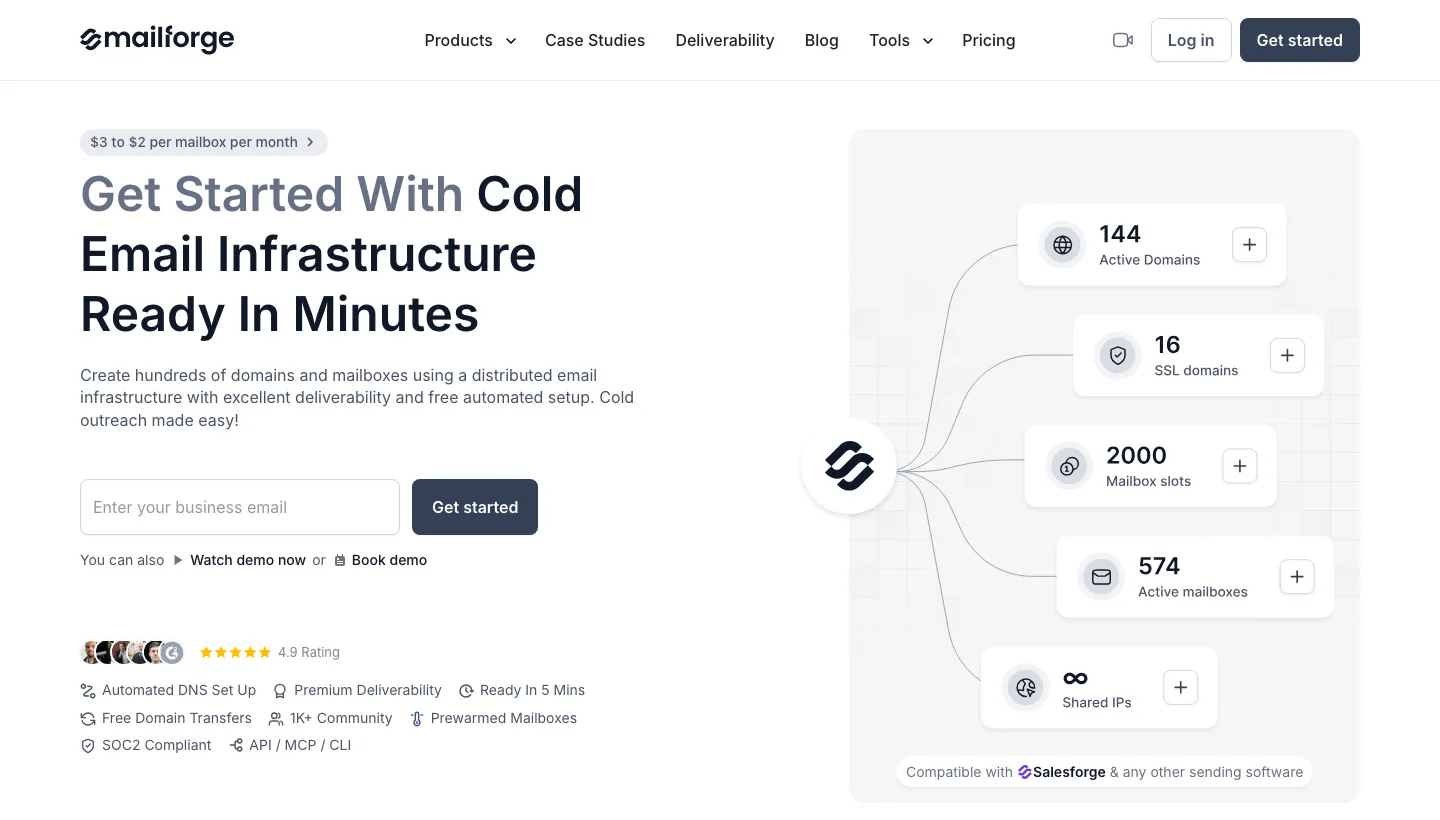
Mailforge gives an outbound team a place to provision cold-email domains and mailboxes on shared infrastructure. Its useful promise is consistency: when you add a domain, Mailforge says it configures DMARC, SPF, DKIM and custom domain tracking, rather than leaving somebody to repeat that work across every new sender.
That makes it a fit for the awkward middle ground between one mailbox and a dedicated infrastructure project. You can organize multiple workspaces, update DNS in bulk and transfer domains while keeping the operational work in one product. It also says it works with Salesforge and other sending software, so the infrastructure can sit behind the sending platform your team already uses.
The important distinction is shared IP infrastructure. That may be an acceptable trade for teams that value a simpler setup and known per-slot pricing. It is not a detail to skim past, because another sender on shared infrastructure is part of the environment your mailboxes operate in. The right decision depends on your outbound risk tolerance, not just the lowest displayed monthly figure.
Mailforge structures its pricing around reusable mailbox capacity and separate domain expenses rather than bundled user seats. Outbound teams start at a mandatory minimum of 10 mailbox slots billed monthly at $3 per slot per month, and those slots can be recycled whenever old mailboxes are deleted and new ones are created for external sending software. Domain registrations sit outside the slot fee in the pricing calculator, with a .com domain example priced at $14 per year, while optional SSL and domain masking adds $2 per domain per month. Across larger domain portfolios, automated provisioning handles DMARC, SPF, DKIM, and custom domain tracking alongside bulk DNS updates, though actual inbox placement still depends on sound campaign practices across Mailforge's shared IP environment. Engineering teams and agencies looking to automate mailbox and domain provisioning can connect through Mailforge's documented REST API and the official Forge MCP server. However, the reviewed public pages do not specify which subscription tier qualifies for programmatic access or whether any per-call charges apply, making pre-purchase verification essential.
Who is Mailforge best for?
Outbound teams
Teams managing several sending domains can centralize mailbox creation and authentication setup.
Agencies
Multiple workspaces and bulk DNS updates suit client infrastructure that needs orderly ownership.
Technical operators
API, MCP and CLI listings make it relevant where provisioning needs an automation path.
Growing campaigns
Reusable slots help when campaigns change and a mailbox needs replacing without another slot charge.
Mailforge is a poor fit for a team that only needs one or two mailboxes, since the minimum is 10 slots. It is also the wrong starting point when dedicated IP control is a non-negotiable requirement. In either case, decide on the infrastructure model first, then compare the actual cost of the delivery services around it.
What features does Mailforge include?
Authentication setup for each domain
Mailforge says it handles DMARC, SPF, DKIM and custom domain tracking for every domain added. Those records are central to authenticating a sender and measuring activity, but they do not turn a weak campaign into a good one. Treat the feature as a way to make your baseline setup repeatable, then keep the campaign, list and sending practices under active control.
Mailbox and domain planning
The pricing calculator asks for campaign inputs and shows the domains and mailboxes involved. That is more useful than a flat plan price because outreach infrastructure has two moving parts: capacity in mailbox slots and the domains attached to it. Model a modest first campaign before buying, rather than treating the calculator's example as a recommendation for your own volume.
Bulk administration
Bulk DNS updates, domain transferring and multiple workspaces are the operational features that make Mailforge more than a mailbox shop. They matter when one person must keep a growing portfolio legible. I would set a clear owner for each workspace and record which sending software uses each mailbox, because troubleshooting gets harder quickly once a domain moves or a campaign changes hands.
Sending-software compatibility
Mailforge names Salesforge and other sending software as compatible, and its site lists API, MCP and CLI access. That makes an automation path plausible, not guaranteed for every stack. Before relying on it, confirm how your chosen sender connects, which actions the interface exposes, and how the team recovers when an automation changes a mailbox or domain.
Reusable mailbox slots
Slots are the billing unit, not active mailboxes. Mailforge says a customer can delete a mailbox and create a new one without another charge because the account is charged for its number of slots. That is a practical cost control for a changing outbound estate, though it does not remove the need to budget for the minimum number of slots from the beginning.
How much does Mailforge cost?
Price checked 27 Nov 2026
| Cost detail | Published price | What it means |
|---|---|---|
| Mailbox slot | $3/slot/mo | Billed monthly |
| Mailbox minimum | 10 slots | Minimum purchase |
| .com domain example | $14/year | Charged separately |
| SSL and domain masking | $2/domain/mo | Optional add-on |
Mailforge prices in US dollars, 27 Nov 2026.Mailforge pricing
The ten-slot minimum makes the mailbox bill $30 a month before domains when you choose monthly billing. Mailforge also shows an annual-billing option: its displayed 25-mailbox example is $60 per month billed yearly, versus $75 per month billed monthly. For an example estate with three .com domains, the displayed domain price adds $42 per year. If you add SSL and domain masking to all three, it adds $6 a month.
- Mailbox capacity starts at 10 slots, not one active mailbox
- The calculator presents monthly and annual billing, but shows the annual example for 25 mailboxes
- Domains are priced separately from the slots, with the displayed .com example at $14 per year
- SSL and domain masking is optional and priced per domain, per month
Where does Mailforge fall short?
Mailforge makes shared IP infrastructure its central compromise. Mailforge compares its shared setup with private infrastructure and says shared servers carry the reputation of other users, for better or worse. That does not make Mailforge unusable, but it means a team that needs control over the infrastructure and security configuration should not pretend the two models are interchangeable.
The minimum changes the economics for a small test. You can replace mailboxes within the slots you already pay for, which is useful, but you still begin with 10 slots. Domain purchases sit outside that recurring bill, and masking adds another charge when you need it. A cheap-looking mailbox unit can become a different monthly commitment once you put a real estate behind it.
Mailforge lists API, MCP and CLI access. Confirm the actions, authentication and limits your team requires before making those interfaces part of an automation.
What are the best Mailforge alternatives?
 Mailforge differs from Mailgun, which serves developers as a transactional email delivery service with RESTful email APIs and an SMTP relay. Read the Mailgun review if your need is application email delivery rather than Mailforge's shared cold-email infrastructure.
 Mailjet offers a RESTful email API and SMTP relay for marketing and transactional email at any volume. Read the Mailjet review when that delivery use case is closer to your team's work.
Is Mailforge worth using?
Mailforge is worth considering when your job is to create and manage a controlled set of cold-email domains and mailboxes without repeating DNS work by hand. The best parts are the automated authentication setup, reusable slots and cost calculator. Its shared IP model and 10-slot floor are the reasons to pause before treating it as the default for every outbound team.
Start by pricing the smallest real campaign, including every domain and any masking you need. Confirm the sending-software connection and the automation controls, then use Mailforge only if shared infrastructure matches the way your team wants to manage delivery risk.
How was Mailforge verified for this review?
Mailforge's own home, pricing, deliverability, comparison, and help pages were checked on 27 Nov 2026. Prices are in US dollars as Mailforge displays them, and the calculations follow how we check figures.
- Mailforge home and pricing pages
- Mailforge deliverability and Mailforge versus
 Infraforge pages
- Mailforge help center pages
What are common questions about Mailforge?
What does Mailforge provide?
Mailforge provides shared cold-email infrastructure for domains and mailboxes, with automated DNS setup and compatibility with sending software.
How much does Mailforge cost?
Mailbox slots are $3 each per month on monthly billing, with a minimum of 10 slots. The displayed .com domain example is $14 per year.
What are Mailforge mailbox slots?
They are the billing unit for mailboxes. Mailforge says you can delete and create mailboxes without another charge while staying within the number of slots you pay for.
Is SSL and domain masking included?
No. Mailforge lists SSL and domain masking as an optional add-on at $2 per domain per month.
 Reviewed byDanny Kirk
Founder of ReddiReach.
 Checked byAndrés Felipe
Digital designer and marketer.
Every figure is checked against the vendor's own page. Read our editorial standards.