
Key Takeaways
- MarketMuse provides established editorial teams with site-level content auditing, personalized topic gap analysis, and comprehensive writing briefs.
- MarketMuse offers ten free monthly queries for one user while restricting full research and strategy packages behind private demos.
- MarketMuse features a ChatGPT integration and generative assistant for outlines but lacks public API or Model Context Protocol access.
- MarketMuse was acquired by Siteimprove in October 2024 and does not publish standard prices for its paid software tiers.
MarketMuse is the content strategy platform to choose when you need to decide what your existing site should create or update next, then hand writers a detailed brief. It was acquired by Siteimprove in October 2024. Skip it if a published paid price or a generous free workspace is non-negotiable: paid plans require a demo and Free allows 10 queries a month for one user.
Agent access
- API
- Not found on official pages
- MCP server
- Not found on official pages
What are the main pros and cons of MarketMuse?
What works
- Patented AI ties topic opportunities to your existing authority
- One site inventory on every paid package
- Nine brief types on the Strategy package
What to watch
- Paid pricing is not published
- Free has one user and 10 queries a month
- The first paid package has only 100 tracked topics
How does MarketMuse guide enterprise content planning and optimization?
MarketMuse replaces guesswork in editorial calendars by uncovering topic authority gaps rather than merely looking at simple search volumes. It is which topic your site can credibly cover next, what has decayed and where a competitor has left room. MarketMuse is built for that question. Its patented AI analyzes a content inventory, identifies topic clusters and points to quick wins based on the authority already on your site. It belongs in the marketing tools directory as a planning system before it is a writing assistant.
The workflow moves from research to a plan, then to a brief. MarketMuse says its plan documents identify content to create and update, along with the effort needed to address gaps. The brief gives writers a structure, related topics, questions and linking suggestions. That is a sensible division of labor for a team that has editors and subject experts, because MarketMuse gives them a case for the work without pretending the final article can run unattended.
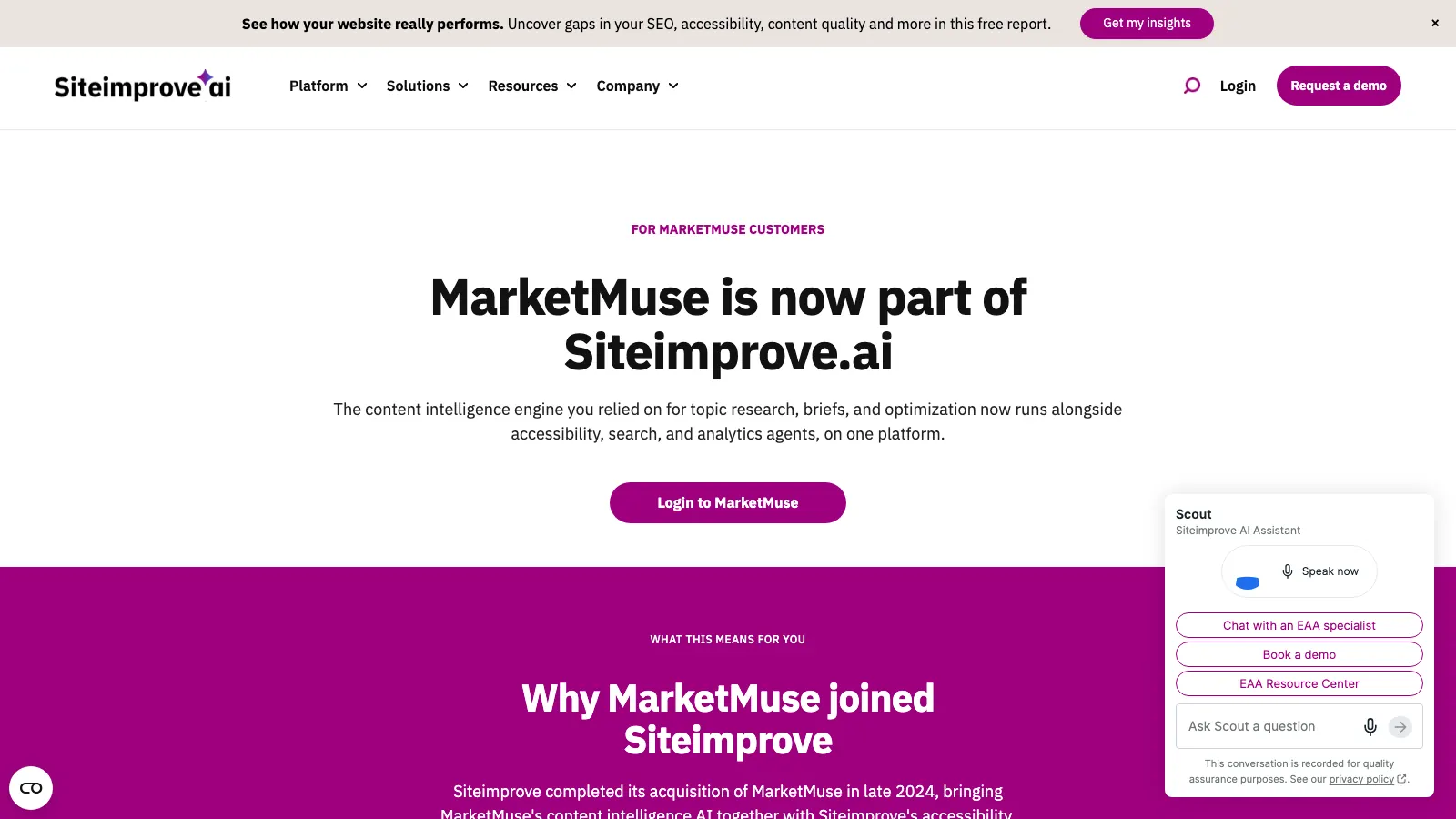
Siteimprove acquired MarketMuse in October 2024. The product still presents a focused content strategy stack, but the purchase matters if your team is deciding whether it wants a standalone specialist or a vendor relationship connected to a wider content process.
Who benefits most from adopting MarketMuse?
Content leads with a backlog
Use a site inventory and content plans to turn a large set of pages into priorities.
SEO teams building authority
Use personalized metrics to judge topics against the authority your domain already has.
Editorial teams using briefs
Give writers topic guidance, questions and internal-link suggestions before drafting starts.
Agencies planning at scale
Strategy supports 10,000 tracked topics, plus 20 briefs and five strategy documents per month.
I would put MarketMuse in front of a team with enough existing content for prioritization to matter. The paid packages each include one site inventory, which is the feature that makes the product more than a single-article editor. A solo writer with a small site is unlikely to get much from a plan capped at one user, 10 free queries and no inventory.
What content strategy and research features does MarketMuse provide?
Personalized topic opportunities
MarketMuse uses your content inventory to identify high-value topic clusters and quick wins based on existing authority. Its planning pages frame this as a way to prioritize what to create and update against both your content performance and the search results. That is the strongest reason to pay for it: the recommendation is meant to be specific to the content you already own, not a generic list of keywords.
Inventory and content plans
Paid packages list one site inventory. Optimize covers 100 tracked topics, Research 1,000 and Strategy 10,000. The same progression raises Content Strategy Documents from one to three to five a month. Those limits make the package choice fairly clear: Optimize is a regular publishing plan, Research gives a small team room to map a serious topic area, and Strategy is for a larger planning operation.
Briefs that fit the assignment
MarketMuse has templates for articles, product reviews, comparisons, FAQ collections, how-tos, guides, local pages, listicles and news or event coverage, plus an Optimize brief for existing content. Optimize and Research list Article Briefs, while Strategy lists all nine brief types. The brief also supplies related topics, questions and linking suggestions. That is useful when an editor needs a repeatable handoff, but it does not remove the need for subject knowledge or an editorial review.
Competitor and SERP analysis
MarketMuse says it finds gaps in competitors' content and identifies topics they missed. Its published plans list Keywords, SERP x-ray and SERP Heatmap, with Site Heatmap and Connect. The product also offers one-to-one comparisons between a page and a top-ranking page, which is the practical feature to use when you are improving a specific article rather than setting a quarterly plan.
Optimize and MarketMuse AI
Optimize is where the planning work meets a draft. It evaluates topical depth and gives personalized improvement insights for existing content. MarketMuse AI adds generative help inside that workflow: it can create outlines and expand or shorten content, and MarketMuse introduced a ChatGPT connection in 2023. Treat that as writing assistance, not a substitute for the strategy and editorial judgment that make the inventory useful in the first place.
How is MarketMuse priced across plans?
Price checked 27 Nov 2026
MarketMuse publishes the plan limits but not the cost of Optimize, Research or Strategy. Free costs nothing, while the paid plans have no published price. That means there is no defensible team bill to calculate before a demo, so get a written quote for your users, tracked topics and brief volume before comparing it with a known-price tool.
| Plan detail | Free$0/mo | OptimizeDemo | ResearchDemo | StrategyDemo |
|---|---|---|---|---|
| Users | 1 | 1 | 3 | 5 |
| Queries | 10/mo | 100/mo | Unlimited | Unlimited |
| Site inventory | ✕ | 1 site | 1 site | 1 site |
| Tracked topics | None | 100 | 1,000 | 10,000 |
| Content Briefs | None | 5/mo | 10/mo | 20/mo |
| Brief types | None | Article | Article | All 9 |
| Strategy Documents | None | 1/mo | 3/mo | 5/mo |
MarketMuse plan limits, checked 27 Nov 2026.MarketMuse pricing
There are no published seat add-ons, annual discounts or enterprise rates to add to that table. Do not mistake the free tier for a trial of the paid workflow: it has no site inventory, tracked topics, briefs or strategy documents. It is a small research allowance, not a way for a team to validate the full planning system.
Where does MarketMuse fall short for content teams?
MarketMuse creates practical procurement friction because it omits transparent public pricing across its primary paid tiers. You can see the ceilings for users, topics, briefs and strategy documents, but not the monthly bill that turns those limits into a buying decision. A team of three might look naturally at Research, yet the vendor gives no public cost to compare with the time it intends to save. That makes the demo part of the purchase, rather than an optional last step.
The free package is also too narrow for a serious pilot. Ten queries, one user and no site inventory means it cannot show the site-level prioritization that distinguishes MarketMuse. Start there only to see whether its research interface matches the way your team thinks. For a real evaluation, ask the vendor how the inventory, brief allocation and strategy documents apply to your own editorial volume.
Finally, MarketMuse AI can shape outlines and revise text, but the product remains centered on strategy, briefs and optimization. Teams looking for a simple AI writer may find the planning framework heavier than they need. Teams looking for agent-ready data should also verify access in writing, because the published package comparison does not list API or MCP access.
What are the best alternatives to MarketMuse?
 MarketMuse alternatives like AI Peekaboo assist teams focused on brand visibility inside artificial intelligence answers rather than traditional organic search content. Its plans start at $30 a month and include an API, MCP access and Looker Studio. The AI Peekaboo review explains where that reporting workflow stops and a writing process begins.
 QuillBot's free paraphraser is capped at 125 words and offers Standard and Fluency modes, making it a focused option for revising a passage rather than planning a site.
 Rytr Create is a writing assistant with 40+ writing use cases, and its Free plan includes 10,000 characters per month. Read the QuillBot review or the Rytr review if drafting is the immediate bottleneck. Neither replaces the question MarketMuse answers best: what should this site work on next?
What is the final verdict on MarketMuse?
MarketMuse helps established websites defend content roadmaps by integrating site inventory, personalized topical authority gaps, and writers briefs into one workflow. I would not buy it sight unseen, because the price is hidden and the free plan cannot demonstrate the core inventory work.
Book the demo only after listing the site, people and monthly brief volume you need. Ask for the paid price, the exact included inventory and the access available for automation, then choose MarketMuse if its strategy documents become part of your regular planning rhythm.
How was this MarketMuse review researched and verified?
MarketMuse official pricing documentation, product overviews, content planning resources, brief guides, and corporate disclosures provided the source data on 27 Nov 2026. Alternative facts are checked against their own vendor pages or approved reviews. Prices use the currency the vendor publishes, and every figure follows the rules in how we check figures.
- MarketMuse pricing and plan comparison
- MarketMuse pages for content planning, briefs and Optimize
- MarketMuse company page for product history and acquisition
What are the most common questions about MarketMuse?
What is MarketMuse?
MarketMuse is a content intelligence and strategy platform. It analyzes a content inventory, identifies topic opportunities and gaps, creates content plans, and gives writers structured briefs.
How much does MarketMuse cost?
Free is $0 a month for one user and 10 queries. MarketMuse does not publish prices for Optimize, Research or Strategy, and each paid tier directs buyers to book a demo.
Does MarketMuse create content?
MarketMuse AI can create outlines and expand or shorten content. The broader product is still organized around research, planning, briefs and optimization, so a team still needs editorial judgment for the finished work.
Is MarketMuse useful for a small site?
It is a harder case for a small site. The paid value comes from a site inventory and personalized planning, while Free has no inventory and only 10 monthly queries. A small team should establish its needs in the demo before committing.
 Reviewed byDanny Kirk
Founder of ReddiReach.
 Checked byAndrés Felipe
Digital designer and marketer.
Every figure is checked against the vendor's own page. Read our editorial standards.