
Key Takeaways
- Portfolio agencies and multi-brand enterprises implement NinjaCat to normalize complex marketing data streams and automate client performance dashboards across hundreds of accounts.
- The pricing structure of NinjaCat is entirely customized, requiring prospective buyers to complete direct product demonstrations and scoping reviews rather than selecting self-serve plans.
- Built-in AgentOS features within NinjaCat unite automated reasoning agents with structured account data to streamline reporting validation, campaign pacing, and budget anomaly alerts.
- Growth agencies should pass on NinjaCat if their analysts demand immediate self-serve onboarding, transparent pricing tiers, or lightweight reporting for modest account portfolios.
For a multi-account marketing team reconciling fragmented sources before every client report, NinjaCat is the best fit when you need governed data, reusable reporting and AI agents across the portfolio. Choose a different tool if you need a published price or self-serve trial, because NinjaCat starts with a demo and quotes each deployment.
Agent access
- API
- Yes
- MCP server
- Not found on official pages
- Automation
- Zapier
What are the main advantages and drawbacks of NinjaCat?
What works
- One Data Cloud for marketing data across connected accounts
- Reusable report templates with white-labeling and roll-up reporting
- AI agents for reporting, QA, pacing and anomaly alerts
What to watch
- No public price or self-serve trial
- No published team bill to compare before a demo
- Enterprise SLA terms are not published
How does NinjaCat automate enterprise marketing reporting and data pipelines?
NinjaCat makes most sense when reporting is no longer a file-by-file job. It gathers marketing data into a Data Cloud, gives agents a governed source to work from, and turns one report layout into deliverables for many accounts. That puts it in the marketing tools directory as a platform for teams whose reporting and data work have become one operational problem.
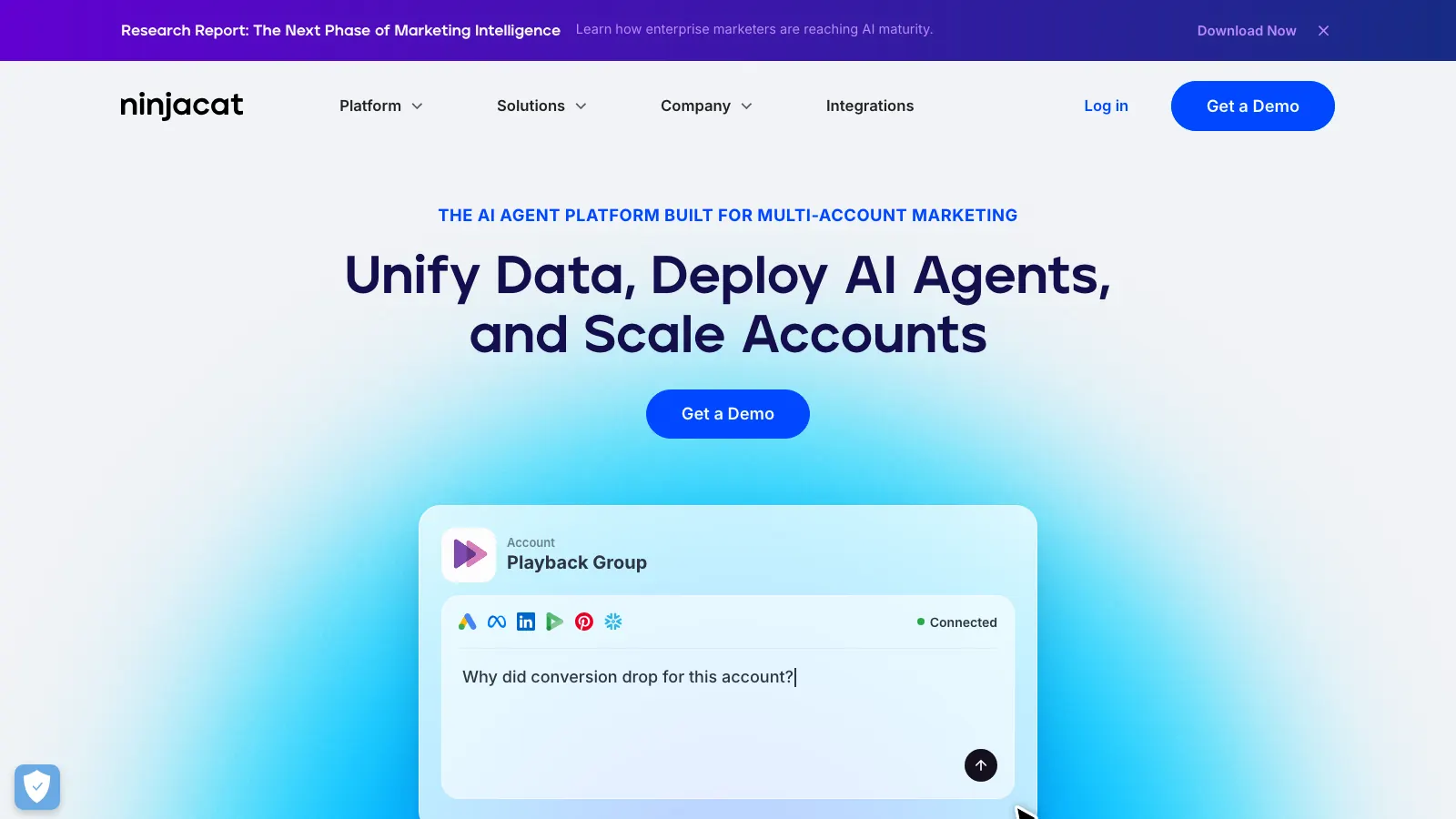
The product has four connected parts. Data Cloud brings paid, social, web, CRM and offline marketing sources into a unified marketing data foundation. AI Agents work against that foundation. Generative Data Apps let people ask questions in plain language and create interactive dashboards. Reporting packages that work into stakeholder-ready reports.
That combination is persuasive for a team that loses time reconciling sources before it can explain results. It is less persuasive if your reporting process is already simple: NinjaCat asks you to begin with a demo, while its public site leaves the commercial terms to the conversation.
Which marketing teams and agency models are best suited for NinjaCat?
Multi-account agencies
Run shared reporting, QA and pacing work across a broad client portfolio from repeatable account data.
Portfolio marketing teams
Roll up performance across brands while keeping the account detail available for each operating team.
Multi-location marketers
Combine location-level accounts with a brand view, then report performance without rebuilding the reporting structure.
Analytics leaders
Give stakeholders governed data and self-serve apps without sending every question through the analytics team.
I would not start with NinjaCat for a single small client or a team that only needs a few scheduled PDFs. Its strongest published capabilities assume many accounts, multiple sources and a workflow worth standardizing. The absent price means a smaller operation cannot establish fit from a plan comparison alone.
What data warehouse and automated reporting capabilities does NinjaCat provide?
Data Cloud
Data Cloud is the layer that centralizes, normalizes and activates marketing data. NinjaCat lists native and custom connectors, no-code and chat-driven transformations, daily syncs and up to two years of historical backfill where the source supports it. It can feed NinjaCat Reporting and AI Agents, or deliver governed tables to destinations including Tableau, Looker Studio and BigQuery. That is the feature to examine first, because it determines whether the account data your team needs can become comparable.
AI Agents
NinjaCat's AgentOS is built around agents that use the account context and governed data behind them. The public library lists agents for campaign monitoring, reporting, budget optimization, data management, SEO and other marketing work. The platform says agents can handle reporting, QA, pacing and anomaly alerts, leaving a person to approve rather than assemble. A published customer case study describes moving from manually checking 50 clients twice a week to monitoring 200 accounts daily.
Generative Data Apps
Generative Data Apps are for the question that does not fit an existing dashboard. You describe the result in plain English and build an interactive dashboard, report or app on the Data Cloud. NinjaCat also says technical users can view and customize the SQL, transformation logic and visualization code. That makes the feature useful when business users need answers quickly but the analytics team still needs visibility into what was built.
Reporting and client presentation
The reporting layer starts from a master template, then generates reports for clients, brands or regions from it. NinjaCat publishes a template gallery, white-labeling for reports, dashboards and emails, and roll-up reporting across accounts. Agencies can also include agency fees in metrics such as CPC or CPM. The important distinction is that it treats the report as a repeatable client deliverable, not just a screen for monitoring a campaign.
Connections and delivery
NinjaCat publishes 150+ pre-built connectors, including Google Ads, Meta and Snowflake, plus custom connectors for unusual sources. The integrations page also lists native connections for Google Analytics 4, Google Sheets, Microsoft Ads, LinkedIn, Google Search Console, CallRail and Google My Business. A large connector count only matters when the connections match your stack, so make the demo prove the sources, fields and destination your reporting process depends on.
How does NinjaCat price its customized enterprise marketing packages?
Price checked 27 Nov 2026
| Plan detail | Quoted scopeCustom |
|---|---|
| Published price | Not published |
| How to evaluate | Book a demo |
| Pricing drivers | Data volumes, destinations and users |
| Available capabilities | Data Cloud, AI Agents, Generative Data Apps, reporting and custom connectors. Confirm scope in the quote. |
NinjaCat publishes custom pricing, 27 Nov 2026.NinjaCat website
NinjaCat does not state a starting plan or per-seat rate, and it does not offer a self-serve trial. Data Cloud pricing reflects data volumes, destinations and users, so the quote should name each driver before your team compares it with a lower-complexity reporting product.
- How many connected sources, accounts and destinations the quote covers
- Whether historical backfill and daily syncs apply to every required source
- Which agents, report templates and custom connectors the deployment includes
Where does NinjaCat fall short for smaller marketing teams?
NinjaCat's missing price is a real limit, not a small footnote. A buyer cannot compare a team bill, test the setup alone or see which capabilities move them to a higher tier before speaking to sales. That is workable when the team already knows it needs a data and reporting platform, but awkward when you are still deciding whether the process merits one.
Some product details also need to become contract details. NinjaCat presents Data Cloud, agents, reporting and custom connectors together, but it does not publish an entitlement table showing which package includes each item. Enterprise SLA terms are not published, so confirm the contracted support commitments, exact scope, delivery commitment and onboarding work in writing.
Finally, breadth can be a distraction. A data layer, agent library and reporting system are valuable when they replace repeated work across accounts. If the team only needs reporting from a familiar set of platforms, a simpler tool may leave fewer operational decisions to make.
What platforms are the best alternatives to NinjaCat?
 NinjaCat alternatives such as AI Peekaboo address brand visibility in AI answers rather than cross-channel dashboards, starting at $30 monthly with MCP connectivity. The AI Peekaboo review explains what agency delivery adds.
 The Octoboard review is useful if a white-label client portal matters, which its Business and Agency Marketing Analytics starting plans list.
 The ReportGarden review suits agencies that need a white-labeled portal with their own branding and domain. Compare those client-presentation options with the NinjaCat demo before choosing.
Is NinjaCat the right enterprise reporting solution for your agency?
NinjaCat earns a demo when multiple accounts and fragmented sources are forcing your team to rebuild the same reporting and analysis work. Its clearest strength is the connection between normalized data, reusable reports and agents that can watch for problems across the portfolio. Do not treat it as a default reporting subscription: without a public price or trial, the vendor needs to prove the deployment is narrower and more useful than a broad platform pitch.
Bring a real account list, source inventory and report example to the demo. Ask NinjaCat to map each to the quote, then compare that scope with the manual work it would remove before you commit.
How were NinjaCat capabilities and platform features validated?
NinjaCat specifications for Data Cloud, AgentOS, analytics connectors, and client portals were gathered from official vendor documentation on 27 Nov 2026. The vendor publishes custom pricing rather than plan figures, and every figure in this review follows how we check figures.
- NinjaCat product and Data Cloud pages
- NinjaCat AI Agents and Generative Data Apps pages
- NinjaCat reporting, integrations and support pages
What are frequently asked questions regarding NinjaCat deployments?
How much does NinjaCat cost?
NinjaCat does not publish a plan price. It asks buyers to book a demo, and says Data Cloud pricing reflects data volumes, destinations and users.
Is there a NinjaCat free trial?
No self-serve trial is published. NinjaCat starts evaluation with a demo conversation.
What do NinjaCat AI agents do?
NinjaCat presents agents for tasks including campaign monitoring, reporting, QA, pacing and anomaly alerts, using governed account data.
Which integrations does NinjaCat support?
NinjaCat publishes 150+ pre-built connectors, including Google Ads, Meta and Snowflake, and says it offers custom connectors for unusual sources.
Can NinjaCat create white-label reports?
Yes. Its reporting pages describe branding for client-facing reports, dashboards and emails, alongside reusable templates and roll-up reporting.
 Reviewed byDanny Kirk
Founder of ReddiReach.
 Checked byAndrés Felipe
Digital designer and marketer.
Every figure is checked against the vendor's own page. Read our editorial standards.