
Key Takeaways
- Klaviyo unifies customer behavioral data, omnichannel marketing campaigns, and customer service operations for retail and ecommerce brands managing ongoing buyer relationships.
- Klaviyo pricing provides a free tier covering up to 250 active profiles and 500 emails, scaling to twenty dollars monthly for 500 customer profiles.
- Klaviyo delivers automated email flows, mobile messaging, segmented retail analytics, and custom enterprise deployments for organizations managing more than 150,000 active customer profiles.
- Klaviyo supports autonomous AI client implementations through documented developer APIs and a dedicated Model Context Protocol server for account data synchronization.
Klaviyo is the strongest fit when your retail team needs customer data, marketing messages and service in the same system, rather than another email sender. Start free while your reachable audience is under 250 profiles, then model the paid bill against your active audience before you build your core flows. It is a less natural choice if your work is outbound prospecting, not customer relationships.
Agent access
- API
- Yes
- MCP server
- Official, hosted or local, OAuth with dynamic client registration for remote; private API key for local
- Works with
 Claude
 ChatGPT
 Cursor
 VS Code
- Automation
- Zapier
What are the core pros and cons of Klaviyo?
What works
- No-cost tier allows 250 active profiles and 500 monthly emails
- Customer data, marketing and service sit in one platform
- More than 400 integrations, plus APIs and webhooks
What to watch
- Your charge follows reachable, active profiles
- SMS and MMS are paid add-ons after the free allowance
- Data warehouse sync is listed only on Custom
What does Klaviyo do for ecommerce marketing teams?
Klaviyo makes most sense when the real task is keeping an existing customer relationship moving. Its B2C CRM brings marketing automation, analytics, service and a data platform together, so the person planning a campaign and the person handling a support conversation can work from one customer record. For a team comparing the wider marketing tools directory, that is the distinction worth paying attention to: it is built around the customer after they arrive, not the lead before they do.
The platform places email, SMS, WhatsApp, RCS, mobile push and social marketing alongside Customer Hub, reviews and service tools. Klaviyo says its platform brings together live behavior, transaction and engagement signals, then makes profiles and segments available across those products. That is useful when an abandoned-cart message, a service answer and a post-purchase sequence should reflect the same recent activity.
I would not choose it merely because it offers many channels. The useful reason is the shared operating model: fewer handoffs between a storefront, messaging platform and support desk. That payoff grows with a store that has repeat buyers and enough activity to make segmentation matter.
Who is Klaviyo best designed for in retail and ecommerce?
Growing ecommerce stores
Run email and mobile programs from activity while keeping commerce data connected to profiles.
Lifecycle marketing teams
Coordinate acquisition, post-purchase and retention messages using segmentation built from each reachable customer record.
Service-led retail brands
Give marketing and support one customer view when orders and follow-up requests need context.
Technical marketing teams
Use documented APIs, webhooks and MCP when tools or AI clients need account data.
It is a poor fit for a sales team whose job starts with cold outreach. For that workflow, the paid tiers and profile accounting solve the wrong problem.
Where does Klaviyo earn its place in an ecommerce tech stack?
Customer data that feeds the work
Klaviyo Data Platform combines behavioral, transactional and engagement data, and the product exposes profiles and segments as part of that foundation. That makes its marketing automation more useful than a standalone campaign calendar when your next message depends on what a customer browsed, bought or ignored. The data layer is the reason the product is most compelling to B2C teams with a connected store, not a generic marketing department.
Messaging and automation across channels
Campaigns can span email, SMS, WhatsApp, RCS, mobile push and social marketing. The integration catalogue says Klaviyo can trigger emails, texts, push notifications and other communications from profile data and customer activity. Start with the channels your team will actually operate. Adding every possible channel before you have a clear lifecycle makes a large platform feel busy rather than useful.
Composer and Customer Agent
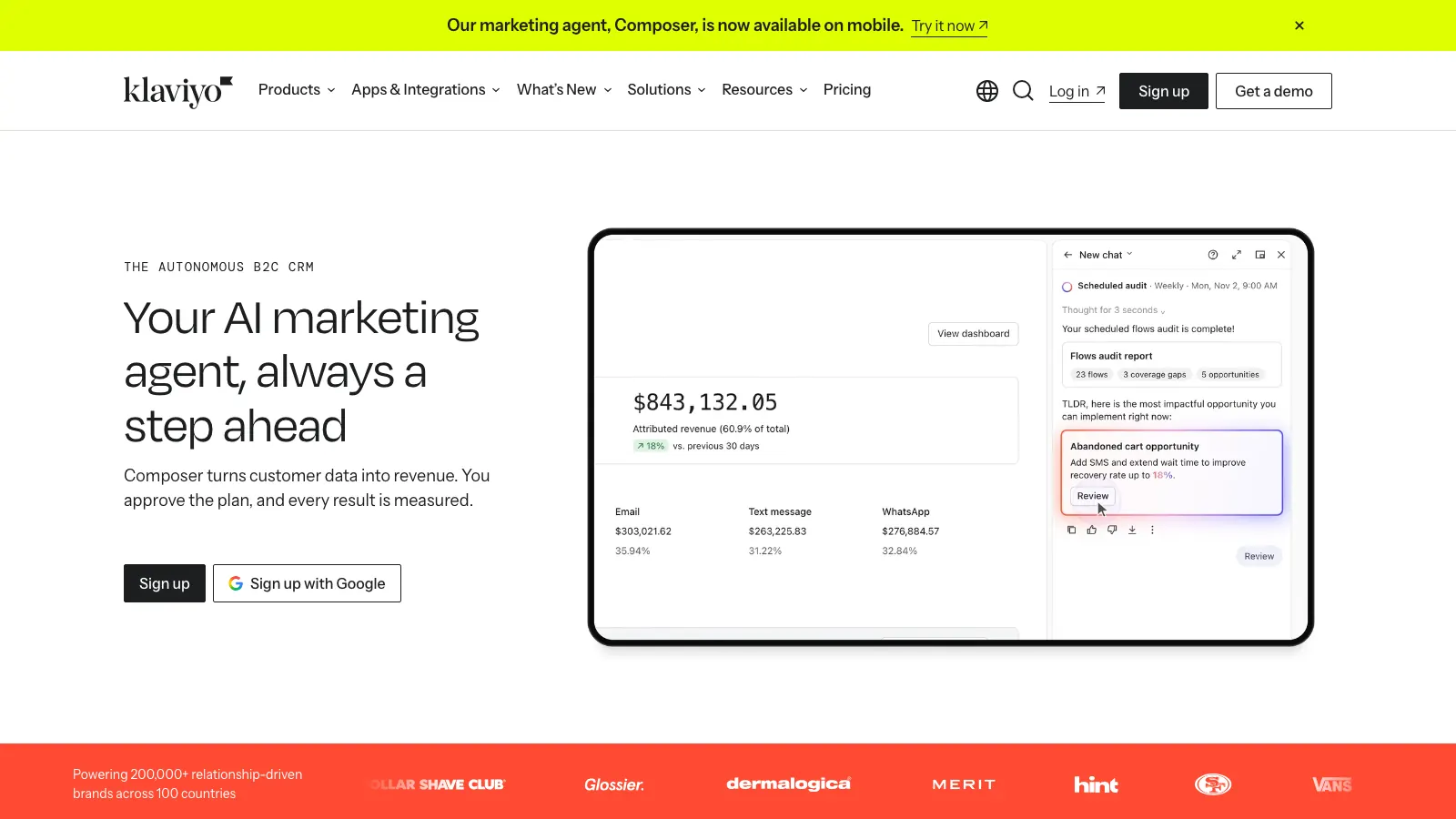
Composer is Klaviyo's marketing agent, designed to spot an opportunity in customer data and plan personalized campaigns across channels for your approval. Customer Agent is the service counterpart: the vendor says it is pre-trained on the brand on day one and customizable with skills. The free plan includes $5 of Composer usage and 10 Customer Agent resolutions each month, enough to see the products in context but not enough to treat either as unlimited capacity.
Integrations and custom connections
Klaviyo lists more than 400 integrations, including  Shopify, WooCommerce, BigCommerce, Adobe Commerce, Salesforce Commerce Cloud and
 Wix. Its integration pages also describe open APIs and webhooks for custom connections. That range is valuable when your commerce stack is already established, but keep the decision simple: confirm the specific data your storefront and support tools need to pass before making a migration case.
API and MCP for AI clients
The developer documentation covers APIs, SDKs, OAuth, webhooks and test accounts. Klaviyo also documents an MCP server that connects an AI client to Klaviyo APIs, with examples such as reviewing campaign performance, finding the best-converting flows and creating a campaign. The documentation does not publish plan eligibility for MCP, so ask before treating it as a guaranteed inclusion in a paid rollout.
How does Klaviyo calculate its profile-based pricing?
Price checked 27 Nov 2026
Klaviyo bills Profile and Email plans by active profiles, meaning reachable contacts. Unsubscribed and suppressed contacts do not count, and each profile tier includes an email-send allowance. That is a fairer model for a well-maintained list, but it means your cost is driven by audience size.
| Plan detail | Free$0 | Email$20/mo | Marketing$25/mo | CustomQuoted |
|---|---|---|---|---|
| Active profiles shown | 250 | 500 | 500 | Over 150,000 |
| Email sends each month | 500 | 5,000 | 5,000 | Custom |
| Social marketing | 250 profiles | Add-on | 500 profiles | Custom |
| Customer Agent | 10 resolutions/mo | Add-on | Add-on | Custom |
| Helpdesk | 10 tickets/mo | Add-on | Add-on | Custom |
Klaviyo prices in US dollars, 27 Nov 2026.Klaviyo pricing
The $20 Email tier is the published starting point for a 500-profile, 5,000-email account. Marketing is $25 for the same profile and email limits, and its table includes social marketing for 500 profiles, reviews without an order limit and Customer Hub for 500 profiles. Mobile messages are separate: the free plan has $5 of messages, while paid plans list SMS and MMS as add-ons.
There is no per-seat figure in the published pricing table, so do not invent a team bill from it. The bill you can establish is $20 a month for the Email plan at 500 active profiles, before mobile messaging and other add-ons. For month-to-month customers, flexible sending can cover temporary peaks, and auto downgrade can move an eligible account down after profile cleanup.
What does the Klaviyo Custom tier add for high-volume brands?
Custom is the route Klaviyo publishes for organizations above 150,000 active profiles or several brands. It lists volume pricing across products, customizable analytics and attribution, advanced data management, enterprise security and compliance, data warehouse sync and personalization. Those are real enterprise capabilities, but the price is not public, so the practical next step is a scoped quote rather than a budget estimate.
Where does Klaviyo fall short for outbound sales teams?
Klaviyo profile pricing represents the biggest trade-off. A big database filled with people you can still reach is not a harmless archive, it is the basis of the bill. Suppression and hygiene become financial choices as well as deliverability choices. Teams that cannot keep a close eye on their reachable audience should set expectations before a rapid acquisition campaign changes the tier.
The platform also makes it easy to confuse a visible feature with an included one. Composer, mobile messages, Customer Agent, Helpdesk and Customer Hub all have different allowances or add-on positions across the table. The Custom plan is the only published place for advanced data management and data warehouse sync. Put every required product in the commercial conversation, rather than pricing only the email tier.
Finally, the MCP server is documented, but Klaviyo does not state which subscription includes it. That is not a reason to dismiss the integration, but it is a reason to make plan entitlement a written requirement if agent access is central to your implementation.
What are the primary alternatives to Klaviyo?
Price checked 27 Nov 2026
 AI Peekaboo is worth considering when the job is measuring how a brand appears in AI answers, rather than running customer marketing. Its paid plans start at $30 a month and include a read and write API, while its AI Peekaboo review explains its reporting and crawler features.
 Klenty starts at $50 a month billed annually with unlimited users for core email sequencing, or Growth is $70 per user per month, billed annually, for multi-channel outreach and CRM. Read the Klenty review if sales engagement, calling and sequences for prospects are the actual requirement.
 Landbase gives 1,000 free credits with no expiry before its $499 monthly paid bundle, and uses credits for enrichment and AI qualification. The Landbase review is the more relevant comparison when pipeline creation comes before lifecycle marketing.
What is the final verdict on Klaviyo?
For a retail team, Klaviyo's appeal is the shared customer record behind marketing and service. The free tier is a credible place to establish the connection, and the paid tiers are clear enough to model once you know the active audience. Do not mistake that clarity for a flat-rate price: growth in reachable profiles and add-ons will shape the bill.
Connect your storefront on the free tier, map the customer moments you will automate, then price the Email and Marketing plans at your expected active-profile count before committing to mobile or AI add-ons.
How was Klaviyo evaluated for this review?
Prices, limits and capabilities above come from Klaviyo's own product, pricing, integration and developer pages, read on 27 Nov 2026. Prices remain in US dollars as the vendor presents them, and every figure follows how we check figures.
- Klaviyo product and B2C CRM pages
- Klaviyo pricing and pricing-explainer pages
- Klaviyo integrations and developer documentation, including MCP
Where can teams find practical how-to guides for Klaviyo?
What are common questions about Klaviyo?
Is Klaviyo free?
Yes. It allows 250 active profiles and 500 emails a month, plus $5 of Composer usage and $5 of mobile messages.
How does Klaviyo charge?
Profile and Email plans are priced by active, reachable profiles, with email send capacity included. Unsubscribed and suppressed contacts do not count.
What does Klaviyo cost after free?
Email is $20 a month for 500 active profiles and 5,000 emails. Marketing is $25 a month at the same displayed profile and email limits.
Can an AI agent use Klaviyo?
Klaviyo documents APIs and an MCP server that can connect an AI client to account data. Its published pages do not state plan eligibility for MCP.
 Reviewed byDanny Kirk
Founder of ReddiReach.
 Checked byAndrés Felipe
Digital designer and marketer.
Every figure is checked against the vendor's own page. Read our editorial standards.