
Key Takeaways
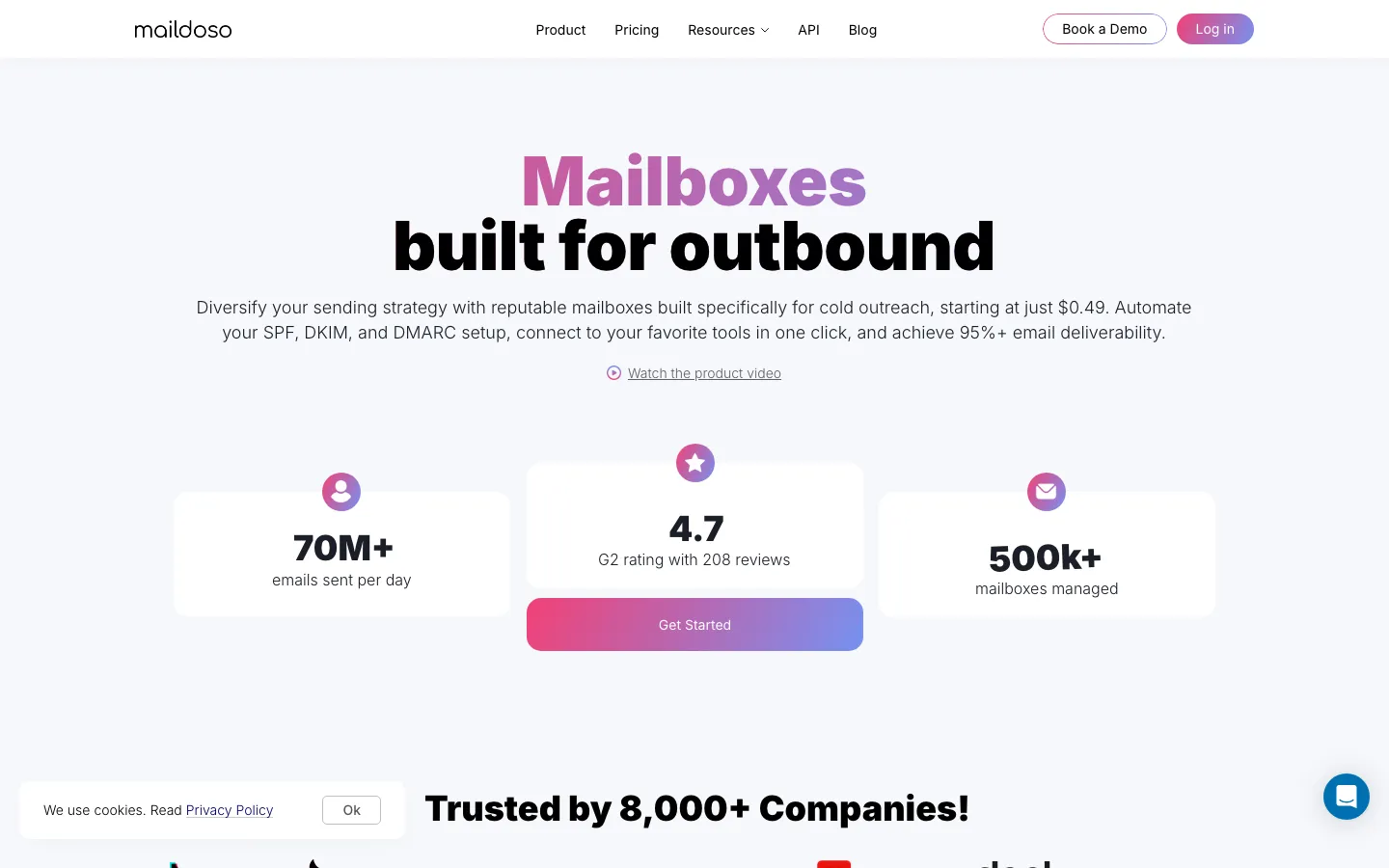
- Maildoso automates outbound infrastructure by provisioning mailboxes, domains, and SPF, DKIM, and DMARC authentication records for cold email workflows.
- Maildoso publishes a standard package of 30 mailboxes for $89.70 monthly ($2.99 per mailbox, or $44.85 first month), with pre-warmed sending domains starting from $11.90 each month.
- Maildoso provides API and Model Context Protocol integrations to register domains, create mailboxes, and sync sending accounts directly to sales sequencers.
- Maildoso requires new buyers to confirm availability for quarterly SMTP bundles and does not serve inbound marketing newsletter use cases.
If you are provisioning outbound mailboxes, domains, and authentication for a repeatable sending workflow, Maildoso gives you a published monthly package alongside API and MCP access. It is a strong option when you want automated SPF, DKIM, and DMARC setup, while custom mailbox quantities offer an alternative to the displayed monthly tiers; legacy quarterly SMTP plans list domains included, but new buyers should confirm availability.
Agent access
- API
- Yes, every plan
- MCP server
- Official, hosted, Personal Access Token (PAT)
- Works with
 Claude
 Cursor
 n8n
What are the primary pros and cons of provisioning infrastructure with Maildoso?
What works
- Automates SPF, DKIM, and DMARC when you enter mailbox names
- Lists API and MCP access with each mailbox package
- Offers custom plans alongside three displayed monthly packages
What to watch
- The displayed monthly packages begin with 30 mailboxes
- Monthly SMTP plans do not include domains
- Mailbox packages state a sending limit of up to 15 cold emails per mailbox a day
How does Maildoso automate outbound email mailbox and DNS setup?
Maildoso packages the technical pieces behind outbound email: domains, mailboxes, authentication, and a handoff to your sequencing workflow. If you are comparing infrastructure options in the marketing tools directory, its clearest advantage is that a team can see its mailbox capacity and cost before a sales conversation. You can register domains in the dashboard or connect domains you already own, then enter mailbox names while Maildoso configures SPF, DKIM, and DMARC.
That makes it a practical choice when the job is repeatable setup rather than campaign creation. The product also lists self-healing mailboxes, IP rotation, CAPTCHA domain protection, and mailbox reputation measurements. Those are operating features that give a team more to manage and inspect after provisioning, not a reason to set the infrastructure aside.
The pricing structure is where I would start the decision. The displayed monthly mailbox packages are 30, 300, and 1,000 accounts, but Maildoso also says custom plans let you choose the exact number of mailboxes and domains. On monthly SMTP plans, you can connect an existing domain or buy one separately; legacy quarterly SMTP plans list domains included, so confirm their availability before treating them as an option.
Who benefits most from adopting Maildoso for outbound sales infrastructure?
New outbound teams
Use a displayed package or custom quantity when a defined campaign needs an infrastructure budget and clear setup.
Growing sales teams
Use the 300-mailbox package when several campaigns need more planned capacity and a shared operating process.
Agencies
Automate repeatable domain and mailbox setup while keeping domain ownership and access clear for every client.
Technical operators
Use the listed API and MCP access when provisioning mailboxes must fit a repeatable internal workflow.
Maildoso suits a team that wants an operating process around outbound infrastructure, whether it chooses a displayed monthly package or asks for a custom quantity. Compare the route for domains as closely as the mailbox count: monthly SMTP plans allow an existing domain or a separate purchase, while legacy quarterly SMTP plans list domains included. New buyers should confirm those plans are available before relying on that route.
Which mailbox provisioning and domain authentication tools are in Maildoso?
Domain and mailbox provisioning
You can register a domain in the dashboard or connect one you already own. When you add mailbox names, Maildoso says it configures SPF, DKIM, and DMARC automatically. That is valuable for an operator setting up many sending identities because it reduces repeated DNS work. Keep a clear record of each domain, its owner, and its use, particularly when several clients or business units share an outbound operation.
Mailbox operations
The mailbox packages list self-healing mailboxes, IP rotation, CAPTCHA domain protection, and reputation measurements. Maildoso says it runs inbox-placement tests every three days and displays mailbox health scores. The useful buying question is whether your team has someone responsible for acting on those signals. Infrastructure is a poor investment when nobody owns the regular review of its authentication and mailbox health.
Sequencer handoff
Maildoso says its mailboxes automatically synchronize with three named outreach platforms, and its FAQ says it can export selected accounts to CSV in nine native sequencer formats. That gives a team a documented route from provisioning into the sending process. Confirm the exact handoff your existing sequencer uses before expanding from a small package, so a mailbox change does not become manual work at scale.
API and MCP access
Maildoso lists API and MCP access with its mailbox packages. Its own materials describe registering domains, creating mailboxes, configuring SPF, DKIM, and DMARC programmatically, then exporting to a sequencer. For a technical team, that is the differentiator: the same setup work can sit inside code or an AI-assistant workflow. Set clear permissions and a review path before giving a provisioning workflow a larger domain estate.
Pre-warmed domains
Maildoso sells pre-warmed domains separately from monthly mailbox packages. One domain is $11.90 a month and can register up to 50 mailboxes; five cost $59.90 a month and ten cost $119.90. The domain packages also state a sending limit of up to 750 emails a day per domain. Use that as a planning constraint, not as a reason to buy more domains than the campaign and team can supervise.
How are monthly mailbox tiers and pre-warmed domains priced in Maildoso?
Price checked 27 Nov 2026
| Plan detail | 30 mailboxes$89.70/mo | 300 mailboxes$297/mo | 1,000 mailboxes$650/mo |
|---|---|---|---|
| Price per mailbox | $2.99 ($1.49 first mo) | $0.99 ($0.49 first mo) | $0.65 ($0.32 first mo) |
| Mailbox count | 30 | 300 | 1,000 |
| Sending limit | Up to 15 cold emails per mailbox/day | Up to 15 cold emails per mailbox/day | Up to 15 cold emails per mailbox/day |
| API and MCP access | ✓ | ✓ | ✓ |
| Mailbox operations | Self-healing, IP rotation, and reputation measurements | Self-healing, IP rotation, and reputation measurements | Self-healing, IP rotation, and reputation measurements |
Maildoso prices in US dollars, 27 Nov 2026.Maildoso pricing
The price cards are simple, but a team that chooses 30 mailboxes and one pre-warmed domain pays $101.60 a month at regular renewal ($56.75 in month one): $89.70 for the mailbox package plus $11.90 for the domain. That domain supports up to 50 mailboxes. It is one monthly setup, not a compulsory minimum bill: you can connect an existing domain or choose another separate domain route. Legacy quarterly SMTP plans list domains included, but new buyers should confirm availability before using them as an alternative.
- One pre-warmed domain: $11.90 a month, with up to 50 mailboxes and up to 750 emails a day
- Five pre-warmed domains: $59.90 a month, with up to 250 mailboxes and up to 3,750 emails a day
- Ten pre-warmed domains: $119.90 a month, with up to 500 mailboxes and up to 7,500 emails a day
- New users on monthly SMTP packages get a 30-day money-back guarantee and free deliverability audits
The $650 package has the lowest mailbox rate, but it is not automatically the best value. It commits the team to 1,000 mailbox licenses. Buy the package that reflects the campaigns you are prepared to run and monitor, then add capacity when the operation has earned it.
Where does Maildoso show limitations regarding minimum tier commitments?
Maildoso requires a minimum 30-account threshold on its standard monthly tiers, which may not suit smaller sender operations. Maildoso says custom plans let you choose the exact number of mailboxes and domains, so ask how that route is priced and managed before comparing it with the three public cards. You can also delete and recreate mailbox accounts within a purchased license count, although new mailboxes require a warm-up period.
The domain route needs attention before you budget. On monthly SMTP plans, you can buy a domain separately or connect an existing one. Legacy quarterly SMTP plans list domains included, but new buyers should confirm availability before they use that as a budget route. The choice changes the total cost and means the team needs a deliberate policy for who owns domains purchased through the service and how they are handled if the subscription changes.
Finally, the listed allowance is up to 15 cold emails per mailbox a day. That is useful for capacity planning, but it is not a license to send without a controlled campaign process. Keep mailbox changes, authentication, recipient selection, and campaign review with a named owner rather than treating automation as an operating model by itself.
Which cold outreach infrastructure providers are top Maildoso alternatives?
 Mailforge review is the better comparison when a team wants shared email infrastructure with a pricing calculator, reusable mailbox slots, and a stated minimum of 10 slots. Its public calculator shows $3 per mailbox slot each month and a .com domain example at $14 a year, which offers a different published pricing structure from Maildoso's monthly packages and custom-plan route.
 Mailgun review is the different choice for application email rather than cold-outreach mailbox provisioning. Its Free plan allows 100 emails a day, while paid plans begin at $15 a month and provide an HTTP API and SMTP endpoint. Choose it when developer-controlled application delivery is the job, not a fleet of outbound mailboxes.
What is the final verdict on using Maildoso for cold outreach setup?
Maildoso earns its place for outbound teams by transforming infrastructure provisioning into an automated workflow via MCP and API access. Its practical appeal is the option to start from a visible monthly package or discuss a custom quantity, then move the same setup work into a sequencer handoff without repeating DNS steps by hand.
The important choice is not a presumed 30-mailbox minimum. It is the mix of mailbox quantity, domain route, and ownership that suits your operation. Monthly SMTP plans leave domains as an existing or separate-domain decision; legacy quarterly SMTP plans list domains included, so new buyers should confirm availability. If your job is transactional application delivery instead, Mailgun is the more natural comparison.
Choose the mailbox quantity and domain route together, establish who owns mailbox health and authentication, and use the API or MCP only after the handoff to your sequencer is clear.
How was this Maildoso infrastructure evaluation verified?
Maildoso pricing structures, authentication workflows, and API specifications were verified against vendor documentation on 27 Nov 2026. Prices are in US dollars as Maildoso presents them, and every figure follows how we check figures.
- Maildoso pricing and monthly-plan pages
- Maildoso SMTP and product pages
- Maildoso API and integrations pages
What are the common questions about Maildoso mailbox provisioning?
How much does Maildoso cost?
Maildoso lists 30 mailboxes for $89.70 a month ($44.85 first month), 300 for $297 ($148.50 first month), and 1,000 for $650 ($325 first month). Monthly pre-warmed domain packages are listed separately from $11.90 a month for one domain. Legacy quarterly SMTP plans list domains included, but new buyers should confirm availability. Maildoso also says custom plans can use exact mailbox and domain quantities.
Can you connect an existing domain to Maildoso?
Yes. Maildoso says you can connect domains you already own or register domains through its dashboard. Its materials also describe connecting external domains through the API.
Does Maildoso have API and MCP access?
Yes. The mailbox packages list API and MCP access. Maildoso says they can register domains, create mailboxes, configure authentication, and export accounts to a sequencer.
What is the Maildoso sending limit?
The listed mailbox packages state up to 15 cold emails per mailbox per day. Its separate pre-warmed domain packages state their own daily sending limits.
 Reviewed byDanny Kirk
Founder of ReddiReach.
 Checked byAndrés Felipe
Digital designer and marketer.
Every figure is checked against the vendor's own page. Read our editorial standards.