
Key Takeaways
- Trengo consolidates customer support communication across WhatsApp, email, chat, social media, and voice channels into a single unified team inbox.
- Trengo plans begin at 131 dollars monthly on annual billing for three users and 1,200 conversations each year, with monthly billing supporting 100 conversations.
- Trengo documents extensive developer resources including a REST API, webhooks, and a custom website-widget API to connect messaging flows with external systems.
- Trengo is less suitable for teams with unpredictable conversation spikes or those needing built-in voice, outbound broadcasts, and AI automation without paid add-ons.
If your service queue jumps between WhatsApp, email, chat, social and voice, Trengo is the best fit when you need them in one working queue and want AI to handle routine questions. Choose something else if you need a low-cost per-agent help desk or an agent-building studio: annual billing on its $131 Base plan includes 1,200 conversations a year, while monthly billing includes 100 conversations a month and several capabilities cost extra.
Agent access
- API
- Yes
- MCP server
- Not found on official pages
- Automation
- Zapier
What are the key Trengo pros and cons?
What works
- One shared inbox for WhatsApp, email, social, voice and live chat
- AI Agent resolves routine questions and qualifies leads in 70+ languages
- REST API, webhooks and a website-widget API for custom work
What to watch
- Base includes 1,200 conversations a year on annual billing, or 100 a month on monthly billing, and allows five users
- Voice, broadcasts, AI Journeys and extra capacity cost more
- AI conversations add a per-conversation surcharge
What does Trengo do for customer service teams?
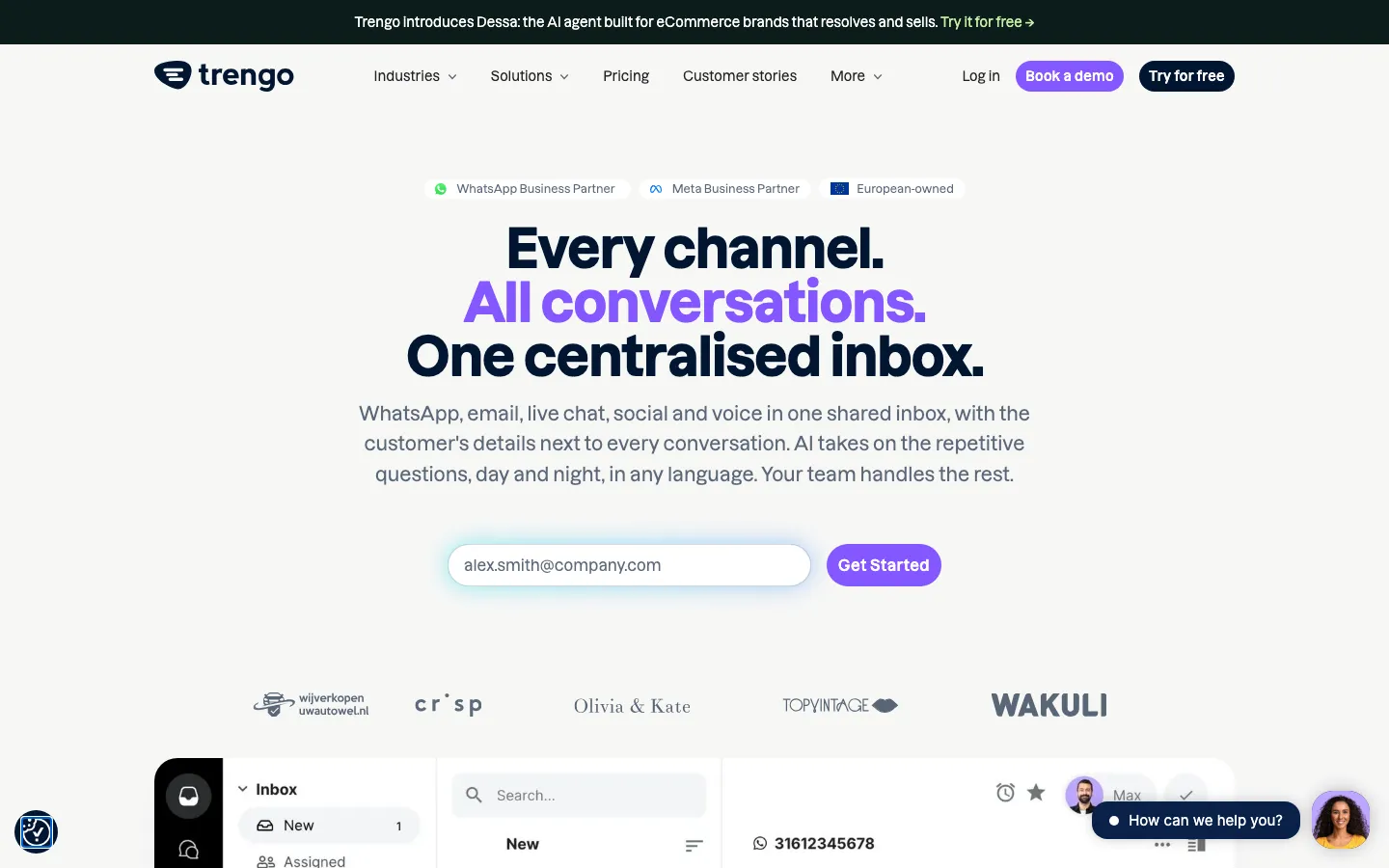
Trengo puts the work of a customer-service desk into a shared omnichannel inbox. The practical win is context: instead of having a customer move between a WhatsApp number, an email address and a chat window, your team can work from one place with that customer's details beside the conversation. It belongs in the marketing tools directory, but its decision is operational rather than promotional: can your team keep up with the conversations it receives?
That focus makes Trengo persuasive for businesses whose service begins on WhatsApp. It is an official WhatsApp Business Partner and Meta Business Partner, and its inbox also brings in email, live chat, social media and voice calls. A manager can assign and coordinate those threads without making customers repeat themselves.
The important trade-off is that Trengo sells capacity as well as software. Each plan includes a bundle of users and a conversation allowance that changes with billing: annual plans show yearly allowances, while monthly plans show monthly allowances. It is a sensible model when your volume is stable. When it is not, the starting price tells only part of the story, so compare the allowance with your normal demand before treating Base as affordable in isolation.
Who is Trengo designed to help?
WhatsApp service teams
Teams needing shared ownership of WhatsApp, email, social, live-chat and voice conversations in a single queue.
eCommerce support
Stores that want an AI agent for order status, returns, refunds and other repeated customer questions.
Hospitality teams
Hotels and leisure businesses that need connected inboxes and published integrations for booking-related customer conversations.
Technical operations
Teams that need documented APIs, webhooks and widget events to connect a customer channel to internal systems.
It is less compelling when the task is to design a bespoke conversational experience before there is an inbox to run. Trengo's AI is attached to service work and lead qualification. Its plans make more sense when there is an established channel mix and someone accountable for the queue.
Which communication features does Trengo include?
One inbox across customer channels
Trengo's central product is a unified inbox with WhatsApp Business API and a website widget. WhatsApp, email, live chat, social and voice can land there for the same team. That is more useful than a collection of channel logins when handoffs are frequent, because the agent taking over can see the conversation in one workstream.
AI Agent for routine work
The AI Agent is positioned to resolve repetitive support questions and qualify leads. Trengo says it can look up live data and take action in connected tools, operates around the clock and supports more than 70 languages. Base lists the AI Agent as playground only, so do not treat the entry plan as a full production AI allowance. Dessa is Trengo's eCommerce-focused AI agent, intended for questions such as order status, returns and refunds.
Journeys, broadcasts and voice
AI Journeys is an add-on on Base for teams building automated flows. WhatsApp broadcasting is also an add-on, useful only if you have a genuine reason to send proactive messages and have priced the channel alongside the inbox. Voice calling is separately priced too. Those extras let Trengo cover more of the customer lifecycle, but they turn a simple inbox decision into a capacity plan.
Developer access and integrations
For a technical team, the published developer surface is clear: REST API, webhooks and a website-widget API with events, methods and custom fields. The integrations directory spans CRM, eCommerce, leisure and hospitality connections. That gives you a route to connect the inbox to an existing stack.
WhatsApp message charges
Trengo's own add-on list separates Trengo bill from WhatsApp messaging. The first 1,000 service messages per number per month are free, then Meta rates apply. Template messages are charged per message with no free allowance. That detail matters for a service desk that sends appointment reminders or shipping updates at scale: an inbox plan does not remove the channel's message costs.
How does Trengo price its customer service software?
Price checked 27 Nov 2026
| Plan detail | Base$131/mo | Boost$329/mo | Pro$549/mo | EnterpriseCustom |
|---|---|---|---|---|
| Billed annually | $131/mo | $329/mo | $549/mo | Contact sales |
| Monthly billing | $164/mo | $384/mo | $659/mo | Custom |
| Users included | 3, max 5 | 10, max 100 | 20 | Custom |
| Conversations, annual billing | 1,200/year | 6,000/year | 18,000/year | Custom |
| Conversations, monthly billing | 100/month | 500/month | 1,500/month | Custom |
| Support | Email + messaging | Email + messaging + phone | Dedicated success manager | |
| Voice calling | Add-on | Add-on | Add-on | Not stated |
USD annual and monthly prices, 27 Nov 2026.Trengo pricing
Base is the genuine starting plan, not an artificially low seat price. Three people are included, but the maximum is five, and annual billing includes 1,200 conversations for the year. A three-person team on Base pays $1,572 for the annual plan before add-ons. That is the useful comparison number for a small service desk, because it reflects the included users rather than pretending each one buys a separate seat.
Budget the additions separately:
- Extra conversations: $17 per 100 on annual billing, or $20 per 100 on monthly billing
- AI conversations: $0.28 per conversation on annual billing, or $0.33 per conversation on monthly billing
- AI Journeys, Base only: $647 per year, or $65 per month
- Voice add-on: $647 per year, or $65 per month
- WhatsApp broadcasting: $647 per year, or $65 per month
Annual billing saves up to 20% on the published price list. The larger question is not merely annual versus monthly. It is whether conversations, extra people and the automation you expect to use are all in the forecast before procurement approves the plan.
What does Trengo Enterprise offer larger organizations?
Trengo Enterprise delivers tailored pricing for organizations needing custom user limits, conversation capacity, bespoke integrations, and enterprise-grade security. It includes a dedicated success manager and full support. That is a credible route for a complex service operation, but it is not a published-price upgrade path. Ask for a proposal built around the channels, volume and integrations your operation actually needs.
Where does Trengo fall short for growing desks?
Trengo introduces significant operational friction primarily through conversation caps and add-on charges rather than missing baseline channels. It is that the channels sit behind a conversation allowance and a small user ceiling. Base can work for a compact team with predictable demand, but a seasonal business could use its annual-billing allowance and then face additional conversation charges. Monthly billing instead has a monthly allowance. The right time to catch that is before a campaign, holiday period or service change increases traffic.
Its AI pricing needs the same discipline. Base offers the AI Agent as a playground, while AI conversations carry a surcharge and AI Journeys is an add-on. That does not make the feature weak. It means the commercial decision should distinguish a useful proof of concept from a fully automated customer channel.
Voice is also an add-on, and Base support is email only. Boost adds messaging support, while Pro adds phone support. A team that needs to call customers or needs phone help from its platform provider should cost its real support level, not anchor on the lowest public plan.
What are the leading Trengo alternatives?
 Voiceflow review is the better read when your real project is designing, testing and releasing chat or voice agents. Its public pricing page asks businesses to book a demo and does not give numerical prices on that page. It is not a like-for-like inbox replacement, which is precisely why its agent-building focus can be the better fit.
 Zendesk review is the more conventional helpdesk comparison. Its Support Team begins at $19 USD per agent per month on annual billing, checked 27 Nov 2026. Suite plans add messaging, live chat and voice, while AI agents are included in every Support and Suite plan and billed by successful automated resolutions.
What is the final verdict on Trengo?
Trengo represents a compelling choice for companies utilizing WhatsApp as a primary support channel alongside unified email and chat inboxes. The channels, official WhatsApp partnership and documented developer tools form a coherent operating system for that job. The catch is that the subscription is a bundled operating cost, not a flat software fee.
Start with the annual Base price only after mapping a normal year's conversations, users and required add-ons. Move to Boost or Pro when the included user count and volume match the operation, not because the feature list looks more complete.
How was this Trengo review verified?
Trengo product capabilities, plan pricing, and developer specifications were verified directly against official documentation on 27 Nov 2026. USD is used because Trengo publishes a USD price view. See how we check figures for the rules behind the dated figures.
- Trengo pricing and add-ons
- Omnichannel inbox, WhatsApp and AI Agent pages
- Trengo developer documentation
What are frequently asked questions about Trengo?
How much does Trengo cost?
With USD annual billing, Base is $131 a month, Boost is $329 and Pro is $549. Monthly billing is $164, $384 and $659 respectively. Enterprise is custom priced.
How many users come with Trengo?
Base includes three users and allows a maximum of five. Boost includes 10 users with a maximum of 100, while Pro includes 20. Extra users cost more.
Does Trengo charge extra for AI?
Yes. Annual billing lists a $0.28 surcharge for each conversation with an AI surcharge. AI Journeys is an additional charge on Base.
Does Trengo have an API?
Yes. Its developer documentation lists a REST API, webhooks and a website-widget API with events, methods and custom fields.
 Reviewed byDanny Kirk
Founder of ReddiReach.
 Checked byAndrés Felipe
Digital designer and marketer.
Every figure is checked against the vendor's own page. Read our editorial standards.